Category: Events

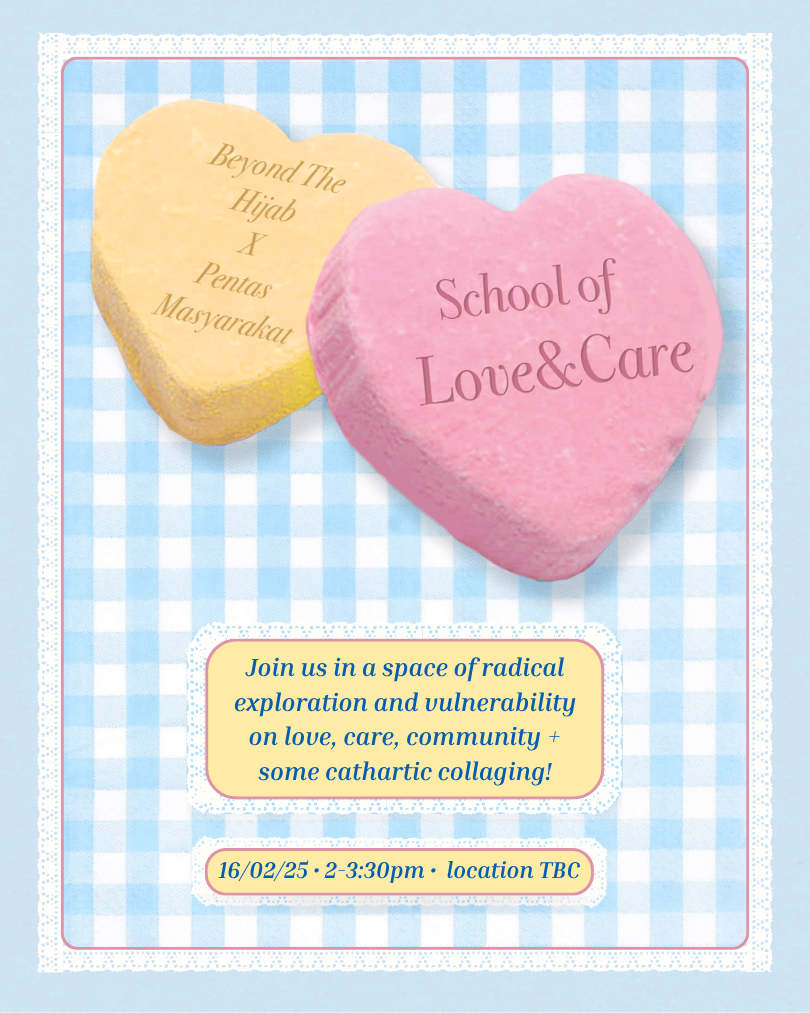
  • School of Love & Care, co-presented by Pentas Masyarakat & Beyond The Hijab

    School of Love & Care, co-presented by Pentas Masyarakat & Beyond The Hijab

    Post-Valentine’s Day, Beyond the Hijab and Pentas Masyarakat invite you into a space of radical exploration and vulnerability on love, care, community + some cathartic collaging! bell hooks once said that there is no ‘school of love’ from which we are taught how to love. We learned love first from family, then society, and these received narratives about loving can be flawed and lead us to struggle in our relationships where care and love are fundamental. For this workshop we want to co-create, unlearn, and school ourselves through collective wisdom and vulnerability. All proceeds will be going to @aseel_kh_art’s efforts to create much-needed handmade knitwear for children in Palestine.

    The language of care is often expressed to us in our communities, institutions and the state. While for some it builds assurance and safety, for others, the language has at times felt more like a weapon that places conditions on who does and doesn’t deserve care.

    How do we really want to be loved? What does that look like, and what would we need?

    Whether you are grappling with self-love, have experienced a loving community, or felt abandoned by one, we invite all to share their collective wisdom. 💕

  • Let’s write letters to Gaza

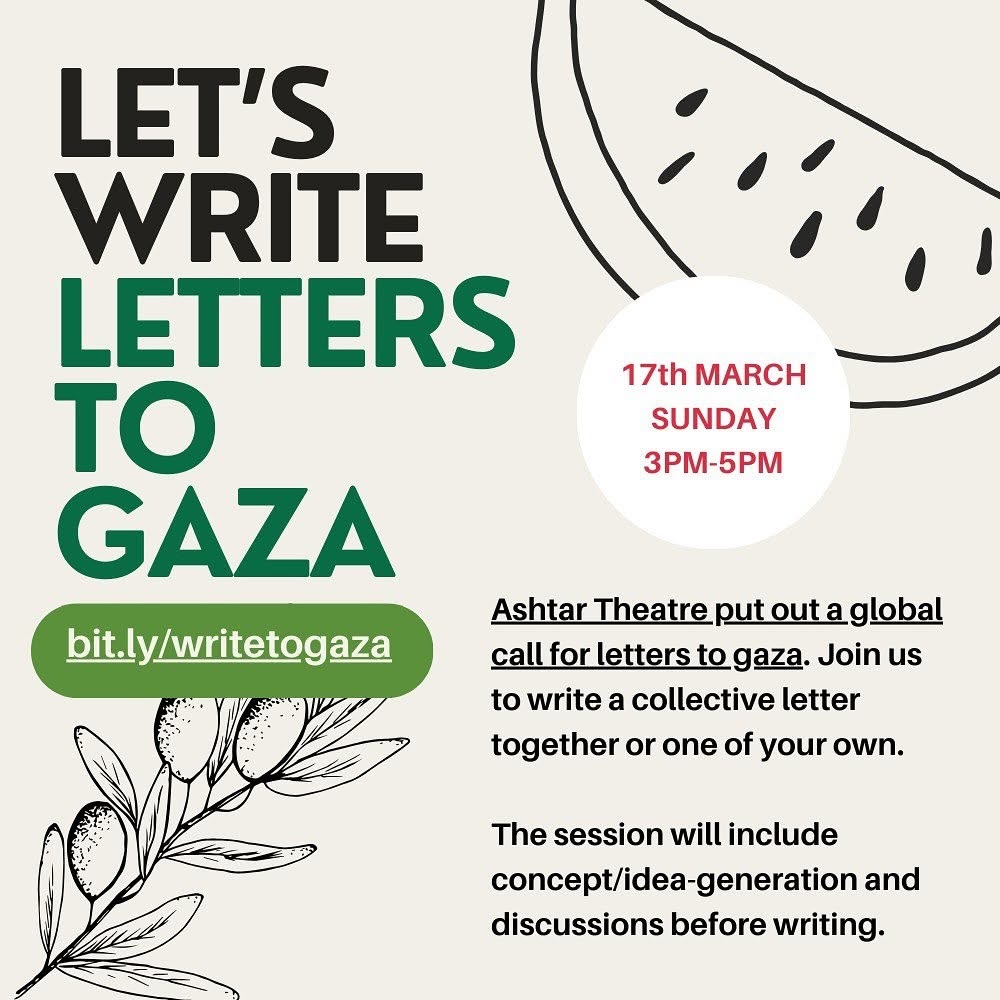
    Let’s write letters to Gaza

    We want to answer @ashtartheatre’s global call for letters to Gaza! Join us to write a collective letter (as Beyond the Hijab & friends💘💌) or come by to work on writing a letter of your own. We will facilitate a brainstorming and discussion session before writing proper. And don’t worry— it’s not about being productive and coming up with something there and then. We’ll be happy just to have you there with us.

    Please sign up at – or click the link in our bio. Do note there will be limited spaces, and data collected in this event will be deleted after a month.

  • Quotes from our ‘Reflecting on Solidarity’ gathering #4

    Quotes from our ‘Reflecting on Solidarity’ gathering #4

    We are most effective when we act from where we are. After all, the issue of the 🍉 genocide is not one that is entirely unconnected to us when we consider the long-standing relationship we have with a settler-coloniser country that has had charges of genocide brought to it in the International Court of Justice.

    The issue of 🍉 has galvanised so many ordinary Singaporeans into action and into occupying their rightful selves as political beings. The issues that are entwined in the question of 🍉 are plenty: the military industrial complex, settler-colonialism, racism and islamophobia, a global system that is selective in who it deems as victims and aggressors, and so much more.

    Acting from where we are here in Singapore also means being aware of the limitations we face and how to navigate them. Something that was discussed for a while during the session was whether we can make any difference at all considering our limitations and how geographically small we are. What was agreed upon was that such a feeling does not arise by accident, but is a product of the political environment we have grown up in. Our role then is to not fall into cynicism or inaction, but to try what we can, even if it is as small as taking charge of our own political education.

    Every action Singaporeans have attempted since the genocide in 🍉 has happened is never wasted. It means our stances and opinions are there on public record, and it can never be said that Singaporeans are completely in agreement with the settler coloniser state is/real.


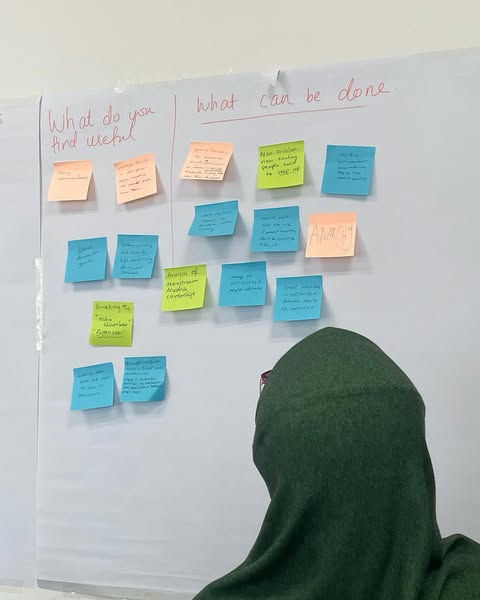
    What has been useful? What can we do?

    I love how passionate Singaporeans are about Palestine and how it has galvanised us. Whether it is through organising kite-flying picnics, a film festival, or solidarity bicycle rides. My hope is that this energy will carry forward into our own* political issues as well.

    *Not to say that the occupation of Palestine isn’t a domestic issue for us as well considering how much our tax $$$ has gone into military trading with their coloniser!

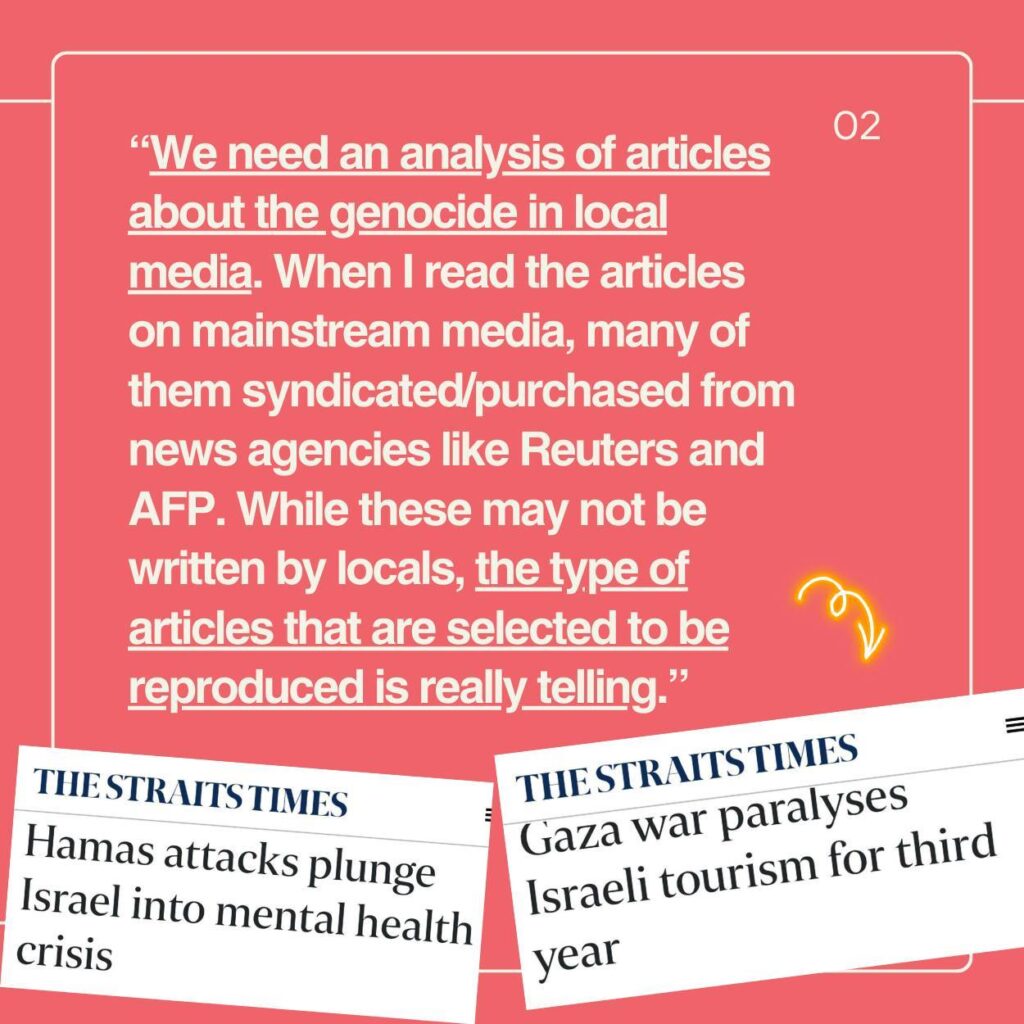
    We need an analysis of articles about the genocide in local media. When I read the articles on mainstream media, many of them syndicated/purchased from news agencies like Reuters and AFP. While these may not be written by locals, the type of articles that are selected to be reproduced is really telling.

    Sometimes we want to hold our government accountable, but why would a government who has been actively engaged in military trading and collaboration with the coloniser be accountable for things they are intentionally doing? We can talk over them and learn how to develop skills and resources to support ourselves better.

    If they show that they don’t care, then maybe we can’t wait for them.

    In my work and engagement with some people working for the government, I feel that things are not going to move on that front. We have to be more creative in how we do things. I believe in community organising, even in small ways.

    We want to do something impactful, actionable, but it can also start small through efforts of trying to increase our level of political consciousness.

    We need to work outside the system – the master’s tools will never dismantle the master’s house*.

    *Audre Lorde

    Having a lot of informal, small-scale efforts are important, because the government can see that it’s from the grassroots and not just big actions from a few big organisations. It’s more powerful. We don’t need cult-of-personality activists to create change. We can do it ourselves.

  • Quotes from our ‘Reflecting on Solidarity’ gathering #3

    Quotes from our ‘Reflecting on Solidarity’ gathering #3

    For those of us who are deeply in solidarity with 🍉, reflecting on our support and advocacy is really important! The more reflective we are, the better our support will be.

    Of course we mean well in our efforts, but we must always prioritise the needs and wellbeing of 🍉. It is they who are important, they whose bodies and lives are experiencing the sum of the world’s failure to end the genocide, they whose voices are routinely ignored and unheard—we must never, even in the smallest ways, replicate that dynamic of ignoring their voices or thinking that our feelings and thoughts are more important than the reality the 🍉 people are facing.

    We are so thankful for the space of discussion and the participants who shared these thoughts, and how much it made us reflect on our own solidarity too. ❤


    How can we support Palestine responsibly?

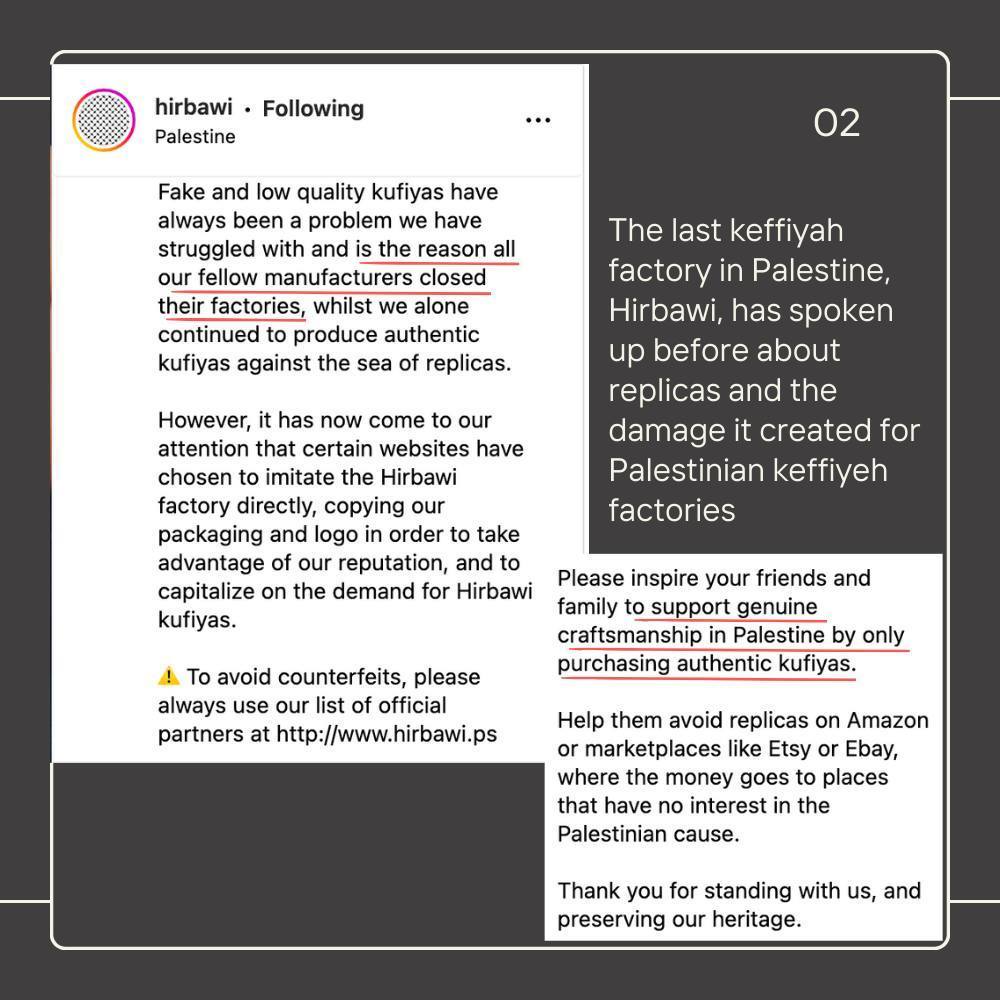
    I bought a “kefiyeh-inspired” garment back when I didn’t know better. After I learned about the significance of the keffiyer, I threw it away. Sometimes when I see fundraisers or people selling or encouraging purchases of the keffiyeh, I get suspicious about where it’s obtained. If it’s Shein or something mass-produced/printed that’s where I draw the line on supporting.

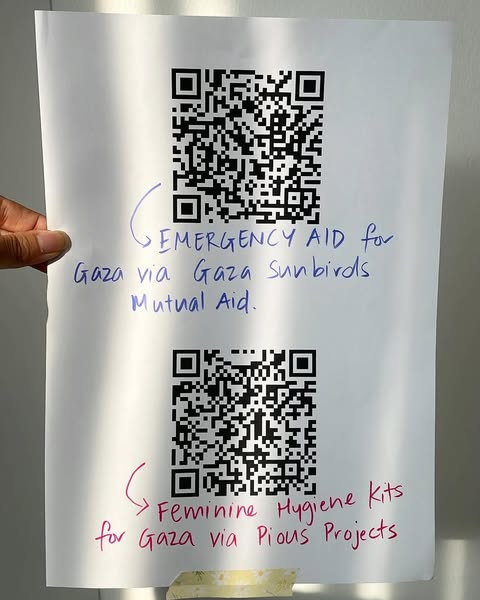
    I saw a post encouraging people to donate to legitimate mutual aid fundraisers too instead of just big organisations; that way the money can directly reach Palestinians. Big organisations have big challenges, as we have seen in how trucks have been stalled at the border, and how Gazans had to break into UNRWA warehouses to reach flour and essentials locked inside while they were staving.

    For example there’s Gaza sunbirds who distribute essentials and aid and can reach communities and areas that trucks are not able to access.

    [Discussing a Singaporean who was encouraging other Singaporeans to visit Al-Aqsa] If we do want to visit, we have to commit to BDS and visit via Palestinian agencies and organisations. But we must not simply fall into religious consumerism where we just romanticise the beauty of the place. We must also think about the deeper, ethical implications of being able to visit there with our Singaporean passport while many Palestinians are not able to or face violence when they do.

    Idealising Palestinians and their resilience using religious language can unintentionally minimise the reality of their suffering. When people claim the streets of Gaza smell like flowers due to the death of Martyrs, but Palestinians have shared that the smell of death fills the city. Or when people tell you to always be thankful in despair because the Palestinians were able to thank God even after loved ones were murdered – but such an utterance is very different coming from the Palestinian seeking spiritual strength and comfort, versus a person using the suffering of Palestinians as fodder to moralise.

    Read our last post about the session.

  • Quotes from our ‘Reflecting on Solidarity’ gathering #2

    Quotes from our ‘Reflecting on Solidarity’ gathering #2

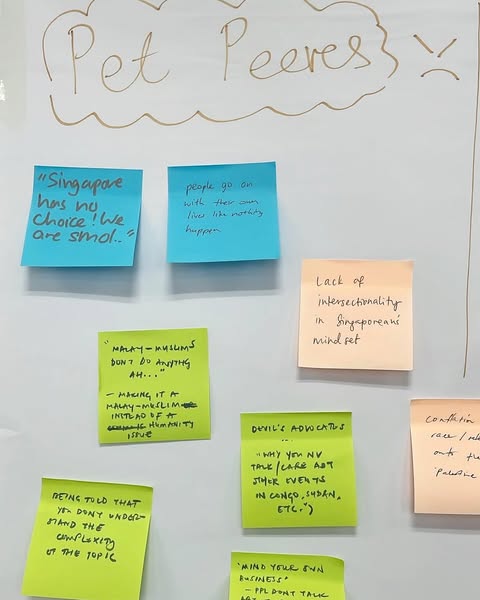
    If our solidarity is going to be effective, it needs to be useful, and more importantly, not deepen any harm. In our gathering we discussed responses that we found unhelpful, harmful or that created new problems/challenges.

    One of the interesting points that was brought up was that while expressing solidarity for 🍉 is not contingent on race and religion and should not be pigeonholed as such to justify clamping down on political expression, there is an element of race and religion to the issue. It’s not in the expression of solidarity where race and religion comes into play, but instead in how Palestinians are dehumanised and subjected to Islamophobic violence both physically and in the rhetorical framings of the genocide where they are constantly figured as terrorists or terrorist sympathisers. In turn, those who support the liberation of Palestine are also implied to support terrorism, which is especially charged when directed at Muslims. In this way, those who profess to keep racial and religious peace may in fact be escalating racial and religious frictions through the way they have chosen to frame the genocide.

    Another burning point was the issue of speaking up. Our friends shared how it pained them to see silence on their friends’ and acquaintances’ social media accounts when a genocide is unfolding and actively happening, and the torn feelings they have about this. On the one hand, they don’t want to guilt or shame people who may have reasons for not speaking up, on the other hand, the scale of the violence happening makes such considerations feel small, especially if said people had professed progressive and anti-colonial political views before. At the heart of the discomfort is the fact that Palestine’s occupation and ethnic cleansing has been happening for 75 years precisely because powerful states and supporters of the colonisers have normalised Palestinian death and suffering. In such a context, silence does not feel neutral at all, but a continuation of the conditions that has allowed occupation to endure.


    What have you found unhelpful or ineffective?

    The Ministry of Manpower (MOM) sent an advisory to foreigners. There were a lot of people speaking out, and those on Emplyment Passes (EP) and S-passes received the advisory. A lot of influencers are based here, but they can’t say anything if they are on EP and don’t want to risk being deported.

    I am pissed when artists who will talk about decolonisation or are proud when their work gets blacklisted don’t even post a single thing about Palestine. But then I realised it’s unnecessary anger on my part. A friend of mine told me to just mobilise with people I know who are speaking about it. That way I can act more for the movement rather than getting people to change.

    The arrowing of the Malay-Muslim community as if this is just our issue. There is an assumption that we are tribalistic and we cannot get angry for other reasons.

    There was an advisory published by MUIS on how to deal with the ‘Israel-Hamas war,’ first published in Malay. Do other racial/religious communities get such advisories?

    The failure to see similarities between different struggles when talking about Palestine. There is a lack of intersectionality in the Singaporean mindset. To get away from it they say it’s a humanitarian issue, but it’s not good enough because there is a real race and religion aspect to it – the way it’s not being recognised as a genocide because many countries are racist.

    When charity is seen as the only path to helping. It gives rise to complacency and pushes down the guilt. We need to recognise our complicity in the genocide, and this would allow us to actually be able to resolve something.

    How much can the average person give, and what is left once it goes through the whole process? Meanwhile, states are brimming with money.

    When it’s just lip service. All talk but no action. When countries say they condemn it, but at the same time they fund it.

    Read the final post in our reflection series.

  • Quotes from our ‘Reflecting on Solidarity’ gathering #1

    Quotes from our ‘Reflecting on Solidarity’ gathering #1

    For anyone whose heart is with 🍉, they would most likely remember when they were first aware of the apartheid, occupation and genocide faced by the 🍉 people.

    During our recent session, most could remember the exact year when the apartheid was brought to their political consciousness. Most notably, what deepened their conviction was seeing cross-solidarity, across countries, between 🍉 and other people who were also struggling against state, carceral and authoritarian violence.

    Some friends in the gathering were new to the issue though, and were learning so much for the first time, in part because the current genocide is impossible to turn away from. Regardless of when you learned about the current 75-year occupation, the important thing is that we are here now, taking charge of our own learning and understanding.


    When did you first learn about Palestine?

    In 2008, it was during Operation Cast Lead. I was researching on images and I was confronted with the images coming out of Palestine. I’ve been following since then, through each intifada, and things keep getting worse and worse.

    It was 2014, the year of the World Cup, when I really started paying attention. I boycotted businesses that supported Israel like McDonald’s and L’oreal. There were attacks again in 2020, around the time when George Floyd was murdered. Seeing the solidarity between the Black Lives Matter movement and the Palestinians really intensified my solidarity.

    My first understanding of the Genocide was from Sri Lanka. I remember being torn and hearing different sides, and how the Tamil Tigers were always villainised. When I was 10 I remember asking my dad why we’ve never gone to Sri Lanka for vacation, since it was a popular tourist destination. He replied: We are never going there until our people are free. He slowly taught me the context of what was happening.

    My dad actually had Zionist tendencies and empathised with Israel more. So it’s not that some people are not capable of understanding the issue, but that the world doesn’t tell them the other side of the story.

    But it was easy for me to convince him by linking the Palestinian struggle with his own. Now his heart is with the Palestinian people.

    For me it was during 2019, during the same period of time as the Hong Kong protests. The Palestinian and Hong Kong people were giving each other tips on how to deal with tear gas!

    My sister-in-law asked me along for the rally for Palestine in Hong Lim Park in 2014. I’m ashamed to say that even back then, I didn’t know a lot. I’ve never really been into politics so I guess I didn’t really bother. It was only recently I’ve experiencing all these emotions and anger. Why is the world so useless when the genocide is so in-your-face? It has also made me learn about other terrible things in the world that, till now, I didn’t even know about – I guess it’s a start.

    To be honest, it’s new to me, although I’ve heard about it from my parents when they were raising me. When you hear about it was a young child, it seems so far away.

    But as you grow older you have to control your own learning and start thinking deeper. History is beyond what you know it to be.

    Read the next post in our reflections series.
  • Quick recap: Letter writing and reflecting on solidarity

    Quick recap: Letter writing and reflecting on solidarity

    Thank you to those who came down for our gathering and to those who helped make it happen! It was important to be able to gather and hear everyone’s voices, to take time to critically look at the current responses to the ongoing genocide, and to grapple with our thoughts and questions together. Seeing people offline and being able to share a physical space together was something we appreciated a lot too. ❤️

    Read the first entry on the fruits of the session!! 🍉

  • Letter writing & reflecting on solidarity

    Letter writing & reflecting on solidarity

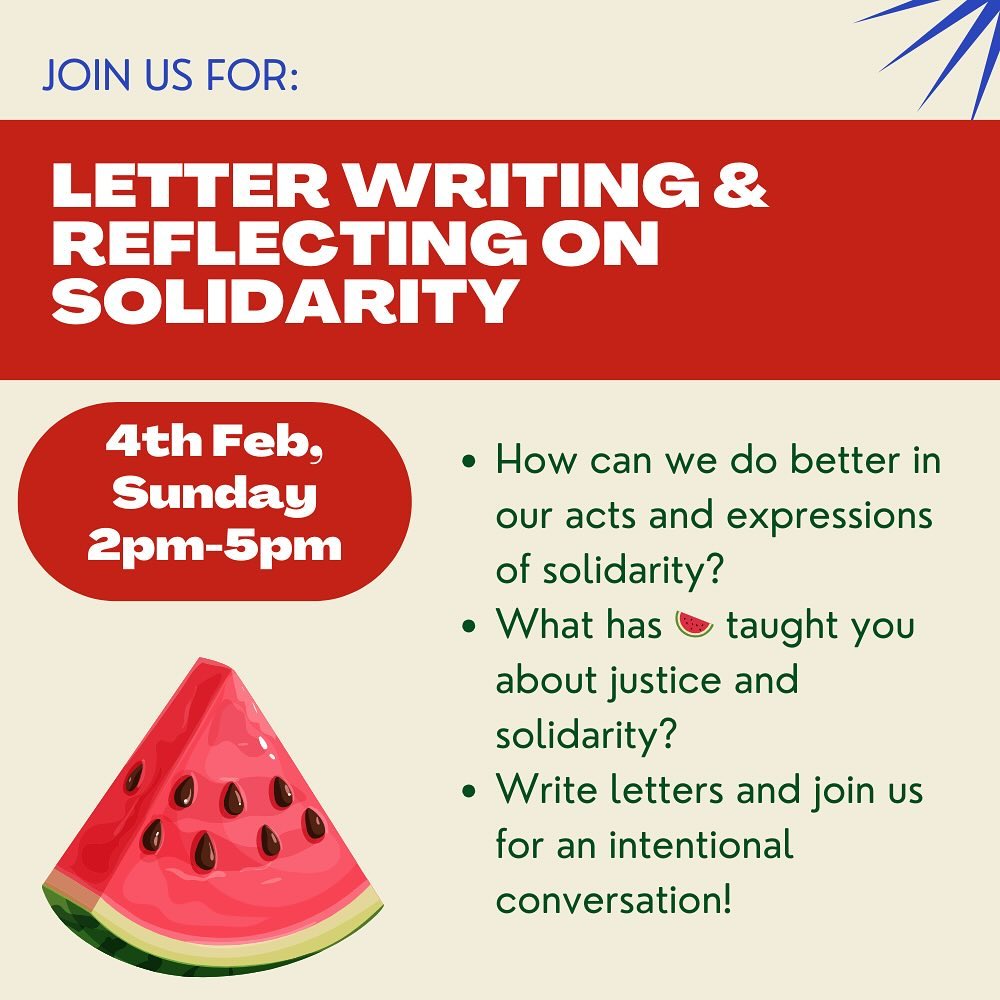
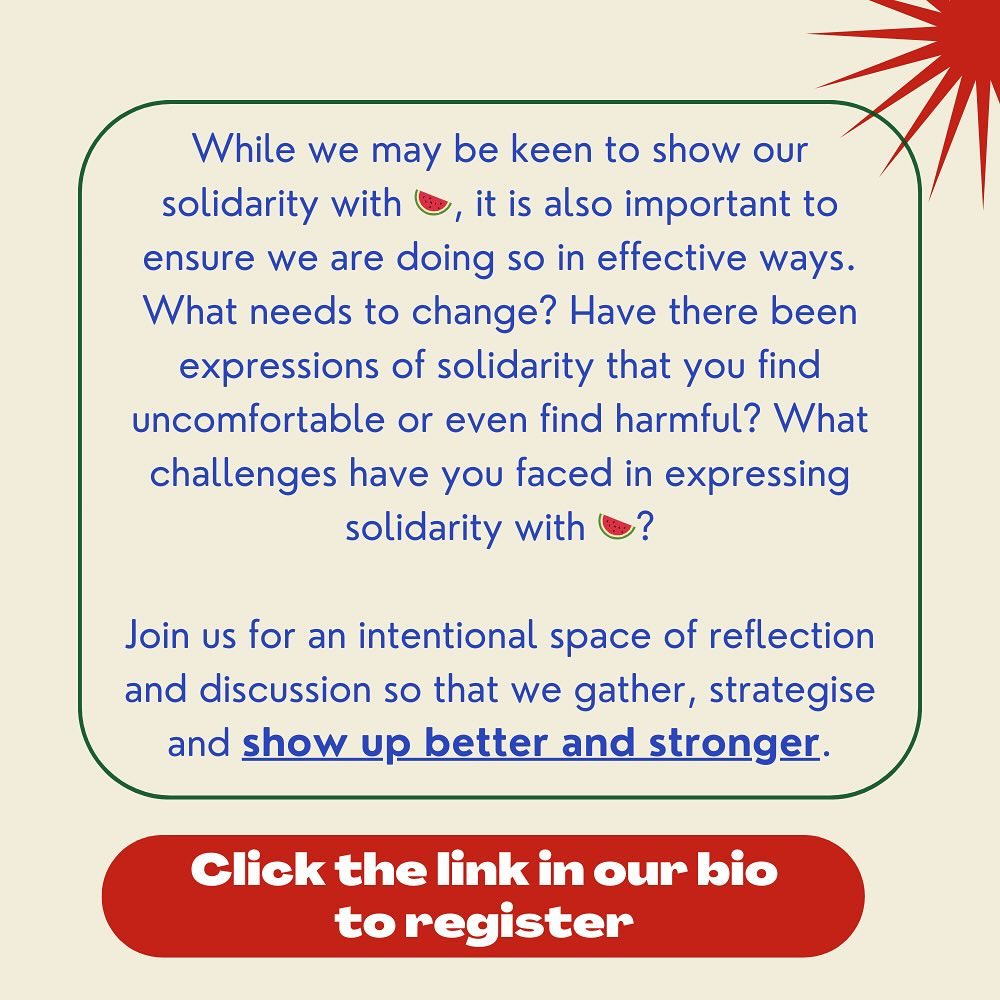
    Let’s huddle to gather strength and sharpen our solidarity. Taking time to critically reflect may seem strange as a genocide is unfolding. But we find it important to ensure our solidarity is effective, useful and not deepening any harm.

    How we respond to oppression faced by 🍉 is a blueprint to how we respond to oppression elsewhere.

    Venue will be shared with registered participants at a later date. Refreshments and teh will be on us!

  • Quotes from Talking about Burnout #2

    Quotes from Talking about Burnout #2

    During our conversation, the experience of burnout was closely linked not only with toxic or even exploitative practices in the workplace, but also the lack of paths one could feasibly take to bettering the situation. In place of actual substantive changes when we voice out our burnout, participants instead face suggestions and advice that attempt to bypass the problem in superficial ways.

    The issue then is not just about being burned out, but the additional feeling of being disempowered from changing your situation in a society that seems to work hard to keep people in circumstances where they do not feel free.


    Does our society set us up for burnout?

    I was talking to my friend in the Netherlands, and her previous workplace was toxic. She showed that she went to a psychiatrist and she got 3 months of 70% pay. I was shocked at how different things could be. I cannot even imagine what having labour rights would mean.

    Do rich people experience burnout like those of use who can’t just leave our jobs? We worry about paying rent, taking care of parents…We have to work so much, do caregiving, chores, and then try to self-care – things rich people can outsource.

    Perhaps they can focus on self-care, and yoga, but I don’t have time.

    All these ongoing health campaigns in Singapore they really don’t care about the lower-income and the marginalised. They tend to paint everyone under the same brush, like: What’s stopping you from exercising? From eating healthy? And buying healthier groceries?

    They say it’s cheap. But fresh food is really not cheap now.

    Workplaces like to address mental health with peer support groups, checking in, tell you how to better support colleagues, better time management. But nothing about actual change that can help people.

    If I have less to do, I will be happier. They never address the elephant in the room which is your work culture – whether your HR or manager is supportive, how much workload does one person have?

    And they love to say that there’s “no choice”. It’s hard, there’s no conversation.

    And if someone leaves, they don’t rehire. So the work gets re-distributed to others, and everyone just adds on to their workloads.

  • Quotes from Talking about Burnout #1

    Quotes from Talking about Burnout #1

    The path to burnout is often long-drawn and exhausting. Many don’t realise they have been burned out until they hit a breaking point.

    From what our participants shared, we unfortunately still do not live within a culture that values a person’s wellbeing outside of their capacity to be productive. There is little consideration for the other stressors a person could be dealing with outside the workplace.

    Whether this alienating pressure is enforced by the workplace or internalised by the individual and self-enforced, the impact is profound and can even be dangerous. Burnout, after all, often has drastic health effects.


    When did you realised that you were burned out?

    I was so burned out I started not caring about other people. I just couldn’t. I didn’t like that about myself. I started having suicidal tendencies, and I knew I had to make a drastic change.

    I quit my job, took a break, and sought professional help.

    I was already burned out but didn’t realise it until COVID-19 made it worse. I had a mental breakdown and went to the hospital because I thought I was having heart problems.

    But it was actually my anxiety having a physical effect on me.

    School on top of work was a lot for me this year. I didn’t realise I was burned out until I started procrastinating a lot. I was anxious and wanted to relax, but I would also be stressed if I wasn’t working on my tasks.

    Burnout cost me my health and sanity. I was hospitalised right before COVID-19 from a rare blood disorder which could have killed me if left untreated.

    But once I returned from hospital, I was still bombarded with work. I couldn’t take it. They still chased me even after I tendered resignation.

    My burnout was worsened by COVID-19. The boundaries between work and home dissolved. My grandmother also had a stroke and the whole family was running back and forth from hospital appointments and work.

    I dreaded work. There was too much all the time. So I took a break that ended up being 7 months long. I didn’t realise how tired I really was.

    Read part 2 of quotes from the session.