We are most effective when we act from where we are. After all, the issue of the 🍉 genocide is not one that is entirely unconnected to us when we consider the long-standing relationship we have with a settler-coloniser country that has had charges of genocide brought to it in the International Court of Justice.
The issue of 🍉 has galvanised so many ordinary Singaporeans into action and into occupying their rightful selves as political beings. The issues that are entwined in the question of 🍉 are plenty: the military industrial complex, settler-colonialism, racism and islamophobia, a global system that is selective in who it deems as victims and aggressors, and so much more.
Acting from where we are here in Singapore also means being aware of the limitations we face and how to navigate them. Something that was discussed for a while during the session was whether we can make any difference at all considering our limitations and how geographically small we are. What was agreed upon was that such a feeling does not arise by accident, but is a product of the political environment we have grown up in. Our role then is to not fall into cynicism or inaction, but to try what we can, even if it is as small as taking charge of our own political education.
Every action Singaporeans have attempted since the genocide in 🍉 has happened is never wasted. It means our stances and opinions are there on public record, and it can never be said that Singaporeans are completely in agreement with the settler coloniser state is/real.
What has been useful? What can we do?
I love how passionate Singaporeans are about Palestine and how it has galvanised us. Whether it is through organising kite-flying picnics, a film festival, or solidarity bicycle rides. My hope is that this energy will carry forward into our own* political issues as well.
*Not to say that the occupation of Palestine isn’t a domestic issue for us as well considering how much our tax $$$ has gone into military trading with their coloniser!
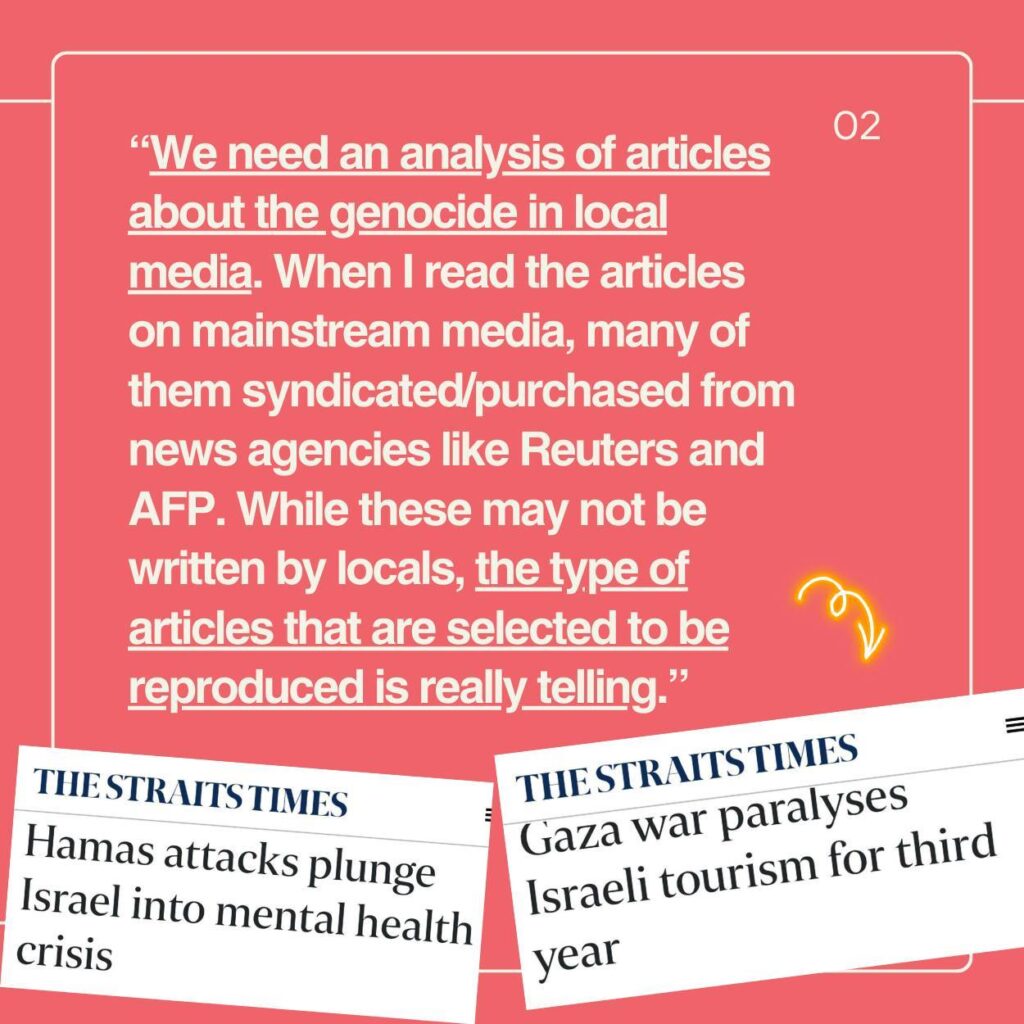
We need an analysis of articles about the genocide in local media. When I read the articles on mainstream media, many of them syndicated/purchased from news agencies like Reuters and AFP. While these may not be written by locals, the type of articles that are selected to be reproduced is really telling.
Sometimes we want to hold our government accountable, but why would a government who has been actively engaged in military trading and collaboration with the coloniser be accountable for things they are intentionally doing? We can talk over them and learn how to develop skills and resources to support ourselves better.
If they show that they don’t care, then maybe we can’t wait for them.
In my work and engagement with some people working for the government, I feel that things are not going to move on that front. We have to be more creative in how we do things. I believe in community organising, even in small ways.
We want to do something impactful, actionable, but it can also start small through efforts of trying to increase our level of political consciousness.
We need to work outside the system – the master’s tools will never dismantle the master’s house*.
*Audre Lorde
Having a lot of informal, small-scale efforts are important, because the government can see that it’s from the grassroots and not just big actions from a few big organisations. It’s more powerful. We don’t need cult-of-personality activists to create change. We can do it ourselves.