Category: Advocacy

  • Must Singapore continue our military ties with Israel?

    Must Singapore continue our military ties with Israel?

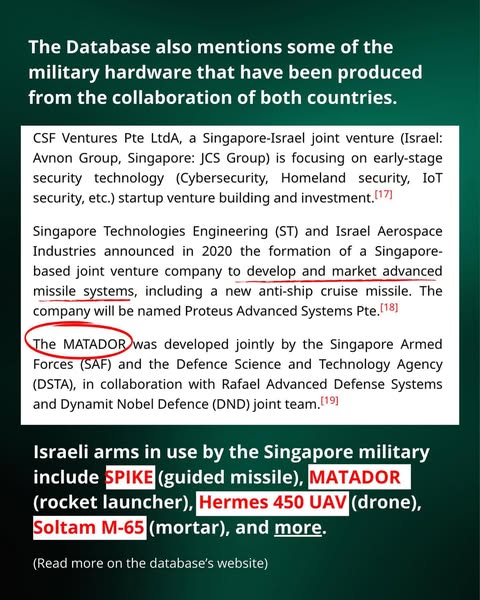
    Since Israel first helped develop Singapore’s army, Singapore has become one of the key customers of Israel’s arms trade and a key collaborator in the research and development of weapons. The flows of money between the two nations in their joint ventures and arms trade contracts amount to hundreds of millions of dollars.

    Information about the full extent of the two countries’ partnership, though decades-long, is not fully transparent. But there have been efforts in trying to piece available information to understand the depth of our engagement with Israel’s military industrial complex.
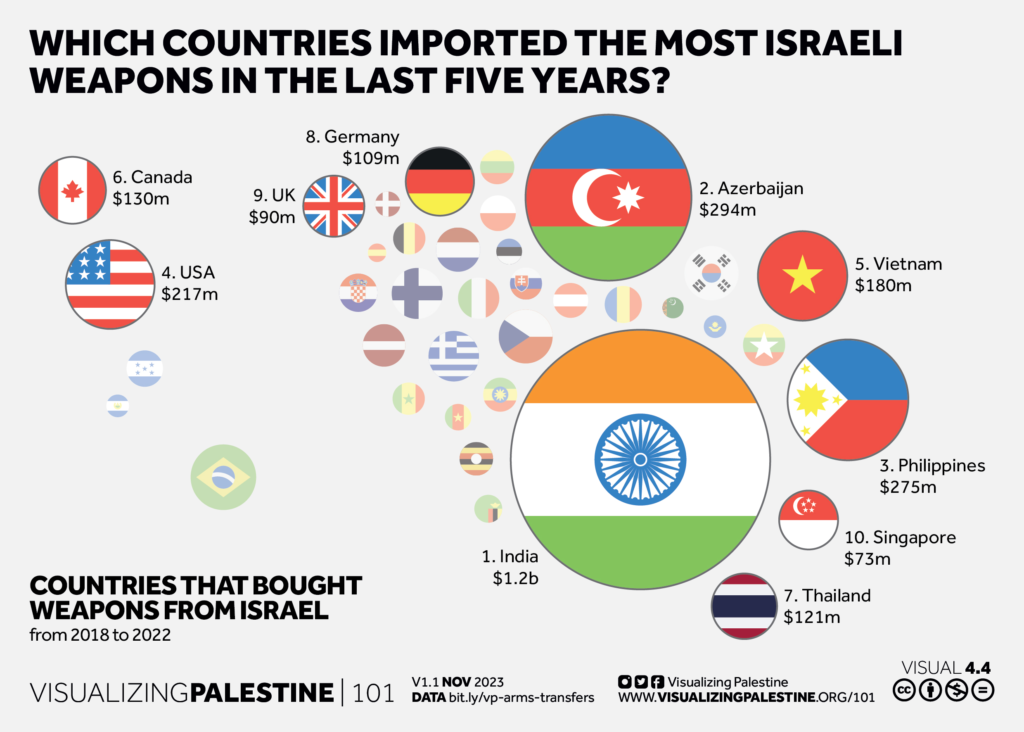
    You may have seen the following post listing Singapore amongst the top 10 importers of Israeli weapons. According to data compiled by the SIPRI Arms Transfers Database, Singapore purchased $73 million worth of weapons from the Israel from 2018-2022.

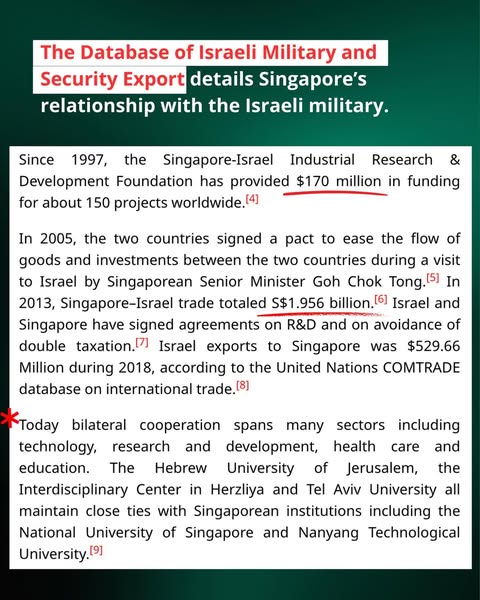
    Indicative of their close strategic cooperation, most of Israel’s arms sales to Singapore are in the form of joint military ventures with Singapore financing much of Israel’s research and development and arms exports to it. Singapore has purchased Israeli anti-tank and anti-aircraft missiles and until a few years ago, Singapore was the Israeli defence industry’s largest customer of arms and weapons systems.

    – Lily Zubaidah Rahim, Singapore in the Malay World (2009)
    Former IOF soldier Eran Efrati alleges in his lecture (An Israeli Soldier’s Story, 2014) that the Singapore government purchased tear gas canisters from Israel.

    Part of the appeal of Israel’s weapons to buyers is that they have been “proven effective” through being brutally “tested” on the Palestinian population (the tear gas canisters purchased included).

    It’s not just about weapons, there’s also Spyware and surveillance.

    2018: Singapore included in a list of 45 countries suspected of infection by Pegasus spyware, produced by Israeli firm NSO group. Pegasus has been used against politicians, activists, and journalists by government agencies around the world

    2022: A Reuters investigation states the Singapore government as one of the first clients of QuaDream, an Israeli firm that develops hacking tools for governments

    2023: 5-year, $14 million dollar agreement announced between Israeli firm Cellebrite and a national police agency in Singapore. The Singapore Police also uses the company’s UFED (Universal Forensic Extraction Device) which unlocks passwords of mobile phones and computers, bypasses encryption, and extracts digital information

    While Singapore claims to be a neutral party, it is hard to view our actions as impartial. Singapore has yet to recognise Palestine as a state while we have nurtured our close relationship with Israel for decades.

    How many of the weapons we helped to create are subsequently used by Israel to kill Palestinians? How many are used in other genocidal regimes that Israel sells weapons to?

    If we truly claim to want peace, is it time to reconsider our collaboration in the military trade with a state committing ethnic cleansing?
  • Joint Statement: End Lorry Rides, Save Workers’ Lives

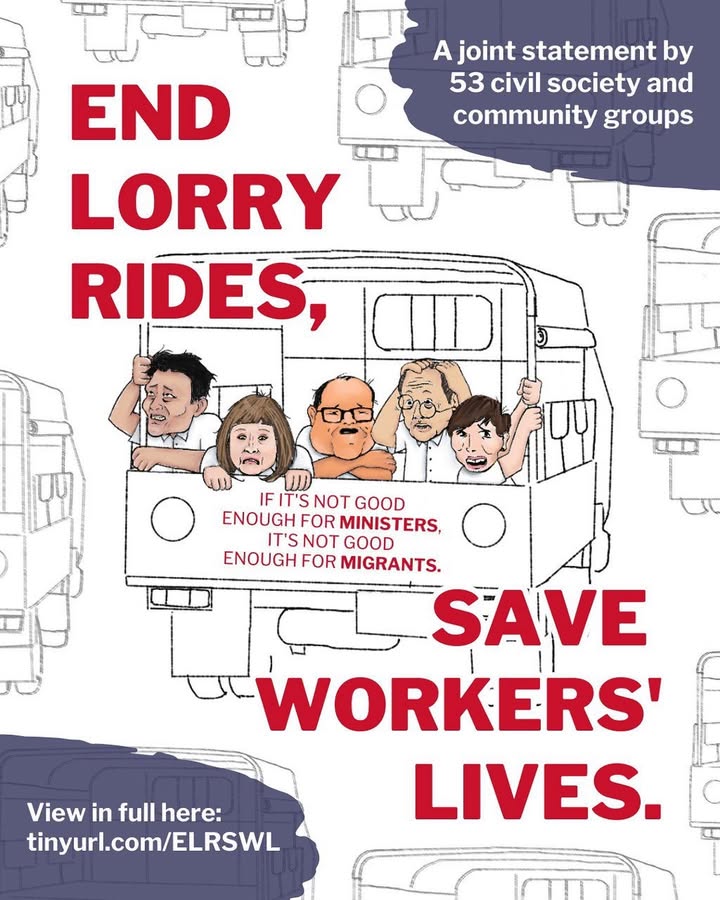
    Joint Statement: End Lorry Rides, Save Workers’ Lives

    Beyond the Hijab is standing alongside the 53 community groups in Singapore who have come together to demand that the government immediately ban the unsafe and undignified transport of workers in goods lorries. Migrant workers lives are put at risk every day because the law allows it. The same law protects the rest of us from such unsafe transport. This is unacceptable – all our lives are equally precious. Change is long overdue. It’s time to act decisively and do the right thing. Justice delayed is justice denied.

    Read the full statement.

  • A Labour Day reminder: The Hijab issue is not over

    A Labour Day reminder: The Hijab issue is not over

    Labour Day commemorates the struggle of workers for fairer working conditions, fair wages, and shorter working hours. On this day, we would like to emphasise that the “hijab issue” is NOT over yet. While the widely reported and celebrated shift in policy to allow healthcare workers to don the hijab is a step forward, it is not enough to dramatically address the struggles faced by women who wear the hijab as they go through their job search or navigate the workplace, especially for women who are not engaged in white-collar work.

    At the heart of the issue, is a fundamental and damaging misconception of the hijab and how the Muslim woman who wears it is perceived. Until the attached meanings are significantly addressed and stop being perpetuated, we will not meaningfully address the discrimination faced by Muslim women.


    After years of particularly intense discussion, it was finally announced that from 1 November 2021, the Ministry of Health (MOH) will allow female Muslim staff to wear the hijab as part of their uniform, subject to guidelines.

    This was a hard won change. But what now?

    “Muslim women are still not allowed to wear the hijab in other sectors. Muslim women are not allowed to wear the tudung while working in uniformed sectors like the police and armed forces. This is because their uniform signals to the community that their services are rendered equally and regardless of race or religion.”

    – Can Muslims Legally Wear the Tudung at Work in Singapore?, Singapore Legal Advice, 2022

    Referring to the hijab purely as a symbol of difference, as necessarily non-secular, and claiming that discussing the issue creates racial and religious tension, will only deepen prejudice and misunderstanding about the garment.

    For example:
    “Mr Masagos said that the heart of the Government’s approach is to “protect the precious harmony” built in Singapore over the years.”

    – Government’s secular stand on issue of wearing tudungs with public service uniforms has been ‘consistently clear: Masagos, Cindy Co, Channel News Asia, 2021

    “Non-Muslims, already wary about the aftermath of the Sept 11 attacks and the arrest of the Jemaah Islamiah operatives, will be even more concerned with the push for wearing the tudung in schools.”

    – Tudung Issue Won’t Benefit Muslims, Deepa Vijiyasingam Channel News Asia, Streats, 2002

    The hijab is a visible marker of one’s religion, but Muslim women are not homogenous and have a spectrum of opinions and tendencies.

    They may be conservative, or progressive, and many believe in maintaining a secular state.

    According to a study by Singapore Muslim Women’s Association (PPIS), financial independence and being a better Muslim are among the top aspirations of Singaporean Muslim women.1 As long as hiring and workplace discrimination for hijabis is not meaningfully addressed, the most fundamental, personal aspirations of Muslim women donning the hijab are directly impacted.

    Many Muslim women already face hurdles in the workplace due to the nexus of gender and race.

    The narrow and dehumanising view of the hijab-wearing Muslim woman as a figure at odds with a secular state only further exposes them to discrimination in the hiring process, at the workplace, and society at large.

    Footnote

    1. Sue-Ann Tan, Financial independence, work-life balance among top aspirations of S pore Muslim women: Study, The Straits Times, 2022 ↩︎
  • This Eid, don’t ruin the vibe with…

    This Eid, don’t ruin the vibe with…

    Aidilfitri is a time when relatives come together, catch up, and even seek forgiveness so that valued relationships are not ailed by continued misunderstanding, resentment or unhappiness.

    With such an emphasis on repairing and maintaining valued relationships, it should go without saying that we should always avoid speaking in hurtful and harmful ways. After all, we may never know what a person is struggling with, and how stressful such yearly affairs can be for someone.

    May our words always be a source of warmth and comfort instead of distress for others.

    We hope Eid/Raya has been a joyous one for you so far ❤️


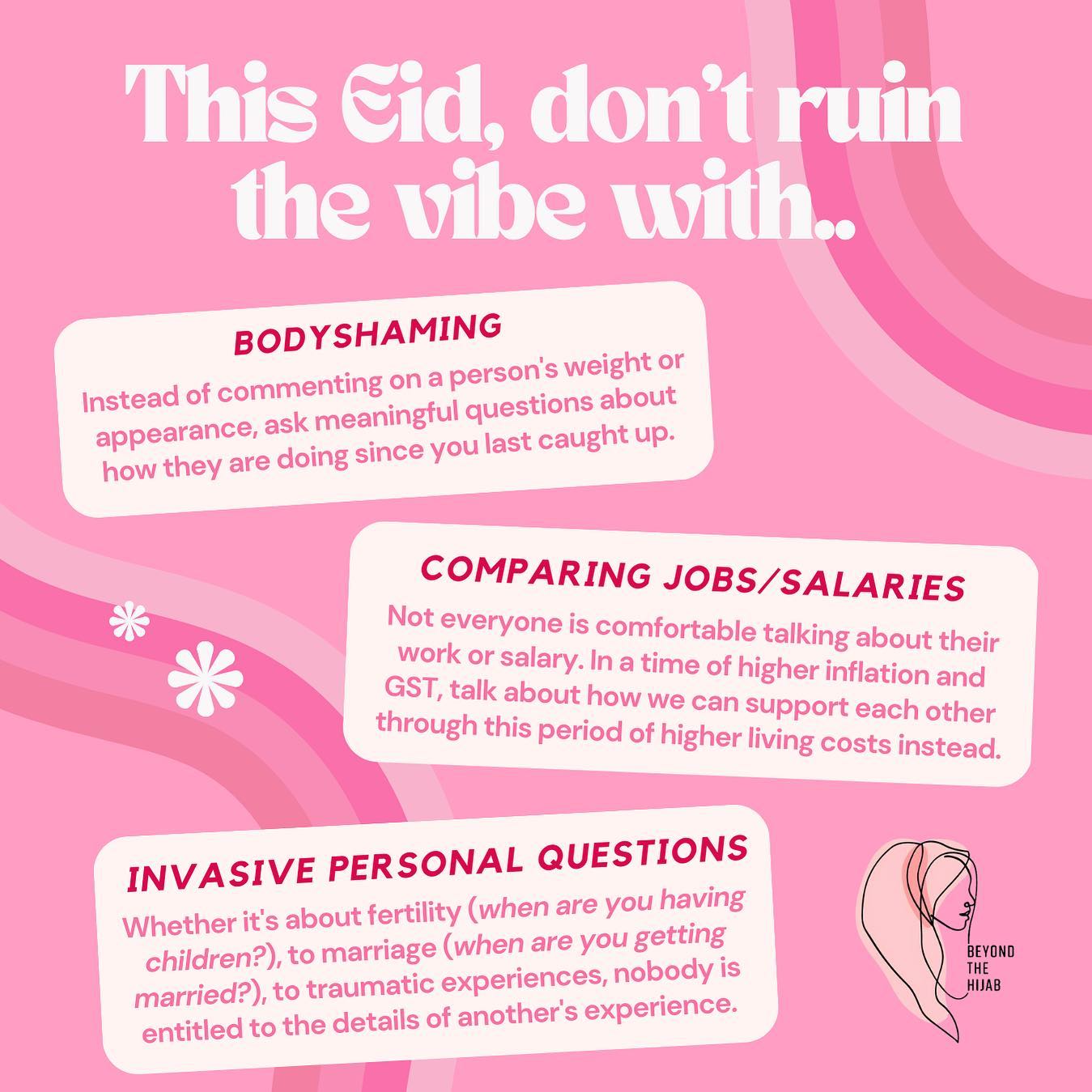
    This Eid, don’t ruin the vibe with…

    BODYSHAMING
    Instead of commenting on a person’s weight or appearance, ask meaningful questions about how they are doing since you last caught up.

    COMPARING JOBS/SALARIES
    Not everyone is comfortable talking about their work or salary. In a time of higher inflation and GST, talk about how we can support each other through this period of higher living costs instead.

    INVASIVE PERSONAL QUESTIONS
    Whether it’s about fertility (when are you having children?), to marriage (when are you getting married?), to traumatic experiences, nobody is entitled to the details of another’s experience.

  • This Ramadan, let’s split the housework fairly!

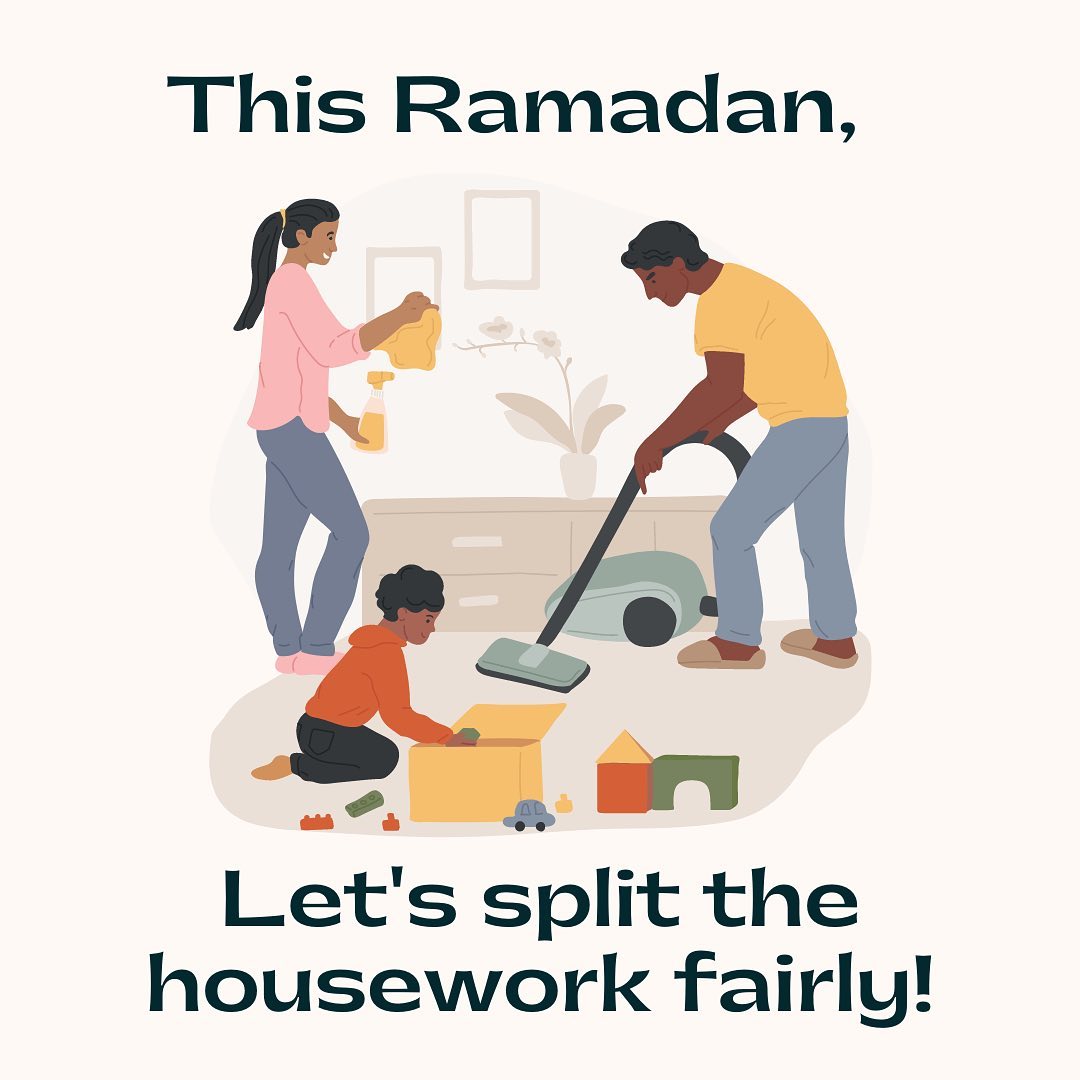
    This Ramadan, let’s split the housework fairly!

    Ramadan can be an intense month, and there tends to be more to do. From preparing meals, cleaning up, preparing for Eid, increasing acts of ibadah and charity…all while fasting. Many mothers are the first to wake up for Sahur, and the last to rest for the day.

    The increase in domestic chores and labour in Ramadan are primarily borned by women. This disparity can result in unwanted outcomes. Women may find themselves exhausted, with less time to perform acts of ibadah they want. It can even create tension and resentment in the household.

    To ensure that the observance of Ramadan is accessible to all:

    • We can discuss how chores can be shared and made more manageable
    • Remember that every family is different. Some women may find it fair, or even prefer to do the bulk of the chores, while other, while others would appreciate more help (especially in bigger families and/or if they do not have domestic helpers)

    And it’s not just about the physical chores, but also the mental load! The invisible, internal labour of planning, anticipating your family’s needs, overseeing tasks and more. It can look like:

    • Planning what to prepare for Sahur and Iftar every single day
    • Remembering to set the alarms and wake the family members for Sahur
    • Constantly taking stock of the chores and caregiving duties left to be done

    We can help to ease the mental load by:

    • Observing and being proactive: We don’t have to wait to be told to do the dishes, take out the thrash, clean up after ourselves, etc.
    • Taking charge of our own schedules (including setting your own alarms to wake up for Sahur!)
    • Taking stock and helping to replenish groceries and toiletries in the home
    • Offer recipe ideas for iftar (better still, to help with preparations if you can)!

    Helping with the chores is sunnah.

    In a well-documented hadith, Aisha (R.A.), was asked “What did the Prophet use to do in his house?” She replied, “He used to keep himself busy serving his family and when it was time for prayer he would go for it” (Sahih al-Bukhari)

    Aisha (R.A.) was also reported to have said “He (The Prophet S.A.W.) did what one of you would do in his house. He mended sandals and patched garments and sewed.” (Al-Adab Al-Mufrad)

    Doing the household chores and caring for family with loving intention is also ibadah, an act of worship. Maintaining a clean home and ensuring that our loved ones are eating well creates an environment where they can experience Ramadan with more ease.

    Sharing the labour of household chores not only eases the load for caregivers, it also abides by the call to ensure fairness and tranquility in the home.

    Ramadan Kareem!

  • Sorry we’ve been so quiet!

    Sorry we’ve been so quiet!

    (But also…rest is important & it’s ok to go slow)

    A pandemic, full-time jobs, responsibilities–there are a whole list of things that has kept our energy and attention away from this platform and the connection that we enjoy building here. We miss this space!

    The reality is that it is really hard to participate in anything outside of wage labour in a society like ours. Over the years, we have seen how passionate individuals and groups push themselves in their advocacy and activities. Unfortunately, this also means that we see a lot of burnout, which leaves groups unsustainable.

    We knew that it was important to respect our own mental and physical limits. Here are some thoughts that have been bubbling…

    Burnout ain’t cute

    – Laurie Bertram Roberts

    • Burnout can lead to serious physical and mental consequences. If we are trying to build a better society and world, one where people care for each other, then we must take care seriously by ensuring we and our loved ones have enough rest.

    In nature, things that grow unchecked are often parasitic or cancerous. And yet we inhabit a culture that privileges novelty and growth over the cyclical and the regenerative. Indeed our very idea of productivity is premised on the idea of producing something new, whereas we do not tend to see maintenance and care as productive in the same way.

    – Jenny Odell, How to do nothing

    • Have we unlearned the demand to be “productive”? As we dedicate ourselves to our communities and causes, with the desire to be inclusive and progressive, are we still pushing ourselves to be “productive” according to capitalist standards? Do we have such expectations of productivity on our friends and fellow activists?

    …de facto leadership is often composed of those with the most time, tenacity, energy, extroversion, preexisting social status, and even plain aggressiveness.

    – Zeynep Tufekci

    • Our standard of “productivity” is exclusionary. Explicitly or implicitly demanding “productivity” means that those who are unable to keep up are excluded. This can be individuals with disabilities, more caregiving responsibilities, or those who take on more jobs due to financial needs. How we operate such that the above quote does not come into play in our own community efforts, and a person’s voice and stake is not based on their “productivity”
    • It’s okay to go slow. Being unwilling to go slow can result in (1) resentment, conflict and harm going unaddressed (2) informal hierarchy prioritising those who ‘keep up’ (3) de-prioritising building and deepening connection (4) disillusionment. Being too anxious about “getting things done” can mean losing sight of other things that are just as, or even more important, in ensuring sustainability and just feeling joy in doing what we do.

    Let’s continue to take care of ourselves and each other! ❤️

  • What is racial gaslighting?

    What is racial gaslighting?

    The term “gaslighting” was coined to refer to misogynistic emotional abuse, and indeed, sexism plays a strong role in gaslighting even outside the context of relationships. Gaslighting can happen in the workplace, in families, and even en masse towards a community. Experts call this insidious form of en masse gaslighting “structural gaslighting”.

    We want to look at “racial gaslighting” since the increased conversations around race has also meant minorities having to experience this chronic and frustrating form of invalidation and abuse.

    Racial gaslighting is deeply wounding because it leaves minorities questioning whether the racism they experience was “real”. Gaslighters somehow want you to believe that they are more reliable narrators of your own lives and experiences than you are. Racial gaslighting is not just exercised on the interpersonal level but can sometimes be perpetrated by institutions or the dominant narratives that we hear that ignore the reality of racism.

    We want to affirm minorities who have experienced gaslighting that their experiences and emotions are valid and real, that nobody gets to define and re-write it on your behalf and that we believe and support you!


    RACIAL GASLIGHTING OCCURS WHEN…

    Racial minorities highlight valid instances of discrimination or harmful behaviour…Only to be dismissed as lying, overreacting, or told that they themselves are the abusers.

    It comes from a refusal to believe that racism is a reality despite overwhelming evidence that it exists.

    RACIAL GASLIGHTING LOOKS LIKE…

    • “I’m not racist, but…”
    • “Isn’t this just reverse racism?”
    • “Can’t you take a joke?”
    • “I don’t even see colour.”
    • “Racism doesn’t really exist anymore.”
    • “Not everything is about race.”

    Source: https://www.refinery29.com/en-gb/what-are-microaggressions-racial-gaslighting

    RACIAL GASLIGHTING CAN TAKE MANY FORMS…

    • COUNTERING: questioning the minority’s memory of events:“Are you sure that’s what happened?”
    • DENYING: pretending to forget and accusing the minority of lying:“You just made this up.”
    • WITHHOLDING: pretending not to understand the allegation: “What are you even talking about?”
    • DIVERTING: changing the focus of discussion: “All of this critical race discourse is a Western influence.”
    • TRIVIALISING: belittling the severity of the situation: “Racism in Singapore isn’t as bad as racism in other countries.”
    • STEREOTYPING: using racist tropes to dismiss allegations: “Well, you people don’t really want to integrate with others.”

    Source: https://www.medicalnewstoday.com/articles/gaslighting# gaslighting-examples

    It is a convenient tactic used to derail accusations of racism and shift the scrutiny onto the accuser – forcing them to question and re-assess their own response to the racism, rather than the racism itself.

    A classic example of racial gaslighting is where a person of colour describes a racist interaction, only to have it immediately questioned.

    ‘Are you sure that’s what it was about?’, ‘Was it definitely about skin colour though?’, ‘But I don’t think that was about racism.’

    – https://www.refinery29.com/en-gb/what-are-microaggressions-racial-gaslighting

    RACIAL GASLIGHTING IS A FUNCTION OF RACISM
    It comes from a refusal to believe that racism is a reality despite overwhelming evidence that it exists.

    Racial gaslighting does more than silence the voices of racial minorities.

    It shifts the blame onto them and makes them even bigger targets for harassment and discrimination.

    The function, the very serious function of racism is distraction. It keeps you from doing your work. It keeps you explaining, over and over again, your reason for being. Somebody says you have no language and you spend twenty years proving that you do. Somebody says your head isn’t shaped properly so you have scientists working on the fact that it is. Somebody says you have no art, so you dredge that up. Somebody says you have no kingdoms, so you dredge that up. None of this is necessary. There will always be one more thing.

    – Toni Morrison

    HOW CAN I RESPOND TO RACIAL GASLIGHTING?
    I’m a racial minority so I can…

    • seek support from others who believe me
    • check in with my capacity to engage with the gaslighter
    • respond according to my own level of comfort and safety in the situation

    “I’m not sure whether you are uninformed or just trying to undermine and dismiss what l’ve said. Here are some resources which might be helpful to understand how racism is a form of systemic discrimination which minorities in Singapore face all the time. I can only continue engaging you on this subject if you sincerely wish to understand where I’m coming from.”

    I’m an ally, so I can…

    • check in with the person who is being gaslit
    • affirm the experiences and statements made by them
    • reveal the subtext behind the gaslighter’s accusations

    “There is plenty of evidence which shows that racism exists here. It bars racial minorities from equal opportunities and exposes them to regular harassment. Are you really trying to deny that racism exists in Singapore, or refusing to take accountability for racism?”

    TO THOSE WHO EXPERIENCE RACIAL GASLIGHTING:

    • Your anger, sadness and frustration is valid.
    • It’s okay to be tired. It’s okay if you don’t want to engage.
    • Thank you for pointing out instances of racism. Doing this is a revolutionary act.
    • Seek support from others who can affirm you.
    • Continue speaking up, not just to prove your gaslighters wrong, but to refuse their re- writing of events.

    Remember: Gaslighting is more about the other person’s inability to take criticism than it is about you.

  • Racism and xenophobia is never justified

    Racism and xenophobia is never justified

    We are seeing more harassment and hate crimes against Indians in Singapore due to a toxic cocktail of xenophobia and racism. We must not isolate this issue as simply current, but understand it as revealing what has always existed.

    While recent incidents are more “obvious” manifestations, it is important to understand that their roots run deeper than specific episodes. Bigots feel safe harassing and attacking minorities because racism is undeniably endemic in our society.

    When dehumanising treatment, portrayals, caricatures, and stereotypes of minorities and their culture are normalised and treated as debatable in public; when those who speak up about racism fear legal repercussions; when racism is treated as “sensitive” and swept under the rug–how can one be surprised?

    And then there’s xenophobia. Dehumanising xenophobic speech often normalised and communicated through the rhetoric of “safety” and the protection of borders, has intensified during the COVID-19 pandemic.

    But even before the COVID-19 pandemic, anxiety over job insecurity amongst Singaporeans has disturbingly found itself misdirected and expressed through xenophobia against Indian nationals, notably through nationalistic anti-CECA sentiments.

    There is active harm and violence in leaving racism and xenophobia unaddressed. The anxieties and insecurity Singaporeans feel about their precarity are real, but xenophobia and racism are responses that explain nothing about the systemic conditions that have created that insecurity.

    Racism and xenophobia is never justified.

  • A joint statement in response to the online poll promoting sexual violence

    A joint statement in response to the online poll promoting sexual violence

    By Beyond The Hijab, Crit Talk, End FGC Singapore, Lepak Conversations and Penawar

    Content Warnings: Mentions of rape, Online sexual assault, online sexual harassment, and misogyny 

    We strongly condemn the misogyny and sexism of a group of men who initiated a poll on a social media platform, to vote who among their women peers deserved to be successively raped (“gangbang”). We are deeply alarmed by the poll’s vulgar sexualisation of women.

    We live in a patriarchal society that consistently objectifies and sexualises women in direct and indirect ways. In the poll, 1,005 participated in this online sexual harassment, of which the majority are men. It is alleged that students of Islamic studies were among the voters. Their predatory behaviour is worrying for the safety of their female asatizah colleagues, the moral and social development of their male asatizah colleagues, and also the larger Muslim community who will rely on their future religious knowledge and guidance. 

    Since the poll was exposed, female asatizah have shared personal anecdotes about the sexual harassment and assault they suffered at the hands of their men peers and how their attempts at seeking redress were in vain. This shows the persistence of sexism in the workplace, where victims are constantly met with a lack of institutional support when seeking justice. 

    This poll shows how sexual harassment and violence is never caused by the victim’s lack of ‘modesty’. Sexual harassment and violence is never the victim’s fault. Rather, it is a manifestation of a patriarchal culture that encourages female objectification with little consequence for the perpetrators and little care for victims. All victims deserve justice and support, not only the ‘modest’ or ‘innocent’ ones.

    We remind ourselves that sexual objectification begins with intentions and words. These ‘jokes’, images and conversations eventually manifest into (sexual) violence. This poll is not an isolated case. In June 2020, similar calls by women to address the misogynist ‘locker-room talk’ in OKLETSGO’s podcasts were belittled, dismissed and met with rape threats.

    This poll exists in a culture where women are persistently sexualised, dehumanised and denigrated, and where male and institutional reputations are more important than women’s dignity and rights to justice. It is this culture that sows the seeds for incidents of sexual violence to keep occurring.

    While we are reassured that figures from the Malay-Muslim community have spoken up, we believe that they have the responsibility to act on this matter decisively, and to address the root of the problem: deep-seated misogyny and sexism in our communities.

    We call on MUIS (Islamic Religious Council of Singapore) and Muslim leaders to:

    1. Require all (1) asatizah, (2) madrasah students, and (3) students attending overseas Islamic universities to attend Sexual Assault First Responder training by Sexual Assault Care Centre (SACC), and Gender Sensitivity training by The T Project Singapore;
    2. Provide comprehensive sexuality education in local madrasah. This includes in-depth discussions of consent, gender-based violence, power dynamics and gender inequality;
    3. Reconsider granting Asatizah Recognition Scheme (ARS) Certification if detailed background checks (introduced in January 2020) reveal previous misogynist and sexist behaviours;
    4. Include compulsory Gender Sensitivity training and Sexual Assault First Responder training under the Asatizah Reintegration Programme (ARP) for asatizah involved in sexual misconduct (misogynist behaviour or sexual harassment). The public must be informed of the previous misconduct and what training was undertaken before the individual is reintegrated; 
    5. Provide trauma-informed care and support for survivors of sexual harassment; and
    6. Implement a national campaign to address myths on sexual violence and eradicate the culture of victim-blaming. 

    Our groups, and so many other individuals, have addressed this issue far too many times. We want our Muslim leaders in power to take concrete action in addressing the systemic rot. 

    We demand accountability. We demand change.

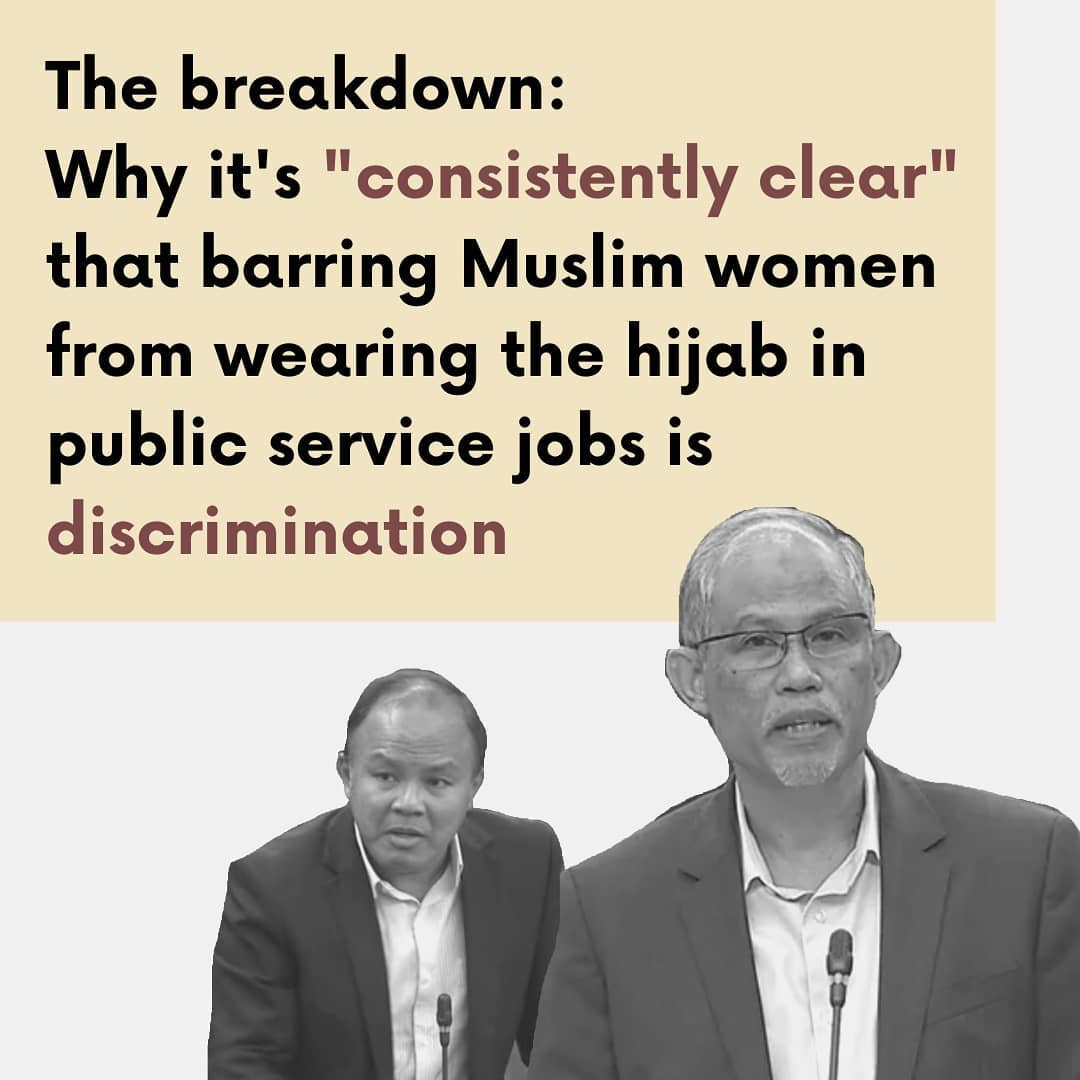
  • The breakdown: Why it’s “consistently clear” that barring Muslim women from wearing hijab in public service jobs is discrimination.

    The breakdown: Why it’s “consistently clear” that barring Muslim women from wearing hijab in public service jobs is discrimination.

    During parliament’s Budget Debate on 24 Feb, MP Faisal Manap raised the issue of current legislation which does not allow Muslim women to wear the hijab in certain public service jobs, such as nursing or law enforcement. Mr Manap argued that this rule has deterred many Muslim women from taking up such roles.

    On 8 March (International Women’s Day), Minister Masagos Zulkifli responded that uniform policies in the public services are meant to ensure that “service is rendered equally regardless of race or religion”.

    He continued: “Allowing tudungs will raise a very visible religious marker that identified every tudung-wearing female nurse or uniform officer as a Muslim…We don’t want patients to prefer or not prefer to be served by a Muslim nurse, nor do we want people to think that public security is being enforced by a Muslim or non-Muslim officer.

    Mr Masagos also labelled the issues as “complex” and “sensitive” and reiterated the PAP’s approach of “careful closed-door discussions”.

    He added that “public aggressive pressure” can only make compromise harder – possible in reference to many previous public campaigns and petitions asking for this rule to be reviewed.

    There are a few reasons why these statements are problematic and are continued attempts to defend an inherently discriminatory policy.

    1. Barring Muslim women from wearing the hijab is not a fix for workplace discrimination
    2. Characterising the issue as “sensitive” implies that opposition to the hijab ban is disruptive by default, shutting down attempts at open discussion about it
    3. Insisting on “closed-door discussions” with representatives excludes open consultation with Muslim women who wear the hijab and relegates their autonomy to others who may not fully represent their interests
    4. This policy is a form of gendered discrimination which disproportionately affects minority women (who already experience multiple forms of marginalisation)
    5. Discussing the hijab as a threat to secularism and the racilisation of public service frames the hijab as a political issue rather than a personal religious choice
    6. Characterising public pressure as “aggressive” and saying that it “only makes compromise harder” undermines citizens’ rights to campaign against and discuss policies they disagree with while framing advocacy as something which “harms minority communities”
    7. There is little to no evidence that hijab affects work practices in the healthcare sector. Muslim nurses wear the hijab while maintaining hygiene standards in Canada, the UK, Australia and many other countries. In Singapore, many Muslim public doctors wear the hijab and still fulfill their professional requirements. However, this rule somehow does not apply to nurses.

    Policies which discriminate against any minority groups, and Muslim women in particular, extend beyond the harm caused to any individual and has the effect of further entrenching the marginalisation of these groups. The reality is that many Muslim women, when faced with this dilemma, elect not to take up opportunities or choose to leave their jobs rather than to give up on what they see as a crucial part of their religious obligations. Creating space for Muslim women to wear the hijab at work would encourage greater participation in the workforce and in society, without for forcing them to choose between practicing their religion and earning a livelihood.