Category: Advocacy

  • Feedback on the proposed amendments to the Administration of Muslim Law Act (AMLA)

    Feedback on the proposed amendments to the Administration of Muslim Law Act (AMLA)

    Strengthening considerations for child welfare

    Amendment to formalise Syariah Court’s (SYC) powers to make orders to allow or prevent a child from being taken out of or relocated outside of Singapore

    This is a welcome change, allowing decisions to be addressed during the divorce process instead of requiring separate applications.

    Amendment to include a provision clarifying that the paramount consideration of SYC when dealing with matters relating to children is the welfare of the child

    The mechanisms or procedures by which the welfare of the child will be taken into account during adjudication should be detailed. While the SYC has powers to make orders on maintenance of minor children, in practice it has not done so.

    Instead, the parent who holds custody has to spend undue time, effort and financial resources to seek maintenance. This complexity directly contravenes the principle that the child’s welfare should be paramount.

    Reducing the administrative burden on Muslim couples undergoing divorce

    Amendment to empower SYC to make orders on the division of matrimonial property upon a foreign Muslim divorce

    This is a welcome change, as it addresses the inefficiency of requiring claimants to pursue matters in two different courts for a single divorce.

    Amendment to empower SYC to make child-related orders upon a foreign Muslim divorce

    We agree with this amendment. Given the expanded scope, we also recommend that more financial and operational support be provided to SYC to effectively manage this increased workload without causing further delays.

    Amendment to simplify some procedural requirements for divorce proceedings, i.e. removing the need for hakam in talak tafwidh cases, and allowing SYC discretion to waive requirements for applications on the ground of fasakh

    We welcome the above proposal and additionally recommend the requirement for sworn testimony of two witnesses in certain applications of fasakh be automatically waived.

    Women face a significant burden in divorce proceedings, as they are required to provide extensive evidence that can be difficult, expensive, or time-consuming to gather. Meanwhile, men seeking divorce through talaq only need to provide evidence of the pronouncement.

    We strongly recommend that AMLA ensures equal rights to divorce for both women and men, including the grounds for divorce and standards of proof.

    Our recommendations on reducing the administrative burden on Muslim couples undergoing divorce

    Divorce is already an emotionally difficult process. Administrative burdens and other systemic issues not only makes it harder, but directly impacts access to justice. Our recommendations are based on our ongoing research on the Syariah court divorce process and the major issues that have surfaced.

    1. Greater clarity regarding timelines and consequences of delays

    The current divorce process is a speedy and fair one for amicable cases.

    However, in an acrimonious divorce, local advocates have shared anecdotal cases of men who delay proceedings and exploit loopholes in the court’s enforcement mechanisms, leading to the postponement of mediation sessions and Pre-Trial Conferences for over 6 months.

    These delays are particularly detrimental to the stability of the children’s family situation, prolonging their exposure to marital conflict and emotional instability.

    1. Legal advice for women who waive their rights

    We have seen cases where men prolong the divorce process as a way to emotionally drain and coerce wives into settling for less, or even completely waive their nafkah iddah, mutaah, and other claims relating to the matrimonial assets.

    Women we interviewed also mentioned being unaware of their rights and what they are able to ask for.

    To safeguard women’s legal rights, we strongly recommend that SYC require that any wife waiving these claims receive legal advice before participating in mediation. This ensures that wives fully understand the legal implications and rights they are relinquishing.

    1. Set up a helpdesk and provide empathetic and trauma-informed support

    As the application process has gone online, women have expressed needing the sensitivity of a human when seeking assistance, as opposed to impersonal online channels.

    We recommend setting up a dedicated helpdesk facility where court officers can provide direct administrative support such as assisting applicants when they bring their draft documents, similar to the support provided by the Service Bureau for civil cases or the help centre at the State courts.

    We also recommend that officers are trauma-informed and deliver assistance with empathy and respect to acknowledge the high level of emotional distress individuals experience throughout the process.

    1. Streamline the divorce process, especially in cases of family violence

    In cases involving family violence, SYC must prioritize the immediate safety and secure housing of all vulnerable individuals and children. Administrative delays isn’t experienced as just the passing of time, but increased risk, danger, and mental health distress for families experiencing violence.

    Given that prolonged administrative delays directly compromise the safety and stability of the family unit, we strongly recommend that SYC streamline the divorce process, especially in cases of family violence, to safeguard the well-being of the vulnerable individuals and child.

    1. Publish a comprehensive step-by-step guide

    The absence of clear, accessible information on the SYC website creates unnecessary stress for individuals already experiencing high emotional distress from marital breakdown, as they are forced to navigate complex legal procedures without adequate guidance.

    To improve accessibility, we recommend that SYC publish a comprehensive step-by-step guide on how to file and serve a divorce application (similar to what is available for POHA), including a more comprehensive flowchart of the process, a glossary of legal terminologies and information about the legal rights of each party involved.

    1. Improve functionality of the online portal

    There are significant user experience issues with regards to the online portal, including lack of notification systems, difficulties in document submission, payment processing, and frequent downtime during peak hours.

    We recommend upgrading the portal to improve functionality and scheduling maintenance outside of peak access times.

    1. Increase financial and operational support for SYC

    We are also concerned over the long postponements of 3 months each time an adjournment is granted at mediation or at a hearing due to the availability of the mediators, registrars and presidents.

    Such delays affect access to justice and have disproportionate impacts on women who are often the primary caretakers of children, and who may have difficulty in finding and maintaining employment while going through protracted divorce proceedings.

    We recommend that more financial and operational support be provided to SYC to ensure sufficiently quick and effective services.

    1. Mandatory trauma-informed and gender-sensitivity training for counsellors

    Individuals should receive non-judgmental and non-directive support to assist them in making their own decisions, free from pre-fixed goals to “save marriages”. Spousal violence, abuse and persistent disrespect, for example, can erode self-esteem and confidence.

    Vulnerable individuals in such cases undergoing a programme aimed at “saving” marriages may experience undue pressure to preserve a marital relationship at the potential expense of their safety and well-being.

    We recommend mandatory trauma-informed and gender-sensitivity training for all counsellors operating within the SYC framework, regardless of whether they are based at FSCs or SYC-linked services.

    1. Mandatory training and accreditation of mediators

    Presently, the experience of mediation varies depending on the individual personality of mediators, not all of whom are trained.

    To ensure that mediation serves its intended purpose of facilitating amicable resolutions rather than causing further distress, we recommend that SYC mediators be formally trained and accredited by the Singapore Mediation Centre.

    Other Issues

    Although these issues were not addressed in the amendment, we would like to reiterate the recommendations we had made in our CEDAW shadow report, as well as those of the United Nations CEDAW Committee in their concluding observations.

    Child Marriage

    Section 96(5) of AMLA provides that a Kadi may authorize the marriage of a girl below 18 years but has attained the age of puberty.

    We recommend AMLA to enforce 18 years as the absolute minimum age of marriage for Muslims and remove all legal loopholes that allow for exceptions. This aligns with the recommendations made by the UN CEDAW Committee’s concluding observations (Paragraph 60(d)).

    Marriage is too significant a commitment for those under the age of 18 – who are inherently vulnerable – to enter into it.

    Polygamy

    Despite the need to get approval for subsequent marriages, Singaporean Muslim men bypass this procedure by marrying Muslim women from other countries such as Indonesia or Thailand, where approval is not needed. These non-registered marriages leave Muslim women and their children in highly vulnerable situations socially, financially and psychologically and there are little or no consequences on men.

    If polygamy remains legal, we urge stronger protections for the first wife. Currently, the first wife may voice objections, lodge an appeal with MUIS, and/or file for divorce on the ground of her husband’s inequitable treatment resulting from the polygamous marriage. Yet these safeguards place an onus on her to proactively act to obstruct the second marriage or to seek divorce, which may be difficult for vulnerable or dependent individuals. The default position in the law should more fully protect the first wife.

    Our recommendations on this topic include:

    • Prohibit polygamy by Singaporean Muslim men. This aligns with the recommendations made by the UN CEDAW Committee.
    • Alternatively, adopt a rebuttable legal presumption that the applicant will not be able to be fair and/or provide equally for both his existing spouse and the potential wife.
    • Provide a model, standard marriage contract with options for a wife to explicitly enunciate a monogamous marriage.
    • On the Syariah Court’s web page on polygynous marriage, (1) state that consent of the first wife is required; (2) clearly outline other factors that are considered by the Kadi; (3) an explanation of the legal and practical consequences of circumventing Singapore’s laws by marrying overseas.

    Inheritance

    The provisions with regard to division of assets are unequal to men and women. In many instances, for example in the cases involving widows and widowers as well as siblings, a woman is entitled to half the share of a man. The UN CEDAW Committee has recommended that Muslim women have equal rights with men to inheritance (Paragraph 60(c)).

    The current rules can result in inequality and hardship when often the daughters or wives are the main caregivers in the family yet only receive half the share of male heirs.

    We recommend AMLA to:

    • Revert to the legal position before the operationalization of AMLA (in 1968) to provide Muslims the option to choose whether to distribute their estate and assets, upon death, under Muslim law or civil law.

    The consultation period for proposed amendments to the Administration of Muslim Law Act (AMLA) is ongoing till 22 June 2026. Read and download a copy of our full recommendations below.

  • Happy International Women’s Day 2026

    Happy International Women’s Day 2026

    Liberation will never come from bombs, girlboss capitalism, or “benevolent” patriarchy. We want anti-authoritarianism, solidarity, mutual aid and justice!

    Imperial feminism justifies wars that oppresses women, not liberate them. Islamophobia and the saviour complex is fundamentally rooted in patriarchy and colonial white supremacy.

    Supporting women is an active verb. Support women—against injustice, rape culture, sexism, racism, homophobia, workplace harassment and discrimination of all forms.

  • Call for focus group participants

    Call for focus group participants

    📢 We are looking for women currently undergoing or have completed their Syariah divorce to participate in a focus group discussion.

    ✏️ Your insights and feedback will be integral to our research project on the lived experiences of women navigating syariah court’s divorce process.

    🗓️ 14 Feb, Saturday, 11.30am-1.30pm

    ➡️ Register &/or share: –

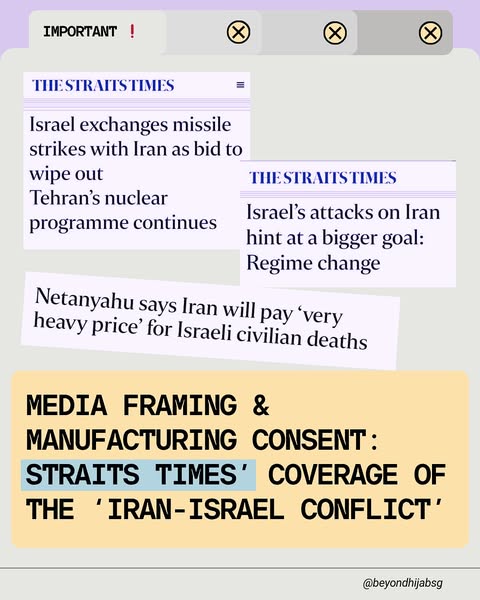
  • Media-framing & manufacturing consent: Straits Times’ coverage of the ‘Iran-Israel Conflict’

    Media-framing & manufacturing consent: Straits Times’ coverage of the ‘Iran-Israel Conflict’

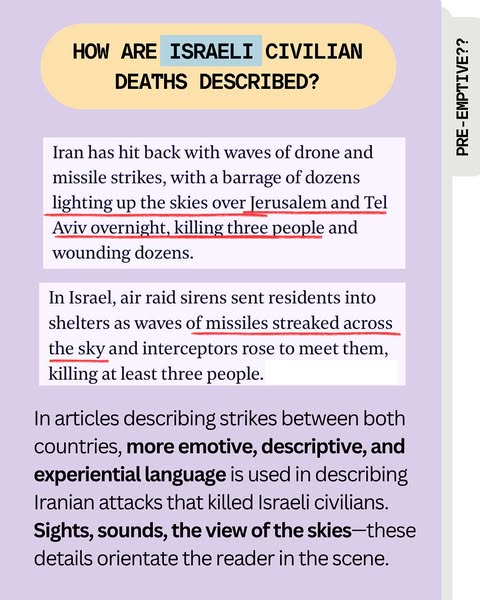
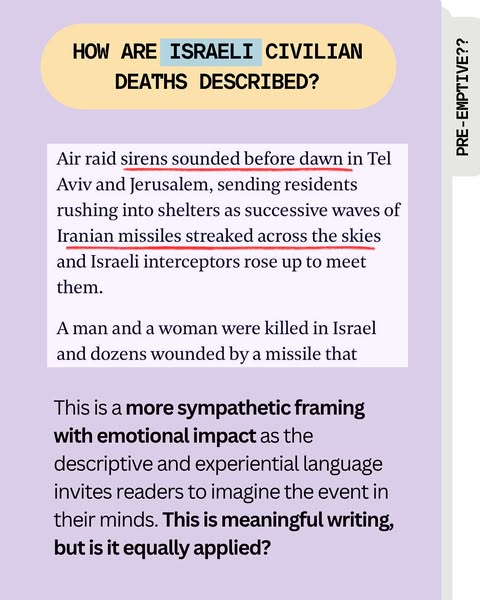
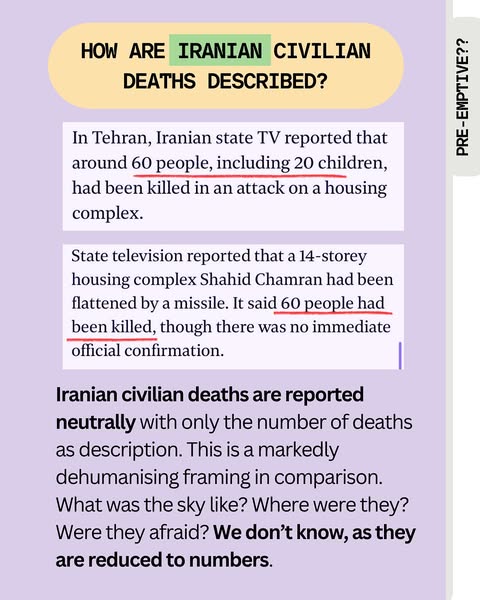
    Whose deaths are sympathized with, and whose are simply counted? Will the sky be described when they are killed?

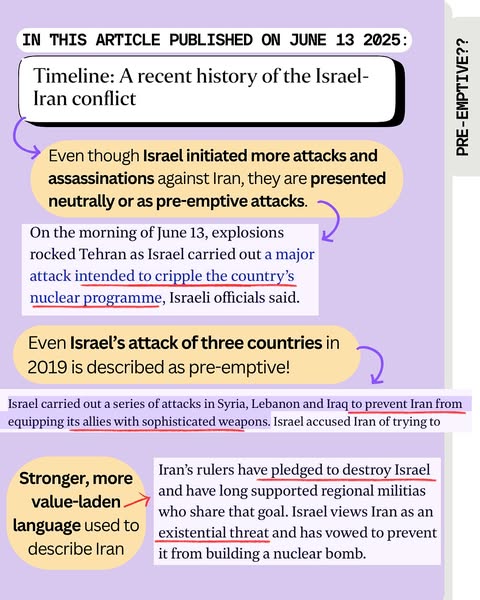
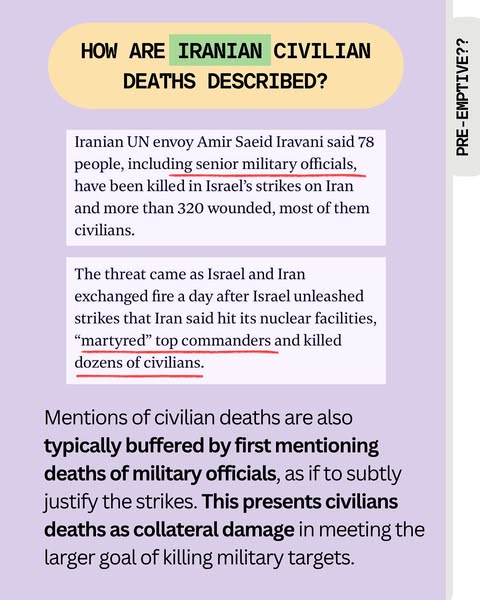
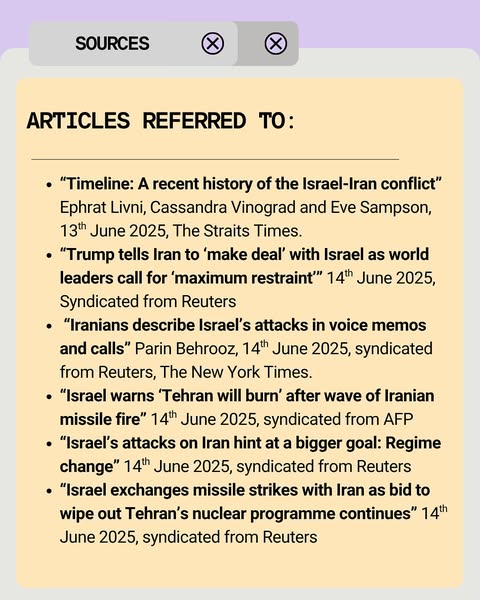
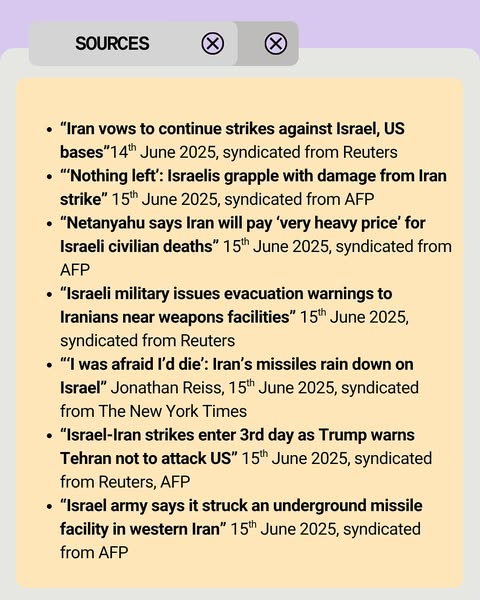
    Through reviewing 13 articles published in The Straits Times, we found a disturbing pattern of minimising of Israeli aggression, and practically wholesale repetition of the Zionist regime’s justification for what is fundamentally an attack that is considered illegal under international law. This also means a concurrent minimising of Iranian deaths. It is the continuation of a disturbing pattern we have seen in reporting about the Gaza genocide too, where a recent study of BBC articles found that Israeli deaths are mentioned 33 times more than Palestinian deaths, despite the latter having a death toll that is 34 times higher.

    The Straits Time recently published that they are the most trusted news brand in Singapore. We hope that they take this responsibility seriously and not participate in the manufacturing of consent for aggressors and their illegal wars where civilians pay the ultimate price.

    We ask that as readers, Singaporeans will also remain critical of the narratives that we consume in every day life, and consider how framing has an effect on how events are understood.


    We read 13 articles covering the ‘Iran-Israel conflict’ published on June 14th and 15th.

    In summary we found

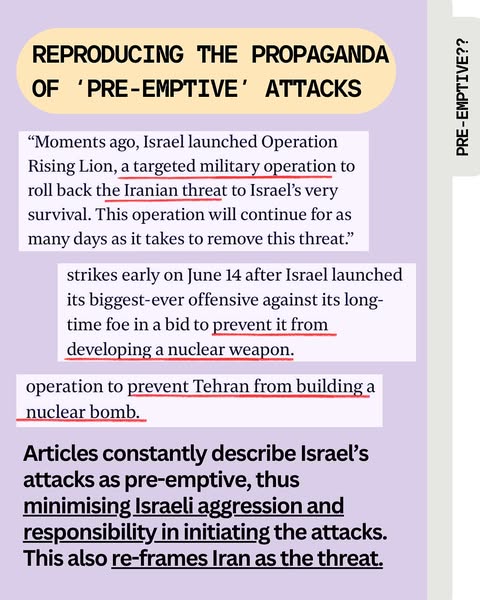
    • Framing of Israel’s attackes as pre-emptive, with no mention of the illegal nature of Israel’s attack
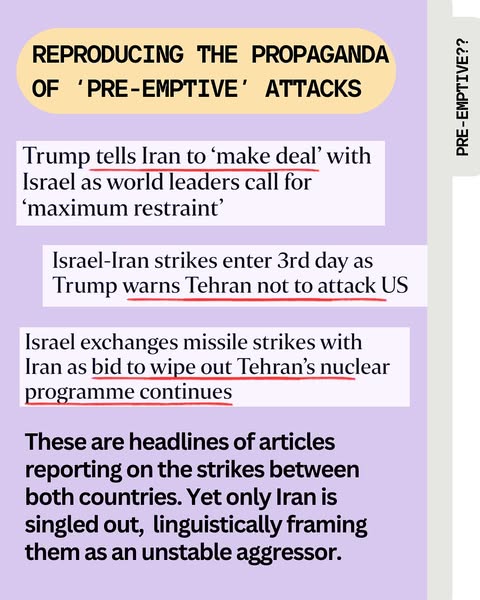
    • Constant focus on Iran’s nuclear program that frames Iran as the aggressor
    • Neutral language used for Israeli attacks, more emotive language used for Iranian attacks
    • More mention of attacks on Israeli civilians compared to Iranian civilians, despite much higher number of Iranian deaths

    A caveat before we begin

    Most of the articles that we read and refer to are syndicated (republished) from Western media sources such as Reuters and The New York Times.

    While they may not have been directly produced by Straits Times, we must still question the selection choices which end up propagating certain dangerous narratives.

    We may also ask why non-Western news agencies are not seen as equally legitimate sources for syndicated articles.

    What’s not being said

    • Only one article mentioned the fact that Israel is not even a signatory of the Non-Proliferation Treaty (Iran is).
    • Only one article mentioned that Israel’s claim that Iran’s production of a nuclear weapon was imminent, was unsubstantiated by US intelligence.
    • None mentioned that Israel has nuclear weapons (Iran does not).
    • None mention that (unlike Iran) Israel has refused International Atomic Energy Agency (IAEA) inspectors into the country.
    • None pointed out Israel’s hypocrisy.
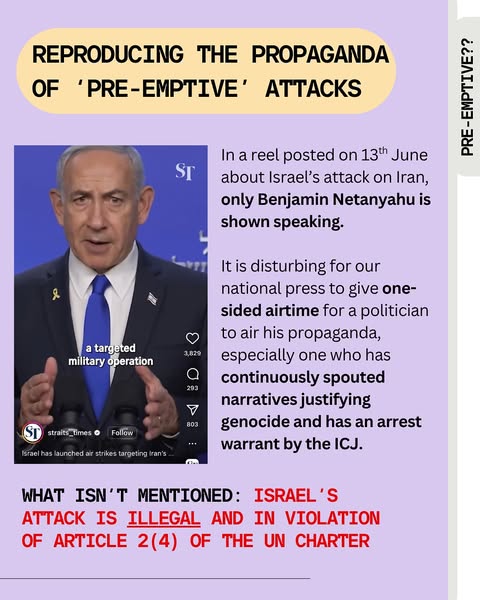
    • None pointed out that Israel’s strikes on Iran considered illegal under international law.

    Why is it important to question how the news is framed?

    Due to media’s reputation as an institution, they hold defining power in framing events and have the ability to mobilise support or opposition to issues as local as housing prices, or as egregious as a genecide. This is significant, as public perception influences policies that affects lives.

    In 2003, the invasion of Iraq was justified through the lie that Iraq had weapons of mass destruction, a claim that was largely uncritically reproduced in the media and became common public belief.

    We must all be concerned if our media is lenient with aggressors, and show symptoms of manufacturing consent for mass violence and war.

  • Open Letter to Inclusive Career Fair and Pink Fest Organisers: There is no pride in genocide

    Open Letter to Inclusive Career Fair and Pink Fest Organisers: There is no pride in genocide

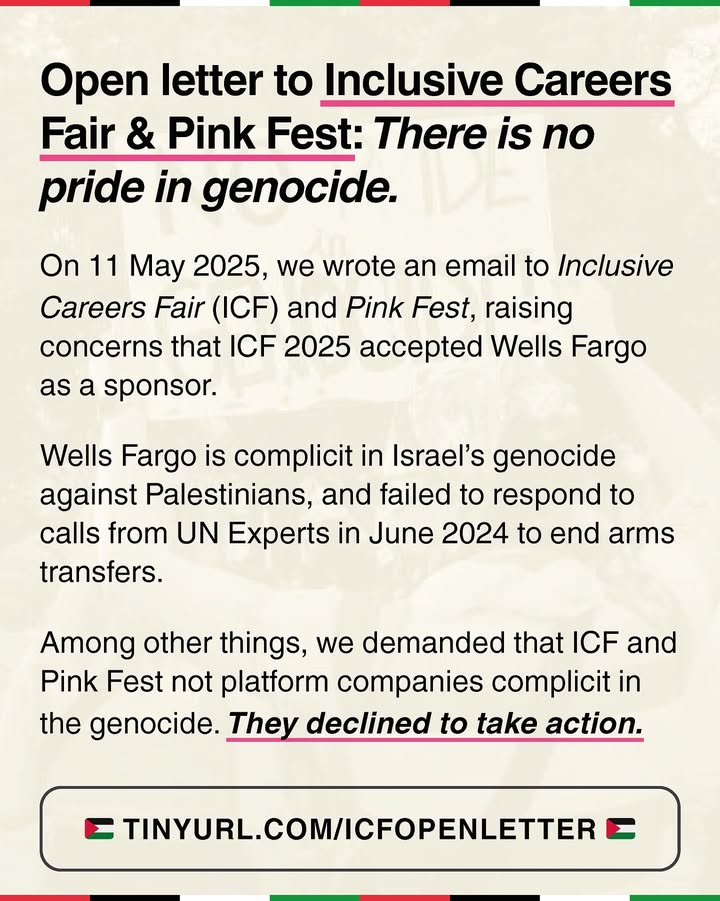
    We call on @inclusivecareersfair and @pinkfestsg to cease future financial dealings with Wells Fargo, a company complicit in the genocide against Palestinians, and commit to review sponsorship vetting processes for future events to ensure the LGBTQ+ community in Singapore does not platform companies complicit in genocide.

    There is no pride in genocide – sign our open letter to stand in solidarity against pinkwashing.

    Pride Month is a time for us to remember that the queer movement is a movement of resistance against oppression. As we stand firm on the believe that everyone deserves equality and social justice, we, too, cannot ignore the struggles of other marginalised communities. As we call on our allies to amplify our voices and join our fight for equality, we, too, must act as fierce allies for others. As we champion the strength that diversity of voices bring, we, too, must recognise the strength that comes when diverse marginalised communities band together.

    Free Palestine 🏳️‍🌈🇵🇸

    Read the full open letter. Allies are welcome to sign too!

  • Dear Singaporeans, there are 38,000 little red dots in this picture

    Dear Singaporeans, there are 38,000 little red dots in this picture

    38,000 is a conservative estimate of the death toll in Palestine since Oct 7 as the Palestinian people endure a genocide.

    As infrastructure in Gaza broke down due to the genocide, so did the capacity to keep track of the dead.

    A death toll that considers the thousands dead under the rubble and the indirect deaths due to the destruction of food, health and public infrastructure runs as high as 186,000.

    That looks like this:

    Each dot represents a rich life forever lost.

    Are these lives – the lives of Reem, Hind, Refaat, Al Ghoul – less important than the maintenance of business, diplomatic and military interests?

    Our “neutrality” continues to line the pockets of an apartheid state through purchase of weapons and military collaborations. Citizens are reminded that we donate to the victims too. Meanwhile, donated food by Singapore is pictured held at the border. Back home, business, cultural and diplomatic ties continue to affirm the existence of a settler-coloniser state.

    This national day, we ask why our past as a formerly colonised country has failed to lead us to meaningful solidarity and action for a country enduring settler-colonialism and genocide.

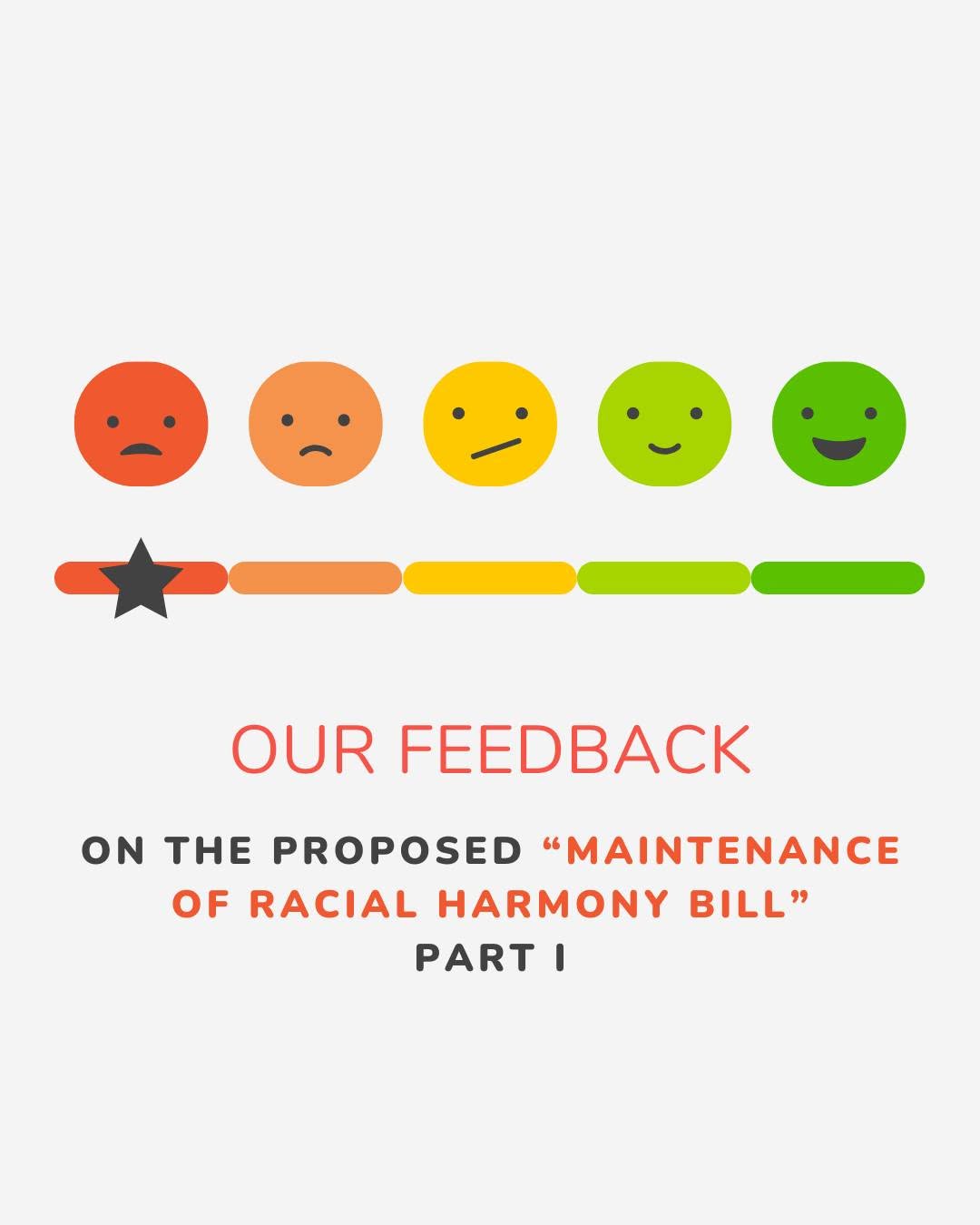
  • Feedback on the proposed Maintenance of Racial Harmony Bill

    Feedback on the proposed Maintenance of Racial Harmony Bill

    The Government plans to pass the “Maintenance of Racial Harmony Bill” later this year. As a group comprising of minorities, the proposed Maintenance of Racial Harmony Bill (“the Bill”) has raised considerable concerns.

    Our key concerns with the Bill are:

    • Lack of a full draft with the Bill’s specific provisions with which the public can submit informed feedback
    • Vagueness and overly broad provisions of the Bill and its enforcement mechanisms, which can potentially lead to the disproportionate criminalisation of minorities who raise issues pertaining to race and racism
    • The imposition of a Restraining Order which would pre-emptively allow the government to act against content before proving criminal conduct
    • Reparative measures that appear to place the burden of reconcialiation on victims rather than seek to address the harm caused

    The Bill sets us back in our obligations as a signatory of International Convention on the Elimination of All Forms of Racial Discrimination (ICERD), and does not in fact meaningfully address issues of racial discrimination in the country.

    Members of the public are invited to submit their feedback and comments by 11 June 2024. Read or download our full report below (PDF, 5MB).

  • CEDAW: Report on Muslim Family Law and Muslim Women’s Rights in Singapore

    This shadow report is jointly submitted by Beyond the Hijab and Musawah, the global movement for equality and justice in the Muslim family, for consideration by the CEDAW Committee in its review of the Government of Singapore, reporting before the 88th Session of the CEDAW Committee in May 2024.

    The report examines the necessity for a comprehensive reform of the Administration of Muslim Law Act (AMLA) in order guarantee equality for Singaporean Muslim women. It highlights the issues of divorce, women’s equal capacity to enter into marriage, child and early marriage, polygamy, and inheritance rights. The report also highlights Positive developments in Muslim family laws with examples of good and better practices from other Muslim contexts.

    Read or download our full report below (PDF, 3.9MB).

  • Ramadan Mubarak & Free Palestine

    Ramadan Mubarak & Free Palestine

    This Ramadan, we are hyper-aware of the suffering of our kin in 🍉. The reality of the genocide they face makes celebration difficult. But it is during times like this when the essence of this blessed month of reflection and spiritual resolve is made clearer.

    May we turn away from the capitalist excess of consumerism and look towards the strength to be found in community. May we turn away from the narcissism of only celebrating individual pursuits and accomplishments, and turn towards advocating for and celebrating the well-being of all, especially the most marginalised and exploited amongst us. May we practice rahma for our fellow Muslims, instead of judging how they may choose to observe this holy month. May we sharpen our commitment to human values of compassion and justice, as opposed to the imperfect political systems and leaders in this dunia that have shaped a reality that makes us complicit in genocide.

    May this blessed month be one full of blessings, spiritual growth, and resolve. May we be steadfast for justice, and may there be liberation for all.

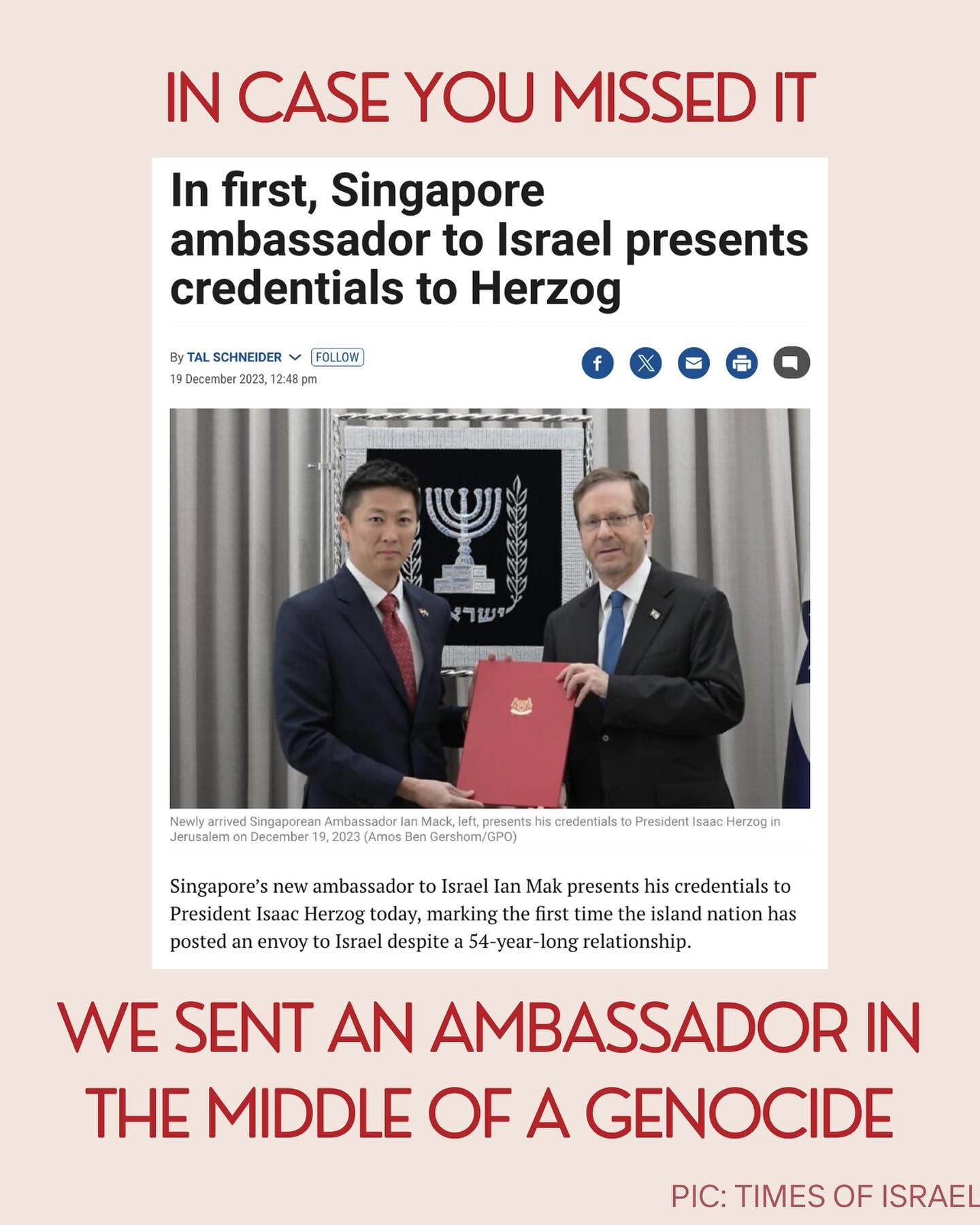
  • ICYMI: Singapore sent an ambassador in the middle of a genocide

    ICYMI: Singapore sent an ambassador in the middle of a genocide

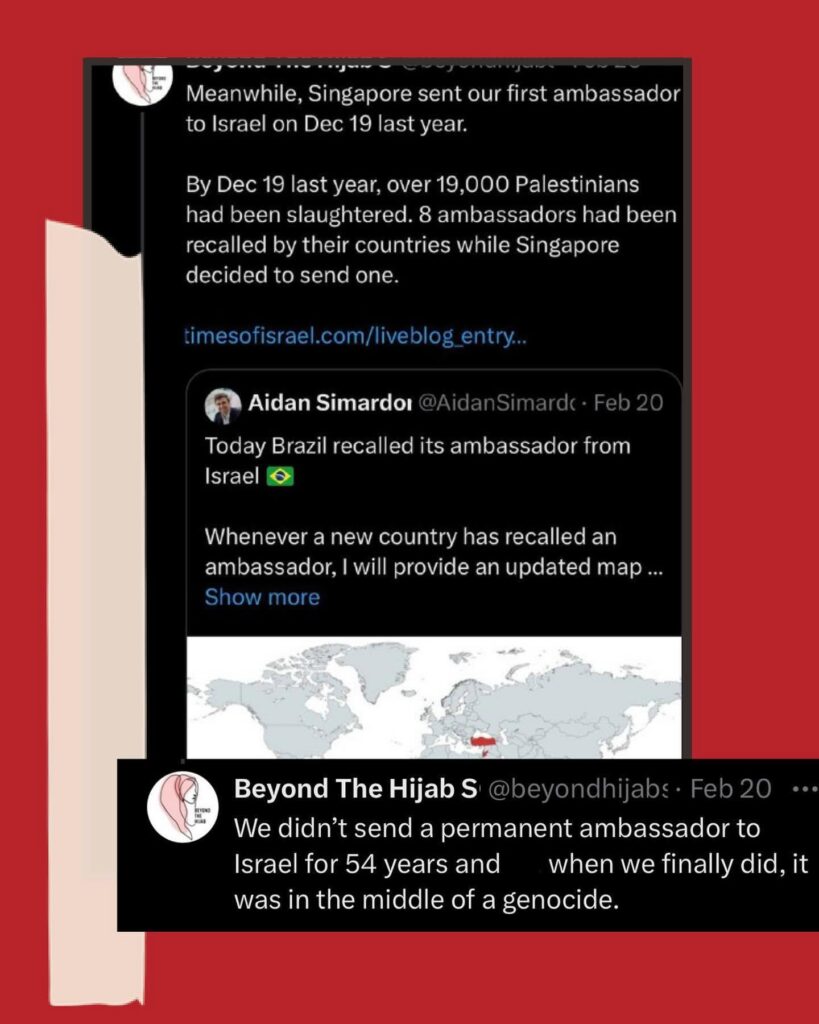
    We sent a permanent ambassador to israel on Dec 19 last year. Sending an ambassador to a country that is currently committing genocide is not a “neutral” act, especially not when ambassadors are being recalled in protest; it’s not “neutral” when it is being heralded positively by those who advocate for the legitimacy of isreal even as they commit genocide and refuse to comply with orders by the International Court of Justice.

    Recall the permanent ambassador to israel! We did fine without one for 54 years 💅🏽

    Change.org/enddiplomaticrelations

    To date, 10 countries have recalled their ambassadors.

    But Singapore, on Dec 19, sent our first permanent ambassador to Israel, thus aiding in the country’s attempts at normalisation.

    While the Singaporean ambassador was shaking hands with the president of a settler-coloniser state, over 19,000 Palestinians had been killed in the genocide.

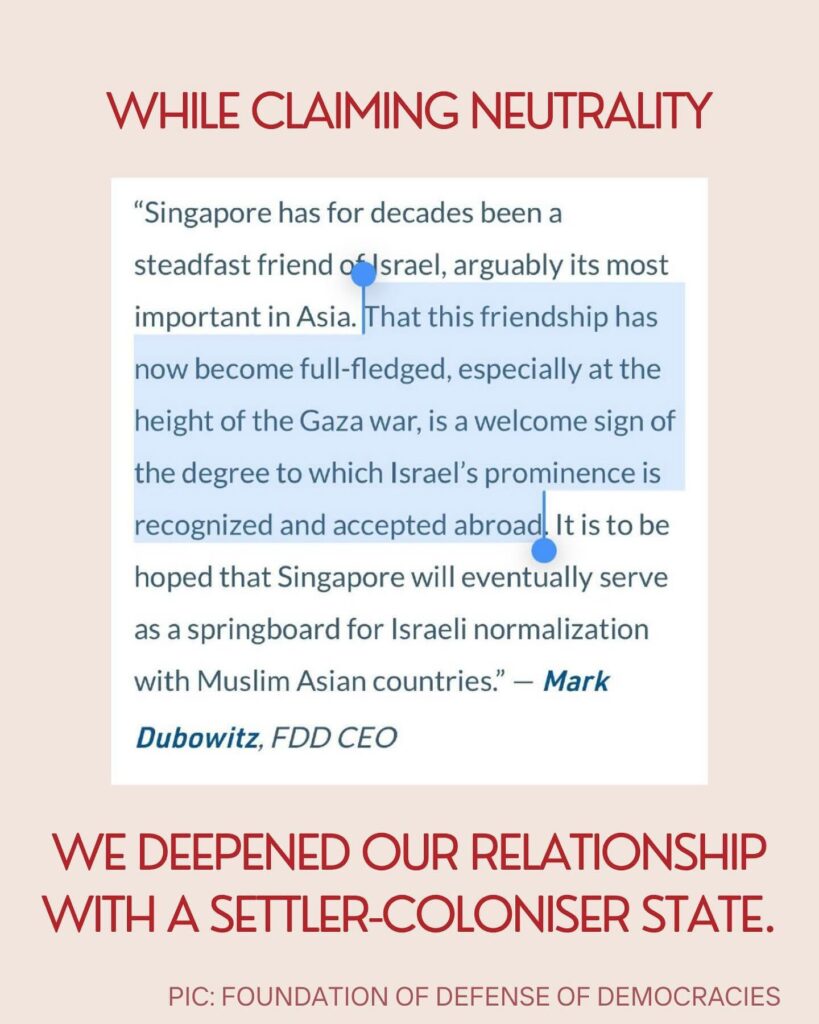
    While claiming neutrality, we deepened our relationship with a settler-coloniser state.