Category: Blog Series

  • Editor’s Letter: Mental Health

    Editor’s Letter: Mental Health

    by Diana Rahim

    It’s hard being a person. Nobody truly tells you this, nor are we really encouraged to look into this fact deeply. As a society, we are uncomfortable with confronting sadness and despair, and would rather concentrate on a superficial, easy-to-understand pursuit of happiness. We are taught to meet our basic material needs, to obsess over our educational and career paths, and to succeed in our society. Far less emphasis is placed on meeting our very important psychological and emotional needs, and in fostering the kind of habits that are emotionally healthy not just for us, but in our reactions to others as well. Very often, even basic emotional responses and sensitivity is stigmatized. Just think of common, dismissive phrases one often hears – “Don’t be so sensitive,” “You’re being oversensitive,” “Why can’t you take a joke?”

    In truth, I truly believe that to see someone express emotion, sensitivity and vulnerability threatens the stability that some people have taken pains to sustain to cope with living in world that can be insensitive and indifferent.

    In describing what I feel to be the deep undercurrent of despair that I think lies within so many of us, especially younger ones, I often mention the fact that every school I have been to has had a suicide. I say this because the epidemic of mental health crisis, depression, and unbearable anxiety, is rooted very much in the way modern (especially capitalist) societies are organized and how people are treated, and it is experienced as early as childhood in the schooling system.

    It is there where we experience the pressure of group dynamics, the shame of classism, the neoliberal demand to succeed as individuals and to have our worth defined solely by our ability to be successfully productive. It is there where we learn that in order to feel respected and valued by those in authority, we have to live according to their rules no matter how painful, unnatural (or even unnecessary) such rules can be. And of course, some people are less aligned to the enforced standard than others, and such people are considered wayward and face more stresses.

    I have to mention the fact of a person’s identity in relation to power because it is undeniably connected to the issue of mental health. While it is true that mental health issues affect people of any class, racial, or gender background, people from marginalized groups are disproportionately affected by mental health problems.

    A recent study by the Institute of Mental Health (IMH) for example revealed that women in Singapore are more prone to depression than men, a pattern that is consistent in other countries (men however have higher rates of completed suicides). Women in the younger age group – between 18-34 years old — are more than twice as likely than men to suffer from major depressive disorder. Queer children (and certainly this very likely leads into adulthood) report staggeringly high rates of abuse and discrimination that in turn leads to mental health issues and even places them at high risk of suicide. There have been studies that also tracked Islamophobia to lead to long-term mental health issues (Islamophobia is also a gendered issue, with women who are visibly Muslim facing the brunt of hate crime attacks).

    Behind these statistics lie real social causes and explanations. Gendered issues shore up when mental health professionals explain women’s higher rates of depression. Experiences of discrimination for LGBTQ+ youth also unsurprisingly figure into higher risks of suicide. The point is that alleviating the inequalities in our systems, and seriously working towards a society that is less discriminatory is not only an issue of justice, but of public health.

    It also means that it is unwise to individualize someone’s mental health struggle as simply a personal problem or just an issue of chemical imbalance. It’s an easy cop-out of interrogating deeper, more systematic issues at play. Those who struggle are often victim-blamed for their own condition, being told that they are at fault for their own suffering. But a lot of times, this is simply not true.

    One of the most moving pieces I’ve read recently on pursuing a more holistic approach to understanding mental health problems was by Johann Hari. I will share the following quote from his article “Is everything you think you know about depression wrong” on The Guardian, though the whole piece is worth reading in full (please do!):

    “In its official statement for World Health Day in 2017, the United Nations reviewed the best evidence and concluded that “the dominant biomedical narrative of depression” is based on “biased and selective use of research outcomes” that “must be abandoned”. We need to move from “focusing on ‘chemical imbalances’”, they said, to focusing more on “power imbalances”.

    After I learned all this, and what it means for us all, I started to long for the power to go back in time and speak to my teenage self on the day he was told a story about his depression that was going to send him off in the wrong direction for so many years. I wanted to tell him: “This pain you are feeling is not a pathology. It’s not crazy. It is a signal that your natural psychological needs are not being met. It is a form of grief – for yourself, and for the culture you live in going so wrong. I know how much it hurts. I know how deeply it cuts you. But you need to listen to this signal. We all need to listen to the people around us sending out this signal. It is telling you what is going wrong. It is telling you that you need to be connected in so many deep and stirring ways that you aren’t yet – but you can be, one day.”

    If you are depressed and anxious, you are not a machine with malfunctioning parts. You are a human being with unmet needs. The only real way out of our epidemic of despair is for all of us, together, to begin to meet those human needs – for deep connection, to the things that really matter in life.”

    People are often unkind or unable to better empathise with those who struggle with their mental health because they reductively view it as a personal affliction. But if we can see that the epidemic of suffering today is a natural psychological response, our brain’s way of telling us we can’t cope with such a world, then we could perhaps see that more can and should be done to make our society a more bearable and healthier place. One where discrimination is acknowledged and tackled. Where people won’t have to be driven to high levels of stress due to low wages. Where living a decent life is an affordable thing to have instead of considered a privilege. Where school systems are better refined to respect a child’s creativity and autonomy instead of stifling or resenting it. Personal worth has to not be tied to personal productivity, which in our times is leading to more mental distress and isolation.

    It is not just stigma that has to be unlearned, but better responses to suffering that has to be learned. We need to actively learn how to respond when someone has an anxiety or panic attack. How to respond to someone who is depressed or who is having a psychotic episode. And just as importantly, we also need to learn how to take care of ourselves if we act as caregivers or support systems to loved ones.

    *

    Those who struggle with their mental health almost always additionally suffer from the ignorance of those who shame it. And just as mental health struggles can stem from very specific experiences pertaining to our identities and the subsequent challenges it brings, the stigmas faced can be very specific too.

    As Muslim women in this society, the conversation on mental health revolves around some big specific issues. In the submissions that will be published in this series, we can see how the language and framework of religion unfortunately can and has been used to invalidate or diminish a person’s suffering. There is often no theological basis to such dismissals (“you should pray more!” “Depression is shaitan”) but simply a more specific way to express the discomfort that people have when dealing with someone who is struggling with their mental health.

    The common invalidating and shaming responses that a Muslim woman receives can often be cloaked in the garb of the faith. For this reason, we must pay attention to the language or behaviour that is often employed against those who suffer.

    Perhaps it is because mental illness is an invisible affliction that reveals no bleeding wounds. A sickness that ails the mind. Perhaps its non-corporeal nature renders it susceptible to being invalidated through the lens of spirituality and religion. Historically, we do know that those who suffer from mental illness have even been thought to be possessed, spiritually afflicted, or beset by bad spirits.

    Of course, it is unsurprising that for people who organise their lives around their faith, a religious explanation is sought after in explaining mental trauma. It’s not that the lens of religion and spirituality cannot be used at all in trying to figure out a way to deal with mental health struggles and trauma. In fact, there is some acknowledgement here perhaps that mental illness is something that requires more than just a medical explanation and solution (it has to include, as aforementioned, one’s own personal history and experiences).

    The problem is that the tendency to simplistic and damaging methods or explanations (like possession) fail to truly and holistically understand the individual’s condition. The problem is that it can result in further trauma, impeding the person’s healing.

    Perhaps mental illness can be seen in some way as a kind of spiritual affliction, but not the kind that denotes possession or being haunted by bad spirits. Psychotherapist Michael Cornwall describes the experience of going through madness as a ‘transformative journey’; an extreme emotional state that occurs often due to the immense stresses and despair of alienating modern existence.

    Grief and confusion can be so profound that it destabilises us and cause great existential shifts that insists on being endured. The profoundness of these experiences are seen as ‘spiritual’ for some because it feels personally transformative. Such a reading would demand a solution that is far more acknowledging of this complex reality and addresses it, instead of simply thinking of the illness as a possession.

    Understanding this, there could be a way that religion and spirituality can be specifically used to the benefit of someone who wants such an approach in their healing process. For example, Stefania Pandoifo provided a more informed way of including Islam into the understanding and treatment of patients. Through researching history and patients in Morocco, she shows how there is a space for the relevance of contemporary Islamic cures for madness.

    *

    So many times, we know that to struggle with your mental health as a Muslim includes battling against accusations that you are spiritually weak, or that you have somehow invited this despair upon yourself through a lack of prayer, or a lack of faith. Of course this has no empirical basis, but such a conviction is not based on reason. It stems from a lack of understanding and ignorance about the reality of mental health issues and what living with it is like. To be depressed is not simply to be ‘very sad’ and to suffer from anxiety cannot simply be healed by surrendering to the will of God, especially since your anxiety can make it impossible to do that in the first place.

    The Islamic faith is replete with stories of prophets and sahabahs struggling with great despair in their lives. There were no words to pathologise any (if any) of their conditions at the time, but we would never deign to call these revered figures weak-willed or lacking in faith as they mourned the loss of wives, friends, family, or as they went through great sorrow, great pain, and the horrors of war (how many of them probably suffered from PTSD!).

    In fact the courage of our prophets in being able to overcome great sorrow and tribulations have always been an inspiring example to emulate.

    Religion can be part of the healing or coping process when it comes to struggling with one’s mental health, or supporting someone who is. But perhaps we should look towards these stories that affirm and validate the reality and difficulty of suffering instead of using the same, tiring religiously-laced platitudes that shame and invalidate someone’s suffering.

    Due to the exposure to so much damaging and invalidating attitudes, it is not uncommon for those who have suffered or who continue to suffer with mental health issues to have a difficult, even hostile, relationship with the faith. To be shuffled from one spiritual doctor to the next without your consent (this happened to a friend of mine) is a kind indirect violence that leaves you feeling powerless. To be consistently told that you are not pious enough by those around you when you were in need of love and validation can leave you insecure and coping with immense guilt.

    Often times, the employment of religion in the shaming and invalidation of your experience can leave you associating the faith with the trauma of your condition. It is understandable if the religion then is associated with pain to you.

    It is okay to have this difficult relationship, and you don’t have to feel guilty. The fact is, of course, it was employed wrongfully by people who prioritised judgement over truly understanding and giving you the care that you needed. Your piousness has no bearing over the reality of your mental illness. Unfortunately, unlike humans, mental illness does not discriminate amongst the religious or non-religious.

     It is not uncommon for you to have to completely re-evaluate your relationship with the faith during and after your journey with your mental health struggle. For some, their understanding and relationship of the faith deepened as it provided a support system that those around them failed to provide. For others, their relationship with the faith has been too damaged by the invalidation and pain that has been associated with it. None of this wrong. The only true thing is the reality of your experience.  

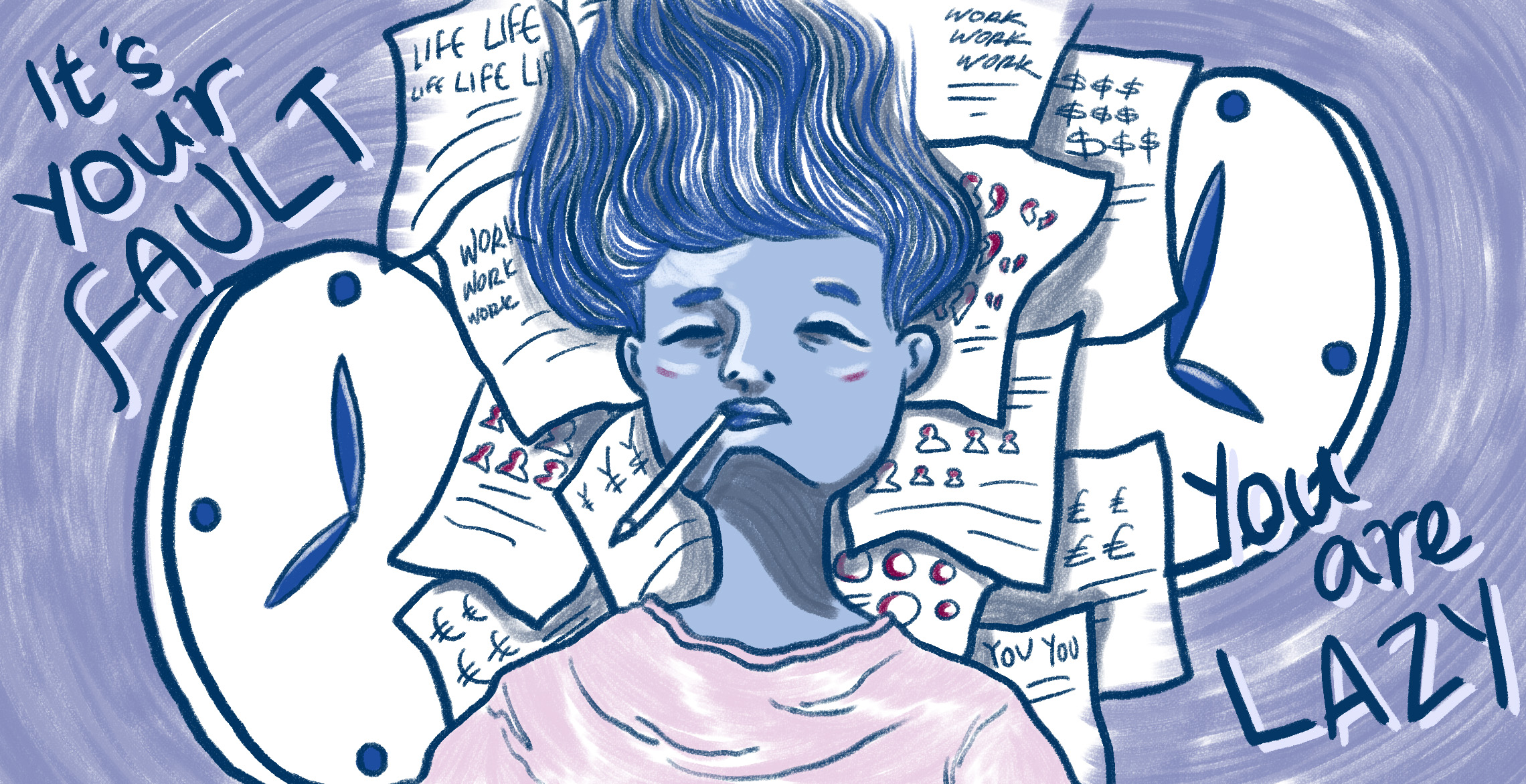
    If you are struggling with your mental health, I want you to know that your suffering is real, that your feelings are real, and that I know you are trying your best to survive. You are not selfish or lazy. There is no shame in your struggle, and I hope that you are taking healthy steps to recovery. There is a place for you in this world, and you are capable of helping and providing love and understanding for others too. You are not alone, though it might feel like that so completely. We are often isolated enough in this world. Though it may be hard, identify those who care about you in affirming and healthy ways, and don’t be afraid to reach out.

    May we take better care of each other, and may our good intentions, especially when laced with the language of religion, be full of love, not judgement.
  • For Love or Duty

    For Love or Duty

    by A Lady

    Marriage has never been on the books for me. My parents thought it unnecessary, hindering, and dooming. They firmly believe that humanity is fast approaching qiyamah (Day of Resurrection), and the time where true believers will no longer exist on the face of this Earth. No one qualifies to be our partners, so neither I nor my siblings are to get married. This notion is especially critical in my case for the fact that I am a woman and, as such, far more susceptible to being led down a deviant path. After all, in Islam, men are tasked to lead and hell is supposedly populated by far more women than men. A belief stemmed from inauthentic, weak, but unfortunately popular hadiths

    Generally, I accepted my parents’ rule, resigned to the plans that they have for me, which is to take on all the responsibilities of the home, finances, and care-taking. I would manage their household and buy them a house using my name. Of course, I would have no real authority, much like a secretary who has all the information and know-how on her fingertips but who works in service to a powerful though ignorant superior. This was the future I consciously worked towards, always trying to find balance between being able to earn enough for them in a field that I could at least enjoy. I never once fathomed that I would want anything else. Until I met my wonderful boyfriend, to whom I am now engaged.

    He is my best friend and the love of my life, who is not only proud of my qualifications and achievements, but also encourages me to reach my potential and pursue my dreams. If he had not persuaded me, I would never have sent my writing out. I learned to step outside my comfort zone, see the life I have to live and make good of. So when he went down on one knee and proposed, I accepted, all stinky from moving day, dressed in this crummy T-shirt and sweatpants ensemble that I have been wearing for about a week.

    However, getting married will be a tremendously difficult undertaking for me. Perhaps it will be even a bigger challenge than the two biggest challenge in my life: weaning off coffee (never) and quitting video games to become a more responsible adult (never, never).

    See, he is Chinese and a non-Muslim. Even if he was Muslim, it would not have been any better. My family are Quranists, therefore religious minorities and some of the most marginalised (outright “outlawed”) within the Muslim community. For them, adherence to the hadith, or prophetic traditions, especially without critical and contextual inquiry is a no-go. For my parents, the limits of the human imagination need to be taken into account in the reading and interpretation of the Quran. The religious education I received differed greatly from my peers: namely, I have never once stepped foot in religious class (and frankly the idea of doing so is about as comfortable as a wedgie) and I have never heard an imam, ustaz or ustazah speak. Religious education constituted of listening to readings of the Quran and a lot of discussion work where my siblings and I would have to think about what a passage in the Quran is likely referring to in the context of the time, and what the message might be in today’s. On top of that, 7.30 to 8.30 pm was dedicated to silent reading and we had weekly trips to the library where we would have to borrow at least two non-fiction books to supplement our unorthodox religious education.

    After decades lacking in acceptance by the larger community, my parents have become highly reclusive and private, and harbour a lot of distrust towards religious institutions and their faithful. I have always wished that my parents were “normal”—lampu kelap-kelip, Sunni-Muslim, mosque-going, imam-respecting, just-follow-law normal. I hated tip-toeing around my other Muslim friends, hated the questions they asked like, “Why you never go to class nagji? Why your family never fast?” Later, explaining my family’s orientation becomes such a chore that I wish I can just tell people we worship pet rocks named Hurbert, Plefter and Margo and sacrifice kelp on their altars from time to time. I hated feeling that I was intrinsically different from the other Malay/Muslim kids. It is only in adulthood, having gone through a robust education in the ways of reading and having met and forged friendships with a diverse and progressive group of individuals, that I grew to understand how my parents came to be who they are and where they are coming from ideologically. To give credit where it’s due, I would not become the woman I am today without them.

    Going back to the issue of marriage, as I mentioned before, due to their religious orientation, my parents do not want me to get married, and they have guarded that view with the ferocity of a dragon guarding its hoard of gold. So the resistance I face in marrying the man I love and who loves me tremendously is further enforced by his race and religious beliefs, which does not sit well with a firmly entrenched dichotomy of ‘We’ and ‘Everyone Else’.

    Things at home got rough, and this is with everyone agreeing that my father, prone to physical violence, should be the last, if ever, to know. My brother, who I have been very close to growing up, called me a selfish disappointment for what he viewed as my plan to abandon my duties as a daughter and leave him with full care of my aging parents.

    Religion has, of course—(Muslims cannot so much as sneeze without invoking religion)—been dragged into the argument to dissuade me from marriage like a hefty cow hung with gold and money and the souls of a thousand tortured infants. Being with a man of religion, who possesses great fortitude and conviction, is the foremost important thing for a Muslim woman because, no matter how good a person she may be, she is only as good a Muslimah as her husband is a ‘Muslim-man’.

    I imagine this must be the scenario at the gates of heaven:

    Archangel Keeper:

    (Consulting their systems): “Good record! Almost perfect, but sorry, we can’t let you through. Because your husband contemplated on the nature of God within the post-structuralist framework of the signified-signifier relationship. Next!”

    Given my family’s orientation, conversion and faithful attendance in religious classes won’t do either because then they view that he would learn the “wrong” kind of Islam. We can’t win. Love, it seems, can’t win.

    There is a quote in A Game of Thrones, which goes:

    “Love is the bane of honour, the death of duty. What is honour compared to a woman’s love? What is duty against the feel of a newborn son in your arms…or the memory of a brother’s smile? Wind and words. Wind and words.” (Thrones, 1997)

    I have a duty to my family, or rather to my mother, who, for almost all of her married life has endured abuse and lived in poverty. She was the sole breadwinner throughout my student life—working a factory job and other part-time jobs to feed her family when her unstable husband would not. She made sure we ate, while she subsisted on just a few biscuits every day. She was there for all of our achievements; she was even there when I went for the university entry interview that would kick-start my journey towards writing and critical, progressive thinking. She is unwell now, and in need of medical attention from time to time. I cannot abandon her because I am the strongest member of the family next to her.

    Yet, at the same time in my heart of hearts I know that I want to be with his man, who has guided me towards even greater strength, growth and self-acceptance. In a world of noise, he is my island of quiet; aid after a siege and home after strange and difficult journeys.

    I grew to feel guilty about wanting a life with someone I love. I would always feel these gnawing sense of guilt, anger and shame each time I am happy about anything, be it winning an award, getting ice-cream or having a whale of a time with my fiancée. Especially when I am having a whale of a time with my fiancée. And I tended to respond by creating this filthy home of unhappiness and self-criticism, and each time I even allowed myself to be happy, I would crawl back into it and told myself I need to do more to atone.

    It got to a point where days just seem to meld into each other and everything felt like its harbouring some fiendish. I got myself into a cycle of staying late in the office to avoid going home, and then getting home so exhausted that I would collapse into bed, still in my office attire and with the lights blazing. Yet, I would be waking up almost every hour, my thoughts keyed to thinking about how I should do more for my family and how I deserve much, much less than what I have right now. I was already a light sleeper but days with little sleep was becoming too much of a norm. Everything everyone does for me must come with a catch in my mind; every ounce of kindness shown to me needed to be repaid ten-fold. All life is a transaction with me needing to pay 200% interest rates.

    My declining state of mental health placed a great deal of strain on my relationship with my fiancée. I was manic and he was driven to fatigue with the questions and the breakdowns. It was a heartbreaking day when he suggested for me to seek help. Doing so was probably one of the best decisions in my life, another being my decision to pack up and move out of my family home into a rented bedroom in a sublet apartment. I tell people that I moved because I had the only room in my old place and wanted my brothers to have a room of their own. This is true as I have been toying with the idea for years now without ever having the courage to take the steps for myself. However, I also did so for myself.

    I am happier now; fiercer, sharper. I am reading and writing a lot more. It is a quiet little space that I have made my own. Even though the move was wrought with stress and fear, the decision to do so was right. My relationships with my family and fiancée has gotten much better.

    However, the question of marriage still remains. It hangs in the air each time I am visiting my family and it is asked by those who know us all the time: “When’s the big day?”

    How does one respond to that when the status is as cryptic as the “It’s Complicated” Facebook relationship status?

    Right now, we don’t know if there is going to be a big day but we do know that we want a future with each other (and a cat or two) in it. That in itself can be enough to start with and I hope God will understand.

    It is a delicate balance between duty and love, and I foresee that it would be so years down the road from now. It seems like the most righteous of stories show heroines and heroes choosing duty over love. Our society practically view that as a virtue. Efficiency in and dedication to work is much lauded over time spent with family and loved ones. However, I believe that one can one still do one’s duty with honour while loving and caring for those who are important. Just so long as one chooses.

    __

    Illustration by Ishibashi Chiharu

  • Till Death Do Them Part?

    Till Death Do Them Part?

    by Nur Hafiza
    _

    I want to introduce the concept of divorce to my grandmother.

    I suppose she had a happy, lovely marriage at the beginning. She left her family to be with him. Despite being more educated than he, she stayed at home to care for their four children while he worked endless hours to bring home money for the family. She cooked and cleaned for him, and even to this day, I have never seen my grandfather do so much as wash his plate after his meal.

    It sounds like such a beautiful romantic sacrifice when I lay it out like this, but then you see what lies below the surface: A woman who gave up her family and a possible career for a man who wouldn’t even clean up after himself. A man who molested two of their grandchildren, and then vehemently denied it. Years of unpaid physical and emotional labour have taken a toll on my grandmother, and after the sheer pain of the news of the abuse, she is done.

    She complains about my grandfather every single day. A rattle in the kitchen? Kau dengar tu? Dia dah lapar dah tu, tengah cari makan, padahal baru tadi makan roti. (Did you hear that? That person is already hungry and finding food when he just ate bread a while ago.)

    She refers to him only in the vague, genderless third person dia, not the more affectionate atuk or abah (grandfather or father). I can’t remember the last time she referred to him as anything but dia.

    She complains constantly about him. Whenever I meet her, or when my mum calls her on the phone it’s what she mostly talks about. Dia memang macam gitu, suruh makan ubat tak nak, suruh sembahyang dia tidur pulak. Buat lupa-lupa, cakap nenek tak bilang dia. Padahal berapa kali nenek dah cakap. (That person is like that, asked him to eat medicine he doesn’t want, asked him to pray he sleeps instead. Pretends he forgot, and accuses me for not telling him even though I’ve told him so many times.)

    Coming from a conservative Muslim family, I guess it’s expected that such a terrible and shameful news such as a grandfather molesting his own grandchildren is swept under the rug and forced to be forgotten. My cousins were incredibly brave to speak out, and I am endlessly proud of them and will continue to support them through whatever they wish to do to find closure, but of course the rest of my family doesn’t feel that way.

    My grandmother too, once told me to please lay this issue to rest, because it was causing her so much pain and stress. I can’t remember what I told her in reply, but after many one-sided conversations on her part, she finally admitted to me that such a disgusting act is definitely something that my grandfather is capable of.

    It was after that admission that the endless, constant complaints started coming in. Atuk and abah became dia in her eyes. He ceased to be her grandchildren’s grandfather and her children’s father; he was just ‘that person’ who she had to spend all her time with.

    So, I want to introduce the concept of divorce to her.

    But what’s stopping me from doing so? And what will stop her? In this community where divorce is seen as a failure of the woman to hold down a man, where divorce is blamed on the woman for being selfish and for not thinking of her children. Even when her children have grown and her grandchildren are even starting to get married and have their own families, I’m sure they would find a way to blame her for tearing them apart, instead of congratulating her for wanting to find her own peace away from someone who constantly upsets her.

    Even beyond blame, there seems to be an ingrained belief that women need a man in order to be complete. Some of it stems from society — patriarchy and the traditional Western belief that the female is the inferior and incomplete man — but most of it is also from the community’s definition of Quranic concepts such as Qiwamah: that men are protectors, leaders, and providers for women.

    In this perspective, divorce to a woman is a huge loss, since she will be incomplete, unprotected, vulnerable, lost, without her leader of a husband.

    Or will she?

    While divorce for many women may not be an option due to economic and financial restraints, my grandmother has her own life savings from a small business she continues to run, and her children are well-off enough to support both parents separately. She hasn’t had to financially rely on her husband for a long time.

    In fact, if anything, it is he who has been heavily relying on her, and who will ultimately lose the most from the divorce. He would, for the first time in his life, have to cook his own food and clean his own plates and clothes and living spaces. Her burden instead, would be halved. Or more than, since he clearly causes her so much constant frustration.

    I personally find comfort in the fact that men have an average life expectancy that is five years less than women, which means that hopefully my grandmother will have at least five healthy, stress-free years away from her frustrating, shameful, disgusting human specimen for a husband. She’s very healthy — years of discipline with her health and food does that — while he is a mess of health problems, so I’m sure she’ll have her peace sooner rather than later.

    __

    Nur Hafiza is passionate about gender justice in Islam. When she is not busy trying to make the Muslim community a healthier place she enjoys binge watching Korean variety shows.

    Illustration by Ishibashi Chiharu

  • When Religion is a Deal Breaker

    When Religion is a Deal Breaker

    by Firqin Sumartono

    __

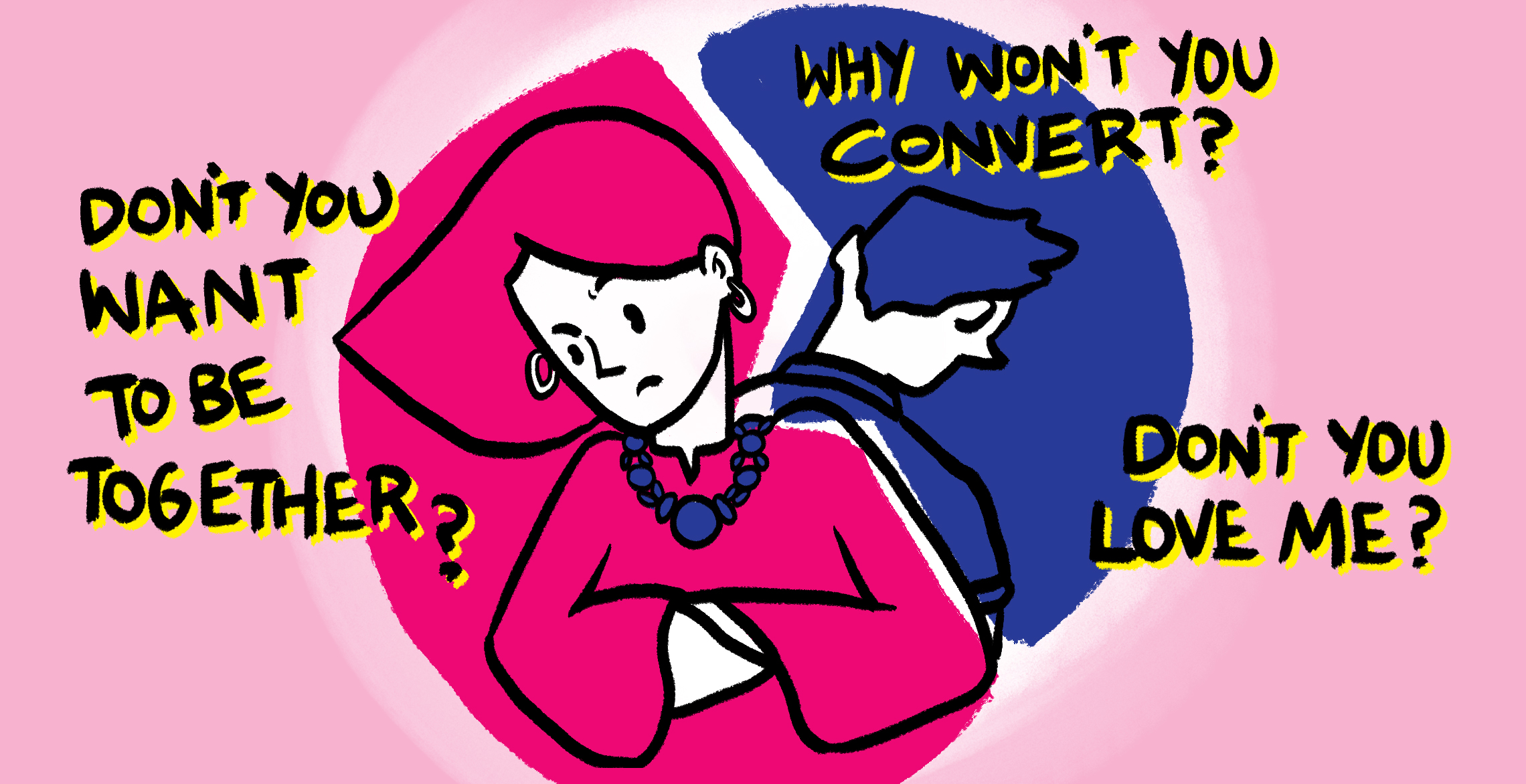
    “Say, if we do get married, do I have to convert?” he asks.

    “Yeah, I guess.” Was my non-committal response.

    “But I don’t believe in it though.”

    “But – what would my friends and family think? People may judge!”

    “I understand but I don’t believe in the religion, or any for that matter.”

    “But- but- what would – If we want to spend our lives together, you would take this into consideration. It would be much easier!”

    “Is this not something we can work on?”

    “I… don’t know… No… I don’t think so…This is what my religion says.”

    “Firqin, it seems like your love will never be unconditional. It will only be on the condition that I convert into Islam…” he said, defeated.

    I fell for a person when I was 22. Naïve, young and a slightly practicing Muslim, I still held on to the idea that when I get married, me and my partner would form the heteronormative, traditional family. I imagined my future self to go back to the “righteous” path, where I would eventually be what a pious Muslim woman is supposed to be. My imagined marriage will be filled with good, pure love and healthy Muslim babies. My husband would be Muslim, not necessarily from the same ethnicity, but definitely a Muslim man. It would be blissful, perfect, easy, and filled with love.

    But Max was not Muslim – celebrating Christmas was the extent of his religiosity.

    At 22, I saw religion through a binary lens and I’m not sure how it came to be that way. Perhaps it was the rule-based doctrine I was fed during religious school. Perhaps it was the polarizing dichotomies (pahala and dosa, haram and halal, heaven and hell) ingrained in me that made me view the world as black and white. Or perhaps it was just blind obedience.

    I had an overly simplified view of what Islam is, how it is practiced, and I was incredibly ignorant to the dynamic and diverse history the religion once had. When it came to my future and marriage, I was certain: my partner had to be Muslim. The culmination of stories I heard over the years did not help. Stories of Muslims and non-Muslims would always end in tragedy. The Malay-Muslim person gets ostracized from their family and their new partner would never be accepted, or there would just be a lot of family members crying. Although I knew that Muslim men are free to marry women from other Abrahamic faiths while Muslim women are not allowed to marry outside their faith, this was not something I questioned, though it did not sit well with me. Marrying a Muslim was normalized to become law. I did not question the law.

    The Malay dramas were not helpful either. Successful romantic relationships were always based on the idea that both partners were working towards loving God or becoming an orthodox, conservative Muslim. There were no narratives that showed inter-religious marriages built on mutual respect, co-existence, partnership and commitment. If there were stories of inter-racial and inter-religious relationships, someone would end up converting into Islam. Hence, the idea of an inter-religious marriage seemed unfathomable and almost blasphemous to me.

    Wisdom came to me only through time and after similar heartbreaking experiences. Max was right — my love was conditional. I was not able to love my partner for the person that they are, the values that they hold, or the principles that they uphold. How I understood religion became an obstacle that impeded my ability to fully experience love beyond my own community, culture and religion. I could never give love freely and love unconditionally without the dark cloud of conversion looming over my head.

    My obsession with the minutiae of religion and how I would be judged by my community, family and friends consumed me. I was blinded to the clear reality that Max was a kind-hearted and loving soul. When I slipped into moments of doubt, he would patiently listen to my inane worries and irrational meltdowns. I was oblivious to the emotional stress I dragged him through and was not sensitive to how intense and difficult it might be for him to constantly have this dangling over our relationship. Yet, through all our arguments and difficult days, he would stay, despite knowing that his partner refused to love him unconditionally with the type of love he truly deserved.

    We later went our separate ways due to other reasons, but I still think of how much I selfishly bullied Max into my religion. I was extremely unfair to him, and blinded to all his good deeds just because he was not Muslim. On hindsight, he did not come between me and how I practiced my religion. Throughout our relationship, he had never threatened to remove me from my faith. If anything, he tried his best to provide me with a safe space to practice it. He respected that I was religious, yet I am ashamed to say he was not afforded the same respect from me.

    *

    It was when I freed myself from the restrictions of what I thought was expected of me that I was free to love without worry. Life is temporary and death inevitable. So I decided to let go of my obsession with religion, and choose to love hard since I cannot love for long. I thought of how I would not have liked it if Max imposed his beliefs on me. I let go of my asinine fear that my future children would not grow up Muslim. Who’s to say I would even be able to have children?  Who’s to say they would stay as Muslims even if they were brought up as one anyway? Also, what good would it be if they grew up Muslims but didn’t have values or a moral compass? I was worrying about things beyond my control.

    As for my irrational worry about how others in my community would perceive me if I married a non-muslim? I did not think it to be too healthy to live my life dictated by the expectations of others. Furthermore, as a 27-year-old woman, they should respect my autonomy to choose whoever I think is best for me to build a marriage with.

    This issue does not only affect inter-religious couples in the Malay community. It manifests differently in different relationships. It extends to intra-faith couples where they face external pressure from their family and peers to find someone not only of the same religion, but of the same sect. Even within the same religion and denomination, religion can still be a deal breaker if one partner thinks the other is not religious enough because of their lifestyle, sartorial choices, or thoughts. When I hear stories like these, I know I am not alone in my struggles.

    Our community’s obsession with the monolithic practice of Islam and how it should play a significant role in our romantic life and partnerships restricts our ability to develop deeper connections with others. It becomes an impediment that has rendered us incapable to cherish others for their true character and worth. If we continue to impose this, and allow it to rule how we love those around us, we might just be on the losing end as we unconsciously build an insular community made up of the same people and mentality. Making religion a deal breaker places an expiration date on the relationship. It forces individuals to rush into the religion, when this is the single journey that requires the most time and patience. Sharing the same religion is not a testament to how much you love someone, nor is it the only path to a marriage filled with respect, love and peace.

    It took years and a conscious effort on my part to get rid of my idealized vision of the future. I had to reprogram the way I approached relationships. It was also the realization that true love is understanding and respecting my partner’s boundaries, what he believes in, what he is comfortable with, and celebrating his freedom to live the way he wishes. Love cannot exist when we do not accept our partner’s boundaries, values, different upbringing and personal faith. Love cannot exist when we disrespect our partner’s convictions and spirit by forcing them to accept ours. We cannot expect them to honor ours, when we cannot honor theirs.

    Now, I can safely say that religion is no longer my deal breaker. Although I do understand that it is a core part of someone’s identity and human experience, it is ultimately a personal pursuit that the individual has to take. It is not something anyone has the right to impose onto their partner. In Islam, we’re required to explore and challenge injustices—and the imposition of religion is an injustice that I recognize, because I am neither giving the other person equal treatment nor respect. Today, I look for patience, compassion, respect and kindness in relationships – the same kind Max had shown me. If we happen to share the same religion, good. If we don’t, it won’t matter to me.
    __

    Firqin Sumartono spends her days analysing speech sounds and conversations in a laboratory. She spends her nights reading nonfiction books that she reviews on her Instagram. Max and Firqin still keep in contact and remain friends.

    Illustration by Ishibashi Chiharu

  • Marriage Is Beautiful, but Only If It Is Done Right

    Marriage Is Beautiful, but Only If It Is Done Right

    Marriage Is Beautiful, but Only If It Is Done Rightby Qis Hakim

    _

    It’s mystifying how Muslim men have succeeded in governing one-sided marital laws for so many generations. Women have conformed to this norm as a way life they have been brought up in. I respect their choices, and I’m in no way complying. We need to pause and take a step (maybe a couple of hundred steps) back, re-learn without prejudices and implement Islamic rulings unbiasedly.

    In its deepest core, I believe Islam is perfect. Hence, it is frustrating when the “Islam” taught to the two people in marriage are two different versions. It’s like they are on different wavelengths despite sharing the same faith. For example, in most conservative families, women are taught to carry household responsibilities which includes managing the children, preparing food, cleaning & laundry, on top of abiding to their husband’s needs, while men are easily considered sufficient if he’s financially abled.

    I would consider my family conservative in many ways, but women in our family don’t all end up as housewives, and it is not a problem. In fact, we strive in education and for the career we dream of. Some men in our family makes lesser contributions in household chores but they make sure their wives get helpers. It’s a clash of ideologies I’ve personally experienced when I was married to a man who believes employing a maid reflects the wife’s inefficiencies, and a woman is not to have an independent career but be placed under the authority of her husband. My father, on the contrary, views achievements in the worldly life to be in parallel with spiritual attainment. So, he made sure that I was provided with sufficient secular and religious education with the hope that I can make a life for myself, and strive for success even bigger than his own.

    Regardless of upbringing and cultural backgrounds, when two people agree to join in a union, they deserve a fresh start in molding the life they share in mutuality. The best thing about marriage in Islam is that we have complete liberty in how to run the marriage as long as it does not go against the laws of Islam, NOT the virtue of culture. Sadly, most men choose to disregard a woman’s paradigm if it suggest changes to the cultivated patriarchal ideals they take comfort in. It’s so strongly held that even working women are still expected to single-handedly carry out household duties and this is very common in our society.

    Let’s not forget that when our Prophet Muhammad s.a.w. married Khadijah a.s., she was a successful business woman, and she was not obligated to drop everything and stay at home following their marriage. She continued her career as it was. Islam highly praises women who choose to devote their life as a housewife, no problem there. But the point here is that a woman reserves the right to decide what she wants to do in her life, as long as it does not breach Islamic rules. So, a marriage is where a man and a woman should come into a serious discussion on how they would manage their life together, consider each of their career paths, and other obligations. Their roles and responsibilities should not be hindered by societal expectations, but agreed upon a mutual agreement, with tolerance and harmonious contribution.

    It is essential for women to be enlightened of their rights not only so that they can have a contented, happy life as a wife, but also as deterrence to abuses in marriage that are so common, that they don’t even realize it. I’ve seen husbands who are not even financially providing for the family, and yet sit still when his wife cooks and clean. There are men who preach about how highly a husband is ranked in Islam, but fails to be good Muslim role model themselves. We have men believing that financial provision is fulfilling his duties with no regards to his wife’s emotional needs. All graciousness to the women patiently endures marital challenges, but men need to stop taking advantage of a woman’s perseverance.

    We have constructed women to duteously accustom themselves to social expectations even if it means forgoing her own needs and personal aspirations. Women are expected to quit her studies or her job once she gets married or have children. There are women not even provided with basic education simply because they are not seen as worth investing in since they will be “working in the kitchen” at the end of the day anyway. This is illogical considering how much women have contributed in various industries, and even in the advancement of technologies. Just like men, women should be given the chance to flourish in what they aspire to be.

    What is even more heartbreaking is to see women bearing oppressive circumstances that goes against the teachings of Islam for the sake of “saving the marriage”. It is not uncommon for women to remain in marriage with sealed lips while their husband is unfaithful. It’s no longer surprising to know a physically abusive husband who has a wife serving him dinner every evening. Women succumb to unhappy marriages for fear of becoming a ‘divorcee’, a tainted label only applicable for women.  These are the results of keeping women ill-informed and letting the man exert his “veto power” in the name of Islam. Marriage is a beautiful unification between two souls, but only if it’s done right.

    _

    Qis hakim is an inspiring entrepreneur and a firm Muslim believer. She was married for love’s sake to a man of a different race, and has since gone through the highs and lows of cultural clashes in a mixed marriage. An emotional & sentimental woman, a passionate jewelry designer, she plans to succeed in both her career and family with her own bare hands.

    Illustration by Ishibashi Chiharu

  • My Marriage Healed Me From Toxic Parenting

    My Marriage Healed Me From Toxic Parenting

    by Sya Taha
    __

    When people ask me how I got married, I say, half-laughing, that my father proposed to the man that is now my husband. I hide behind humour because it is sinister and painful to know that my father is not equal parts benevolently patriarchal and protective (as people would interpret his actions to be), but a man who feels the need to choose his daughter’s partner because she’s too smart/dumb/frivolous to do it herself.

    My father, thinking of his reputation and social standing, wanted me married off as soon as it was possible. Being the middle child with an older sister with a disability (who was thus exempt from many heteronormative norms) and a younger brother, I was the only child that seemed to have any chance of getting married (“before they die” being a psychological tactic they often passed off as an argument).

    In this case, seven years ago, they wanted me to get married, at the age of 25, to the first man I was interested enough to bring home to meet them. My previous relationship with a wonderful, smart, funny, family-oriented Muslim only added urgency to see me married, because the person in question happened to be a woman.

    In comparison, my husband seemed the perfect catch. Not only was he the first man my parents knew of, his Whiteness seemed like an unbelievable bonus that trumped other factors. My father had spoken to me before, with high esteem, of a friend’s daughter who married a White European Convert, and how having their wedding at a mosque proved how Islamic the White European Convert could be. My father would have been pickier with a Malay Muslim man: he would have to be moderately rich, work a professional job, be highly educated (at least the same or more than me), no previous sexual partners or spouses, and deeply and visibly religious.

    Deeply awash with relief upon meeting my husband who had not even completed his legal conversion to Islam, my father uncharacteristically decided to throw the religious factor out the window. One deeply uncomfortable evening when my husband was visiting Singapore on vacation, my father sat us all down and proposed “something small, like the exchanging of rings”. Never mind that ring exchange is a highly charged social ritual symbolising commitment. The point was that he needed total control over my life decisions.

    As a young woman who did not understand then that my father was a narcissist and that our relationship had been toxic for decades, I gave in. Which daughter, indoctrinated with strongly Confucian and Islamic values of filial piety and obedience to parents, wouldn’t want to make her parents happy? Since their love was conditional, I would try my hardest to meet those conditions. If they wanted me to marry someone I had known for only 10 months, I would.

    I was not forced. I could still choose (putting aside debates about agency for now). I thought that engagement would not have much social benefit, as I would still be morally policed from my parents and extended family. I chose marriage instead. I knew my husband would never force me to do anything, and yet I could still conveniently say “My husband says I should ___”.

    A few years later, my brother told me that my father thought I had been co-habiting with my husband while overseas. My father forgot the countless Skype calls from my own apartment, which I shared with an Indonesian girl. The urgency to see me married made even more sense as I remembered one of his ‘parables’.

    I dread car rides with my father because over the years these have been moments for him to impart his wisdom through long monologues which include stories of other people, refashioned as modern-day parables. Once he recounted to me, with much sympathy, the story of his cousin who lived with his Malay-New Zealander children in Australia. Furious upon finding out that his daughter was co-habiting with her White boyfriend, the cousin said, “If I find out where they’re living, I’ll burn the house down.” I assumed my father felt the same way.

    Looking back, I’m not proud of the reasons why I got married. I wanted to make my parents happy without thinking of the costs to me. I didn’t have a regular income, so I depended on my husband for income, a resident’s visa and a work permit to stay in his country. I don’t know if I would have managed to stay in his country for the five years I eventually did, on my own merit. I wanted to have sex with a man, without that very real Muslim sex guilt. He was my first male sexual partner, and while I discovered many things about my sexuality with him, monogamy doesn’t work for everybody. Looking back, I don’t know if I would have even decided that marriage was the right thing for me at 25.

    Nevertheless, now that we have children, I appreciate the legal benefits of marriage the most. I see it as an institution with certain benefits that I have the privilege of enjoying. As a legal family unit with ‘powerful’ passports, we are mobile and can have the choice of living in different countries. I also get to enjoy the social standing of being married: I use my husband’s surname strategically or get him to speak on my behalf in certain situations, and I see a major difference in how the situation is resolved sometimes. Opportunistic? Certainly.

    But these benefits are secondary. The best thing about my marriage is the self-awareness and clarity that I have obtained about how my parents see me, my relationship with my parents, and their relationship with each other. My mother sees the married me as an extension of herself, encouraging me to behave the submissive Stepford way that she did: she advises me to make coffee for my husband, cook what he likes, iron his clothes. “Ugh. It should never even be like this! You make coffee for me, I make coffee for you, because marriage is like that,” was his reaction. My husband finds it ridiculous, abhorrent and wants that I do none of these things out of obligation.

    My father once said to him, “If Sya starts to nag at you, just take a break.” He saw the married me as also an extension of his wife, my mother. He doesn’t know the consequences of his own advice but I do. I was four years old, and I saw my father with a packed duffel bag and a fishing rod. “I’m going out,” he said to me. I walked into the kitchen and there was my mother. “Bapak kau selalu macam gini! Asyik hilang [Your father is always like this. Always running away],” she said, wiping tears away. My sister and I were left behind to mother our mother, something we would keep doing for decades.

    My husband taught me how to communicate healthily. In the first year of our relationship, I used to write him e-mails when I was upset. As my parents punished us for expressing negative feelings, I had never learned to communicate anger, disappointment or jealousy growing up. In situations of conflict, I shut down completely. My parents had never modelled healthy communication to us, so the hardest things for me were expressing my negative feelings, showing empathy for someone feeling sad or angry, and apologising.

    For my husband, these things come naturally and by making a huge effort to change the way I react to these situations, I am also rewiring my brain and changing how I parent my son. It becomes easier each time to express my own fear or sorrow, help my son identify and show empathy for his negative emotions, and apologise when I make a mistake or when I have a bad day.

    I asked my husband what kind of Malay man he thinks I could have married. He had no answer, saying that there was no way of knowing how our lives can turn out if we change just one variable. (Though I think most likely I would be single or single again.) But this I am sure of: if I had married someone who grew up in a similar environment as me, I would have unthinkingly passed on my parenting wounds to my children.

    That is what I am most grateful for: choosing to be and stay with someone who helps me break the cycle of toxic parenting I received as a child. I want to continue parenting my son in different and better ways. Because my husband loves me, I am healed from my childhood wounds. Because my husband loves me, I am challenged to be better for my children.

    __

    Sya Taha is a feminist writer exploring the media representation of Muslim women through race, disability and other intersectionalities. She has an MA in Development Studies from the International Institute of Social Studies, specialising in Women, Gender and Development. She co-runs Crit Talk, a discussion space of taboos for Muslims.

    Illustration by Ishibashi Chiharu

  • Editor’s Letter: Marriage

    Editor’s Letter: Marriage

    by Diana Rahim
    _

    My mum loves to point out the actor Khairudin Saharom every time he appears on TV. Each time she’ll not-so-subtly say something like “Isn’t he handsome? And he’s smart too, you know…” She even found his Instagram account and suggested that I follow him and leave a comment on a picture of his cats; the first step that will eventually lead to a burgeoning romance. Usually I jokingly reply that if she finds him such a catch, she can marry him herself. It’s hilarious, it’s irritating, and to me, it represents how one of the biggest concerns out there for a mother is that her daughter get married.

    The propaganda targeted at young girls to aspire to marriage has failed to work on me. Marriage, to me, is not necessarily romantic. It is unrealistically idealised especially to young girls and women. Two people who love each other committing to a life together? Of course that can be wonderful. But the institution of marriage itself, tied to the state and its resources, riddled with legalities that leave women vulnerable to abuses, and all the difficulties tied to it? Not so much. Make no mistake, heterosexual marriages are still far from egalitarian.

    In fact, the heterosexual marriage has always been such a contested topic precisely because it is the site where many women directly face gendered violence and discontent. Early feminists have even described it as a kind of “legal prostitution”; an economic transaction where the sexual access to her body is exchanged for financial stability. These days, women are thankfully more empowered to seek financial independence, which provides them with more options for a stable life other than marrying a man and limits the possibility of financial control and abuse.

    *

    It’s time to demystify the cult of marriage – the fact is that statistically, single women are more likely to be happier than married women. Married women tend to be unhappier than their partners, and are more likely to be the ones who initiate divorce. And honestly, is it surprising? The problem, of course, is not marriage per se. The problems were already there, it’s just that marriage can exacerbate the problem.

    Consider the Popular Malay Drama. In these toxic popular dramas, women with superhuman patience endure crass, controlling, unkind men, and then end up being married to them, presumably to endure that behaviour for life. The stories may change, but the dynamic remains the same. The woman is expected to be subordinate, patient, and suffer forbearance even as the husband exhibits the emotional maturity of a troubled child. This is what women are told are the virtues of an honourable wife. I can only hope that not too many women internalise this call to withstand emotional and even physical abuse for the sake of “love.” Why is this romanticised?

    What these dramas do reveal, however, aside from the ideal qualities a woman should have if she is to be marriageable, is the fact that women shoulder the bulk of emotional labour in a marriage. Women also shoulder most of the undervalued, unpaid work of maintaining a house, therefore working more hours than their partners, and are more likely to make personal and career-related sacrifices for the family.

    I need to think no further than of my own mother, who while she was pregnant with me worked as a nurse, went home to continue working on the chores, and even after I was born continued to shoulder the bulk of the household labours. The support she received from my father was minimal, and she was so exhausted and weakened that when she was pregnant with my sister, she realised that she had to quit her job in order to cope. This left her financially dependent on my father.

    If I were to look around, I do not see many encouraging, loving marriages. Yet our female relatives in dissatisfying marriages often have no issue encouraging us to get married.. there is something sad about it. Of course, I understand that they would want us to have a better marriage than they ever did. It’s probably why they would often bring a list of qualities we ought to value in a partner (“the love of God” being one of the most highly prized). Sometimes I wonder if they list qualities lacking in their own husbands.

    *

    I feel that it is important too to bring up the topic of marital rape.

    One of the most fervent criticisms of marriage is the vulnerability women face in the bedroom. Marital rape is often dismissed, or even excused under the belief that it is a wife’s “duty” to have sex with her husband. Such harmful beliefs risk breeding a sense of entitlement in men and a complete disregard for the sexual rights of the wife.

    As of now, marital rape is not a chargeable offence in Singapore, and many women do not bring it up. How often does this crime (which isn’t acknowledged legally as a crime) occur? In an article by Melissa Zhu detailing marital rape in Singapore, a counselling supervisor estimated that he sees “an average of five married couples a year where one partner had forced sexual intercourse on the other.” No legal intervention was done or thought possible in all of these cases.

    The issue of marital rape is one of the many ways in which the institution of marriage reveals the disproportionate amount of power and leeway that is given to the husband for gendered violence and abuses. It reveals how society has failed women when something as criminal as rape is not even considered a crime and rarely punished.

    The problem is, I suppose, that marriage is never simply about love. It has only been about love in recent modernity. For much of history, so many marriages were loveless, were based on political or familial convenience, and occurred while the female was still a child. Both of my grandmothers were child brides, as many women of their generation were. Even today, in countries where there are laws that make child marriages illegal, 7.5 million girls are married illegally below the minimum age. For so long, marriage was simply another way that women’s autonomy and sexuality were controlled.

    Change is not going to happen so soon, and they’re certainly not going to happen without some serious contestations of ideas. It will take some serious work to fully shake off the serious problems attached to the institution of marriage.

    Maybe I sound too critical, maybe marriage is about love; if fortifying love is what we truly care about, then I welcome the conversations we should have about how we can have a more respectful, loving relationship where both parties feel valued, and supported. Conversations on how we can ensure that abuses are not tolerated. Marriage courses would teach mutual respect and dignity within the context of a marriage and not perpetuate harmful beliefs on the “duties” of women. There would be some serious discussions on why polygamy is still allowed in Singapore despite the fact that it is a set back for women’s rights, and are barely done for noble reasons. (In a study by Sisters in Islam, 70% of men admitted they did it due to sexual attraction and 87% of children in polygamous marriages report negative and emotional psychological impact due to the experience.)

    Look at any truly loving and respectful couple and you can see how a marriage is not necessarily a problem. Not if your partner is a kind person who won’t subject you to abuses. The problem is if the protections are not there and leave you vulnerable if your partner turns out to be pretty terrible. The problem is if we have yet to unlearn harmful social, gendered conditioning that gets in the way of a truly fulfilling experience of love.

    I mentioned earlier that it’s time to demystify the cult of marriage. But when I say this I don’t mean to say that marriage is ipso facto terrible. That would be missing the point. It’s more about the larger problem revolving around the control of girls and women, the obsession over their sexuality, the great apathy to their gendered violence and discrimination that marriage can particularly exacerbate. The wool needs to be pulled from our eyes so that we don’t fall for the popular, unrealistic, and idealised narratives of marriage as a noble, wonderful goal to aspire to that will bring us happiness when the reality is so different.

    Continuing to perpetuate false expectations and idealised narratives on marriage, and refusing to have difficult conversations about its problems, will only leave more women unprepared for the challenges that may arise. It will deprive them of the knowledge of steps they can take should they face any serious issues. And to be honest, they are still a lot of serious issues tied to the institution of marriage. So let’s talk, and hopefully, this will let us see clearer. Bring your husband along too.


  • Familial Priorities

    Familial Priorities

    by Zarifah Anuar

    I fight a lot with my parents. I think that’s inevitable when you’re an opinionated young adult whose views are a direct contrast to those of your conservative parents, but the most recent argument topic was quite strange to me. It was about time and planning.

    I’m a planner. I have a bullet journal where I schedule everything — work, meetups with friends, family obligations, even my own me time. I like organising my week and knowing what’s in store for me in the days to come.

    My parents are different. They’re not quite spontaneous, not quite planners. They know what they have in the future and sort of just file it away until the day approaches.

    Which leads to clashes that look a little bit like this:

    “Kakak, are you free tomorrow?” my dad would say on a Friday night.

    “No, why?” I would ask, though I know well what it is.

    “Can you ikut [follow] your aunt pergi Johor ambik Atuk?” He would say. He would not sound sheepish, because this would not be the first time. Or the third. Or the fifth. I have lost count the number of times he has asked me if I’m free the next morning to do a four hour drive up to Segamat to fetch my grandfather.

    “I can’t, I’m not free,” I would repeat. I would be trying to stay calm, but I really can’t. “Why didn’t you tell me earlier? She always schedules these way ahead what.”

    “Yeah, I’m just asking,” my dad would retort.

    “You know if you were to ask me, like, on Monday, I would set aside Saturday for this,” I would reply.

    “It’s okay, you’re always so busy. Got friends to meet with,” he or my mother would say, and I wouldn’t miss the sarcasm in their voice.

    “Not always. You know I will always set aside time for family.”

    “No, you will always set aside time for your friends,” either one of them would reply — the ultimate killer line, and it would hurt.

    It hurts because I try my best to put family above everything else, but it gets really hard to do so when I’ve already made plans ahead with friends, and it would be ridiculous to cancel them every time my parents want me to do something for the family — which is, well, every other week.

    Perhaps it’s some kind of generation gap — when my parents were twenty-five they were already married, and life revolved around their families and work, in that order. At twenty-five my life revolves around my work, family, friends, and my hobbies, though the order gets kind of jumbled sometimes.

    There is this expectation that family should hold the same level of importance for me as it did for them. In many ways this is still true, because I was a caretaker for my grandparents when they were in the hospital. I still do take leave to care for them when necessary. When asked, I also try to be involved in whatever big event that’s getting my extended family excited — be it a wedding or a birthday.

    Is that not enough? Perhaps the older generation expects initiative where I can only give participation. And to me, my participation is an expression of my filial piety and love for my family, but to them it equates to family being less important. Less of a priority.

    In today’s society where women are expected to play a myriad of roles and hold an assortment of responsibilities, I find myself lost in what is important, and to whom it is important. To me, family is important, and so is a career and nurturing meaningful friendships. To my parents and grandparents, it would be more meaningful if I were to put the energy I spend on my friends into finding a suitable candidate for marriage.

    Unsurprisingly, the burden of caregiving seems to fall more on women even as more opportunities are opened up to them. We don’t hold our sons up to the same standards we hold our daughters up to, even as we allow our daughters to pursue careers and interests beyond the home and family.

    As a daughter, the definition of filial piety is caregiving: to my grandparents, my parents, and my brother, coupled with the looming shadow of marriage constantly hovering over me. When I say that I’m not looking for marriage and I don’t intend to bear children, I’m constantly told that I will change my mind, that it is in my nature, as a woman, to desire companionship and offspring.

    Even the concept of marriage and childbearing in our community is seen as something that is not personal, but a journey that the family takes together. You don’t just marry your partner; you marry into their entire family as well. Similarly, you’re not just carrying your child, but also your parents’ and in-laws’ grandchild.

    With this mindset it’s easy to assume that every woman’s life should follow a certain template, especially with the exciting expectations that come along with certain milestones such as marriage and pregnancy. Even with the myriad of opportunities available to women now, filial piety in the form of caregiving, marriage, and bearing the next generation still seem to be expectations that are highly valued by the family and community.

    Some time back I shared with my grandmother that one of my second cousins was getting married. She was overjoyed, saying, “Alhamdulillah, untung mak bapak dia, sekarang dorang boleh relax, dia boleh jaga.”

    It left me confused. Won’t getting married mean that she would have even less time to care for her own parents, because now she would also have to care for her in-laws and husband as well? And once she has children, won’t that increase her caregiving burden even more? Why is marriage seen as something necessary for a woman to go through in order to ‘level up’ and be an even better caregiver?

    One of my role models growing up, and to this day, is my aunt. She isn’t married, but has an amazing career and is the main caretaker of my grandparents — all of which I aspire to be when I am older. She recently shared that the reason why she didn’t feel particularly burdened by expectations of marriage was that her mother never imposed such expectations onto her.

    Perhaps, that is what we as women need from each other — freedom of burdensome expectations, and validation of our own desires and aspirations. When I look at my aunt all I see is an ideal portrait of my future, when in another’s eyes it would be pity. But why? She is an independent, successful, filial, religious woman. So why would lacking a husband and a child make her seem less to others?

    _

    Zarifah Anuar is a writer, graphic designer, educator, and a volunteer with AWARE and Gender Equality is our Culture. She also co-runs Penawar, a support group for women with religious trauma.

    Illustration by Ishibashi Chiharu

  • The Price of Love

    The Price of Love

    by Zubaida Ali

    My son has found his one true love at the age of 28. She is a delightful young university graduate, who is the perfect match for him. There is talk of marriage and the traditional ‘masuk meminang’ event that has become part of our Malay culture. With it, is the inevitable discussion of the hantaran that is the amount that we, the groom’s side is willing to set as the dowry for her. Her family decided that $10,000 is a good sum that goes with the prevailing market rate as she is, after all, a graduate. As the mother of the groom I find the concept of ‘paying’ for a daughter-in-law disturbing and against my values of equality and feminism. While the young woman in the center of this is inclined to agree with these values, she is caught in the filial piety she has for her parents. She will not broach the subject of breaking away from such norms.

    What is the dowry meant for anyway? To compensate for the expenses that the parents have invested in the person we are marrying into our family? To give the couple a positive head start in life? If that is the case, then the couple should get to keep the hantaran but that is unheard of. Usually the hantaran goes into a black abyss and is pocketed by the bride’s parents. Apart from the hantaran or dowry, there is the mahar or maskahwin, in the form of a piece of gold, like a ring or chain, as a symbol of their marriage. This is sunnah, just like what the Prophet has encouraged Ibn Ali to give to his daughter Fatima before marrying her. And finally the wedding expenses itself, that the wedding couple is supposed to bear. Since the bride has only recently graduated and is jobless, the task of coming up with the wedding expenses falls on the groom, a bill that comes up to $40,000 for a typical Malay void deck wedding.

    So far this is what the costs look like:

    Wedding expenses

    Dowry/Hantaran: $10,000
    Mahar/Maskahwin: $2,000 (est.)
    Wedding expenses: $40,000
    Mak Andam (makeup artist) and costumes: $5,000

    Total: $57,000

    This does not include the romantic honeymoon that the soon-to-be-wedded pair would like to go to after their wedding ceremony, another bill that could come up to $5,000. Neither does it include the token sum to the kadhi for performing the nikah ceremony. Gifts in the form of money to the ‘pengapit’, groomsmen or wedding party before getting on the pelamin or wedding dias and so on.

    A financial output of between $50,000 to $60,000, three times the cost of a degree education is what it needs just to get married in Singapore.

    Of course, the couple need not go through such financial hoops to get married. A simple nikah ceremony in a mosque with a modest reception for family members, with a mahar of a few recitations of the Al Quran will do too. However, the family my son is marrying to, is one steeped in local Malay culture and “it is what we are used to” has been set up front during the wedding negotiations attended by delegations of aunts and uncles from both sides.

    My heart goes out to the young people from our society today faced with these challenges in order to start a family. This pressure is worrying and has the element of ‘keeping up with the Joneses’ that has become prevalent in our culture today. It is time for members of our society to speak out against such trends and emphasise what really matters — the overall readiness and wellbeing of couples intending to set off on this marital journey together and the support that the community could give. Now that will be a wedding gift worth giving.

    __

    Zubaida Ali is a community worker, mother of four grown up children and activist on social issues. She occasionally writes on relevant issues pertaining to the Muslim community.

    Illustration by Ishibashi Chiharu

  • Never Enough

    Never Enough

    by A

    The first time I told myself I wasn’t enough, I was 10 years old. It was my birthday.

    It all started out so simply. My family went out to celebrate my birthday at the cinema. We were going to watch Transformers: Revenge of the Fallen at around 2pm, so we decided to grab some lunch at Swensen’s beforehand. I’m not entirely sure what happened next, but what I do remember was that in the middle of the movie, my father got up and never came back. Everyone assumed he went for a quick bathroom break, but when the movie ended he was nowhere to be found, and we went into a frenzy. We searched all over the mall but to no avail; eventually we headed home only to find that he had been there the whole time.

    I recall receiving the scolding of a lifetime from him that night. Apparently, he had called for me the night before and I had not answered, so he decided to do the same to me so I would understand how he felt. In hindsight, that was probably not the best way for a grown man to teach his daughter a valuable life lesson since it further reinforced the idea that everything was my fault. 

    When I was younger, my father was always in a bad mood. My mother used to say that he was just tired and grouchy – that’s just how he always is. She was probably trying to protect me from his wrath, but you can never fully protect the curious fool that tries to find out the truth. We rarely saw him during the day because that was when he would come back from work, exhausted and in dire need of rest. He was only awake at night so I would try to bond with him then. I did everything I could to make him happy; I consistently got good grades, researched on his topics of interest just so I could talk to him, I made sure to do all my chores, tried my hardest to include him in family activities but alas, things don’t always work out the way you want them to. Despite my efforts, I was still the target of his anger and my sister was still favored over me. It was almost as if my efforts were not enough, as if I wasn’t enough. 

    As time went by, things only got worse. He started getting angry over the smallest things, going into a blind rage over matters that others consider insignificant. Sometimes he would threaten me or my sister; usually they were not carried out, but on the rare occasions they were, the whole house would go still. It didn’t matter if he was just taking away our allowance or our internet privileges, the look in his eyes said it all:

    “If you do this again, it’ll be worse.”

    I vividly remember an incident that changed my life. I don’t exactly remember what I did or what happened, but I know this – it was the first time my father had gotten extremely close to slapping me but stopped short. Sure, my parents may have caned me as a form of discipline; but slapping is an entirely different matter. I had never seen my father so furious. I was sure that this would be the end of the line for me. I’ll never forget his words – “You’re lucky I don’t slap you.”

    Since that day, I began walking on eggshells around him for fear that he might do something even worse than just slapping me. Little did I know that this was merely the beginning of my living hell.

    Now, if you can imagine how I was constantly treated by my father based on the above anecdotes; you’re in for a treat. When I was diagnosed with rapid cycling bipolar disorder, my father was less than thrilled at the idea that his over-achieving shining star was suddenly broken. He was in constant denial up until my suicide attempt, where he just broke down and told me that he just couldn’t believe I was broken. Due to his words, I stopped taking my medication not long after seeking treatment to prove to him that I didn’t need chemicals to be normal; that I could fix myself. Obviously that backfired horribly. Instead, I was publicly humiliated by him in a parking lot and in the heat of the moment he uttered “I regret getting your mother pregnant with you.”

    It shattered me to hear that. My mother once told me that when I was born, my father was the happiest man on the planet. To hear him say those words felt like someone ripped my heart in two. I imagined him smiling and laughing as he picked me up and held me in his arms, and that mental picture just didn’t fit with the man standing in front of me. My father wouldn’t hurt me, he couldn’t. And yet he did. I wanted to cry in that instance but I did my best to hold back because I didn’t want to appear any weaker than I already was in front of him.

    He went on and on about how I didn’t deserve to feel the way I do because others have it harder, and did I know how much of a financial burden I was? How ashamed he was of me for being mentally ill? To put it simply, he basically said I was worthless and he never wanted me. Now, people struggling with mental health issues shouldn’t be dealing with others hurling abuse their way when they are already fighting a war being waged in their own head. I can’t stress enough how important it is for people like me to be surrounded by an understanding support system. I think if my father reacted differently to my diagnosis, it would have saved him a lot of money and spared me a lot of time and pain.

    Later on, I learned from my mother why my father is the way he is. When he was younger, my grandfather used to favor him over the rest of his siblings and my grandmother was jealous of him. She thought that he was stealing her husband’s affections so she mistreated him in any way she could. Right now, my father is behaving in the exact same way my grandmother did when he was my age. Additionally, according to my grandmother, she was also mistreated by her stepmother when she was young. This is a vicious cycle in my family that has to end somewhere. I hope that I’m the last victim because no one deserves to feel this way about themselves, I hope my child gets a better father than I did. Truth be told, there’s a part of me deep down that understands and empathizes with what my grandmother and father went through. However, this doesn’t negate their hurtful actions towards others, including me.

    As a result of my experiences, I have developed an unhealthy co-dependency with my father. I value his opinions of me highly and derive almost all of my validation from him. On top of that, there isn’t any emotional boundary whatsoever between the two of us; so I feel every single one of his emotions and I worry about his problems when I’m not supposed to. I enable him to remove all responsibility from himself and put it on me which is terrible, might I add.

    Having said all this, my father isn’t actually a terrible man. In fact, I think he’s doing what most parents are; he’s just doing the best he can with what little he has. Not everyday is a nightmare for me. Sometimes he treats me like the little girl he’s always wanted and other times he’s downright mean. As a result, I never really know whether to love or hate him. I constantly feel conflicted about my feelings towards him but I am still what most would consider an obedient daughter.

    On the other hand, both my mother and sister exist outside of the obedient box that a lot of Malays tend to put women in. My mother has always been very outspoken and when she got married, she never really mellowed out so when my father started mistreating me; she immediately confronted him about it. She’s not one to bend over backwards just to please her husband because she believes that a woman’s worth comes from herself, not from anyone else. She was always there to encourage me to pursue my interests, no matter how unconventional they were. It didn’t matter to her whether or not her husband approved of her actions, as long as we were comfortable and happy.

    Despite dealing with mental health issues herself, she always made time to talk to me, especially if it had anything to do with my father and for that, I couldn’t be more grateful to have her in my life. She told me that the reason why she believed me every single time I came running to her was because she wholeheartedly believed that children were a trust from God, they were meant to be taken care of.

    Although my mother maintained a great relationship with her children, her marriage isn’t exactly what you would see in fairytales. Growing up, I saw a lot of arguing between my parents and there were many a time where I thought they were going to get a divorce. I also noticed that unlike other people’s parents, mine didn’t actually interact. It was almost like they were actively trying to avoid each other, yet they still live in the same house and sleep in the same bed. Just as my father was unsupportive of me, he also didn’t support my mother in her times of crisis and as such; she wasn’t surprised at all when he did the same to me. Seeing my parents’ marriage fall apart right before my eyes is probably the reason why I have a hard time trusting anyone, because I know that the people closest to you are the ones who are capable of hurting you the most.

    I used to believe I was alone in my pain until I confided in a few individuals and realized that this behavior among parents, especially fathers, is more common than we realize. I have a theory regarding this. Most boys are raised believing in the lies of toxic masculinity. They grow up being told that having feelings beside anger is wrong and the only way to show affection is through aggression. Eventually when they have a family of their own, they become dysfunctional parents because they don’t know how to love their children safely. Too often, we see this type of behavior excused in Malay dramas because ”he’s your father, no matter what you have to forgive him.” Yes, he may still be my father and yes, I still have to treat him with respect, but nowhere does it state that I have to forgive his wrongdoings immediately. Let me grieve over the father I never had and heal and forgive at my own pace.

    Nowadays, I cope mainly by going to therapy and figuring out my own identity separate from my father. I am still filled with fear and dread whenever I have to interact with him or members of his family, but I just put on a big smile and power through no matter how drained I am. However, I try to limit talking to him because I’ve learned that you have to love some people from afar and that’s okay. Maybe one day things will be different, but until then I’ll continue with life and continue praying that he’ll have a change of heart.

    _

    A is an ever curious 17 year old student living with rapid cycling bipolar disorder. Her zealousness in life and love for all things pink are the first things people see; but peel that back and you will find creativity and empathy hidden inside. Her only wish is to better the world, one way or another.
    Illustration by Ishibashi Chiharu