Category: Blog Series

  • Editor’s Letter: South Asian Muslims

    Editor’s Letter: South Asian Muslims

    by ‘Afifah Shameemah

    __

    “They call us crows; black, ugly, noisy. ‘The crows have descended’, they’ll joke among themselves.” – M. A.

    A friend, M, reached out to me to share her experiences as an Indian Muslim woman in Singapore through an insightful yet disheartening email. Much like her, many other South Asian Muslims have taken to Social Media to share their personal experiences with racism in the Muslim community.

    My own earliest recollection of a racist encounter was as a 10-year-old. I had to wear slippers to school with my baju kurung uniform because I had a toenail injury. A teacher called me out when she saw me and said something along the lines of “Jangan pakai selipar macam gini. Nampak macam anak keling.” (Don’t wear slippers like these. It makes you look like an Indian child). I didn’t know what to tell her. I am Indian, and proudly so, but at the time, I thought that I shouldn’t tell her because she sounded so condescending, like being Indian was a bad thing, and I didn’t want to be treated as less than.

    My ancestors are Indian and they married into Malay families when they settled down in Singapore. I am more in tune with my Malay roots than my South Asian ones, with my mother tongue being Malay, my social circle being consisted of primarily Malays, wearing traditional Malay clothing, partaking in Malay cultural practices and etc. For this reason, I am privileged in a sense where I can pass off as Malay and fit into the Malay community, the race that makes up majority of the Muslim population in Singapore. But from time to time, I get racist remarks from the people around me about my dark(er) skin, my ‘angry’ and ‘unapproachable’ demeanour, loud voice and my temper – traits people associate with being Indian. I believe that this is a shared experience many other Indians feel because we no longer fit into the CMIO model so easily.

    I was incredibly honoured to be invited as a guest editor for this edition, but I was honestly contemplating whether I should take up the offer. Some people think that I am not ‘Indian enough’ or that I’m not a ‘real Indian’ because of how disconnected I am from my Indian heritage, which means that I don’t have the right to speak about the complexities of being a South Asian Muslim in this country. But what pushed me to do this is my privilege. I am privileged enough to be accepted by the Malay community as a Malay while at the same time being tethered enough to see and understand the marginalisation South Asians face, even if my personal experiences haven’t been ‘extreme’.

    The objective here is simple: To provide a platform where we can amplify the voices, experiences and concerns of South Asian Muslims, the minority within the minority, if you will. Hopefully this experience can be liberating and cathartic for our fellow South Asian Muslims. Beyond that, hopefully, after listening and reading, we can work towards positive changes by reflecting on our personal prejudice, internalised racism and even systemic injustices that oppress our own Muslims.

    This series is dedicated to South Asian Muslims, people of Afghan, Bangladeshi, Bhutanese, Indian, Maldivian, Nepalese, Pakistani or Sri Lankan origins and/or decent. It was imperative that we used the term ‘South Asian’ instead of just ‘Indian’ because one of the most common forms of microaggression is the racial grouping of all brown people as Indian, when in actuality, the variety of ethnic groups in South Asia goes beyond that. When any individual insists that all brown people are the same (read: semua pun sama: India), they are invalidating and disrespecting the origins, heritage and ancestry of South Asians, the differences that distinguish their cultures and their diversity, even if there are some similarities.

    This microaggression is not only seen in day to day experiences, but in media as well. It is important to acknowledge the existence of this casual racism in mainstream media because media has a big role in influencing the masses, especially those who are not exposed to the racial diversity of South Asians. Let’s look at Disney’s rendition on Aladdin.

    While they took steps to be more mindful of racial complexities in the 2019 version as compared to the 1992 animated film, there were still many instances where they mixed Middle Eastern culture and South Asian culture. Granted that these two cultures may have influenced each other to a certain extent due to some of our shared history, there are still very stark differences between the two that should not be cherry picked at the convenience of white producers for entertainment. Between the dance scene that was clearly inspired by Bollywood dance numbers to the clothing worn typically by South Asians (not Arabs), the movie being filmed in Jordan and the casting of both South Asians and Arabs, the movie lumped many different races and cultures into one: Exotic Browns.

    While the racial diversity of the cast was admirable, we have to ask: why? Was the cast racially diverse for the sake of appealing to people to reap a larger audience or was it for the sake of empowerment and representation? How can we claim to appreciate and respect different racial groups, diversity and cultures when we don’t even bother to learn and portray their differences properly? If proper representation wasn’t the goal of creating these movies, what is? Entertainment? At who’s expense?

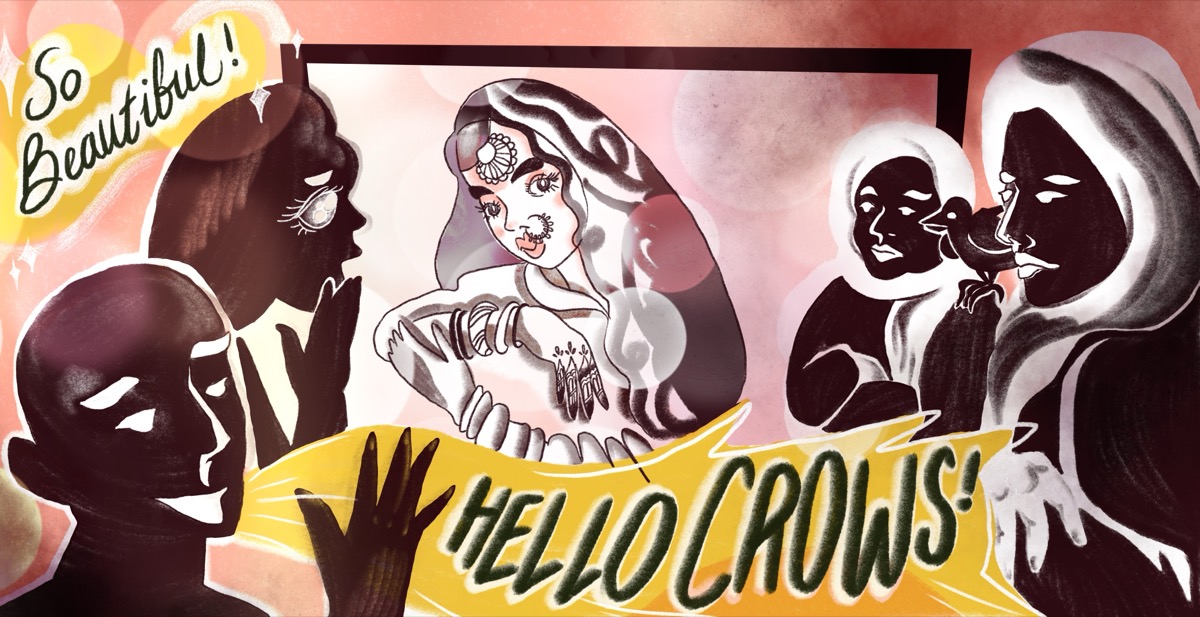
    For a more localised context of the portrayal of South Asian culture in media, let’s look at Malay social media. In recent months, a Malay celebrity/model advertised for contact lenses by donning the lehenga, a large nose ring, bangles, with henna on her hands while lip syncing to a Hindi song. This was inspired by her appreciation and fascination for Bollywood films. Many questions were raised from this incident: Is this cultural appropriation or cultural appreciation? Is this fetishizing South Asian culture or is this appropriate for a multi-racial country like Malaysia and Singapore? In his Facebook & Instagram posts, writer Alfian Sa’at asks three important questions: Where do we draw the line? Who gets to draw the line? What would our country be like if we loved South Asians as much as we love their movies, food and fashion?

    Perhaps in this case, the intention of the model and the company should not be put under scrutiny. Perhaps what is more important is that we ask the bigger questions like as part of the majority, how does one show appreciation for a culture that is not theirs? Is it enough to appreciate the culture and their people simply through wearing traditional costumes and eating their food? Do we go the extra mile to speak about difficult topics and address the racism within our own communities to truly be allies and supporters of South Asian people? How can we do better by South Asian Muslims in our countries?

    The issues faced by South Asian Muslims in Singapore is a non-exhaustive list. While it is simple for me to sit down and write about the struggles we face, I hope to remind people and myself that the experiences of our contributors should not have to be here for intellectual discourse. These are their lived realities. I urge readers to read their words, internalise them, ponder on the questions asked and think of how we can do better as part of the majority so that the lived realities of South Asians can shift away from what it is in our present day.

    ___

    ‘Afifah is an aspiring Social Worker who is passionate about Social Justice and holding up safe spaces to discuss anything and everything for anyone and everyone.

    Illustration by Ishibashi Chiharu

  • Wearing the Hijab at Work

    Wearing the Hijab at Work

    The Tripartite Alliance for Fair & Progressive Employment Practices (‘TAFEP’) is currently investigating an incident in which a hijab-wearing woman (‘hijabi’) working as a promoter at Tangs was asked to remove her hijab. Tangs had initially taken the position that this was a case of miscommunication regarding the company’s dress code and grooming standards to the sub-contractor. However, this incident is bigger than a simple issue of communicating guidelines and is part of a larger pattern of discrimination and exclusion that hijabis often have to endure in the job market.

    Hijabis often face barriers when applying or interviewing for jobs and have anecdotally reported that they are sometimes passed over for opportunities because of their headgear. Even when they are offered jobs, the hijab is subjected to added scrutiny and judgement over whether it is considered “professional” attire. This has material impact on hijabis when they are denied jobs because of their appearance, feel obliged to defend their choice of clothing or lifestyle, or have to expend more energy to overcome implicit biases of their colleagues or employers.

    It is also worth interrogating why the instinct was to assume that the hijab is seen as “unprofessional” or even subject to be scrutinised in this first place. What are the assumptions about the hijab and those who wear it that need to be questioned and unlearned? Are hijab-wearing women any less educated, committed or capable than their counterparts?

    Employers or policymakers who offer explanations that the hijab and other religious garments cannot be allowed because Singapore is a secular country signal that personal religious garments pose a threat to our secularism in some way. These justifications frame the hijab as a political issue rather than a personal religious choice and serve as a basis to validate policies which unfairly discriminate against hijabis.

    Policies which discriminate against any minority groups, and Muslim women in particular, extend beyond the harm caused to the individual in question and has the effect of further entrenching the marginalisation of these groups. The reality is that many Muslim women, when faced with this dilemma, elect not to take up opportunities or choose to leave their jobs rather than to give up on what they see as a crucial part of their religious obligations. Creating space for Muslim women to wear the hijab at work would encourage greater participation in the workforce and in society, without forcing them to choose between practicing their religion and earning a livelihood.

    We are encouraged that TAFEP is seriously investigating this incident and urge other women to seek support if they face instances of discrimination at the workplace because of their religious beliefs. If you are facing or are aware of any such discrimination, you may make a complaint to TAFEP, or consult AWARE’s Workplace Harassment and Discrimination Advisory.

    Hijabi women should be allowed to practice their faith without being discriminated against. Until we have comprehensive anti-discrimination laws in the workplace, it is up to us to look out for each other and call these instances out when we see them.

    —
    Edit: Tangs has recently issued statement that it now intends to allow all front-line staff to wear religious headgear. We encourage all companies to similarly review and revise any policies which unfairly discriminate against Muslim women or any other minorities.

  • Hope Is The Light of Kindness

    Hope Is The Light of Kindness

    by E

    __

    [CW: This post describes the aftermath of rape, its emotional impact of rape & experience of intense victim-blaming.]

    What is Hope, you ask? Hope is Love personified. Hope is Kindness acted out. Hope is a Friend, and a Lover, who offers compassion unconditionally. Hope is everywhere if we simply allow it to be.

    I learned to love again, and along with it, the idea of hope became less elusive, allowing me to learn to live with the cracks in my heart. As long as it keeps on beating loud and proud. 

    I am a (gang) rape survivor. I can say that now, ten years after that night. 

    It started with a tequila shot and ended with me waking up naked in an empty bed and my clothes all over the floor. Next to the bed, my black Guess handbag was intact and zipped up on the bedside table. I reached out to check my mobile phone and saw multiple texts, and a few missed calls. I stood up and picked up my clothes from the floor. I did not remember what went through my mind. I only remember that I wanted to leave as images started to form in my head.  

    I pulled up my jeans and realized the zip was broken and the button was nowhere to be found. I remembered thinking to myself, now that is a good thing, isn’t it? Clearly, I must have struggled. 

    I went down the stairs of the two-story building and found a familiar face by the door, asking me if I was fine. He walked me out to show me the way to the nearest bus stop so I could get home. I insisted for him to have a cigarette with me. In truth, I was starting to realize the fear that was creeping up in me. I was starting to remember. 

    Days, weeks and months after, I was fumbling around in a hopeless place. I was literally living in a home where spiteful remarks would be made by a man who did not know how to be a father to a rape victim. I believe I was coerced to drop the police report I already wrote. “No one is going to believe you”, the police said. “The process may take months or even years, adik, please think carefully and consider what your dad is saying.” 

    As a Malay and Muslim girl, I was made to reflect on my “bad decisions” instead, and how much shame I brought to my family. I was made to feel so much guilt for disappointing my late mother who was (still is) my light and my soul. 

    At nineteen, I could not fight. I swallowed every single accusation, every insult, every degrading word thrown at me for already losing my virginity anyway, and worst of all, for getting so drunk I could not protect myself! Tak ada maruah betul!

    “Just move on. Be strong. Redha sahaja la. God will guide you back again. Show remorse and you will be forgiven. Taubat je la.” 

    Words thrown to me so carelessly, words that only served to dig a deeper hole for me to climb into. 

    Words that I consumed and allowed to define me. I grovelled so hard to find a sliver of hope, that silver lining in a shitty predicament. 

    Over the next three years, I coped in several different ways. I even “turned to God” and made a hundred-eighty degrees change to my physical appearance – donning the hijab and covering my skin just to feel a little safer. In hopes that it will help me redefine who I am.

    Three more years passed, and all I felt was more disgust. I did not feel comfortable putting on a persona, trying to be “more Muslim”, in a world where being Muslim means I have to always be reminded of my shameful past. Every Muslim has her/his own experience of turning to Islam in Singapore – mine was not liberating. I felt suffocated more than ever. 

    I also learned from a beautiful soul that the One & Only Creator is Most Merciful, and that “there is no compulsion in religion.”

    And soon after that, came the realization of who I am. A Malay-Muslim woman who can write her own story, her own life regardless of what the Malay and Muslim communities may think of me. I had to pick my battles. 

    I am already fighting a demon in my mind, the voices of my past. 

    Now in 2020, I must say that Hope had appeared to me, in an echo, a voice that kept whispering into my ears. A whisper that got louder over time. A familiar whisper telling me that there is no shame in being broken. A damaged thing can still be precious. That damaged can describe a whole range of things, from being attacked by cancer to being gang-raped. And most importantly, that hope can exist in an imperfect reality. 

    And that hope persisted. In the voices of others who offered a listening shoulder or an empathetic ear. I found strength in living with the ugliest parts of my life. The vilest of experiences. Yet these experiences do not need to define who I choose to be.

    And now I would like to share Hope with the whole wide world. There is no shame in building solidarity. In asking for help, in screaming out loud for Hope. Every victim, every survivor, knows it. Even with the #METOO movement, Hope can still seem far out there. But it is there. Let me remind you that Hope is alive.

    __

    If you or someone you know is facing partner/domestic violence don’t hesitate to call the Women’s Helpline at 1800 777 5555 (Mon – Fri, 10am – 6pm, excluding PH). If you are facing any kind of sexual violence, call the Sexual Assault Care Centre (SACC) hotline at 6779 0282 (Mon – Fri, 10am – 6pm, excluding PH) or email sacc@aware.org.sg.
    __

    E is turning twenty-nine this year and she lives on, the only way she knows how—by wearing her heart on her sleeve.

    Illustration by Ishibashi Chiharu

  • Light with HIV

    Light with HIV

    by Hannah
    __

    In November 2017, I was diagnosed with HIV. When I was first diagnosed, I couldn’t believe that I was positive. My mind went blank. All I could think of was that I was going to die and that it was the end of my life. From what I knew then of HIV, it was an infectious diseases and scientists have not found the cure for this illness. I didn’t know about the survival rate of HIV-positive persons.

    I decided to go for treatment because do I have even a choice? If I don’t undergo treatment, my health will get worse and I don’t want to be in tremendous pain anymore.  My counsellor at DSC Clinic was the one who told me that I’ve got to go for treatment even though there’s no cure yet. They said that there’s still hope, I can even have my own family if my viral load is undetectable. My doctor also gave me encouragement not to miss my medication. 

    The first person I told about my diagnosis was my husband. When I started having the symptoms of HIV, I told him that I was worried that I was always falling sick easily and frequently and had to go for a thorough check-up. But he told me that I shouldn’t worry because it just a normal flu and fever. I believed him, but then my condition worsened.  

    I was hospitalised for one month after I was diagnosed. The consultant who was in charge of my case at that point of time was the one who informed me of my HIV status to my sister-in-law. When they got to know, my dad and brother looked so worried and felt pity for me. My other family members reminded me to take my medication. I guess they must be thinking of why I have to go through such pain. But I don’t need their sympathy, I just need their understanding. I don’t want other people to judge me for my condition. I don’t want them to blame whoever who gave this illness to me. It will just make me sadder. But so far, they have tried to be mindful when they are with me. 

    When I found out I was positive, I was not in the right mind. There was a lot of things happening in my life at that moment. I found out that my husband was having an affair while I was so sick at home. I was worried about my future that had been destroyed. I had thoughts of ending my life.

    I felt constantly alone. It’s because I’m the only one who went through all this pain. Others might see the pain but they can’t understand how I feel to have this illness all my life, to remember to take my medication every night without fail, just to keep me alive.

    But when I think back, I realised that I still have people who love me and that makes me more motivated to continue with my life.  My sister-in-law and my godsister are my pillars of strength. 

    My first pillar of strength is myself. No matter how hard life is, I’ve got to be strong to continue my life for my loved ones. I believe God give me this illness for a reason. I have accepted my fate. I must think about others who I care about. I don’t want them to get my illness. I have to be responsible about my illness. 

    Being in this society that still has misconceptions about HIV, I can’t talk openly about my status to anyone. I try not to talk about it. At work, it’s physically tiring for me as I work as service crew. I try to push myself slowly and think that I’m a normal person. But I can’t take things lightly when I have cuts or open wounds. It might be a danger to other people who are not aware of my health condition. I try to be socially aware of my surroundings.

    I used to keep quiet when people talk about HIV with their misunderstandings as I think I don’t have the power to do anything. But I want our society, especially my Muslim community, to learn and understand more about HIV. That’s why I decided to share my story.

    We need to educate and have more awareness campaigns regarding HIV in Singapore. We should also have charity for HIV+ persons who need support. We always hear about charity or donation drive to help the cancer patients, kidney failure patients and heart disease patients, which is great and important, but what about people living with HIV? Are we going to be bogged down by our expensive medication and frequent medical check-ups? Are we not worthy of community support too? 

    Before I was diagnosed with HIV, even I had misconceptions about the illness because there’s not much awareness about it. And this is still the case when people keep asking me questions like: Can the virus be spread easily through saliva? How long can we live? Can people living with HIV socialise openly with other people? 

    I am sick and tired of answering the same questions over and over again. I am not here to educate you. We are living in a time where all the information you need is at your fingertips. Please inform yourself of HIV and don’t spread fake news. 

    For employers, especially in the F&B sector, hospitality and customer service sector, they should not discriminate against people living with HIV. For these sectors in particular, we must go through a health check-up before being accepted and it is very demoralising and hurts our self-esteem and self-confidence when we are rejected from jobs and being discriminated just because of our health status. Employers must educate themselves on HIV and not just easily believe myths and misconceptions. Employers must understand and regard people living with HIV as normal human beings that also have feelings. 

    Last year, the national HIV registry was leaked. I hope this doesn’t happen again and hope that the government will tighten its privacy securely in the future. This leak of sensitive information should never happen again. 

    Currently, I am hopeful because my health is better. My doctor said my condition has improved. I only have to go for my check-up every six months compared to when I was first diagnosed which was every 3 months. I fall sick lesser. 

    I am slowly able to accept the reality that I have this illness. I have stopped blaming the person who gave me this illness. I’m trying to live my life like a normal person even though it’s hard as the medication is a constant reminder that I am sick. 

    Now that we are in the middle of the COVID-19 pandemic I’m not sure how COVID-19 will affect an HIV positive person like me, but I’m feeling okay. The other day, the nurse called me up to postpone my next appointment for my blood test, maybe so that our healthcare system can focus on fighting the virus. It’s okay, I’m willing to do my part to help. I still have enough supply of my medications for a few more months so I’m all set and hopeful for a brighter and joyful future. 

    Please visit the resources below for more information on HIV:

    Married women also at risk of HIV/AIDS

    People Living with HIV | Can Ask Meh?

    What do you really know about HIV and AIDS?

    DSC Clinic

    Action For AIDS

    __

    Hannah enjoys reading, writing and travelling. She is also an aspiring writer. 

    Illustration by Ishibashi Chiharu

  • awan

    awan

    by Tysha Khan

    _

    the lone cloud
    small and proud
    pulls away from her nest
    in search of her own path.

    she feels herself leaving
    thinking she is now
    her own body

    while the wind gently pushes her
    along a journey
    that changes the way she is seen.

    her edges soften
    less defined
    as she learns to breathe herself
    into the endless sky

    she does not notice reaching out
    until gently, she slows,
    touched by other clouds expanding.

    the resolute cloud
    has travelled halfway across the sky
    to find herself gently held again.

    her heart is full.
    she turns to rain.

    a new cloud drifts
    across the bluest plain.

    _
    This poem was conceived a long time ago when I was feeling kind of alone and lost. I forgot where exactly I was, but at that moment I was watching the clouds. There were huge, huge clouds, the kind that painted the whole sky from the horizon, somewhere on the left and right. Then there was this one tiny tiny cloud, that was so round and solid. It was like a little animal, and it was speedily crossing the space between these two giant clouds. I was very impressed with how resolute it seemed and was moved to write about it.

    As it moved it became less and less compact, more wispy, and had more tendrils. Before long it stopped when it came too close to the wisps of the big cloud on the right. Then slowly, it became part of that cloud. Everyone will have their own take on this sight.

    As I wrote, I found that I was touched by both its solitary nature, and also when it ended up converging with the other clouds. I thought about how people break away from where they were raised and the things they already know to see what else there is out there. How that journey may change the way we see things and change the person we are. How we find what we want to do and the community we want to be a part of. How the whole time we think we are alone, community is still around us to buffer the strong winds and keep us safe.

    I think now, more than ever, community solidarity is important. For example, we saw how the Malaysian workers who come to Singapore in search of better opportunities were left stranded when the lockdown came into place. They may have left the big cloud of Malaysia, thought themselves alone, and willing to rough it out, sleeping at MRT stations. Then people reached out to offer them shelter and help. They found community in each other, and also found that the big cloud of Singapore chose to hold and help them in this trying time.

    I think inherently, many people want to help and be kind to one another. I am glad that often, I am proven right.

    __

    Tysha is a Singapore-based actor and writer. The first Malay-Muslim woman to graduate from the Intercultural Theatre Institute, Tysha hopes to create theatre that effectively captures the culture of her community. She also aims to keep making and performing work that explores different facets of identity and delves into societal issues.

    Illustration by Ishibashi Chiharu

  • How I Hope

    How I Hope

    by Aishah Alattas
    __

    I am privileged. I was fortunate enough that through my parents’ hard work, we grew up living comfortably, moving around to countries overseas and not having to worry about a roof over our shoulders, food on our plates and clothes on our back. I graduated from an international high school where it was given that all of us would be going to overseas universities. I completed my bachelor’s degree and my master’s by the age of 21 with financial help from my mother. Surely, I would be geared up for success and pass this privilege on to my children. 

    I am also at a disadvantage. I was born with visible physical deformities that for a considerable part of my childhood and early teenage years was the subject of ridicule from my peers. After 5 years of being on the back brace, which was to no avail in improving my condition, I opted to go for a spinal surgery which I believed would make me look normal. It did not. The surgery did not go as planned and I was stuck in the same body, except now I was in infinitely more pain and it would take months for me to be able to recover and complete daily tasks independently again. Not only was this the first big disappointment I had faced, worse still, I had no one or nothing to blame. 

    In my teenage years and early twenties, I proudly called myself a pessimist, claiming with confidence that if I never expected anything to go my way, I will never be disappointed. This way, I could be pleasantly surprised by even a mildly good outcome. The problem was that I never experienced this pleasant feeling, as my pessimistic tendencies meant that I always saw the worst in things—someone being nice to me would mean they had a hidden agenda, an achievement would be due to sheer luck and will be brushed off anyway. Safe to say, being pessimistic wasn’t working out all that great. 

    During the time I was having this realisation, I started to fall in love. They say your first love hits the hardest, and that was definitely the case for me. I was completely caught up in my emotions. I was walking on clouds and seeing everything through rose-tinted glasses. I had never felt happier. Then he abruptly texted me one day that he no longer wanted a relationship and cut me off all forms of possible contact. Not only was this the second big disappointment I faced, but I had no answers or explanation as to why or how something so great could come crashing down with barely a moment’s notice.

    My search for answers led me nowhere, so I decided that there was something terribly wrong with me. I’ve now gone beyond pessimism, this is realism. I had to face the fact that I was the problem. Perhaps my deformities disgust people, maybe I’m too needy, is it the way I speak? I took it upon myself to believe that it was all of the above and more until I felt there was nothing left of me that would be worthy of anyone’s attention. I was committed to embodying this new persona of non-existence, letting my body, my mind, my soul, my time and my resources be used however people saw fit without any opinion or input from me because I didn’t let myself have one. 

    I call those years the invisible years, where I made myself invisible to myself and those around me because if people can’t see me, surely they won’t be able to hurt me or disappoint me. This was also when I started to pursue my Master’s in Mood Disorders. I had applied for it before my “invisibility” when I was still with the guy, when I still had my plans and aspirations. I wanted to opt out but it was too late as the payments and related arrangements had been made. 

    Hard as it was, I pushed through. Academic settings are where I’ve always thrived so I thought I’ll just study, get the grades and go back in hiding. So I did it, I went to class, I went to work, I saw friends and family even though I mostly felt withdrawn from any interaction I had with other human beings and had this impending sense that I was being judged for all the flaws I magnified in my head. And somewhere down the line I learnt that as long as I’m seen as being ‘alright’ people will treat me as someone ‘alright’ and yes, they still can and maybe even will hurt and disappoint me. 

    That’s it. I can’t run away from it. People can and will disappoint me. Just like how they do to every other person. Heck, I’ve probably disappointed and hurt people without even meaning to or knowing that I did. As part of my Master’s programme we were put on placements in community mental health settings and in psychiatric hospitals where I came into contact with people whose traumas are those you could only imagine coming from a horror movie. How could I sit there and wallow in self-pity while at the same time trying to help others move on from their pasts? 

    It didn’t come to me spontaneously, but rather in a series of analysis and acceptance that within and throughout all of the hardships we all inevitably face, there is one necessary sentiment which allows us to overcome and live fulfilling lives. This could be as simple as getting rejected from a job that you were hoping to get, all the way up to the unjust and untimely death of your husband and child. 

    Eventually, it is hope that pulls us through. 

    Hope is everywhere all the time. It’s the reason we do anything at all. We run for the bus because we hope that the driver will wait for us before he drives off, we buy that new highly-acclaimed moisturizer because we hope it will make our skin look better, we live simply because we hope for better lives. The more we live, the better we hope our lives will be. I say it took analysis because the range of issues that everyone faces is so vast and sometimes dependent on other factors like gender, race and socioeconomic status, that I wondered if there were things where simply being hopeful would just not suffice. I say it took acceptance because it wasn’t easy for me to take this abstract concept of hope and rely on it to serve myself and the people around me. It just can’t be that simple, but it is, and then it isn’t. 

    It’s simple because we all hope all the time without even noticing it. Everything we do, every choice we make to get out of bed, to shower, to eat, to fulfil any and all our responsibilities, no matter and especially how reluctant we are to do so, is because we hope that it will benefit us in some way. It is oh so complex because no matter how much or how hard we hope, we will still face disappointment, rejection and at times helplessness. Hope does not prevent us from the downs that life brings to each one of us without discrimination, it does not ensure that we will spend every living moment happy and carefree because the truth is, nothing will. 

    What happens when we think of this harsh reality is that we abandon all hope, because what is the point if we are going to end up being disappointed anyway? But that’s exactly the point. We know we’re going to get hurt and be disappointed sooner or later. It has happened to all of us before and it will happen again. So why spend the time we have when we are not hurt and disappointed acting like we are? Why shouldn’t we allow ourselves to enjoy what is good? Even if that good thing ends up not being good for us after all, at least we’ve taken our slice of the cake and enjoyed it while we could. But if it turns out that it was good for us all along, we would have never known because we just assumed the world is working against us. 

    Now, at 25 years young, I’ve had enough surgeries to finally have a ‘normal’ body, but it’s still not good enough as I have persistent acne on my face and body. I had a stable job as a mental health counsellor but put that on hold for an opportunity to pursue my passion in acting, a step that some regard as a downgrade and a waste of my education. I’m on good terms with my ex-boyfriend, but I still deal with trust issues and haven’t been in a relationship since. I’m still privileged and I’m still at a disadvantage. The only thing that’s changed is that I’ve leaned into the innate hope that we all have within us. I’m not afraid of disappointment, of being hurt or being rejected because I have hope that things can and will get better after that, and then get worse, and then get better again. I enjoy my life and I enjoy being me at a level that I never did before because I hope for the best outcome while actively taking steps to work towards it, and I hope that everyone can see the value in this too. 

    __

    Aishah finds writing about herself in the third person to be rather awkward. She is a mental health professional, an actor, a writer, a vegan, a shower singer, a terrible painter, a decent daughter, an annoying sister, a loyal friend, a platypus enthusiast and above all else, a human in progress.


    Illustration by Ishibashi Chiharu

  • Editor’s Letter: Hope

    Editor’s Letter: Hope

    by Diana Rahim

    _

    “Resistance is first of all a matter of principle and a way to live, to make yourself one small republic of unconquered spirit. You hope for results, but you don’t depend on them.” – Rebecca Solnit

    I know you will believe me when I say I had a hard time figuring out how to write this letter. It felt absurd that I have to write about hope in these times. On the other hand, it is precisely in these moments when hope becomes far more real, far more threatened, and far more precious. It’s not simply a topic that I can discuss with an intellectual distance anymore, but a real source of motivation that I am struggling to understand and hold on to. 

    Sometime back when I had been obsessively thinking about the concept of hope, I had a strange dream. I was having a conversation with someone when they suddenly asked: “What if everything from this moment on stays exactly the same? From now on, nothing changes, nothing improves anymore”. Immediately things began to fall apart. The lightbulbs began to burst, things began to malfunction, and even the walls began to crumble. I woke up the way we usually wake up from nightmares, suddenly and with immediate relief. Relief that things were not (physically, literally) falling apart around me.

    The message of my dream was that our present reality and what happens right now is dependent on the conviction we hold for our future. If we give up on the future or believe that things will never change, we determine that things will fall apart. More importantly, the loss will not only be felt when we reach the future–It will be felt immediately. Relinquish the future and you relinquish the present. 

    Rebecca Solnit had discussed this difficult tangle that is hope in her book Hope in The Dark. Her book was written during the Bush administration, a context in which the US government had invaded Iraq but also when the world saw the largest ever protest against that very war with 600 cities protesting in unison on February 15, 2003, numbering an estimated of 6-11 million people. It was a moment of great international solidarity, and yet it seemed as if they (we!) failed. The troops had been sent in anyway. But this resistance was still necessary. Solnit wrote that those months of protests delayed the eventual invasion of Iraq, which gave time for civilians to evacuate or brace for onslaught. She added that protests also successfully deterred the Bush administration from using the “shock and awe” saturation bombing in Baghdad. These may seem like small wins in the face of the larger loss that was the eventual invasion, but these “minor wins” translate to thousands, possibly even tens of thousands of lives saved if the US government were allowed to proceed as they please.

    To have and to move with hope is to move and act without the need for the certainty of pure victory. It is to understand that we are acting not just for specific results, but out of a larger principle that will not be quashed even as we are met with defeats. Every move, action, and attempt matters because no matter how “small” a victory seems, a life is a life, and it is always worth it to have avoided the worst possible outcome that would have happened if nothing was done.

    A lot of the times, the people who are dismissive about attempts for change are people who are not oppressed by the realities of the present. They are not as invested with change because they don’t see the need for it since their state of affairs will remain undisturbed anyway. But if I may quote Zadie Smith from her book of essays Feel Free:

    Only the willfully blind can ignore that the history of human existence is simultaneously the history of pain: of brutality, murder, mass extinction, every form of venality and cyclical horror. No land is free of it; no people are without their bloodstain; no tribe entirely innocent. But there is still this redeeming matter of incremental progress. It might look small to those with apocalyptic perspectives, but to she who not so long ago could not vote, or drink from the same water fountain as her fellow citizens, or marry the person she chose, or live in a certain neighbourhood, such incremental change feels enormous.

    But of course, it’s not only the privileged and obnoxious who turn their noses away from attempts for change and the courage to hope. Some are allergic to attempts for change not because they are comfortable, but because they are traumatised. They have suffered deeply and they believe that to give whatever little energy you have left to a cause that they believe is doomed to fail is not worth it. Personally speaking, I have felt burned-out many, many times while engaging with the issues I care about. Does it matter that we do this? Will things change? Many times I have felt utterly dispirited and defeated because I do not see any tangible returns that reflect the amount of mental, emotional, and physical effort that I’ve given for the causes I care about. I know many others share this feeling.

    But what use is this despair at the end of the day? What kind of life will we lead if we carry with us this feeling of inevitable doom? Is there a way to understand the reality of pain, difficulty, and brutality so endemic to human life, in understanding that the arc of justice and peace has always been long, uncertain and non-linear, while also refusing to cave to totalising despair? And even if we do despair, can we harness the energy of this anger and sadness into a force that makes us move against oppressive forces in our world, instead of consigning ourselves to immobility and defeat?

    Ronald Aronson had written in the article “The Privatization of Hope” for The Boston Review about how Hope is something we understand primarily as something we need to have for ourselves. We have our personal hopes, but what about collective ones? It seems that there has been a dwindling of collective forms of hoping and this is due to seismic shifts in social systems that have privileged individualism and the dismantling of collective forms of living and relating. He explains it as so:

    We have not lost all hope over the past generation; there is a maddening profusion of personal hopes. Under attack has been the kind of hope that is social, the motivation behind movements to make the world freer, more equal, more democratic, and more livable.

    Not only does this privatization weaken collective capacities to solve collective problems, but it also deadens the very sense that collectivity can or should exist, as the commons dissolves and social sources of problems become hidden. This leads to pathologies that, according to a sociologist Edsall cites, “undermine solidarity as the glue of social life.

    Individual hope may be powerful, but it is limited, especially when confronted with failure. When we hope in individual terms, we suffer in individual terms too. Social and structural failures are subsumed into an individual who then has to bear all blame and cost. We already see this in the way the individual is often made to bear the mark of personal failure for things like poverty, depression, and other forms of distress that have in fact been deeply aggravated by our current unequal systems. 

    Recently, as we are all going through this pandemic, I’ve seen an article telling people that it is a great time for upskilling. Even in a pandemic made worse because of our extractive, capitalist system, the logic of personal responsibility and pushing ourselves to be more productive workers for capital still manages to slip in. We don’t need to upskill to be better workers. We need to be treated as human beings whose basic needs should be met regardless of our capacity to meet the ableist demand to be “productive” in a way that is compensated and understood by a capitalist system. The social systems that have aggravated this crisis need to be radically changed. The way we relate to each other needs to radically change.

    What does collective hoping look like? It looks like making demands beyond the fulfilment of individual needs and towards collective betterment and liberation. It is not enough that if I were to get sick, I can have enough money to access healthcare. No, that is merely a personal hope. To hope collectively means that we want healthcare, and a host of many other basic human rights, to be accessible to all unconditionally. It is not enough that I can survive, I want us all to survive.

    Here then, at least to me, is the answer: I know for sure that I have been able to keep moving despite the burnout I sometimes feel not just because I understand I am moving for something beyond myself and beyond the pleasure of immediate returns, but because I have received care and solidarity from friends and others. We move, act, try, and celebrate incremental victories when they come because we understand that we do all of these things for something beyond our individual self and needs, but we are only able to sustain ourselves when we have each other’s support.

    This is not a romanticisation of heroic self-sacrifice for the “greater good,” this is understanding that moving collectively and in solidarity is a far fiercer, sustainable, and far-reaching force than individual hope. This is understanding that the burden of trying, of demanding and creating change, is not something that we shoulder individually, but together. To refuse isolation, to practice care for each other, to refuse advancement in individual terms as we are conditioned to, is to move in a disruptive way in a neoliberal, capitalist society. 

    It seems we are in terrible times now, just as humans have always been hit with terrible times. More uncertainty and suffering will come as we will confront the reality of climate breakdown. But what I am certain of is that to hope stubbornly together, we are already making the life we want right now in the present, bit by bit. We refuse the despair of the present by believing in bringing the future we want right here, right now.

    _

    Illustration by Ishibashi Chiharu

  • The Woes of an Indian Muslim Sister

    The Woes of an Indian Muslim Sister

    By Nurul Deanna

    –

    I am an Indian Muslim. No, I did not convert. No, I am not Hindu (did I already mention I’m Muslim?). I am Indian and yes, I’m very sure that I’m Muslim.

    I remember when I was in a Grab on the way to work for my internship. The driver took one look at me and the first thing he asked me was, “Eh, you Indian ah?” When I replied that I am Indian, he was shocked. “You don’t look Indian eh,” he said. I began to think. What is an Indian supposed to look like? You mean to say each person has specific biological features that determines their race?

    Oh man, here we go again.

    I hoped the conversation would end there and I could pretend to be asleep. But alas, the driver was an extremely curious man.

    “So that means you Hindu, right?”

    “Uh… No, uncle, I’m Muslim.”

    “Huh? But I thought you said you Indian?”

    At that point of time, I begged to be thrown out of the car. I imagined the road would open up and I would be swallowed into the black hole, never having to deal with this kind of situation ever again. But this is real life, and Singapore’s roads are smooth and efficient and probably one of the best in the world.

    And then he tried to convert me to Christianity because according to him, “Islam very restricted, right?”. I thank Allah SWT for giving me the patience to sit through that ride.

    Fast forward a few years later and I was sitting in an interview to qualify for my University’s bursary that would help with my tuition fees. In front of me sat four Chinese women. For some reason, I felt extremely nervous and my brain was subconsciously preparing me for some kind of fight. I remember telling myself to keep calm. I remember reminding myself that I had to stand up for my rights too if something were to happen. But I was also confused. I am in a room with women. I should be comfortable, but why was I scared?

    Turns out my instincts were right.

    The interview lasted about 10 minutes, but it was the longest and most painful 10 minutes of my life. To sum up, I felt attacked and violated. In the first few minutes, they asked me about my religion. When I told them I’m Muslim, they must have assumed I am Malay too. I had to explain how I am actually Indian, but it looked like they couldn’t seem to grasp the idea that I am both Indian and Muslim. The kinds of questions they were asking after that made me feel like I had to prove that I am Muslim. I was quite taken aback by all this. As an educational institution, shouldn’t their priority be helping the students get the best education they deserve? What has my religion or my race got to do with my chances of getting a bursary? My fight or flight mode began to kick in. I felt like I was being interrogated instead.

    “Why do you need the money?”

    “How hard is your family’s condition financially?”

    “How do you get the money for your daily expenses?”

    “Why didn’t you apply for a bank loan?”

    “You’re Muslim, right? Apply for Mendaki lah.”

    “What’s the difference between Malay and Muslim? Same what.”

    For every answer I gave, they had a counter for it. And for every counter they gave, I felt my hope diminishing. I felt smaller and smaller. It was four against one, what could I do? By then, I was already preparing an explanation for my parents. I did not want them to know that I might not get a bursary because of my race or my religion. I began to list down in my head some other ways I could do to get more money to help pay for my tuition fees. All this while they were shutting me down with every question asked.

    Half of the interview was them trying to convince me to apply for a bursary with Mendaki. To my knowledge, the bursary under Mendaki is only for Malay-Muslim applicants. So, the other half of the interview was me trying to convince them that Malay and Muslim are two different identities, and that I am Indian and not Malay. From anecdotes I heard, I knew my chances of getting accepted by Mendaki were extremely low. If someone I knew had to change his race from Indian to Malay just to receive financial aid from Mendaki, what makes you think I don’t have to do it too? If someone I knew, a convert, had to put in voluntary hours on the weekends to receive the financial aid from Mendaki, what makes you think I don’t have to do it too?

    I felt like the weight of representing the Malay, the Indian and the Muslim communities fell on my shoulders. My answers and my explanation would determine what they would think about race and religion in Singapore. This was not a responsibility I wanted nor am I ready for. But they were ruthless. I had been silenced countless of times during the interview. By the end of it, I became quiet. What was the point of trying to defend myself anymore, I thought. I left that room thinking that I will probably never get that bursary. (I got it in the end. I guess my defence left some kind of impact on them.)

    The fact that race plays a vital part in determining your access to services and opportunities is problematic. The CMIO policy, for example, continues to frame our national policies from housing to education, including public housing ethnic quotas.

    With the brownface incident involving the E-Pay advertisement and local online star, Preetipls and her brother, rapper Subhas Nair, it shows that conversations on race are long overdue. Avoiding such discussions by censoring them does not help deepen our understanding about racism and the offensiveness of brownface. It only entrenches our fear of talking about race. By avoiding and censoring issues, it limits knowledge and prevents the exchange of ideas. As a society, we need to mature and learn how to have a civil conversation about a difficult topic. We need to have more open discussions and debates to talk about these issues without the risk of censorship, and in a safe and non-threatening environment. This includes sharing stories from minority communities by giving spaces and public platforms for them to be heard.

    Not only that, sharing and reading stories from minority communities allows us to practice empathy. It forces us to analyse the thoughts and feelings of the person in the narrative, putting ourselves in their shoes. Hearing their experiences and the troubles they face can teach you not to judge, but to listen actively and understand. From these stories, it answers the question of what it’s like to be ignored and sidelined by society.

    Similarly, in the Muslim community, it is important that we not only giving air time and platforms to just the Malays or just the Sunnis. A Muslim in Singapore is not always someone who is Malay or Sunni. They may not always be wearing the hijab. They may not even be heterosexual.

    We shouldn’t censor the diversity in our community by choosing to present only one kind of “acceptable Muslim” and ignoring everyone else that do not fit within this restrictive and arbitrary category. In her talk at TEDGlobal 2009, Chimamanda Ngozi Adichie talked about the danger of a single story, wherein a community or a group of people are only shown as one thing and only one thing over and over again. It reduces people to one single identity and robs them of their dignity. It emphasises how we are different rather than how we are similar.

    It is important that we continue questioning the narratives, stereotypes and assumptions that has been fed to us. From these powerful diverse stories, we can become a more inclusive and empathetic community.

    –

    Nurul Deanna is an undergraduate pursuing her degree in Criminology. Her interests include studying marginalised communities and risk societies, looking at colonial and postcolonial literature, and learning about intersectional and transnational feminism.

    Photo credit: Firqin

  • Re-thinking Disability in Islam

    Re-thinking Disability in Islam

    by Sya Taha

    __

    Disability and Islam

    My sister, Syiqah, gets around on a wheelchair. When we used to attend Islamic classes in our younger days, the mosque we went to was not accessible. We had to gather two or three young men each week to carry her wheelchair down three big steps to where the classrooms were, before rearranging the wall panels to let her into the classroom. This process was reversed after class. Many thanks to these young men, but sometimes I wished that we didn’t have to make such a grand entrance into class every Sunday.

    I often wonder though, how the people who worked at the mosque and madrasah viewed my sister. To start with, I will look at discourses and examples of how people with disabilities (PWDs) have been represented in Islamic theory and practice in history, and also in the contemporary period. For a basic understanding, I then turn to the Qur’an to come up with a nuanced understanding of disability. Finally, I will take Syiqah’s experience as an example to provide insights and suggestions on how to embrace Muslims with disabilities in our communities.

    Ideas about disability in Islam today

    In mainstream Islamic discourses, people with disabilities (PWD) are often said to be “special” or closer to God, with the reason given that they may never have the capacity to do any wrong. While disability is often not differentiated, accountability requires mental capacity. Hence, this should only apply to those with mental disabilities, and even then, only some types. This logic states that some of them will always remain in an innocent, child-like state, and therefore cannot be held accountable for their actions.

    However, there is also the notion that they are “imperfect” or “special”, but this is often two sides of the same coin. This logic states that there is a perfect model of a human body, created by Allah. A deviation from the norm is what is often identified as a disability. Nevertheless, it implies that when Allah deprives a person of a certain ability or gift, Allah may bestow upon them other, special gifts to compensate for this imperfection. For example, those who are deprived of sight may have ears that are so sensitive they can hear very low beats or movements around them. They are given excellence in many other abilities to compensate for their imperfection.

    In the Malay archipelago, there are several dua related to children that are taught to parents. This supplication from Surah Al-Imran, in particular, stands out: 

    At that, Zakariya called upon his Lord, saying, “My Lord, grant me from Yourself a good offspring. Indeed, You are the Hearer of supplication.” (Qur’an, 3:38)

    This verse describes Prophet Zakaria’s supplication God for offspring that is tayyib (good, righteous, or pure). Tayyib is used in the Qur’an to describe land (34:15), Paradise dwellings (61:12), food (2:57), properties (4:2), upright men and upright women (24:26), as well as an abstract concept that is the opposite of evil (3:179, 5:100). However, in Malay translations of this verse, tayyib is often translated and explained as sempurna (perfect or complete) or tidak cacat (not imperfect). In parallel, Muslim parents are also taught a dua before having sexual intercourse asking God for protection from Shaitan harming one’s baby. Following this logic, disabled or deformed newborns are seen as a trial or burden from God for the parents, or the result of Shaitan’s influence in the womb or at conception.

    Mental illnesses, in particular, are the most susceptible to being viewed in many cultures as possession by jinn. Although this has no basis in the Qur’an, it remains a controversial topic among Muslims globally. My deceased niece had schizophrenia and many relatives used to speak of her as being possessed before she was given medication. In mainstream jurisprudence, ‘aql or a rational state of mind is required for acts of worship to be valid. Hence, those with mental disabilities growing up in Muslim families are often exempted from fasting, prayer, or going to the mosque.

    PWDs are not discouraged from taking part in communal Muslim life, but physical barriers often stop them from doing so. In Singapore, mosques (as any other building) built after 1990 have to be accessible, and older mosques are being slowly upgraded to include lifts and ramps. However, there are still some mosques in older or historic neighbourhoods that remain inaccessible. The second oldest mosque in Singapore provides a tent-like, fully-curtained space outside the male main prayer space for women who cannot climb two flights of stairs to the women’s space. But Muslims who cannot even climb the stairs to enter the main prayer hall will have no way of accessing the mosque at all.

    The success of organisations that work on providing religious access to the blind depends on their country’s infrastructure and levels of awareness. For example, Al Fitrah Foundation, a Malaysian non-profit organisation for visually impaired Muslims runs a Braille Quran Initiative, but dependence on private donations means that it will be some time before every blind Muslim in Malaysia can have access to one.

    However, in countries with more developed infrastructure for PWDs, organisations like Kitaba (United Kingdom) and Dirasa (Norway, Denmark, Sweden) have been producing and teaching in Braille and audio, as well as even organising assisted umrah trips for Muslims with visual impairments and other Muslims with disabilities.

    Malay Islamic discourses have a certain perception of PWDs with regards to their characteristics and life purposes, and these are often a fusion of pre-Islamic culture and Islam. A look at the perspective mainstream Islamic history helps us to enlarge our perspective on this topic.

    Disabilities in Islamic history

    Julaybib was one of the Ansar, the first community of Muslims surrounding the Prophet Muhammad in Madinah. The name Julaybib means “small-grown”, suggesting that perhaps he had dwarfism. He was also described as being damim (ugly, deformed, or of repulsive appearance). Most importantly, his parents or lineage was not known – a serious limitation. He could not expect any help, protection, or support from a society that heavily stressed family and tribal connections. 

    His physical and financial difficulties meant that Julaybib was ridiculed and shunned, to the point of being prohibited by a certain Abu Barzah of the Aslam tribe, from entering his home. However, the Prophet being aware of Julaybib’s needs and sensibilities went to one of the Ansar and suggested that his daughter marry Julaybib. While her parents protested, the Ansari girl trusted the Prophet’s decision-making process and married Julaybib. She is lauded by scholars for having ‘readily agreed to be the wife of a physically unattractive man’. While this is indeed an honourable attitude to emulate and promote to Muslim women, the opposite does not often happen today. The emphasis on the reproductive abilities of Muslim women could partly explain the dearth of marriages between Muslim women with disabilities and able-bodied Muslim men.

    Historically, there was even a religious position which favoured those with disabilities. Blind men were deliberately employed as mu’azzin in Muslim-majority countries to give the call to prayer from the minarets of mosques. Their disability was an advantage: they could preserve the privacy of surrounding houses as they could not look into these courtyards. After the advent of loudspeakers in the 1950s, being blind was no longer a requirement for mu’azzin. Could it be possible that since no one reaches out to engage PWDs, today’s mosques may have overlooked accessibility in designing, building and organising their spaces?

    As the acceptance of PWDs in practice is fluid and changes across time and space, it is always useful to go back to our basic source of divine knowledge.

    Theoretically speaking: A Qur’anic analysis

    The Qur’an gives us a comprehensive and nuanced understanding of disability. I did a search in various translations of the Qur’an for any verses that made a reference to PWDs. A general reference was al-darari (4:95), or ‘disabled’. Coming from the root d-r-r, it can connote ‘harm’ or ‘suffering’. Humans can suffer or be harmed, but this only occurs with God’s permission because only God can harm or benefit us. The actions of shaitan, hypocrites, disbelievers, or disobedient believers (through magic for example) cannot harm us (2:102). This already clearly counters the idea that mental illnesses are the cause of jinn possession or black magic.

    The form ud’turra means ‘force’ or ‘compulsion’. Doing something forbidden by force or by necessity, such as eating forbidden food, has no sin. Another form, darraa connotes ‘affliction’, ‘hardship’ or ‘adversity’ is a type of force or compulsion because it comes from God and it not under our direct control. 

    And [mention] Ayyub, when he called to his Lord, “Indeed, adversity has touched me, and you are the Most Merciful of the merciful.” (Qur’an, 21:83)

    Like Prophet Ayyub, we should acknowledge that adversity in the form of disabilities as an example, as coming from God. It is helpful both for those with disabilities and those without to remember that only God can remove afflictions from people. 

    For those of us with disabilities, we may interpret that when God gives us hardship, it is meant for us to remember and call on God (10:12, 16:53, 30:33, 39:8) and be patient (2:177) because it is just a trial (2:214, 39:49) aimed to humble us (6:42, 7:94). God only gives us what we can handle, and even provides supplications for us (2:286). Everyone will experience hardship and ease, it’s only whether we realise it or not (7:95). If we are in the position of ‘ease’ in that we are healthy, we should be empathic towards those in the position of ‘hardship’, because it can easily come to us someday.

    Taking all these nuanced meanings into account, al-darari (4:95) is thus a person who has either been hurt, harmed, or born with a disability, making her unable to fight in the way of God by necessity. These conditions are a kind of adversity or hardship in their lives because society is mostly adapted and geared for the able-bodied and the neurotypical.

    However, being exempted from striving in the way of God does not mean that they are forbidden, as shown by the historical example of Julaybib. Julaybib contributed in his own way to the cause of Islam, managing to kill several in a battle before dying. The Prophet was so moved by his contribution that he prepared Julaybib’s grave himself.

    My sister

    My sister was born with a genetic condition called spinal muscular atrophy. This is a group of inherited diseases that cause muscle damage and weakness, which worsen over time and eventually lead to death. She has Type II, which means that her condition was not apparent until she was about a year old. This led my family to think that something had happened to her because she appeared healthy until that age. This condition was also only recently recognised in medical books, so when she was young, my family went to different people to try and find a cure. 

    I remember a bomoh, or a traditional healer, performing rituals on my sister in my home. In the Malay culture, traditional healers may combine Qur’anic recitation with other pagan practices, making this practice perfectly acceptable to many Muslims. At the same time, she also went for regular physiotherapy sessions.

    Eventually, when she was in junior college and researching her medical condition, she read about the disease’s shortened life expectancy. From then on, she decided to make full use of her life. She has been fortunate in this respect because my parents supported her fully. My mother used to carry her to the bathroom, wash her, and dress her. From primary school to university, she always had a friend to help her with taking out her homework, pencils, or bringing her specially-made table around to the next classroom. My father advocated for her to enter a high-ranked school (which she was not eligible to enter) because it was the only one that had a lift, provided the financial means for her to go to school in a London taxi that could accommodate her bulky power wheelchair. They also later hire a domestic helper to help her with caregiving at home.

    My parents used to exempt my sister from fasting or praying, saying that she didn’t have to. However, as she got older, she became more interested in attending seminars, conferences and additional classes on Islam. We did start attending one class together in a mosque, but stopped going when we realised that the bus between the mosque and home was not accessible. (We could take the train, but that took too much time.)

    My sister wears the hijab because she believes that is part of being a good Muslim. She also told me that she would like to get married and have a family someday, but she realises that her disability does stand in the way. The right partner would have to be willing to take care of her, and any future children, because she cannot do any of the physical care herself.

    Most importantly, she says she does not feel disabled because she was born with her disability. To her, asking her if she would like to walk is like asking us if we would like to fly. Today, she leads the best life she can, in the present. She has been able to excel in her studies, her work and her sport. She works and supports our family, she can get around on her own, and have a social life.

    Rethinking disability

    Firstly, there needs to be nuance when thinking of PWDs, because they are not a homogenous group. There is the matter of family support and financial ability to provide caregiving and transport. There also needs to be a differentiation between physical and mental disabilities. Many PWDs are eager for a sense of community, too.

    The visibility of Muslims with disabilities, in general, is low. This is probably because of the predominant ideas about them and their spiritual capabilities, as discussed above. For example, using a guide dog to help them live independently is something virtually unheard of in the Muslim community. It would effectively bar the person from entering religious spaces. Another possibility is that of overworked caregivers, who may place going to the mosque as low on the priority of needs.

    Saying that all Muslims with disabilities are ‘special’ and do not need to fulfil religious obligations is counterproductive for inclusion. How many mosques are accessible with ramps, lifts, railings and larger toilets and ablution areas? How many mosques have Braille Qur’an, or television screens to visualise khutbahs?

    … “[A]dversity has touched us and our family, and we have come with goods poor in quality, but give us full measure and be charitable to us. Indeed, Allah rewards the charitable.” (Qur’an, 12:88)

    When a PWD expresses their wish and interest to participate in a Muslim community, it becomes our duty to be charitable, to make our best efforts in making things easier for them. In particular, a masjid should be a refuge and not a place that causes divisions (9:107). 

    Today, there is the widespread availability of Islamic knowledge through online Qur’an and hadith databases, as well as live-streaming of seminars, sermons, and Friday prayers. More than ever, those with disabilities can connect with other Muslim communities across the world.

    Ultimately, the empathy we cultivate for Muslims with disabilities should extend to empathy towards other marginalised Muslims. Let’s make sure we are not overlooking an integral part of our community.

    __


    Sya Taha writes about the media representation of Muslim women through race, disability and other intersectionalities. Her current research looks at Malay women’s experiences of maternity care. She has facilitated workshops on gender, interfaith and human rights issues.

    Illustration by Ishibashi Chiharu
     

  • Naked Face and Bare Feet: Language and the Body

    Naked Face and Bare Feet: Language and the Body

    by Atifa Othman

    _

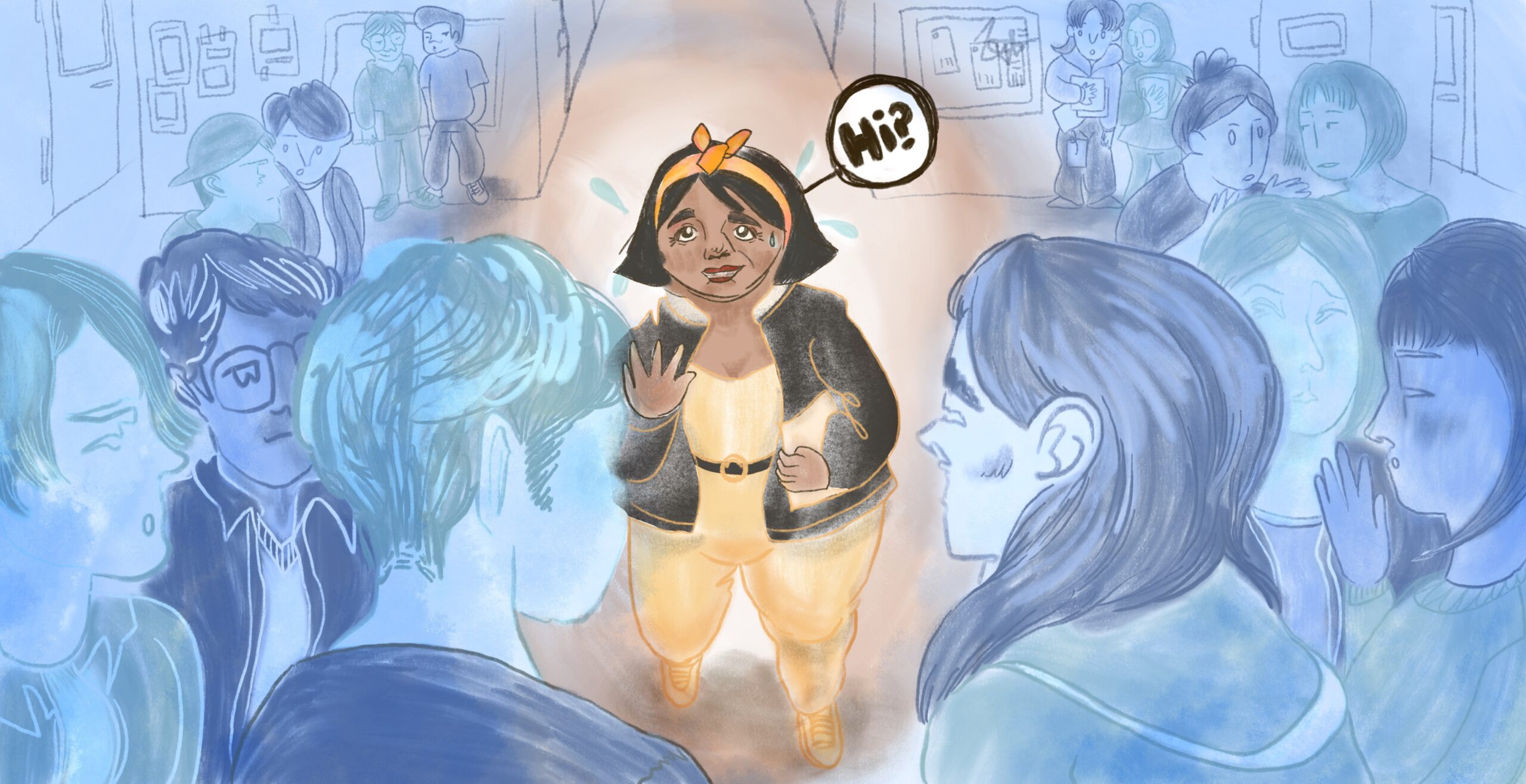
    There I was, bare feet and naked face, drenched in salty sweat after a 1-hour workout. I was a regular at that gym and I always tried to make it a point to look approachable and friendly. I never had a problem frequenting exercise spaces on my own (apart from the occasional random anxiety about my body), but I did sometimes hope to seek simple acquaintances I could get along with on a “Hi!” “Bye!” level. 

    After frequenting the gym for three months, I still never managed to attain that with any of the gym members. Most of them would speak to each other in Mandarin. The Asians sporting Westernised accents found more interest in the White expats (who also only spoke to one another). It wasn’t an unfamiliar situation. Even now, after exploring new fitness spaces with various kinds of profiles, it still isn’t. 

    *

    I used to think that only intellectual conversations were worth opening my mouth for. All the way from secondary school to university, I was exposed mostly to people from middle-income families and above because of the profile of the schools I went to. I made some friends, several acquaintances, and a few enemies, but honestly, most of us shared a common thirst to be intelligent and worthy of a conversation. 

    However, I learnt that people only find you worthy of deep conversations if they assess you to be of a certain profile. 

    I am a brown-skinned Malay girl. My accent shifts depending on the people I’m around. I play up its ambiguity (cultivated after watching a variety of movies and shows over the years) whenever I’m around Chinese people or snobby Malay people who think they’re too good for common folk. With Malay-speaking Malays, I speak my language more and use Singlish liberally without restricting myself. They often laugh at how awkward I sound, and I laugh along with them.  

    Language has a way of interacting with the body to bring out the worst in people who are prejudiced and don’t even know it. There were countless moments when people in the university I went to would leave me out of conversations during seminars while flocking towards all the White and light-skinned Asian people in the room. I used to wonder if it was because of my introversion and social anxiety until I mustered enough courage to start saying “Hi” to students from other divisions who would, to little surprise, stare at me blankly and give me a strange smile. (And then flock to the White and light-skinned Asian people in the room.) 

    *

    We were at a cafe in Raffles City. There was a quiet, charming bustle in the air. Sal and I don’t usually hang out alone very often, so we were chattering loudly and excitedly. What began as lighthearted talk about cute babies developed into both of us talking passionately about how Malay women are always underestimated in the workplace or assumed to be lazy once we are seen taking a damn break.

    We were sharing a buttery almond croissant and I was sipping a butterfly pea drink that was an appealing indigo but didn’t have enough taste for my tongue. Once we were done, we stood up to leave. 

    Behind us, a pair of lean Chinese girls who had been chattering as loud as we were had their eyes fixed on us while we got ready to go. 

    “Finally,” one of them scoffed in the fake American accent a lot of wealthier Chinese Singaporeans like to sport. “They’re leaving.” 

    I don’t think Sal heard them. I didn’t want to bring it up either, because I had enjoyed that short time we spent together alone. I remember wondering if I should have spoken less Malay. But I realised that when you and your friends are excited, you shouldn’t have to think about controlling your volume in a space where noise is all around. On that day, it became ingrained in me that even being socially accepted enough to chatter in excitement can be a privilege. 

    *

    Sometimes, if people hear me speak a mixture of Malay and Singlish the first time they meet me, I predictably receive shifty eyes and get spoken over whenever I try to contribute to “intellectual conversations” until I manage to correct them on a linguistic mistake they made, or call them out on an opinion I find problematic in a way that destroys their idea of what the capacity of my brain is. It used to make me feel so proud to easily shift between different modes of speaking, to alternate between the organic vernacular and the contrived formal, to gloss over the natural accent of my ethnicity and show off that I can sound like a snooty and proper English-speaking person if I want to. I had a lot of pride thinking of how the world saw me whenever I did that: Here is a dark-skinned Malay girl who can talk intellectually, and isn’t like the others. Here is the rare exception to the norm. 

    But I hate it now.

    I began to disgust myself whenever I had to switch my modes of speaking. It sickens me whenever I have to conceal my identity by sounding like I possess a certain class and level of education. It sickens me that speaking a certain way makes others view me as more worthy of intellectual conversations because it somehow cancels out the starkness of my brown skin and dark features. A colour problematically associated with failure, leisure, lack of complexity, and traditionalism by the majority. 

    During the Singapore Writers Festival, in a panel about language and the body, South African writer Kagiso Lesego Molope said she dresses to the nines just to go out and buy bread. She was sick of being followed around in supermarkets and shops in Canada, to the point that she herself questioned whether she accidentally stole something. Of course, even dressing up did nothing to solve the problem of racist assumptions and profiling. This became so common that she eventually stopped going out to shop, and did most of her shopping online. What she said felt familiar to me. I have had one too many experiences of being tailed by a Chinese shop assistant, even if I was holding a jarringly full bucket of things that would be impossible to sneak out of the shop. Even if I was dressed to the nines.

    *

    I had on my favourite red lipstick that I only wear when I feel like dressing up. I had been waiting to buy a new phone case for a long time. Bugis Street was heavily crowded that day. I chanced upon a small booth with several phone cases that stood out to me. Immediately, I walked towards it. 

    A Chinese salesgirl appeared by my side out of nowhere. I noticed the harshness of her stare before that of her voice cut the silence between us. 

    “Yes?” she spat. 

    Instinctively, I retracted my hand from the phone case I was holding.

    Still trying to be patient, I asked, “Do you have Google Pixel 2XL phone cases?” 

    “Huh? No, don’t have,” she quickly replied and continued to stand beside me and stare. 

    I was tempted to be sarcastic about her exceptional service like I had done before to similar salespeople in the past. But I was tired. 

    “Nevermind.” 

    *

    Even when people like me do not speak, we are assessed. To the prejudiced individual, our silence is as dangerous as our voices. And if it is not dangerous, then it’s unnecessary. Us creating an image that pleads for society to integrate us into a presentable, educated norm cannot erase the classist, racist mentalities that are so pervasive yet insidious in our society. I used to seek only intellectual conversations, but I now find them a chore and a bore. It sometimes ends up just becoming a game of who sounds smarter than whom anyway.

    It took me years of having my voice undermined to understand that the knowledge you gain and the lessons you learn from people are not defined by how eloquent or educated they are. Human connection is sometimes the most genuine when you can talk about the most mindless things. Honestly, the desire to only have intellectual conversations is, at times, a convenient excuse for a discriminatory social circle anyway. 

    *

    My mother robustly walked around the Louis Vuitton racks of Galeries Lafayette in Paris. The wide sleeves of her jubah circled the air with every step that she took. Like any street-smart auntie, she immediately noticed a foreign sign that mainly said: “20%”

    Of course, she approached the nearest salesperson to enquire what the sign meant, as the noticeably smaller words were in French. 

    “This one is 20% discount?” she asked timidly, in a soft voice completely different from the confident, commanding one she uses around her family. 

    A pause, and a blue-eyed glare. 

    “For French people only,” replied the salesperson curtly. 

    *

    I once longed to be confident enough to wear slippers and the most comfortable, casual outfit I could think of, and stroll along a high-class place like Orchard Road without feeling all eyes on me in judgment. I thought I could somehow do that by losing weight to look more brown Lana Del Rey-esque and by magically becoming a less nervous person. Perhaps bringing out more cheekbones with a contour stick and shimmery highlighter would somehow make me have more presence in any space. Or maybe my shoes were the problem. Perhaps I needed a certain height of heels to have the power to simpy walk without people wondering why I should exist in a bougie area. 

    But scrap that. If I cannot be regarded equal by another human being as my natural self, I don’t see why it’s me who has to change. If I were to appear before someone with my naked face and bare feet and have my existence be seen as an annoyance or a threat, then my silence, my body and my voice are not the problem. 

    __

    Atifa is how she likes her coffee—severely caffeinated. She is so proud of this statement that she lifted it from her Instagram bio. Her works have been published in TAYO literary magazine and Perempuan: Muslim Women Speak Out.

    Illustration by Ishibashi Chiharu