Category: Blog Series

  • The Disease of Womanhood.

    Exiting the bathroom stall
    Sweat drips from forehead
    absorbed by cotton hijab
    Red drops drip from skin
    absorbed by cotton pads
    I lift my jumper and check my butt in the mirror
    Leggings stained with spots
    The marker of my womanhood
    It is here.

    I scurry outside
    to the sea of white and blue
    Clenching my tummy tightly
    I whisper in her ear
    “do you have Tylenol?”
    Access granted.
    She slips me pills from her pocket
    They were always there.

    The ringing of the bell
    summons our quarantine
    Locked up in a cell during the afternoon prayers
    Aliyah stands guard
    A male passes our door
    She sends us a signal
    and we duck in shame
    We were never there.

    Avoiding exposure of our disease
    we run to the entrance of the mosque
    but careful not to make noise
    Just as the Imam finishes praying
    we slip back into the women’s section
    We were always there.

    Mariam falls behind and gets caught in the act
    She runs into a male classmate
    The stares are awkward.
    They both know it but won’t say it
    The distress of being an adolescent
    lingers in the air
    They both sit in their desks fiddling thumbs
    When the rest of us reach the class, Omar calls over the boys
    Huddles, whispers, points, giggles
    She’s been exposed
    A woman is here.

  • Exodus 3:14 or Decolonizing the Multi-Racial Body

    By Diana Rahim

    My body is the world because –
    You won’t let me be myself.
    History won’t let me be myself.
    Cultures won’t let me be myself.

    My skin holds down blood
    that does not know which ocean to return to.
    Creases on my skin demarcate borders
    between countries.

    When I shift my bones,
    continents groan in movement.

    My grandmother placed China on my cheeks
    My grandfather placed Pakistan on my nose.
    I have India in my eyes and
    Indonesia on my tongue.

    The borders between countries compete for meaning.
    I am a hundred civil wars at once when you ask –

    “What are you?”

    I was whole before you forced these borders on my body.
    Other my limbs and tell them they have lost
    their mother country.
    You forced your language on my ancestors, now
    I speak with the colonialists’ tongue.
    Sanskrit ripped from my language.

    My great-grandmother died with the last ‘Khan’ in her name.

    Isn’t it funny how we broke God, made “him”
    a man; white, distant, fearful, before we said –

    “We were created in God’s image“.

    Why do we break God
    to fit him in the ego of the man.
    Why do break the body and force it
    to choose a name. A country.
    There is space enough here for refugees.

    My body is the world
    You will not colonize me.
    Anglocize my deity.
    Create difference so you can feel special.

    My blood will break the borders
    you’ve drawn on me.
    Reclaim every sign you’ve bastardized
    as submission.

    My body is the world
    and I carry it whole.
    Ask me again who I am and I will no longer
    carry wars on my skin.

    Ask me again and
    I will dare to say that
    “I am who I am”


  • Coming Undone.

    Coming Undone.

    By Zubaida Ali

    My head is so wrapped up with silken lies
    As I walk this flimsy path of truths and untruths

    Will Allah love me more just because I cover my hair?
    Will Ibu, Ayah, all look up to me?

    I get burdened with so much guilt
    just because of this piece of fabric a mere two feet long

    My conscience pin-pricked with so many questions
    Who am I doing this for?

    As the lies unfurl
    I do not know where my true self begins
    and ends


  • The Difficulties of Praying in A Mosque for a Muslim Woman

    The Difficulties of Praying in A Mosque for a Muslim Woman

    By Filzah
    Because I’m a Muslim Girl
    I pray behind a wall
    I pray behind curtains
    I pray behind men
    Because I’m a Muslim Girl
    I don’t go to the mosque on Fridays
    I don’t go to the mosque on my period
    My presence is not necessary
    So I shall go home.
  • The Normalization of Body Damage

    In second grade, I joined a co-ed Islamic school. I was happy to be around girls and boys who looked more like me. I was no longer the only Big Bird with awkward lanky bones. I could hide my untamed hair under a white cotton hijab. My chai colored skin was mid range on the spectrum of skin tones and my hairy arms and legs were covered thanks to our strict uniform.

    There were instances, however, that made me feel extremely insecure about my body even amongst my “own people”. There is a scale in terms of hairiness in my Muslim community. You have those who are fair with hair – but it’s blonde, so nobody cares. Then you have those who have darker skin and dark hair so it isn’t as noticeable. You then have the hardest category – the girls with a medium skin tone and dark thick hair. The extent to which the hair shows can differ person to person.

    When I was 10, I got picked on for being on one extreme of this scale. The hair on my arms – or rather – fingers – became the subject of scrutiny for my less hairy friends. I stopped wearing rings and bracelets. I stretched my long sleeves to cover the back of my hand. I was tired of being embarrassed. One day, I came home to find my older sister waxing her arms in the kitchen. “Can I try?”. I scraped the hot wax onto my skin with a butter knife. I pressed down a rectangular cloth strip with one swipe and pulled in the opposite direction with the other. It hurt. The hairless rectangle on my arm felt smooth and shined under the light. That was the first day I ever felt pretty. The black thorns jutting out of my honey colored skin needed to be removed in a regular fashion from then on. Eventually, the removal of body hair became as normal as showering.

    In 7th grade, my boobs were non-existent, I was taller than almost all the boys in my class and my glasses and braces only emphasized my growing unibrow and moustache. By 8th grade, my moustache was comparable to my male counterparts in class. It was then that I started experimenting with bleach to address my “excess” facial hair. Just a dab in between my eyes, right where my eyebrows met and a line across the top of my upper lip. It stung. My eyes filled with tears as I stared at the clock waiting for 10 minutes to pass. When it was finally time to wash it off, I looked back in the mirror. Like an invisible marker, the bleach erased the unwanted characters off my face. “Oh wow, I can see your face now” my sister joked. As if making invisible the hair on my face somehow showed my real identity. I internalized this manufactured identity and ran with it.

    Fast-forward to 11th grade. It was Friday night and we had a girls party to attend for my sister’s wedding. This was one of the few times my hair and all the flaws associated with my bare head were in plain sight. I brought out the curler, hair straightener and tried to do whatever I could in the 10 minutes I had to make my hair not look like a bird’s nest. The curler grazed the back of my ear. It burned. Only completing half, I pulled the rest back with a clip, covered my bald spot with my bangs and threw a dupatta back on my head. As I got to the party, my friend exclaimed “You look nice!”…I sighed and gave an excuse “I didn’t have any time to get ready, my hair is such a mess”. I found it hard to accept the compliment because I didn’t believe it myself.

    Upon graduating from college, I was once again bombarded with parties. This time, for my own wedding. I was dolled up with make-up every week. The bright lipstick emphasized my yellowing teeth. The natural color of my teeth was pointed out to me by friends as a defect. I made an appointment with the dentist to undergo teeth whitening. I sat in a reclined chair, unable to move an inch for 2 hours. After the appointment, I drank a glass of cold water to help cope with the heat of the summer. It throbbed. The once soothing drops of cold liquid now icicles jabbing at the surface of my teeth. “All worth it” I told myself later, as I looked satisfied at the wedding pictures on facebook with hundreds of likes.

    Years later, I am writing this post at my desk as a self-identifying feminist with chipped bright red nail polish at the tips of my unwaxed fingers. I will be giving a presentation to a room full of women tomorrow with my expressive, unwaxed eyebrows and bright pink lips shaping my discolored toothy smile. I’ll be sure to take a selfie. I still wax, do my hair and wear make-up – when I feel like it – for me. I have learned to tune out the societal murmurings that blemished the love I have for my body. The wounds of my damaged body are still healing and may never fully recover, but I try to be the best caretaker I can be. I now value the days where I feel healthy over beautiful. I have identified my own sense of style independent of the latest trends. I compliment the little girls I know on their skills instead of just their pretty dresses and accept instead of fight compliments from my own friends. The only type of woman I have to be, now, is the woman I already am.


    Written by an American-Pakistani Muslim living in Singapore.

  • more than this

    I had the pleasure of reading the article “Here’s whats wrong with your hijab tourism and your cutesy modesty experiments” a few days ago, and this passage in particular resonated with me:

    “These approaches reduce Muslim women to veiled, enigmatic symbols of Oppression; and whether you’re upholding the veil as symbolic of oppression or purporting to “challenge assumptions” about it, this is still a reductive, one-dimensional and over-simplistic view of how Muslim women experience their faith, their identity and their bodies. Hijab and niqab are positioned as central to our experience, such that the only thing one has to do to understand how Muslim women feel is put on the ‘costume’ of one. In a society obsessed with externalities it’s not terribly surprising that Muslim women’s lives are constantly reduced to the most salient external symbol of our identity; but it is frustrating and depressing. We are more than just a veil.”

    So true, and yet, I sometimes wonder if we Muslim women have somehow subconsciously equated ourselves to the veil. We bristle when what we perceive to be “outsiders” engage in this kind of reductionism, but are slow to see our own tendencies to do the same.

    So much of our own discussions on what it means to be a Muslim woman centre on the question of the hijab – from our debates on what can properly be considered a hijab, to whether there is a need to wear one at all, and how it shapes our identities. Every time we meet a new person, we size them up based on what they’re wearing, measuring faith in square centimetres of covered skin. We raise our girls to strive to wear the hijab, believing it is somehow the gold standard of piety. And then we expect the women who have donned the hijab to suddenly be paragons of virtue, free from all temptation, as if the hijab is some kind of miracle cure, a panacea to all the world’s ills. We are, quite frankly, obsessed.

    What is truly ironic is that we should expend so much time and energy defending the practice, and educating others about the purpose of the hijab – to guard our modesty, so people value us for the people we are and not for our appearances – only to run the same risk of valuing the appearance over all else. We want people to look at who we are behind the veil, but in our collective fixation, we have somehow lost sight of the need to cultivate the values that we want to be defined by: the constant pursuit of knowledge, a healthy work ethic, the intolerance of injustice, charity, and respect for others.

    Unless and until we start believing that our religion is more than the cloth that covers us (or lack thereof), how can we possibly expect everyone else to do the same?

  • Forced into the hijab (Part II)

    1) Modesty mustn’t simply be defined in terms of what you’re wearing, but more importantly, how you behave

    I don’t know, I don’t think modesty should be as simple as a piece of clothing. I’ve seen women who are truly modest, and they don’t require a Hijab to be so. At the same time, I’ve seen women who dress modestly lead a decadent life. That’s why I think modesty needs to be more than how you dress. It is an entire behaviour. And no amount of clothing could alter that.

    2) Religious decisions should never be forced upon anyone

    I always believe that spirituality is a very personal thing. It is something between you and god, and you and god alone. No one should ever, ever come into the picture to influence any of your spiritual and/or religious decisions. I always don’t understand why people see the need to police or ‘save’ other people. Impositions of your own religious beliefs are not only unnecessary, they distance someone else from the religion altogether because it is very off-putting to have someone tell you how to behave. It is also another problem entirely when people tell me to wear the Hijab because they don’t want to be dragged into hell by my sins (i.e my reluctance to wear the Hijab). If anything, what I learnt from my JC experience was that people are able to appreciate the religion even more when they learn it on their own accord. My JC friends are so happy to wear the Hijab because it was never forced upon them.

    3) The creation of a dichotomous identity

    The person I see wearing the Hijab and my true self – the one who is not defined according to her physical form cannot co-exist. I actually do feel a sense of dissonance and conflict when I have to repress myself in order to maintain the good image of the Hijab. I’ll be honest; by nature I’m quite a free-spirited person who is both sarcastic and enjoys dry humor. I particularly like to make jokes (and crude ones at that) which make many people feel uncomfortable because it’s very unbecoming for a tudung girl to be like that. Due to that I hide my true self and appear to be this seemingly modest person in front of others. And  it worked – people describe me as someone they deem ‘gentle’, ‘quiet’ and ‘shy‘. I can’t decide which is worse – being hypocritical by my wearing of the Hijab or simply to act as I like with no regard for it.

    4) People define you in terms of your tudung

    People being people, they judge you according to your appearance. When it comes to seeing a tudung girl, naturally, people will see a tudung girl first, and, say, a funny girl second. I do this too, because we always think that people who put on the tudung do so because they are motivated by goodness. As you can already tell, this idea doesn’t apply to me at all. Also I honestly feel sad when someone defines me according to my tudung; because I see myself as someone more than that, and I want to be acknowledged for being witty and funny and other things in which I pride myself for. Furthermore, people see you as ‘the other’ when you wear the tudung. They don’t ever see you or treat you as a regular person in society but as ‘the other’ or ‘the tudung girl’. Personally, I too, wish to be noticed (by the object of my affections) as someone who has a unique personality, but that unfortunately never happens because of how I look.

    5) People police your behaviour and they see the need to ‘protect you’

    This is an entirely problematic way of thinking which has existed since probably the dawn of time. This is linked to how someone has told me that they don’t want to be dragged into hell by my sins. I recall an incident in school whereby someone told me that my hair was showing and he made a deal out of it. He even jokingly asked – ‘You’re not wearing the inner part of the tudung right?‘ When you think about it rationally, how silly that must sound, because after all, it was simply two strands of hair. The world doesn’t stop when my hair shows, and neither will a hole appear before me and swallow me alive when my hair shows. It was then that I asked him why he felt it was such a problem to the point of accusing me of not wearing the inner tudung. He told me that he thought it would be a sin on his part to not tell me, which fairly reminded me of the kind of things other people tell me when they need to justify their policing of my behaviour or other religious decisions. Personally, I don’t believe that Islam, being the fair and merciful religion it is, would hold you accountable for the sins and the mistakes of others in which you do not consciously partake in. I believe that only the individual and the individual himself should be accountable for such, and not only that, it is an insult to the tudung-wearer to always be reminded that her body is a constant object of sin.

    6) Paranoia, awareness of social judgment, and objectification of the self

    A few months ago, I decided to do a project on the Hijab, where I challenged myself not to wear the Hijab to see how I would react, since I’ve always wanted to take it off anyway. I always thought it would be easy to take it off, being someone who’s always been reluctant to wear it. It was however, startling to see that it was extremely hard to do. When I didn’t have my tudung on I started feeling paranoid. I remembered taking it off in the toilet and having this intense urge to put it back on the moment I got out of the toilet. I feared someone would see me, someone would come to me and ask me why I am not wearing the tudung, and would then frown upon me. I also felt insecure showing a small part of my neck, and my hair, although the rest of my body was covered. I was experiencing a combination of confusion, insecurity and dissonance within myself. I thought I would feel liberated if I didn’t wear it but what ensued instead was only paranoia. It was amusing to see that when I wore the Hijab, my personality was at odds with my Hijab identity but when I took it off, my Hijab identity in turn was at odds with my personality. That was also when I discovered the idea of a dichotomous identity within myself, which could in no way, merge or be one with the other. Also, that whole experience taught me that objectification must be so prevalent in society when you out of all people, objectify yourself. I’ve always thought I was insecure of my features because I hid my hair, but after years of being conditioned to wear the Hijab, the reverse happened. I was now insecure of my features because I was used to hiding it. It doesn’t do anything for your self-esteem and doesn’t promote a healthy body image at all.

    7) Having to compensate

    I don’t think wearing the Hijab necessarily equates to a modest way of living. Initially, one of the reasons why the Hijab was so ideal was because it was supposed to shift the emphasis away from how you looked so you could focus on other more important things, like faith, the religion, and ultimately, God. However, if you look at the way things are presently, the Hijab no longer functions that way. It was also supposed to steer the emphasis away from materialism and consumerism, which, as we now know, is simply an ideal. The Hijab market is definitely on the rise now, as we see fashion shows dedicated to not only Hijab and clothing for veiled women but also fashion shows for theTelekung, which is a prayer gown. It is ridiculous to think that a modest piece of fabric that was once supposed to allow women to lead a modest lifestyle now becomes an industry in which people profit from. Furthermore, sometimes, as women wearing the Hijab, we feel the need to compensate, or to make up for what we lack through various means. I’m not saying this is true for everyone but at the very least it is true for myself. I find myself having to dress up more because I want to present myself better because I wear the tudung. Although I know it defeats the purpose of the tudung, I can’t help but to do what I do – because honestly, who doesn’t want others to see the best version of themselves? Dressing up is not about impressing other people but more about making yourself feel better. And this whole process of having to compensate – because I wear the tudung, does take its toll on me. I constantly think that if I don’t wear the tudung, I wouldn’t have to go through so much trouble — because with the tudung, you constantly have to be creative in the way you put your clothes together and you have to work around many things. After you get used to it, it is not much of a hassle, but it definitely isn’t the best way to live, and it definitely isn’t the best attitude to have when you wear the Hijab.

    8) No good intentions

    I find myself to be, quite frankly, a rather horrible person and because of that, I don’t think I deserve to or am ready to wear something like the Hijab which is a symbol of goodness in society’s eyes. Also, a person such as myself should not be wearing the tudung simply because I don’t believe in it and don’t have any strong convictions to wear it. Furthermore, I don’t think the Hijab or any other religious practice should be done when you’re not sincere about it. Although I wear the tudung everyday, every time I start putting it on the only thing I can think about is how much I dislike wearing it and how I wish I don’t have to. Because of this, my wearing of the tudung is no longer a kind of service to God but is reduced to a pointless ritual which benefits neither myself nor my relationship to God. It is also not of any justice to god, and it defeats the purpose entirely. At this point someone will ask “Why don’t you take it off then“, to which my answer would be – ‘I just can’t‘, as I’ve explained earlier on.

    9) Endless questioning

    Whether you wear the Tudung or not, as a Muslim woman, you will constantly be subjected to questions your entire life.

    What initially drove me to write about this was because of my deep yearning to have my hair seen, after watching the television yesterday and observing the way this lady’s haircut perfectly framed and somehow enhanced her face. It was the kind of yearning that made me feel pathetic, knowing that having your hair shown is such a natural thing in which many people take for granted. I always wondered what life would be like if my hair could be seen. I always envisioned it to be a much better life, because it seems like I will be free from the many responsibilities, expectations, judgments, hypocrisy and confusion which I have now.

    I would like to renounce it, if I could, but that is definitely not within my power.

    I would like to say that these experiences are not just my own, but that I am very certain that many of us who have tried wearing the Hijab, or any Muslim woman for that matter, has felt similar sentiments.

    To be honest, I am uncertain of where my life will head after I’m done publishing this and if small changes will slowly happen in my life, but I have this sinking feeling that nothing will change – I will forever don the Hijab because I don’t know how to live my life otherwise.

    Read the first installment.
  • Forced into the Hijab (Part I)

    Ramadhan has always been a special time for me because it’s the time when I sit down and reflect about my religion more seriously. I don’t mean for this to look like a biography, but I thought that it’d be easier to write things chronologically.

    See, for as long as I can remember, the Hijab has always been an obligation enforced upon me and my sister.

    As a young Muslim, you don’t really question these things but you just do it because your parents tell you to. When I was younger I don’t remember if I had true conviction for wearing it, but I wore it anyway. I just assumed it was the norm since my mother wears it, and because it was compulsory to wear it when you went to religious classes. So I did.

    It was only in my pubescent teen years when this strong sense of dislike towards the Hijab sat at the back of my mind. The pubescent years was when how you looked started to matter, and for me, a person who has always struggled with low self-esteem, it aggravated the problem. I recall this incident that happened some time during my Secondary School years. My friends and I were out for a “Jalan Raya” outing. I was the only girl wearing the Hijab. I resented it the moment I put it on as it made me feel uglier than I already was. Seeing how pretty the other girls looked in something other than their Secondary School uniforms was enough to implant this small seed of jealousy within me. What worsened it however, was when the boys snickered, labelling me “alim” or pious because I wore the tudung. I remembered them laughing about it when I shortly excused myself to pray. It was something that damaged my self-esteem even more. At that moment I hated my parents for forcing such a thing upon me, and I hated the Malay community for endlessly criticising – it is a problem in their eyes to both wear it and not wear it. Most importantly, I hated that company; and that was when I swore to myself never to attend a “Jalan Raya” with anyone other than family.

    This dislike for the Hijab continued into my JC years, although in a smaller scale. The JC years introduced me to new perspectives on the Hijab, both good and bad. For one, my Chinese friends were more accepting and encouraging of the Hijab than my Malay friends. They told me things like “You look good with the Hijab, it frames your face nicely“, “You’re pretty“, “I like the way you dress” which really made me feel better about myself. Never once did they question me for my decision to wear it. The Malays in my JC, were nicer than the ones I met in Secondary School. Not only were they non-judgmental, they never once snickered at me for wearing the Hijab. Furthermore, the girls were undergoing a transition like myself. We were all at the age where we wanted to take our lives more seriously, and the Malay girls I knew were all making the decision to wear the Hijab because of varying reasons. I was really happy that they were making the decision to do so, and listening to their stories made me feel more optimistic about the Hijab. However, along with it came a deep sense of jealousy. You see, my friends were the sort who were never forced to wear the Hijab by their parents. When they wanted to wear it, it was a decision they made on their own accord, and I truly respected them for that. It was something that was never in my capacity to do. How I wished I were them, loving and embracing the Hijab for all that it is. I couldn’t however, as my deep sense of repulsion for it was still there. You see, the more you are forced to do something, the more you shy away from it.

    The present is when I’ve been starting to really rethink the whole idea of the Hijab. I am in uni now and it seems that in uni, at any given point of time, people see you in the Hijab and only the Hijab. I remember in year one I didn’t even bother to adopt a defensive attitude towards the Hijab. My friends asked me why I wore it, and I just answered “Because my parents forced me to“. I remember in JC I would tell my friends lies like “Because it allows me to be more modest” or something of the like, which, looking back, must have sounded really baseless and presumptuous.

    Read the second installment. 

  • An Evening at Hong Lim

    An Evening at Hong Lim

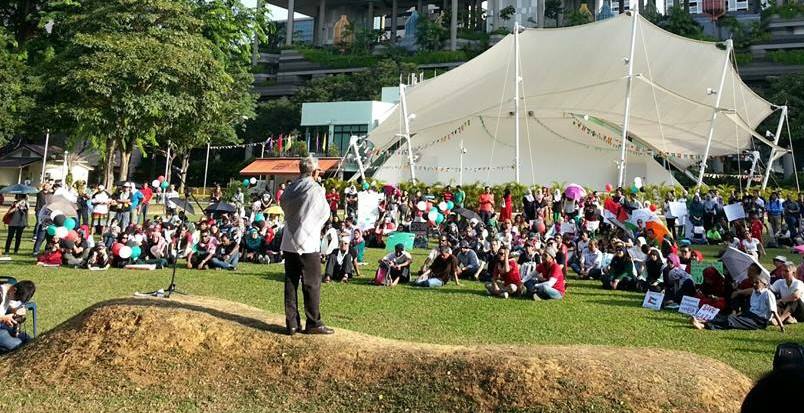
    Photo credit: #sg2gaza

    I have now been to three separate events at Hong Lim Park, each with a different agenda and each, extremely close to my heart.

    The first event was held on March 8th, International Women’s Day. It was the first ever celebration for IWD at Hong Lim Park and it was my introduction to how “gatherings” work in Singapore. There were permits, rules and regulations that needed to be followed in order to secure the space and make the event happen. Although the event was “All Fired Up!,” the passion from the crowd was missing. Participants of the march were rather confused as to how a march works but I figured this was something novel for most who were there so I lowered my expectations. Channeling your emotions in the form of a protest is something that is a part of who I am. I have protested budget cuts at my university, joined in celebratory street marches when Obama was elected (only the first time) and angrily marched to city hall in solidarity with global movements. Although All Fired Up was not as grand, it was still a space where community was built and felt. The most touching and beautiful part of the event was our candlelight vigil in the end which included lighting tea candles in plastered bellies and singing in unison to “We Shall Overcome”. Overall, the event was intimate and meaningful for all in attendance.  It was a space where issues were discussed and personified. It was a celebration of the women’s movement, how far we’ve come and a reminder of how far we have yet to go.

    My second event was Pink Dot. As a Muslim woman who wears hijab and also identifies as an ally of the LGBT community, I knew my attendance at Pink Dot was unconventional to say the least. I was conflicted whether I should actually go or not because it was the first night of Ramadan and I didn’t want to miss Taraweeh prayers. I also knew that because of the Wear White campaign, my presence in that space was important. I ended up going for a few hours, but missed the formation of the dot. Nevertheless, I was glad I went. The sense of community, of love and of belonging was absolutely amazing. I had never seen so many people from so many walks of life join hands to celebrate acceptance, family and love. I floated through a crowd of pink and witnessed the diverse families that make up Singapore. My experience of Pride events has always been much more blatant and extravagant. In San Francisco, Pride was more than just a space for the LGBT community. It was a space for engagement on issues pertaining to the LGBT community and beyond including HIV/AIDS, cancer, homelessness and animal welfare. The vibe was much lighter and there weren’t any critical discussions taking place about the legitimacy of the space created, yet it was still very powerful. It made a statement – we are here, we are real and we are Singaporeans.

    My third event, and the event I was the most emotionally invested in, was the Singapore to Palestine Peace Gathering for Gaza. This took place organically over the span of 24 hours. In response to the rising violence against the Palestinian people in Gaza, a facebook group, known as From Singapore to Palestine, rallied up a group of volunteers to organize a peace gathering to show solidarity to all those who are suffering. They only confirmed the acquisition of the police permit 24 hours before the rally was supposed to take place, yet the attendance was astounding. Close to 1000 individuals attended the event with signs, t-shirts, balloons and clothing all showing their support for the Palestinian people. Although the speeches were not representative of Palestinian voices and some of the speakers misinformed the audience about certain issues, it was still a very well done event. Everyone that was there truly believed in the cause and the need for such a space to exist. It had been stifling for me to be in Singapore and watch my friends around the world march, protest and visibly speak out against the loss of life and violent war crimes taking place in Gaza. This event at Hong Lim Park provided many of us who have been feeling paralyzed, a place to be visible. A place to make the issue visible in Singapore, and for Singaporeans to show Palestine that we also care and we are with you.

    Hong Lim Park has now become a sacred space for me. It is a place that symbolizes freedom from the regulatory culture of Singapore. It is a place that symbolizes community for Singaporeans who believe in real issues. It is a place I can now associate with belonging, family and home.

  • Difficult Questions

    I had stumbled across the beautiful words of the Prophet’s (PBUH) last sermon this past week. This sermon was delivered by the Prophet during his pilgrimage to Mecca.

    The sermon contains universal values of justice, fairness and equality. It touches on, among others, the themes of ‘freedom, equality and human rights’.

    Finding the sermon was a balm that soothed what had seemed like a rough day. However, a part of it left a tingling feeling of (for the lack of finding a better word to describe it), ‘unease.’ The part in question (highlighted below) reads:

    “O People it is true that you have certain rights with regard to your women but they also have rights over you. Remember that you have taken them as your wives only under Allah’s trust and with His permission. If they abide by your right then to them belongs the right to be fed and clothed in kindness. Do treat your women well and be kind to them for they are your partners and committed helpers. And it is your right that they do not make friends with any one of whom you do not approve, as well never to be unchaste.”

    I searched in vain for variations of translations. Instead, I found a piece written by an Imam regarding this sermon. He provides a disclaimer that the sermon could be seen as one of the ‘earliest declaration of human rights in written history’, if you can drop your ‘21st century cultural baggage’.

    Is my ‘baggage’ causing me to overlook the bigger picture that the sermon is asking us to reflect on? Am I then second-guessing my principles?

    Embarking on a journey to learn more about your faith raises a lot of hard and difficult questions about yourself that only you can answer. It is even more of a challenge when you seek gender equitable interpretations. I can only pray that Allah leads me down the right path, iA. Allah knows best.