Category: Education

  • Teaching ‘feel-good’ Islam: Toxic Positivity & Silencing the Oppressed

    Teaching ‘feel-good’ Islam: Toxic Positivity & Silencing the Oppressed

    by Mysara Aljaru

    _

    An ‘Islamic’ Toxic Positivity

    “You just need faith in Allah, you are where He wants you to be.”

    These were words I frequently heard growing up, especially from religious teachers in weekend madrasahs I used to attend as a child. It seemed reassuring at that time. Why wouldn’t it be, right? It calmed uneasy feelings I had for a short while, thinking that all I had to do was to be kind and patient regardless of what life throws at me because God is always there and will always be there. As I was taught, what better way to prove your faith than to leave it all to the Almighty?

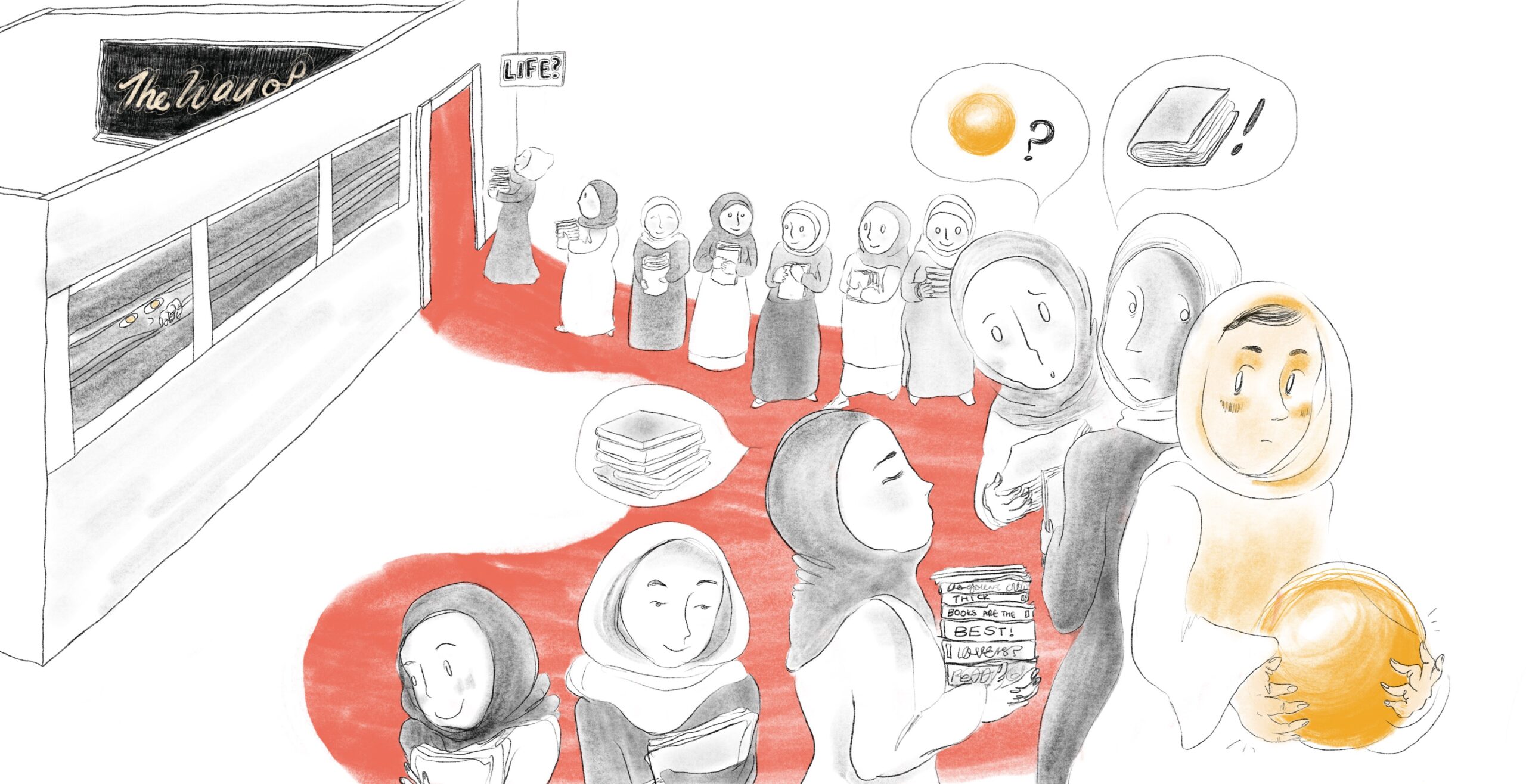
    But as I grew older, I began to feel more frustrated. Whether it was my weekend madrasah classes or in secular schools, I couldn’t remember being taught any form of emotional intelligence or how to deal with the despair rooted in experiences of injustice. As a minority Muslim woman, what does Islam teach us when it comes to dealing with racism, sexism, Islamophobia or abuse? How do we deal with emotions that stem from these injustices? In the classroom, we are not taught to think critically about the root causes of our unhappiness. We are not taught to question.

    With a lack of resources and a lack of knowledge on how to teach emotional intelligence in the mainstream and Islamic education system, society has come up with another way to cope with overwhelming thoughts and feelings: the culture of toxic positivity.

    In such circles, toxic positivity is also used to silence oppression.

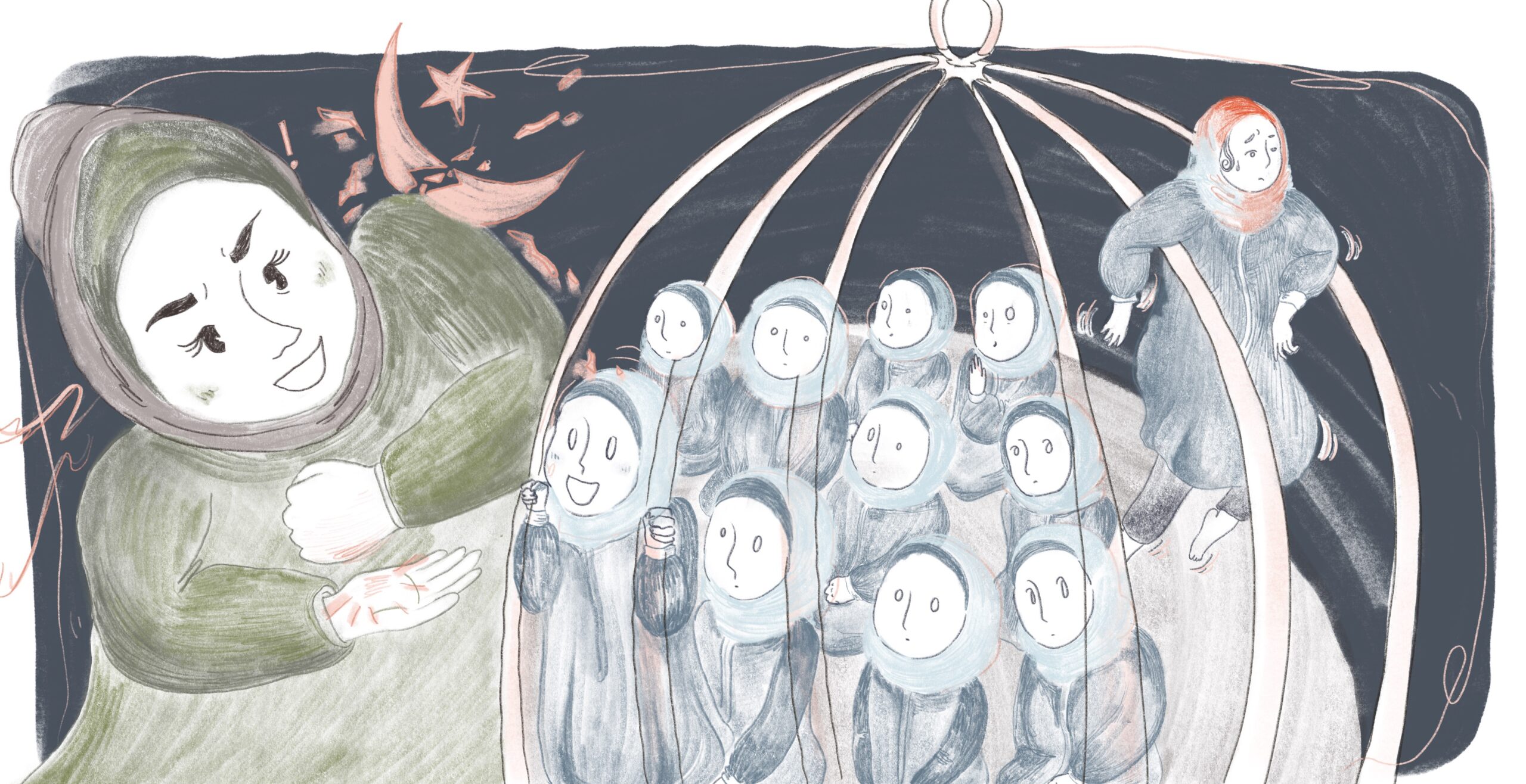
    As a minority Muslim woman, my identity has made me even more aware of injustices in society, aside from those I personally experience. While it was easy for me to reject superficial positive thinking from countercultures like the neo-hippies that are more self-indulgent, toxic positivity in the Muslim community that often silence injustices was harder to fight off. We are often hushed, taught to be silent and to never, ever question the teacher.

    In the Muslim community, trauma is hardly addressed. Religious leaders and Muslim social media influencers who use spirituality as a form of escapism without seriously addressing trauma, encourage a more “Islamic” version of toxic positivity. One is encouraged to think positively of God, believe that there’s a silver lining to everything and to pray away the pain. But the pain never really goes away and will eventually manifest itself in other ways.

    Take, for example, when cases of domestic abuse are addressed in religious circles. Women are often told to have faith in God, to put their trust in the religion, and in some cases, that they will be rewarded for their patience in putting up with an abusive husband. Some narratives I have heard from the community even tell the victim that they are the ‘chosen one’ by God for going through this ‘test’. This toxic positivity approach takes away the need to hold the perpetrator accountable for any form of abuse.

    None of these suggestions addresses the trauma caused by an abusive husband. Even when trauma is addressed, religion is immediately taken as a solution without taking into consideration the welfare of the victim. This becomes a problem if religion itself has been used as a tool by the abuser to abuse, guilt, and oppress the victim. Toxic positivity also becomes more prevalent when the perpetrator holds some sort of religious authority. The abuse of the perpetrator is silenced, more so if he is male, and is especially silenced by other religious figures. Additionally, children who grow up in violent households risk being stuck in a vicious cycle if they do not receive proper support.

    Toxic positivity in religion can also be used to justify violence against the vulnerable, where one is told that certain verses in the Quran are there ‘for a reason’ and we should have faith in the religion without studying it with any form of context or in a critical manner.

    Just two years ago, Ustaz Zaid Isahak wrote in a column for the local Malay newspaper that it is permissible for a husband to hit his wife if she “unreasonably” disobeys him, and even gave guidelines on “beating” the wife. There were rebuttals from other religious teachers such as Ustaz Irwan Hadi, who mentioned that the term “wadhribuuhunna“, used in the verse, “must not be understood literally as a license to ‘hit’, hurt or abuse your spouse, be it verbally, physically or emotionally”.

    While the rebuttal was published fast, it is disturbing that some religious teachers still see violence as a way to solve a domestic conflict. It is also disturbing that we have normalised the idea of having a guideline on hitting women. Furthermore, a lot of narratives on handling domestic conflict still revolves around the idea of the “problematic” or “stubborn” wife.

    Instead of addressing the issues openly and ensuring the safety of other believers and worshippers (as Islam would teach), the victim and the society are encouraged to think positively. One is told to not just think positively of God, but also of the perpetrator. One can hear the word ‘husnuzon’, (which means to think positively and not make assumptions) being uttered continuously as a form of silence towards any protest of the abuse and acts by the perpetrator.

    The perpetrator’s past ‘good deeds’ are instead resurfaced and the case silenced. There is no justice for the victim, for the abused and marginalised, despite the importance of being just in Islam:

    “God commands justice and fair dealing…” (Quran 16:90)

    _

    Bringing Social Justice Back to Islam

    Toxic positivity taught in Islamic schools and encouraged by Muslim influencers on social media also erases an important part of the religion: social justice. Teaching someone to place complete faith in the religion and God without any form of action not only silences oppression but also erases the essential aspect of striving for justice in Islam.

    Our society still grapples with the idea of having faith in God and fighting for social justice at the same time. We don’t know how to avoid staying silent towards oppressors, whether it’s state oppression or oppression happening within the community itself. While Islam has a history of teaching and encouraging the ending of social injustice, society has unfortunately shifted far away from that focus when its practice is reduced only to its rituals.

    This can be traced to how we teach religion in schools and in the home, where it is heavily focused on rituals: how many times we pray, when we fast, or how often we read the Quran. The message of empathy and humanity is lost as we silence the cry of those who need our help. We are quick to diagnose religion as the solution to issues such as drugs and poverty, without looking at the lived realities of the community. The education system encourages us to accept what is taught without questioning while the constant policing by society produces a Muslim society with a mass-man mentality.

    I remember one day at my weekend madrasah, the Ustaz brought up the topic of teenage pregnancy during class. His immediate suggestion in ‘tackling’ the issue was to get the pair married. I raised my hand and questioned him about the importance of getting them married immediately when many of these teenagers had urgent socio-economic realities that were being ignored. I also raised my concerns about creating a vicious cycle by forcing teenagers to get married, to which he responded:

    “I’m thinking in an Islamic point of view, you’re thinking in a secular point of view.”

    Many of us who grew up in conservative household and communities knew what it meant. Secular was a code word for not Islamic. My views of wanting a secure future for the teenagers and their child without forced marriage when they were not ready, was somehow seen as not Islamic. After class, some of my classmates told me they did not agree with him, but none of them spoke up.

    This toxic positivity, assuming that we don’t need to take an active response in critiquing ideologies comes through when the community is thrown with alternative ideas that they may not be comfortable with. While we are told to give a benefit of the doubt to people who may hold toxic ideologies, any other form of ideas that goes against the mainstream view is immediately dismissed.

    A person who shares their bad experiences in Islamic circles such as in a madrasah or in mosques (which is not isolated but just not talked about) would be immediately shunned. Some of my friends and I have faced online harassment by a man who simply did not agree with the work we have done. Toxic positivity creates a monolith of ideas as it usually just defends only a specific thought and destroys any potential safe space the community needs to understand diversity, while at the same time not realising it is unacceptable and disturbing for a grown man to harass women online “in the name of Islam”.

    As another example, passive thinking can be seen especially in Ramadhan, where we’re taught that one reason we fast is to put ourselves in the shoes of those living in poverty. We see an increase in commendable acts of charity; everyone wants to donate cash or food items to the needy. But nobody thinks about or wants to question the system that perpetuates poverty. Very few question the structural barriers that prevent the poor from getting the help they need and deserve.

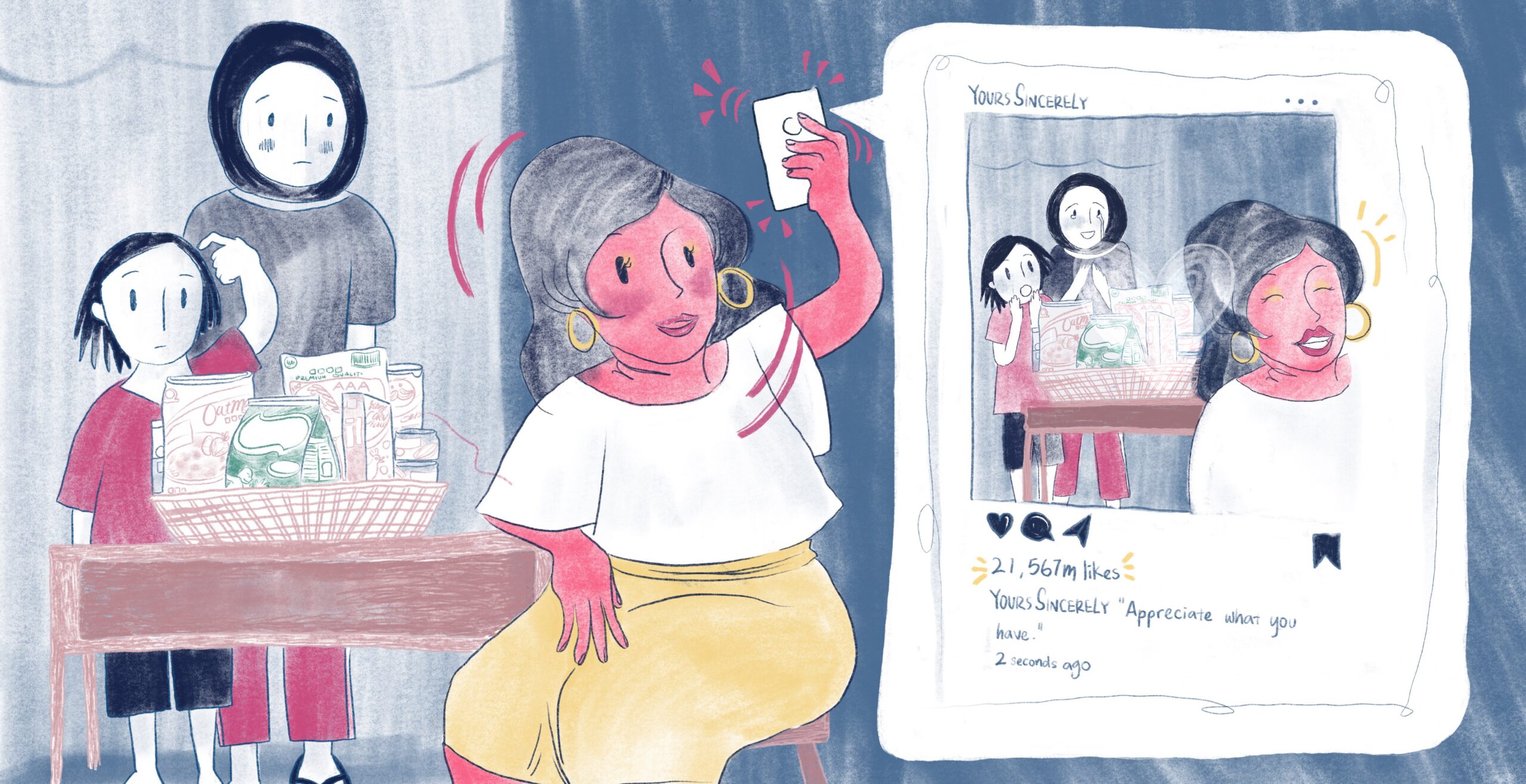
    Acts of charity, while important, is useless if we do not challenge the status quo. We, unfortunately, do not use this month to really understand the root cause of inequality and to fight the system that causes it. A feel-good Islam also sees people in the community happily sharing their charity acts on social media, while taking away attention from the important issue that needs to be discussed. Such acts allow them to see themselves as saviours to the poor, with no form of reflection on the structures that need to be changed. The poor are treated as “life lessons” on how we should “appreciate what we have”.

    Once a year, we’ll see an article or commentary about food wastage in Ramadhan, but hardly any critique linking it to an increasing capitalistic middle-class Islam that encourages consumerist behaviour. Their idea of social justice is passive, one that doesn’t encourage any form of action or critical thinking.

    However, when they do fight for social justice and speak out against oppression, it becomes selective. They define humanity based on someone’s faith, gender, class and sexuality. Anyone who does not fall into their limited checklist is immediately deemed as deviant and thus, not deserving of any form of kindness, humanity and sometimes they’re not even seen as human.

    You see the community raging as they decry the oppression of Muslims in Palestine and Myanmar but are either silent or are in support of Brunei’s law of stoning the LGBT community. Any form of human rights are only for specific groups of people like themselves, yet they will cry oppression while being completely fine with another marginalised community being oppressed.

    An Islamic based justice response should be one that is critical. It should be just and ensure the safety of the victim and marginalised. The well being of the victim and marginalised should not be ignored at the self-interest of the abuser, nor should the plight of the marginalised only be used as a ‘life lesson’. Faith in Allah means not doing injustice or restricting humanity from someone, regardless of who they are. Social justice in Islam goes beyond protecting the sanctity of the religion, especially since God does not require or need our protection. God needs us to protect the vulnerable and not to weaponise religion to protect perpetrators of abuse and oppression, regardless of the power they hold. Justice in Islam permits no favouritism.

    We need to be more critical of the patriarchal interpretation of Islam that is often used as a tool of abuse and we should not lead passive lives when it comes to fighting abuse and oppression. We must fight against injustices and abuses in our community, for God does not favour the unjust.

    _

    Mysara Aljaru is a former documentary producer who is currently pursuing her Masters in Malay Studies at NUS. Her interest includes representation of minorities in media, decolonising environmentalism and intersectional feminism. She has facilitated with Penawar, a support group for women/non-males raised in the Muslim community, dealing with negative experiences from patriarchal interpretations of religion.

    Illustration by Ishibashi Chiharu
  • Knowing What We Know: The Education Of Young Girls

    Knowing What We Know: The Education Of Young Girls

    by Zubaida Ali

    _

    Now that I am in my mid-fifties and expecting the birth of my first grand-daughter, I ponder at the thought of how she will receive her education in life.

    Not the academic education that will surely be given to her but the passing on of cultural knowledge such as beliefs and rituals that inevitably will lead to the expectations society has of girls and young women. How can I, as the matriarch of the family, ensure that she be spared the interpretations of cultural practices that are harmful and negative for her? How do women know what they know?

    Much of the way we know comes from oral tradition and role models. My mother learns what she knows from her mother. My mother passes what she knows to me and I pass it to my children who pass it to their children. Family traditions such as how to address the elders or other relatives within our family, how we hang on to heirloom recipes and reprise them for certain occasions, unique practices and rituals we hold dear just because we have been doing them all these years.

    A friend once shared that in her conservative family the men in her family gets served first during meal times and were given the best cuts of the chicken during family events and celebrations. The women ate later whatever was left.

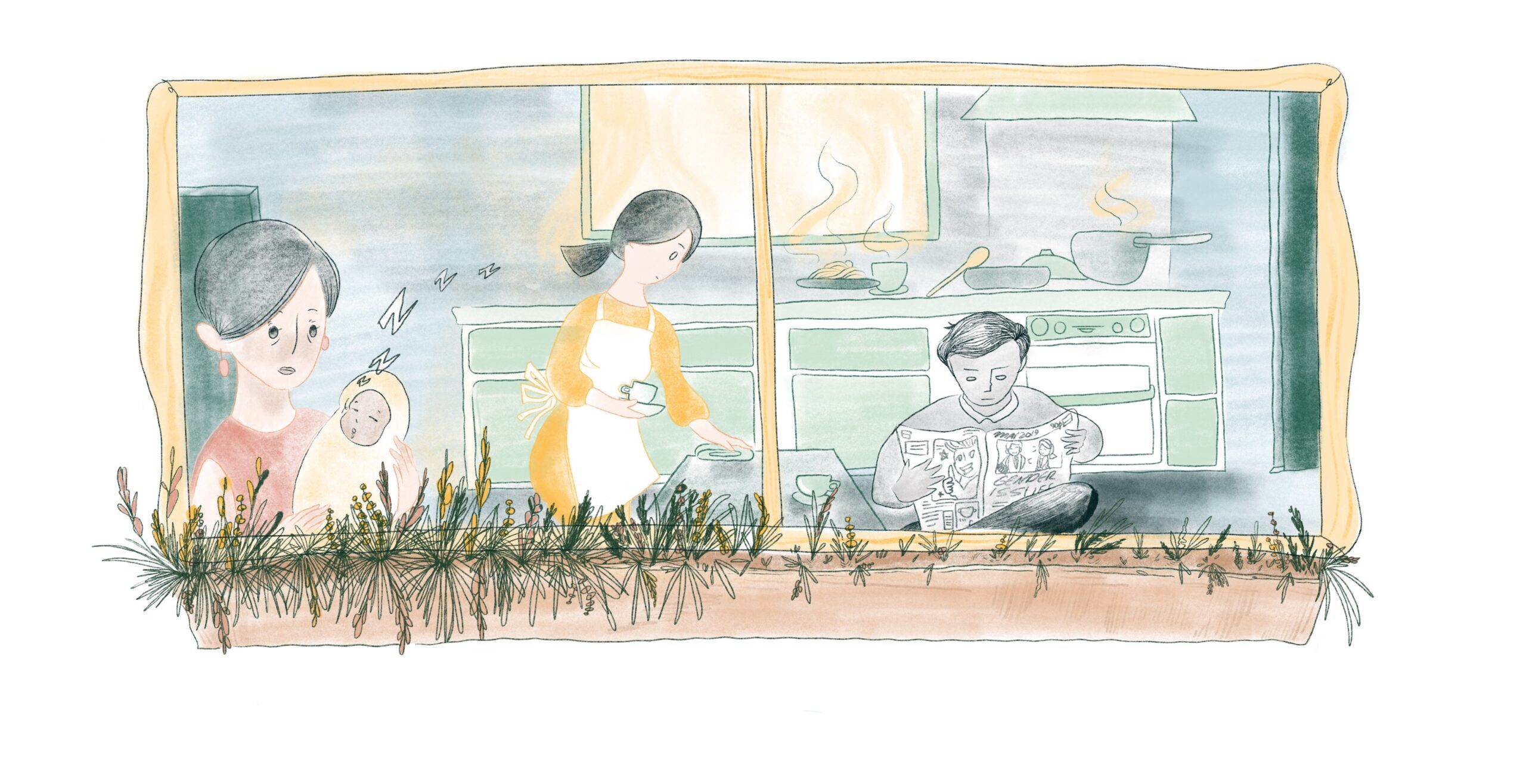
    Even today, I see the female members of my extended family set the table and serve their sons and husbands at meal times, and their daughters follow the same exact footsteps of their mothers to take on the responsibility to prepare and serve the meals.

    I once had a request from a participant of an evening class I was teaching to start the class later so she could ensure her husband gets a good meal before she left the house. She emphasised that she has to fulfil her duty as a good wife first. (My answer to her request was no).

    In another instance, a young girl came to me with tears in her eyes because her father refused to let her continue her education at ITE believing that it is a waste of time because girls are going to get married anyway and it is about time she stopped wasting her time outside the house.

    There are many other instances where daughters are being stopped from going on school trips overseas or taking up sports because they will need to run around and expose themselves by wearing fitness clothing. You may think these are isolated cases but for the young girls caught in these challenges, they are very real barriers to living full and productive lives.

    Other harmful beliefs based on religious interpretation have young brides believe that it is a sin to say no to sex with your husband; that if you say no, the angels will curse you. There’s also an interpretation of a hadith suggesting that if your husband requests for sex, you have to drop whatever you are doing and oblige, thus positioning women as sex objects with no rights within the marriage.

    Body policing or the obsession over aurah and the showing of skin has become a major topic many young Muslim girls have had to learn is their lot in life. They also learn to suppress any expression of themselves deemed inappropriate or wanton by the family, prevailing systems, or cultural norms. The stories are endless and I am sure if you are reading this, you have some insights of your own to share.

    This is not the vision I have for my yet precious and unborn grand-daughter. I want her to be an equal member of her family and given access to all the opportunities available to succeed and realise her fullest potential. If she cooks and serves for her family, which includes her grandma, I want it to be out of love and a sense of nurturing rather than just because she is expected to because she is a girl.

    It is said that we make sense of the world through eight ways of knowing: language, reason, sense perception, memory, faith, intuition, imagination and emotion. I hope my granddaughter will be given an education that allows her to fully explore this full spectrum without hindrance and the old baggage of out-dated and potentially dangerous beliefs and practices.

    _

    The writer is a speaker and trainer who strive to improve the lives of women through job readiness and personal development programmes at a non-profit organisation. She also runs support groups and community-based programmes for women of all ages.

    Illustration by Ishibashi Chiharu

  • I Wanted to Teach Islam in a Madrasah

    I Wanted to Teach Islam in a Madrasah

    by Amber

    _

    Part one was about an experience Thauria went through in a full-time religious institution (Madrasah). I am immensely grateful to have shared such important experiences with Thauria in our Madrasah for the past 12 years and I am so honoured that she invited me to write about my experiences as well.

    What I need to clarify is that all that we share is not just for the sake of slander or painting Madrasahs to be a bad place filled with bad people. In principle, full-time madrasahs are great. We get to learn about our religion while also working on our “secular” subjects. You get the best of both worlds! Or at least, you’re supposed to.

    I believe so much in the potential of our community and the students who enrol in madrasahs, so if anything, this comes from a place of wanting to see change and improvement. Given our lack of resources and support from the government, madrasah students (generally) somehow manage to thrive and do well enough to make something out of ourselves. I do not doubt that our asatizahs are trying their absolute best to maintain what they believe to be true and to uphold what they believe is the purest form of Islam.

    But what I doubt are our methods and our beliefs.

    Through her experiences, Thauria explained how the beliefs and methods of our asatizahs affect the spirituality and education of students like us. Now, I’d like to shed light on how the quality of education in full-time Madrasahs affect Weekend/Part-time Madrasahs.

    Many secular school students are sent to weekend Madrasahs in hopes of gaining some form of basic Islamic Knowledge, and so far, we have managed to cater to the crowd. From more popular institutions to more small scale private ones, it’s safe to say that thousands of children and youths have some form of Islamic education. But quantity doesn’t reflect quality.

    I have taught in a few different weekend Madrasahs and there are two main areas that I personally feel needs to be reviewed urgently so that the quality of Islamic education can reach greater heights.

    1. Quality of Education

    I was asking my Secondary 3 students for topics they would like to discuss in class one weekend and they posed many topics, which made me happy. And then one student looked at me and said:

    “We should discuss the declining quality of Islamic education in Singapore.”

    He’s right. From my experience as a teacher, I could see that the syllabus was either too easy or too difficult. For that particular class, I had to teach the students about things like the history of the Umayyad Empire. Most of them don’t even know the name of the Prophet’s immediate family members.

    I taught in another institution, and in that class, I had to teach a bunch of twelve-year-olds how to be compassionate through slideshows. For activity time we had to decorate a bunch of tiles with “positive notes of compassion”. The students ended up drawing Minecraft characters and BTS word art.

    The syllabuses created were not catered to secular school students. In full-time Madrasahs, our grades are highly dependent on our performance in individual Islamic subjects like Fiqh, Tauhid and Sirah, and for that reason, we had to strictly stick to our curriculum. Islamic religious knowledge was academic.

    But what many local asatizahs (all of whom come from the SAME full-time Madrasahs) fail to recognise is that these students aren’t here to study Islam as academics. They are here to study Islam as a way of life. But on the other hand, we also have asatizahs who underestimate the learning abilities of secular school students and dumb things down drastically. Unfortunately, asatizahs who do understand the needs and capabilities of the students aren’t able to teach at the students’ pace because they are forced to catch up with a particular syllabus set by the higher-ups.

    When we force students to adhere to a syllabus that is not catered to them, they end up wasting away a good 4 hours every weekend for YEARS, not learning anything that can contribute to their spirituality.

    What needs to be a part of the syllabus is how to integrate Islamic principles and teachings into our lives, living in a non-Muslim country. We need to start teaching our students how to be practical Muslims that are able to adapt to real-life situations while preserving/adding on to their spirituality.

    We need to start teaching students based on their capacity to learn and their needs in this world.

    But alas, when I brought my ideas up to the superiors in my organisation, they told me they wanted to stick to the books written by a friend.

    Because sucking up is more important than actually trying to benefit the community.

    When I tried to implement my own ideas in class while simultaneously covering the syllabus by simplifying our prayers to only the required actions, they told me I had to force my students to memorise everything, even if it wasn’t wajib (obligatory), to standardise the way students pray. Because sticking to our culture’s ritual is more important than showing our Muslims that our daily prayers can be simple and practical.

    2. Ideologies

    I hate vicious cycles. We often hear about the cycle of poverty, the cycle of abuse, etc, but have you ever heard of the vicious cycle of ignorance in the Malay-Muslim community?

    Local religious teachers often come from one of the 6 full-time madrasahs. They learn from their teachers who come from the same background who learn from older teachers from the same background and therefore adopt the same set of ideologies. This cycle has its benefits, where we get to preserve the original ways of our people and our adab (etiquette). If there’s one thing I truly love about the Malay-Muslim community, it is our level of adab and courtesy and helpfulness, especially when anything Islamic is involved.

    But the bad thing is, negative ideologies that are hateful, racist, exclusivist, misogynistic, homophobic and condescending don’t just remain, but becomes widespread.

    Our asatizahs don’t only stay within the full-time madrasah circle. Right now, because of the high demand of Islamic Education in Singapore, asatizahs go out and teach their beliefs to the wider Malay-Muslim community.

    The easiest and most non-controversial example I have is with regards to Sunnis and the Shias. In full-time Madrasahs, the hate Sunnis have for Shias is incredibly prominent. Time and time again they remind us how Shias are astray and are not considered as Muslims until that very exclusivist ideology is embedded in our minds and becomes a part of our beliefs as Muslims.

    Unfortunately, this ideology has become so widespread in the Malay-Muslim community that we dehumanise Shia Muslims. It’s a disease that blinds us from the fact that even scholarly consensus (under the Amman Message) has agreed that Ja’fari and Zaydi Shias are recognised as Muslims, and declaring them as disbelievers or transgressors is impermissible.

    In my pre-university years, we are often reminded that one of the main problems that caused the end of the golden Islamic era that stunted the growth of Muslims is something call “penyakit akhlaq”, which can be translated to moral illness. Muslims back then would be too obsessed with the imams they followed to the point that they would actively try to bring down Muslims who abided by other imams who are equally credible. It BOGGLES me that even though our asatizahs are highly aware of this, they don’t stop. Ironically, we continue to promote the idea of rejecting every opinion that is not ours while declaring that Islam is a kind and fair religion.

    Another problem in terms of ideology is that asatizahs are generally sheltered. Because they all come from religious backgrounds where people always pray and heed by Islamic laws, who don’t drink, gamble, take drugs, take part in crime or talk to the opposite gender unless required, they often give unrealistic advice to the general public who face these problems on the regular.

    They don’t understand major topics like addiction, poverty and abuse and don’t make a point to mingle around with those who do, but still find a way to convince themselves that they are qualified to give advice to victims. The advice given often includes the phrases: “Just be patient and stay strong” and “Remember God and stop”.

    My solution: stop being ignorant. If only our local asatizahs took the time to stop being ignorant and start opening their eyes to the reality of everything, the reality that people aren’t as bad as they think and that problems are bigger than what they hear from a friend’s friend. Then maybe, just maybe, Madrasahs could truly be a place of understanding and growth.

    I am speaking from my experience and my experience alone. I speak for no one but myself. This is all merely what I have observed and what I hope to GOD can be made better.

    Everything I have written comes from a place of love. I love my religion. I love my community. But it also comes from a place of sadness. Because I know, deep down, no matter how much I wish no matter how much I try, some things just don’t change.

    This is my story.

    A story of how I wanted to teach Islam in a Madrasah.

    __

    Amber is an almost twenty-year-old who is trying to figure out her place in the universe and life’s purpose.

    Illustration by Ishibashi Chiharu

  • I Couldn’t find God in a Madrasah

    I Couldn’t find God in a Madrasah

    by Thauria
    __

    Growing up, many Muslims around me strongly believe that Madrasahs are institutional representatives of the Muslim community, which is not a baseless sentiment. Madrasahs have been institutionalised as the representatives of the community through legislation such as AMLA (Administration of Muslim Law Act). However, in many ways, this representation has been internalised by Muslims to mean “representatives of Islam” instead. This notion is extremely problematic because it gives an illusory idea that Madrasahs act purely based on religious interests, and to a certain dangerous extent, even “represent God”. One of the ways this belief has played out in my experience was when a senior of mine genuinely expressed that she had chosen to enter a Madrasah and continue on a religious path because it “secured her place in the hereafter”. It was also common to hear of parents who genuinely believe that they can achieve the same thing by entering their children into Madrasahs. Unfortunately, I had internalised the same toxic sentiments as well.

    Growing up in a conservative family and studying a local Madrasah, I came to see religious institutions as the custodians of religious affairs and believed that every decision they made only had religious interests at heart. This deeply affected me in my later experience in a Madrasah, where I realised that many of the actions made by the people in these institutions did not reflect the Islam that I knew and understood as compassionate, kind and liberating. In addition, realising that the education and system were not up to standard completely shattered my expectations of a Madrasah, which in turn affected my faith and how I saw institutionalised religion.

    I spent 12 years through primary, secondary, and Pre-University in one of the local Madrasahs in Singapore. There were occasional fear-mongering lessons, homophobia, racism, and sexism in class when my teachers wanted to make a point to “obey God”. I hated it so much when they used these methods, especially fear-mongering. In secondary school, I had a discipline teacher who constantly used fear as a way to make us abide by the school rules by framing them as “God’s rules”. She usually did this by saying that if we “disobeyed” the school’s rules, we would also be questionable to God.

    One of the things that she would say was that since most rules in a Madrasah, such as the school attire, were “rooted in religious texts”, going against the school rules also meant going against God. Sometimes, if we broke rules that didn’t have any religious implications, she would still find a way to bring God into the picture by saying that “disobeying the teachers” was equivalent to disobeying God. I didn’t like this for obvious reasons. Not only was the equivalence untrue, but the fact that they held themselves to the likes of God felt disgusting and hypocritical. The language she used also shaped an authoritative-submissive relationship between teachers and students, making the students feel fear and mistrust, instead of respect and admiration. Adding God into the equation just made the relationship dynamic even worse because it also conditioned us to feel afraid of God and shaped how we saw God as petty, angry, and spiteful.

    One time, my class had an extra lesson on Saturday, but the canteens were closed so we had to eat outside. However, going out in school uniform was not allowed, even to nearby stores. When the class suggested going to one and buying food for the rest of us, a friend got scared and reminded us about what the discipline teacher said about being accountable to God, which totally didn’t make sense to me. I replied that if God was going to put me in hell for buying food, then he’s really not so much of a God.

    It was not okay either that some of the teachers could be very exclusivist in their attempts to force students to believe in a “one, true Islam”. I remember my friend and I arguing with a teacher because she had said that although the Shia sect was recognised by MUIS (Islamic Religious Council of Singapore), “they’re not actually accepted”. In her own words, “they’re okay but they’re not okay”, which was utter rubbish. My friend and I got so angry, not only because she was pushing an entire religious sect under the bus, but that she was also spreading this hateful sentiment to a classroom of could/would be-future asatizah. When you assert your position as an authority with unquestionable credibility whose words should be taken as Gospel, it is inevitable that the students would internalise your message and pass it onto the next generation.

    These experiences did not help me like the Madrasah any better, because they gave such an unfair description of who God was, and how Islam was meant to be seen. I am not the best Muslim out there, but to leave impressionable, young students with the idea that God is unforgiving, petty and needy was unbelievably wrong to me. I felt angry that my teachers would frame God in such a way, and as a member of the Malay-Muslim community, I felt betrayed that the Madrasah was doing such a disservice to the students and foregoing their social responsibility to the community. What were they honestly thinking when they said all of these things in class? What was the kind of Islam that they wanted us to believe in? Wouldn’t they think of how these students would grow up, become religious teachers, and spread the same sentiments of an angry God to their future students? How was all of this okay?

    However, my biggest problem with the system was the educational curriculum. It was only at the pre-university level that I fully realised how Madrasahs lacked the educational resources and expertise to teach students. In terms of resources, my friends and I had to scour for past year papers and ask for them from other Madrasah/Junior College students. It wasn’t just us who struggled just to get access to resources. Our teachers had to work twice as hard to gain information about the slightest syllabus change, and scrape for even the smallest details to help us ace the A Level exams. We were lucky enough that some teachers came up with their own initiative to collate the past year paper questions so we didn’t have to ourselves.

    It didn’t help either to know that the Madrasah’s lack of resources is a systemic issue. In 1999/2000, the Madrasah problem came to light in Parliament because the rate of enrolment was increasing at such an exponential rate, even though most of the graduates “did not have much economic prospects.” The solution to educational institutions that didn’t have enough resources and access to governmental educational aid? Introducing the Compulsory Education Act that would require all Madrasah students to sit for the national Primary School Leaving Examination (PSLE), and set a standard for them to reach, following which if they are unsuccessful, a closure of their Primary One intake, until their Primary Sixes can reach the required standard and save the school from shutting down.

    Another problem with the curriculum was the fact that most of the teachers were not NIE-trained (National Institute of Education), aside from the occasional short-length courses. They were rarely qualified enough to teach the subjects they were assigned to, and some often relied on online notes, which were also accessible to us students. This lack of training or qualification not only meant that some teachers were unable to teach efficiently, but they were also oblivious of the subject syllabus and its demands. Oftentimes, this forced us to self-teach and rely on friends who were informed on the subject syllabus because of their interactions with students from other Madrasahs/Junior Colleges. This often creates the illusion that Madrasah students are ‘independent’ and ‘resourceful’, but a forced ‘independence’ only reflects a broken system that cannot afford to provide a meaningful education.

    At the end of the day, all of this accumulated dissatisfaction and frustration towards the Madrasah system—how it worked, how the teachers taught (or didn’t), and the poor relationship dynamics—affected how I saw religious institutions. Conventional religious knowledge tells you that these are the institutions that have your best interests at heart and are supposed to serve the community and God, but at the end of the day, they are still made by people, run by people, for people. My Madrasah experience has taught me a lot about how people will always have their personal interests at best, even if they are working in places that are deemed to be “selfless”. Now, I see faith as a personal complex, and that means I have a choice of standing by with religious authorities or figures that represent my principles and interests. And of course, my experience wasn’t absolutely horrible. There were some high points throughout my educational experiences, but I don’t feel the need to express them when their good points have always been part of the mainstream conversation in our community.

    Writing this has been very difficult for me. I almost didn’t want to at first because I thought that whatever I experienced was perhaps purely based on sentiment, and I was being too emotional or my expectations were too high. It didn’t help too that there were people around me who have said these things to me. But my expectations are not ‘too high’ or unachievable. In fact, expecting a school to be a school, to provide an education, is the bare minimum. Aside from the fact that the bar is on the ground, at the end of my experience, I completely stopped putting even a tiny ounce of professional expectations on my teachers or administrative staff. I just wanted one thing: come into class and teach. That was all. The only reason why this article even happened was because a dear friend of mine who went through the same experience with me convinced me to write. She told me that writing this meant sharing MY story. And that’s it. This is my story and mine only. By writing this, I am not responsible for representing other Madrasah students’ stories. Perhaps they had a different experience and don’t share the same opinions as I do. And that is their story to tell. But this is my Madrasah story – a story of how I didn’t find God in a religious institution.

    _

    Thauria is a 20-year old who is trying her best to heal, unlearn, and learn again.

    Illustration by Ishibashi Chiharu
  • The Unbearable Heaviness of Education

    The Unbearable Heaviness of Education

    by Sha S.
    __

    I am a beneficiary. I am a spurned sceptic. I am a perpetrator. I am an advocate.

    In the context of Singapore, where meritocracy and individual hard work are lauded as the twin rudders of social mobility, my parents are the textbook case of good parenting, having raised all of their three Malay-Muslim daughters to be graduates. This might seem completely normal to well-heeled families, but my parents came from very humble beginnings. My father, having never entered Secondary school after 6 years in a Malay primary school, was raised by a single Thai-Muslim mother. My mother had to sit for her A Level examinations while being kicked out of her home for refusing a suitor. Both my parents had always drummed in us the importance of education.

    To us, being academically “unproblematic” was how we expressed our obedience and filial piety. To them, perhaps providing us with a comfortable and supportive home to ensure that our education journeys were not fraught by gaps was their primary way to show us their love and care. That, in itself, is a massive privilege, and I was acutely aware of that.

    By way of my personality, I expected nothing but excellence of myself to feel like I deserve their love and care after having seen their sacrifices to raise all of us up. By no means were we rich, but we lived modestly comfortable lives. Through the generosity of the Bursary schemes, I could afford small indulgences.

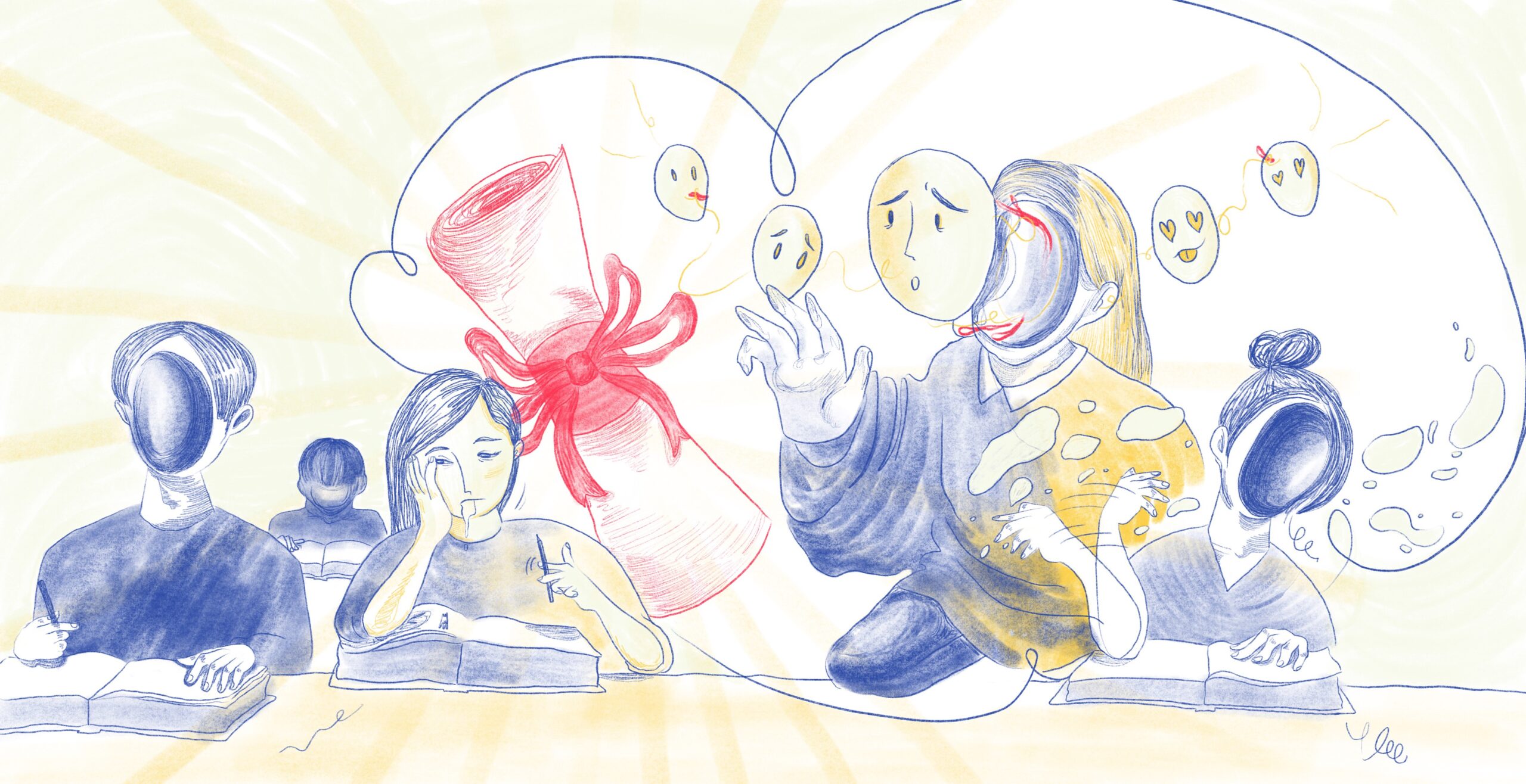
    Undoubtedly, education has given me the tools to make sense of, engage, and fight for what I believe in in a world that seems all too fragile and fascinating at the same time. Education has connected me to brilliant and inspiring educators and peers. But in the same breath, it is the site where I had multiple forays in declining mental health, where I had to contest my self-worth, and where I grappled with crippling imposter syndrome.

    I did well for my O levels, scoring straight As that was enough for me to enter a JC infamous for its retention rates in its day. Through a tumultuous A level journey, I was left traumatised and remained a quasi shut-in for the next 9 months before starting University. I felt demoralised and ashamed at having scored a “less-than-stellar” ABB, and I cut myself off from friends and spent an inane amount of time in my room, only coming out on some evenings for lonely dinners.

    I felt like I had let down my parents for not scoring a scholarship for an overseas education, that I had let down their dreams of me becoming a doctor. I felt like I had made poor use of all the comforts and monetary support that they (parents, bursary monies) have given me, fully aware that there are needy students far more deserving of the money. If that’s not an indication of an unhealthy relationship to education, I don’t know what is.

    Fortunately enough, I enrolled in a local public University and managed to find my footing in the Social Sciences. I felt at home and savoured the indelible sweetness of another chance at soaring. And soared I did. I graduated as Valedictorian and that landed me a scholarship to do my Masters at a local University.

    But not without its haunting brushes with uncomfortable student-professor interactions. I still cannot forget the sense of confusion after my senior thesis defense when my supervising Professor asked the other examining Professor to excuse us, before proceeding to kiss me on the cheek and hug me as a preface to how “proud” he is of me. A part of me is still unsure of that A- grade and unsure of his intentions. Perhaps he felt proud of me like how he would be proud of his daughter. But even if I were to rationalise it that way, I still felt infantilised and acutely aware of my female body in relation to male guidance, tutelage and approval in the institution of higher education.

    I felt even more acutely aware of my Malay Muslim body when someone commented “may my community progress with Islamic values in mind” on my sister’s Facebook post of my appearance on Berita Harian a few weeks after my graduation. A part of me is unsure if my peroxide shade of blonde and my exposed neck is the visual prompt for me to be reminded that my academic achievements and success has to be tempered with a responsibility to guard my appearance as a Muslimah.

    The biggest blow would be my first job out of school, ironically at my first alma mater. Coaxed by a top administrator at the prospect of entering their pipeline of funded PhD student to faculty member, I leapt at the chance to be a research associate for an auxiliary project by a large bank. Eager and bushy-tailed at my chance to prove my worth (whatever that meant), I was in for a rude awakening to know how exploitative and extractive knowledge production and the hierarchies of academia can be in certain cases.

    The scale of the project was monumental as the assembled team did not have the research wherewithal to pull it off convincingly from the get-go. It spanned 5 countries, and we had to pull off a comprehensive report of skills and labour issues in the span of 8 months. There ad-hoc assistants and no real research methodology to start off with. The inherent busyness of the principal investigators holding high administrative and teaching positions and the reluctance of other professors being goaded into the project meant that I inherited a lot of responsibility to pull this off.

    “So can you speak Chinese?” enquired a principal investigator, while we navigated the streets of Jakarta. Why was that even a question? Was the irony lost on him that without a Malay speaker, the previous interview that was entirely in Bahasa Indonesia would be a complete waste of their research funding? Perhaps it was, as he continued on with talking about his SAP* school experience. In that instance, I felt other-ed.

    This was followed up by months of hard work, trying to fashion some research findings that hardly existed in the public domain. I felt it an impossible task to convey to the principal investigators that what they were looking for, these mysterious figures, probably only existed within government bodies. The possibility of presenting qualitative research about skills to quantity was not only impossible but erroneous. But I did not possess the courage to state my perspective. After all, I am just the assistant to do the menial knowledge work.

    I remember the two weeks leading up to my breakdown. Despite anxiety attacks and a sense of desolation, I mustered all my willpower and worked tirelessly to produce what I thought were solid 250+ pages of reports for three countries. For a day I felt that at least I did something right. At least I managed to give them something to assess and approve of.

    One fateful morning, I received a damning email, almost berating me of my contribution. Words such as “wasted a lot of time” and “most of the material are irrelevant and not useful” and “find the figures…” were a crushing blow to my anxiety and stress. That fateful morning, I broke down to my parents and confessed to life-ending fantasies in front of the doctor, and in front of my very own mother. A palpable sense of guilt engulfed me as I questioned myself – did my mother work so hard and sacrificed so much to see me like this?

    To this day, I don’t know if my mental breakdown was warranted and justified. To this day, there was no word by the higher-ups after my email explaining everything that transpired. No word, except for me being credited and most of the research findings that were deemed “irrelevant” eventually being published in the final report. To this day, I wonder if it was all a farce, or that maybe this is just the way life works, and that my resentment, guilt and hurt are all just minority-millennial entitlement.

    Things are better now. Today, I benefit economically from a billion dollar industry that seems to feed off the kiasu anxiety of Singaporean parents. To find sustenance and financial support in the aftermath of depression, I tutored primary school kids. In all honesty, I was initially resentful and upset at myself for having let the situation transpire as such. In my mind, I blew all chances of ever advancing in higher education, and that because of my lack of mental fortitude, I let myself to do work that is ‘below me intellectually’, but perhaps what I ‘deserved’.

    But it is in this industry that I’ve found my comfortable niche and purpose to (hopefully) help my younger Malay/Muslim counterparts improve and thrive beyond just the paper chase, drawing from my setbacks and painfully acquired lessons. Leaning into the service of teaching for my community was been largely rewarding for the past 2 and a half years. At times, I push myself to the limit, working every day and having 28 hour weekends. I think there is an aspect of my wanting to compensate for the lack of something to show for. It is not a title that I have within the formal education industry. I still feel like I’m a scrappy rogue amateur that only an empire will be a convincing show of achievement.

    I am privileged to the gills when it comes to education. I have the support of my family and peers. I have built a business that I thrive in, and for the most part, I really do love what I do to survive. Why then, this sense of inadequacy and lack?

    In recognising that feeling, I realise that achievement is a drug in our neoliberal society and education system. Achievement is an avatar of identity. Achievement allows for hierarchy. Achievement is the currency in the market of self-worth. All of my unhealthy psychological associations with over-achieving, internalising failures and endless self-flagellation is socialised through the process of education, under the ideology of meritocracy. For those without the social capital, support or network to navigate this, pursuing education and achievement is but another manifestation of the oppressive twin structures of inequality and hierarchy than it is edifying.

    As Malay-Muslims, unless the narrative of underachievement that pervades the thinking of Singaporeans dies off, we would either be condemned as a Malay behaving as expected or lauded as a Malay who defied whatever unfounded cultural trappings that hold us prisoners. Neither positions are helpful to those of us who merely are trying to survive and lead a life that is purposeful and meaningful to our own individual desires.

    _

    *SAP: Special Assistance Plan schools are historically Chinese language medium schools which receive additional resources and assistance in recognition of the importance of promoting Chinese language and culture. This plan has been controversial because it is not available for any other ethnic or language group.

    _

    In her previous life, Sha was an overworked research associate. Now, she works as a full-time private tutor for Primary and Secondary level students, finding healing through connecting with youths in her community.

    Illustration by Ishibashi Chiharu
     

  • A Malay schoolgirl’s chronology of class and race

    A Malay schoolgirl’s chronology of class and race

    by Sya Taha

    _

    In Secondary Two, after sports training, a friend said she could give me a lift in her father’s car. When I got in, I looked at the driver – it was not her father but a middle-aged Malay man.

    *

    In Primary One, I was called to see the English teacher. “Did you write this composition yourself?” I had written, as the last sentence of a short essay introducing myself, “I am very clever.”

    In Primary Two, I was so bored in class that I was given assessment books to complete by myself while the girl behind me kept falling asleep in class and was getting 10/100 for a mathematics exam.

    In Primary Three, I was selected for the ‘gifted’ stream and had to transfer to a school that offered the programme. The nearest school to my home in the east was a bilingual (read: Mandarin) independent school, but the principal explained that the school did not offer the Malay language by saying, “We don’t accept Malays.” I went to a school in the west instead, where I was one of two girls in the class who studied Malay.

    In Primary Four, I was the only one in the class who did not know that C came before A – in music, at least. Since I was the only one who could not sight-read music, I had no choice but to pretend that I did and learn it as fast as I could, struggling in my own time. It turned out that everyone else was learning piano or violin (this was rumoured to be especially good for improving one’s math skills) and had been, for years.

    Halfway in the year, the day before a project report was due, I went to a nearby shop in the neighbourhood to print and bind it. When I submitted it the next day, I saw that one girl had printed her report at home, in colour, with a laser printer.

    In Primary Five, the entire level was in the afternoon session, except the ‘gifted’ students. Since the Malay students from all classes normally met in one classroom for the mother tongue lesson period, this meant that the two of us were not enough to warrant a teacher. So, for this year, we joined the students from Primary Six – we were two ‘kids’ amongst the kakak-kakak.

    In Secondary One, as the number of ‘gifted’ Malay girls in my cohort increased by 50 percent to three, we were given the task of representing our community. This time, we had to prepare a presentation on Islam, and we did a reasonably safe, uncritical explanation of the Five Pillars and Six Articles – whatever we had received in our weekend religious education.

    My classmates had lives I could not conceive of. Compact discs (CDs) were a coveted luxury, and one girl used to buy singles – imagine that, just one song on one CD! Another girl lived in a hotel suite where her father was a manager, and another girl’s parents brought us once a week to a country club, where we ate fancy grilled cheese sandwiches. They had birthday parties, with music and dancing and cupcake-decorating. It was all fascinating but strange to me.

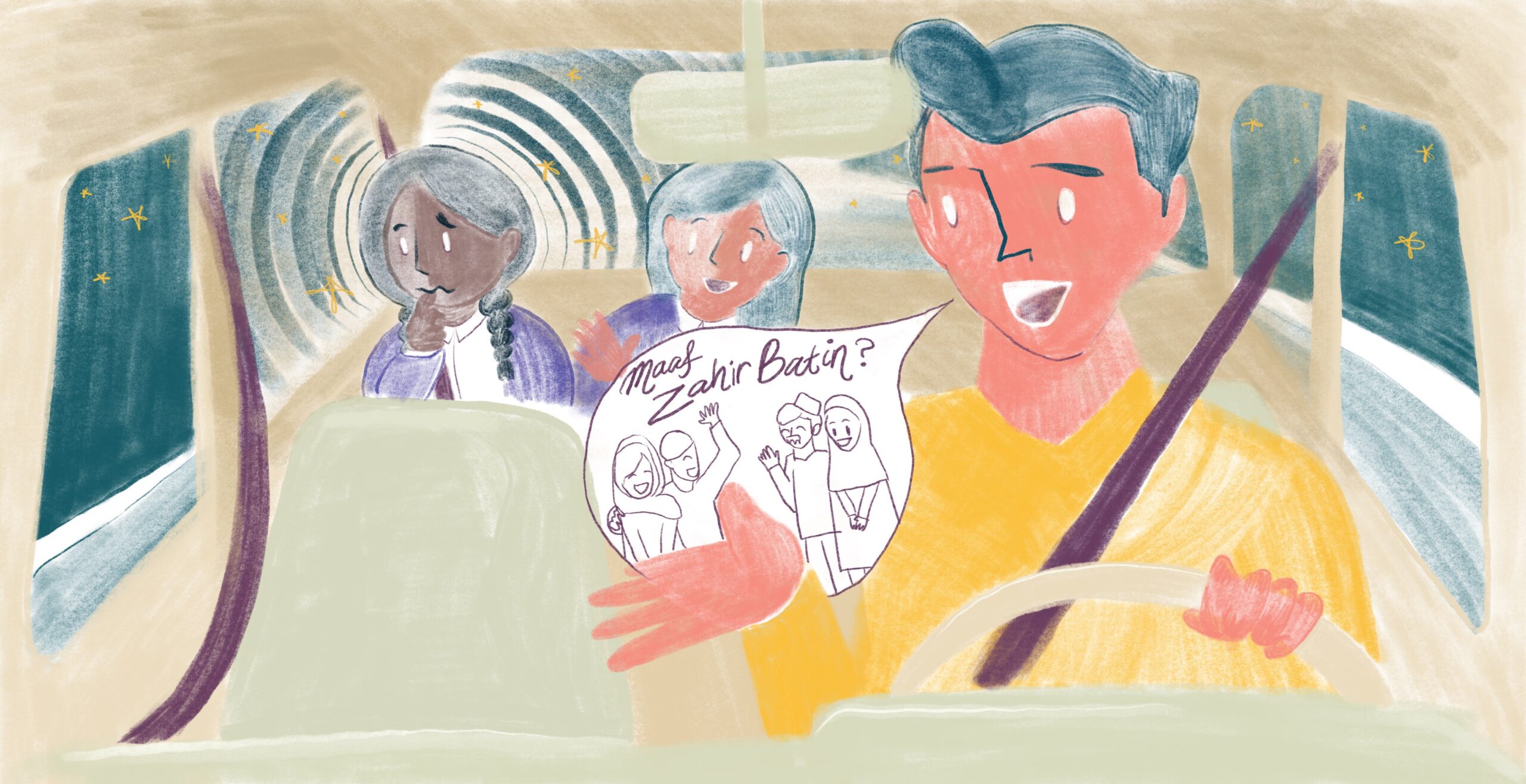
    For them too, I was probably just as strange. Was I possibly the only Malay person they had known, outside of their drivers and gardeners? A friend of one of my classmate’s parents once asked, as they drove me home, “When Malays say ‘Maaf Zahir Batin’ during Hari Raya, do they really mean it?” At 10 years old, I suddenly had to take on the task of simultaneously representing an entire community and defending insinuations of their duplicitous character.

    *

    Even though I was raised to make polite conversation with makcik and pakcik, I did not say a single (Malay) word to the Malay driver in my friend’s car. As he drove, the social class between a teenager and her elder never felt as unbridgeable as it did at that moment.

    _____

    Sya Taha is a PhD candidate researching on obstetric violence in Singapore. Her interests include decolonial theory, intersectional feminism and medical anthropology. She co-founded and co-runs Crit Talk, a safe discussion space for Muslims.

    Illustration by Ishibashi Chiharu
  • Education as a weapon for narcissistic abuse

    Education as a weapon for narcissistic abuse

    by Sya Taha

    _

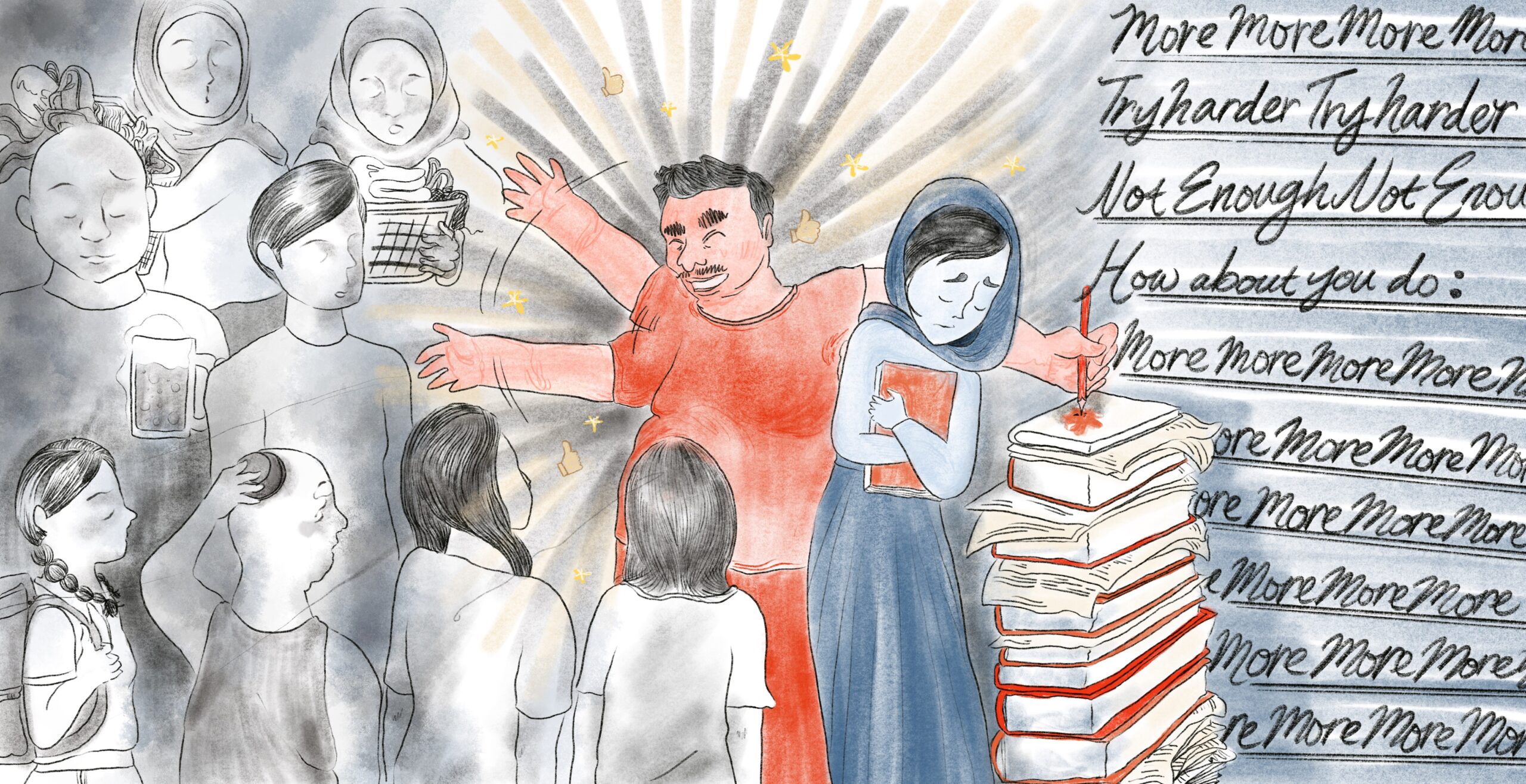
    “I don’t know what I did wrong, but perhaps, you are too educated!”

    My father said to me to end a big quarrel we had. It worked. I was so dumbfounded at this accusation that I shrank away.

    He had always been, as I perceived, my biggest fan and supporter in education. I had even written an ode to him on social media for Fathers’ Day, thanking him for encouraging me to go to the highest-ranked schools I could qualify for, funding part of my tertiary education overseas, recommending books by Malay men and women, political dissidents, lawyers, poets and academics. He often persuaded me to do a doctorate, all the while assuring me that he would pay the entire way.

    In hindsight, I wrote that Fathers’ Day ode so that he would love me. He had never expressed genuine appreciation or shown unconditional love for my achievements. In hindsight, my journey through the highest levels of elite and overseas education was something for him to brag to his friends that Malays ‘could do it’. In hindsight, his internalisation of many of the self-deprecating ideas of Malay inferiority led him to treat me as the exception that would lead us into a bright future.

    He said to me often that I because I was smart, I had to work hard to prove that Malays were not stupid and lazy. (Ironically, years later a Dutch professor would say to me in my freshman year, “You’re smart but lazy.”) Despite his goal of demolishing negative stereotypes, my father was embedded in local versions of success: his ultimate scholastic dream for me was to win a government scholarship. In secondary school, when I was hesitant to participate in a club activity because I did not feel confident enough, he told me I had “an attitude problem”.

    The pressure to do well – excel and excel perfectly – was intense. My mother, also, did not fail to let me know if I disappointed her. After receiving my ‘O’ level results of mostly As and a few Bs, I faced her declaration, “My daughter used to be smart.” She had compared me all throughout my schooling years to her sister’s daughter born in the same year as me, especially about the grades we got in major examinations.

    Finally, after earning my master’s degree from an overseas university, I hoped I had met my parents’ expectations. After graduation, it was difficult to find a job as a Brown migrant in Europe. As I worked freelance and from home for a few years, and later in a labour-intensive, sports-related job with my sister, my parents (and their friends) would ask, “You study so high, why you work this job?”

    However, as I reached my mid-20s they began to change their tone to reflect the saying: perempuan belajar tinggi-tinggi akhirnya masuk dapur juga [women may be highly educated, but will eventually spend time in the kitchen]. They were getting antsy as I was approaching the limits of marriageable age, but my education level seemed to be getting in the way of a husband.

    When I met my now-husband, with whom I made some unconventional marriage decisions, my father said that he “didn’t like how I was practising the religion” and that perhaps, it was because I was “too educated”. The ideal education was one that did not make her cross the boundaries of prescribed norms of femininity.

    From where I stand now, I see the multiple colonisations and violences that my father lived through as a Malay man. He had described how a racist teacher in secondary school (“I don’t like teaching Malays. All you Malays are lazy!”) demolished his self-esteem to study harder.

    In primary school, after we learned about the merger and separation between Singapore and Malaysia, he snorted that we were not learning “the real story”, which made me acutely feel the gap between two generations and two accounts of history.

    In hindsight, I believe his patterns of narcissistic abuse were rooted in his inability to reconcile modern and traditional ideas of women. Unfortunately, he took it out on me. Even though I try to understand his behaviour now, I do not excuse it and I do what I can to protect myself from further abuse. While I agree that what happens to us is not our fault, since becoming a parent I believe that healing and doing better is our responsibility.

    _

    Sya Taha is a PhD candidate researching on obstetric violence in Singapore. Her interests include decolonial theory, intersectional feminism and medical anthropology. She co-founded and co-runs Crit Talk, a safe discussion space for Muslims.

    Illustration by Ishibashi Chiharu
  • Of Passion and Privilege

    Of Passion and Privilege

    by Shaf Ghani

    _

    I remember one of the Raya gatherings when a distant cousin, whose opinion I did not need (but had to listen to anyway because I was obligated to kuehs and protocols), casually commented that I read too much. It was pre-contact lenses days, and he said that the next time he saw me; I would be wearing coke bottle glasses. Firstly, how did he know, because I always made sure I wore artfully chosen ones, those with a little better style than his attempts at friendship. More importantly, it could mean that I was too serious to take a joke or that his conversation attempts were bordering on offensive. Even at a young age, he had always portrayed himself as someone extremely worldly and considered books outside of school to be of no significance. That was just the beginning of the war between knowledge-for-knowledge’s-sake and knowledge-for-money’s-sake.

    Years passed, everybody grew up, and I met said cousin again in another Raya year. You would think that adulthood would make people generally more civilised at the very least. But said cousin had to go on being nothing but his good old self. Said something along the lines of “Study Literature? What for?” He sure knew how to push all the right buttons and I was completely floored by his ignorance. There was nothing wrong with having opinions but a wise friend once said that you have the right to have opinions but it should not hurt anyone. Honestly, any opinion could hurt anyone but maybe it was the way he said it.

    For a few days, I thought about what he said. Maybe said cousin did not mean it. After all, said cousin was not the only person that insisted that I had to study things that led to the next step. You don’t just say you study to find out truths or because you were curious about the world. Truth is a pretty loaded concept and the world should be lived, not just read. It was years later that I understood why it felt uncomfortable to be able to proclaim and study what I loved. In my secondary school years when many people were flocking to the hard sciences because they were clear routes to getting concrete, uncontested, examination marks and perhaps, easier future job prospects in Singapore, studying humanities was a little going against the grain. It meant that you were not carefully thinking about your future if you were too involved in the arts. To be able to make a living should be forefront in everyone’s mind but isn’t it also poverty if your soul was deprived of understanding people and the workings of the world deeply? They said arts was fluff and what sweet dreams are made of. Except that it opened my mind in a way that the sciences never could. But of course, holding the minority opinion is not always easy. It was not easy then, has not been easy now either.

    As a Malay student, I was also not supposed to be very good at Math and Sciences so the other options were languages and maybe, painting. Except that I actually did well enough to have the freedom of (limited) choice to study whatever I wanted. I could have studied more Chemistry, but I chose not to. So year in year out, I followed my passions. It was all still school and structure and I suddenly realised that the reading and marvelling over the fun facts would be a challenge when I had to apply them in exams. That being said, I did not think that applying scientific concepts would be any easier. They both had their unique sets of challenges.

    Being educated in Singapore meant that I learnt mostly in English and my mother tongue, Malay, was viewed as secondary because it is just how the education system works. How often have I heard people from my own community dismissing their own language or culture either in jest or seriously and I thought to myself have I been taught my mother tongue, the language of my family and identity (Malay), as a lesser tongue?

    Also, the educational institutions I went to were to be intrinsically affiliated to my personality. People still talk to me about neigbourhood and non-neighbourhood schools and I even learnt a new term for it, the NSK or the Neighbourhood School Kid. The quintessential NSK smoked, had her skirt hiked up all the way up her thighs or his pants made tight, got bad grades, probably got into trouble with the law as well. Now if one came from a good school, which was not part of this ghetto-like ‘hood’, one was considered a good child more or less. Sure, girls from good schools do get pregnant at 16 once in a while, but people were generally good there, they had hopes of making it in society. You were supposed to be thankful that you were not an NSK. Hope existed in a good school, people there loved knowledge and they talk politics, books and ideas. People in good schools also underwent puberty and dealt with body issues. But a lot of them notably came from wealthy backgrounds, those whose parents could afford tuitions worth three thousand dollars per month and Adam Khoo motivational speeches that made people bawl their eyes out at the sheer thought of doing badly in their studies and disappointing their ancestors.

    It reminds you of branding, a good school is a good brand and a neighbourhood school is not as good a brand. Here, it becomes some kind of social capital for you, this string of ‘good’ schools that you came from. Anywhere else around the world, nobody could care less.

    I remember streaming, EM1, EM2 and EM3 back in primary school and noting that EM3, the stream for students not so academically inclined, was made up of a specific race. I remember some people in school looked at them a certain way. At such a young age, an iron curtain had already fallen amongst us but we did not really talk about it.

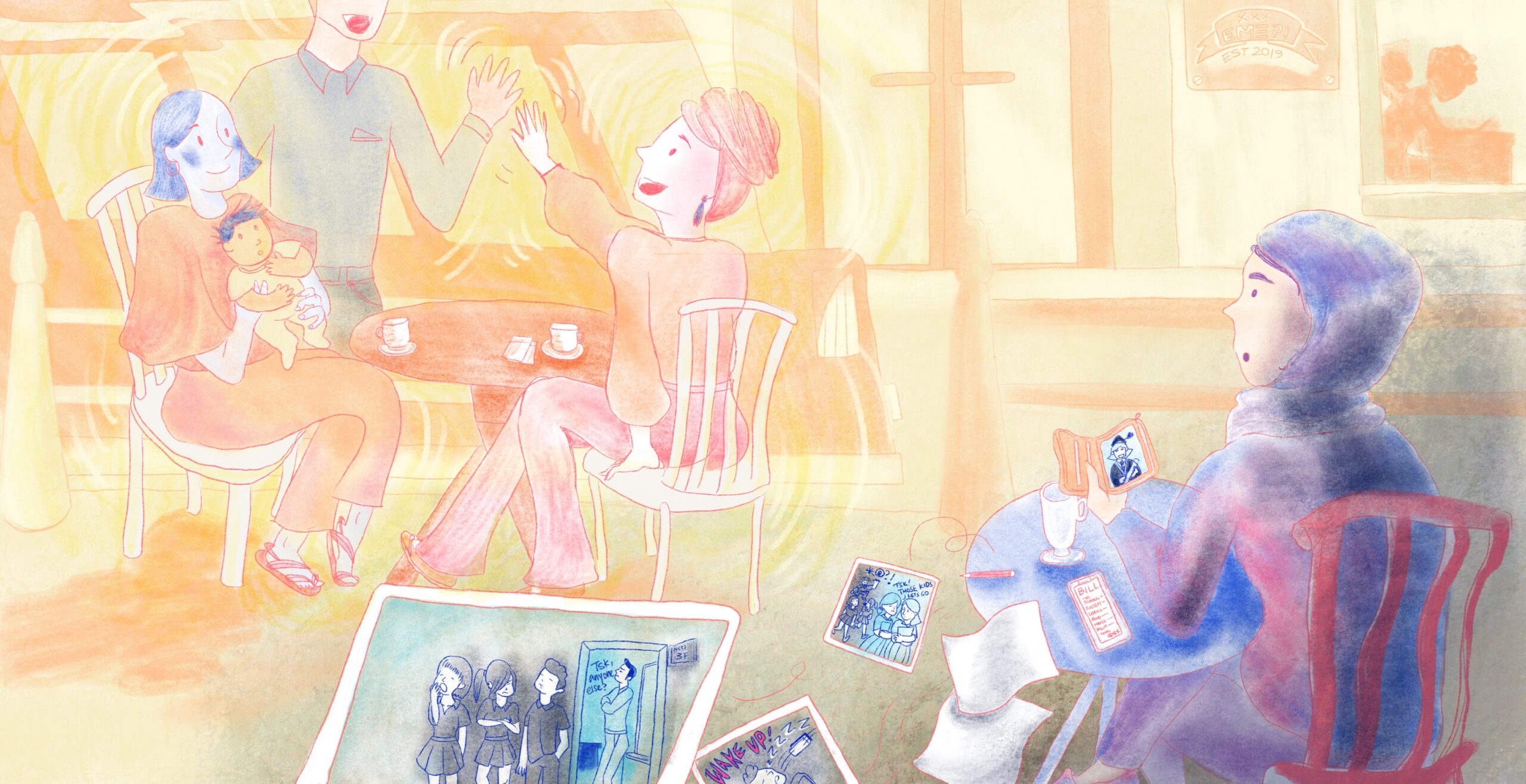
    Passing by some old school acquaintances from EM3 in adulthood as strangers in the same transport cabin spurred so many thoughts in my head. I thought about how their lives had turned out and I questioned myself, how did my life turn out so far? I wondered if it was that different from what my child-self was made to think. Regardless, I heard of friends who found happiness in their lives no matter which stream they came from.

    There were people from lower-end streams who had happy families and successful businesses and people from top streams who made permanent bad decisions in life, just to paint a picture. All the truths that I was educated with, or what I was made to believe were shattered time and time again and though I am forever indebted to the system that taught me to think well, I wish that in time to come, learners could learn and do what they love by the passion that is in their hearts. It would make our world so much better.

    __

    Shaf Ghani writes poems and short stories. She also teaches children and copywrites for a living. More of her works can be found on shafikassanctum.wordpress.com. 

    Illustration by Ishibashi Chiharu
  • Editor’s Letter: Education

    Editor’s Letter: Education

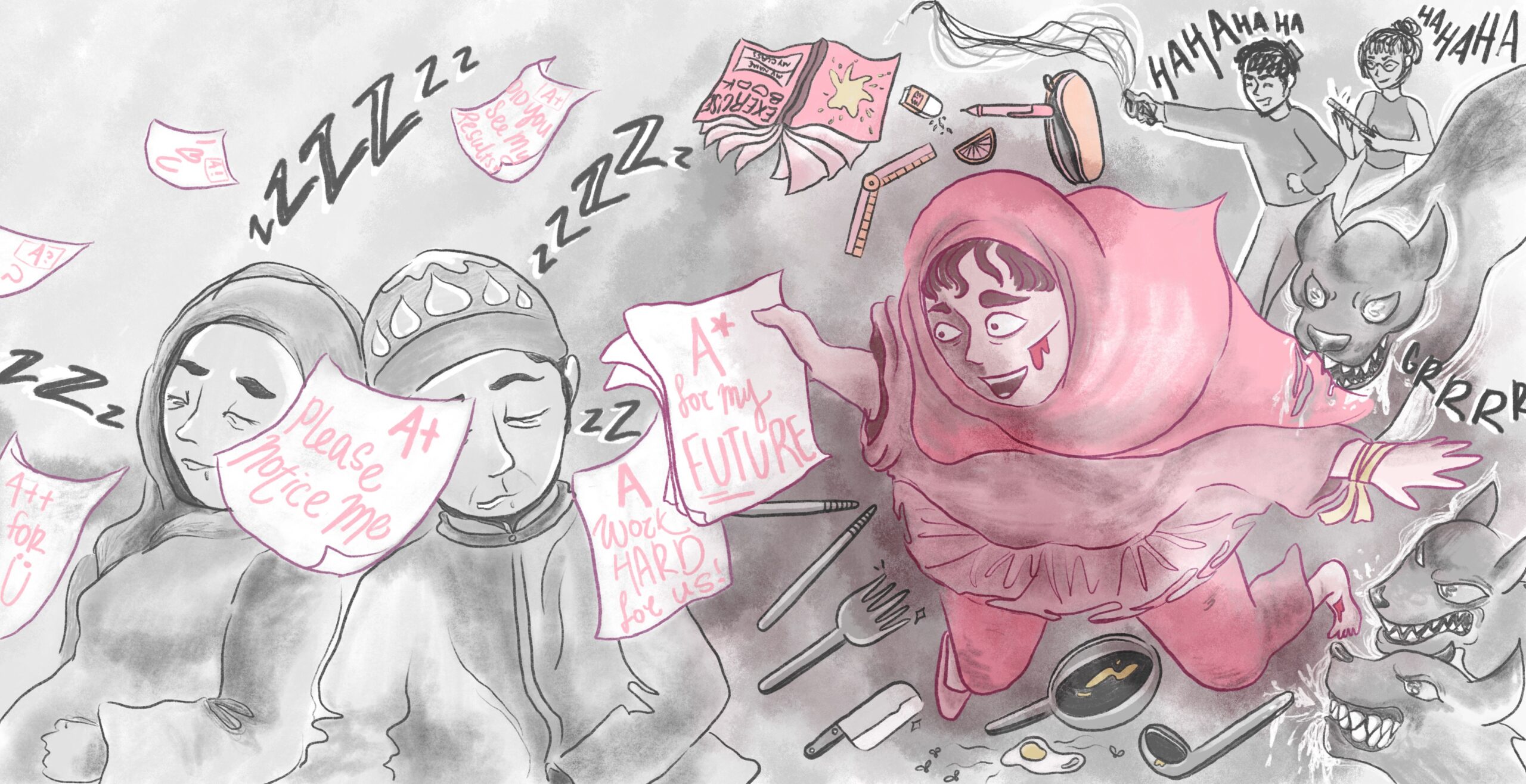
    The theme of education, to my surprise, elicited the most responses so far. Submissions range from women who have studied in Madrasahs, to mainstream schools, to those who have been through the Gifted Education Programme. The theme of education was also interpreted outside the parameters of school to include meditations on the informal education we may receive while living as a Muslim woman in Singapore. Cultural conditioning, after all, can be considered as an “informal syllabus” that gives us lessons on how we are to acceptably exist within our communities and even the world at large.

    I suppose the abundance in submissions is not so surprising when we consider how challenging and soul-breaking the education system can be in Singapore. Built on the hard pragmatism and ultra-competitiveness of the post-independence period and cemented with the eugenicist policies privileging graduates who marry each other (graduate mothers scheme), we have received and sometimes painfully internalized the message that our value in this system depends on how well we perform according to its standards. When the news came out that schools will start to phase out streaming, I was happy for future students who would not have to feel as intensely the shame and stigmatization that comes from being streamed to a “lower” class.

    This shame, sharpened when stratification intensifies existing social inequalities, is such a key experience of schooling in Singapore that we have had landmark creative productions detailing the experience. If this were not true, there would not have been such an explosive popular reception to the I Not Stupid movie or the critical appreciation for the theatre play “Normal” by Faith Ng.

    Of course, doing away with streaming will not end the way inequality seeps into schools and how it affects a child’s educational path, be it social or racial. In fact, these two things often interact with each other since a disproportionate percentage of the poor are also Malay. Malay students often suffer from the prevailing stereotype of being lazy and performing poorly in academics. These are then attributed to their culture instead of any consideration or sensitivity to more complex structural issues. Lily Zubaidah Rahim has documented this brilliantly in ‘The Singapore Dilemma’. I would like to share some passages I have never forgotten:

    “Encumbered by the double burden of class and ethnicity, socially disadvantaged minority youth often become alienated and disillusioned with the education system when their self esteem has been dented by their placement in the slower streams. . . Stigmatised as a ‘failure’, many ethnic minority students have responded by acting out their label and like a self-fulfilling prophecy ensured their ‘failure’. Frustrated with school, many Malay youths . . . wage cultural forms of resistance by resorting to various forms of disruptive behaviour as a means of striking back against the school system.”

    This tendency for Malay youth who ensured their own failure as if through a “self-fulfilling prophecy” due to the alienation they feel was something I noticed when I was in school, noticing how Malay students who did not do well and would have predictably felt insecure about their grades would try to redeem their self-esteem through rebelliousness.

    Lily Zubaidah Rahim would go on to say:

    “The common problems and impediments shared by the poorly educated and socially marginal across all ethnic communities suggest that the socio-economic and educational marginality of Malays cannot be simplistically explained away as a ‘Malay problem’ requiring Malay solutions. Such an explanation has engendered a truncated and fragmented understanding of a complex phenomenon that is strongly rooted in the historical, ideological, and institutional processes of Singaporean society.”

    *

    Growing up in a working-class family, intense importance was placed on my education. My family believed firmly in the state narrative of meritocracy and education as a social leveller; that it was a way out of our social strata into a more comfortable life (of course the past five years have seen intense critique on the myth of meritocracy and suggests that the education system only deepens existing social inequalities).

    My childhood was filled with memories of my mum saying what I know so many children from working-class and underprivileged backgrounds hear: when you’re older, buy mama a big house. Sometimes the house is a car. Holidays overseas. An oven, or any expensive kitchen appliance in general. Whatever it was, it signalled the fact that the future was a site of idealised possibility and wealth and the path to that future was through the educational ladder. I have sometimes often felt intense pressure to live up to their expectations. Like many Singaporean children, I have often felt like their approval rested on my ability to excel. Till today, I have internalised this demand and slip into intense self-criticism where I consistently feel like I have not succeeded enough in the education system, even if intellectually I know that I would never impose such vicious standards onto anyone else. I have to say though that the pressures I feel do not compare to the intensity of pressure faced by other students who are even more stigmatized and whose intelligence or abilities are not captured by the education system.

    Fueled by the image of an abundant future, I had my mother’s involved commitment in my education when I was younger. However, as my sister grew up and my youngest brother came into the picture, my mother no longer had space or time to be as involved as she would like. Even when she later quit her job, she could not be as directly involved since the school assignments were pass a stage where she could understand them enough to help us. This is a common problem and I learned that there was even a program started some time back where parents are taught according to the syllabus so that they are better equipped to help with their children’s homework (if they even had the time)!

    For many Singaporean children with parents who do not have the privilege of offloading caregiving and home duties to a domestic worker, or the financial ability to purchase supplementary and tuition lessons, so much of their educational journey depends on available public resources and communities: the school, its environment, our teachers, our friends, available (or lack of) support systems, public spaces for studying. It is for this very reason that paying attention to these public resources and the welfare of teachers is important. It matters that in an already unequal society, we try our best to make sure the available resources to students is decent and dignified.

    My time in secondary school has taught me so much about the ways in which class can distort a person’s educational journey. I went to a “neighbourhood school” which had a population of students whose class background generally matched mine. Though I don’t wish to romanticise the working-class or the poor as more “authentic,” I can safely say that I look back at that period fondly. I was in an environment where I did not feel the pressure or awkwardness of my class background so strongly as alien or undesirable–feelings that cropped up when I went into junior college and felt even more keenly in university, where racist jokes and elitism punctuated my time in school.

    Secondary school was also a time when I saw how school was not just about studying and getting good grades, but about navigating what can feel like a complex, precarious minefield of social life that can intensely affect your mental well-being and shape your sense of self. These things which may seem trivial and unimportant as adults were undeniably felt so much intensely in youth: wanting to feel included, to make and keep friends, to be able to pursue the interests you were developing, to feel loved and appreciated by your parents, to feel affirmed for who you are.

    In an environment where everyone is subjected to obey established rules and punished if they don’t; a space that is touched by the biases of the world–imagine how additional pressures can compete to take up your mental and emotional space. How these things can eventually interfere with someone’s deserving future since the path is ruthless is discarding those that don’t meet its standards.

    So much happens in a school aside from an education, and it was intensely clear to me back then that not everyone was on an equal starting point. I remember a friend streamed into a better class than I graduate with mediocre grades for O levels because even during the exam period she had been working part-time at Mcdonalds. I even heard of a boy who was working at KFC earning $4 per hour just to be able to pay the already heavily subsidised school fees. I had a classmate who disappeared for months due to family problems and only returned to school later in the year, his education disrupted.

    When people sometimes speak of youths from underprivileged backgrounds as being unmotivated to study, as difficult to control or teach, as aimless, I know that they are either willingly ignorant, or have chosen to ignore the fact of how the totally absorbing emotional toll of present difficulty can make one lose the luxury of considering the long-term implications of their decisions. When you’re going through intense moments in your life, or when the daily stress of finances place a weight on your ability to function, when home is not a safe place, and when there is little proof around you that society cares for your existence, how much mental space do you have left to allocate to studying or to think about the future? When the present is always an emergency, how can you look away and spend the time needed on other things? Willpower alone is often not enough to get you where you need to be.

    Being able to have an education, and to focus on it, is an immense privilege. I know I have had immense privilege to be able to pursue it without debilitating distractions, even if my class background does not present me with ideal options or an easy journey (my university journey was sometimes tiring as I juggled multiple part-time jobs along with school), but I know I was very lucky to have had the chance to pursue a higher education.

    I mention this because as someone who was lucky enough to have a family who supports my education and wants me to pursue it as far as I am able, I was rudely shocked to realise that even in the year 2018, there are still women and girls who have to struggle painfully with their family when they want to further their education or to simply take it seriously. There are still women and girls who are pressured with the message that their priority lies not with their education, but with gendered expectations like getting married (and how often have I heard female friends/relatives telling me they are re-considering further studies because it threatens the egos of their husbands!), having children, or being the primary caregiver for the family. It’s not that these things are not important, and certainly, some women do prioritise these things. The problem is not what is prioritised, but the element of choice. A person should always have the freedom to make their own informed choice about what they wish to prioritise for their version of a fulfilling life.

    I’m really pleased to see that many of our submissions came from women who recounted their experiences in the education system, and were able to articulate the structural issues they saw or faced. In fact, I would say that a good education is one that results in a person being able to critically engage with the knowledge or experience presented to them and question whether the dominant or received interpretation is one that they can accept.

    We learn so much when we hold up things to the light, turning it this way and that, and trying to figure whether it holds up to honest, critical scrutiny. In Singapore, even this perfectly normal and healthy desire to critically analyse, to scrutinise, to critique, can be seen as disruptive, negative, and undesirable. It is, therefore, all the more precious when we insist on our right to question, which is something I think our submissions all have done. They refuse to settle for prevailing narratives that may tell them how they should feel about their education or certain myths and stereotypes that are abundant when it comes to education and the school system in Singapore. They have articulated their stories so poignantly, so strongly, and so honestly. I can only hope that people will listen.

    _

    Illustration by Ishibashi Chiharu