Category: Editor’s Letter

  • Editor’s Letter: Income Inequality

    Editor’s Letter: Income Inequality

    by Diana Rahim
    _

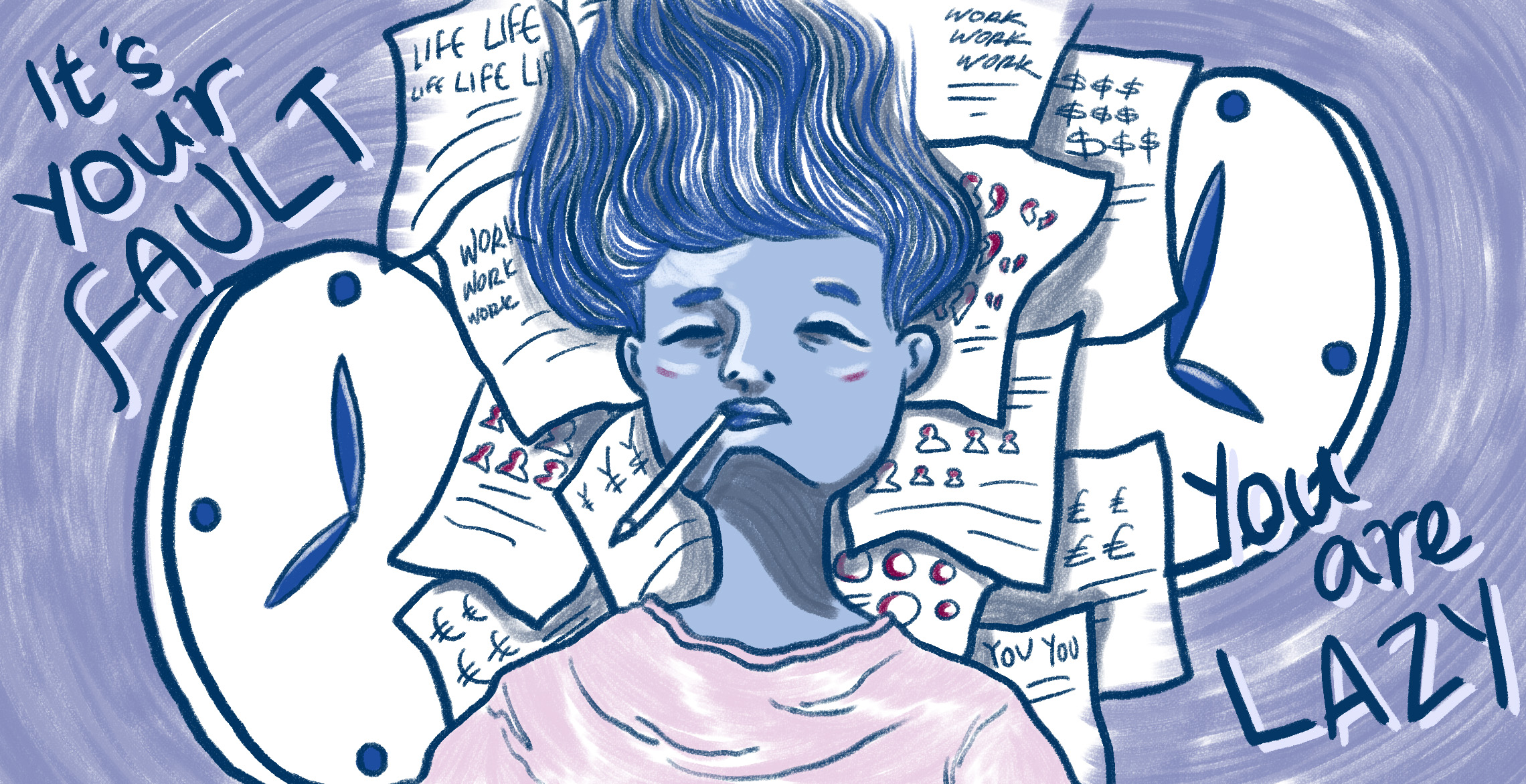
    When I started thinking about this letter,  I was still processing the announcement by Trade and Industry Minister Gan Kim Yong that food prices are expected to rise due to a rise in energy prices, supply chain bottlenecks and labour shortages. There has also been an increase in bus and train fares in Singapore for the first time in two years, a rise in rental costs, and an increase in electricity and gas tariffs. Now, Singaporeans are also told of a planned increase in the Goods and Services Tax (GST).

    Essentially, we have seen an increase in the price of food, rent, transportation, utilities at the same time there is a rise in retrenchment, a rise in the unemployment rate, a reported increase in food insecurity and demand for food aid and an overall greater experience of precarity amongst the low-income, who are hardest hit by the pandemic and its effects.

    Unfortunately, this isn’t a phenomenon secluded to Singapore. There has also been a global rise in food prices and we also know that the ultra-rich has gotten even richer. About a year ago, it was reported that the wealth of billionaires rose by $10.2 trillion during the pandemic. An article about the billionaire boom last year stated that nearly 700 individuals were made billionaires. Most damning though was this:

    As the virus spread, central banks injected US$9 trillion into economies worldwide, aiming to keep the world economy afloat. Much of that stimulus has gone into financial markets, and from there into the net worth of the ultra-rich. The total wealth of billionaires worldwide rose by US$5 trillion to US$13 trillion in 12 months, the most dramatic surge ever registered on the annual billionaire list compiled by Forbes magazine.

    Reading this, I thought: let there never again be the claim that the poor are over-dependent on welfare when the rich are raking in money meant to keep countries afloat, money that they don’t even need. In truth, the world is run, bent, and being destroyed to feed the wallets and egos of the rich. The poor are often judged and stigmatised for needing financial help, when in actual fact, most are not being paid the true value of the work they do and it is the rich that game the system to their advantage, through exploitation and wage theft.

    Even when the crisis hits individuals from every stratum, it is undoubtedly the poor who suffer the most profound losses and difficulties. Their incomes cuts are far higher, especially if they work in customer-facing industries, where there is no option to “work from home”. A report by Beyond Social Services found that the median household income of families they assisted dropped by 69% from $1,600 before the Covid-19 pandemic to $500 after.

    While we can share numbers and data to prove the existence of income inequality, it should not be forgotten that it is something that is materially, emotionally and psychologically felt. It means immense psychological stress day after day that keeps one’s mental state perpetually distressed. It means a lack of nutritious and adequate food that leads to health issues and a difficult relationship with food. It means that one’s self-esteem takes a battering, in the struggle to provide for one’s children the quality of life all parents wish for their children. It means a vulnerability to an array of negative coping mechanisms in order to bear the the pain and indignities of life.

    In the submissions of this series, we see infuriating and frustrating examples of how people must suffer dehumanising treatment and waste precious time and energy just to access the help that they so badly need. Financially vulnerable and exploited communities, what we call the ‘low-income’ community, are people who have been sacrificed in a system that requires a population to be underpaid and overexploited. They are then put through gruelling experiences and means-testing to access the funds they need to live a decent life. Financial and material struggle in Singapore is by no means rare, especially when we consider the fact that (as of 2020) around 52,000 Singaporeans earn less than S$1,300 a month.

    Workers go through a strange kind of affirmation in Singapore, and I suppose this is true for many other countries. They are offered gestures of support in the form of claps and cheers at sundown. They are publicly admired for their grit, endurance, and determination to make a living and support their families. But the moment they speak about their exploitation, or organise against employment abuses, this support seems to wither. Economically exploited workers seem to only be admired if they quietly endure their exploitation.

    To me, true concern and resistance against economic injustice means supporting workers when they advocate for their labour rights and resist against what keeps them exploited. I think of the bus uncles who bravely decided to file a lawsuit against their company for alleged unfair work practices such as long working hours and unpaid overtime. I think of the delivery riders who filled up a Meet-The-people session to express their frustration and anger when an e-scooter ban impacted their work overnight. I think of migrant workers who speak about the shameful conditions of their dormitories, unfair work practices and the dehumanisation they face in Singapore. I think of nurses sharing about the unforgiving conditions they are enduring as hospitals strain in the pandemic. I think of the people who contributed their experiences in this series, shedding light in the difficult navigation around bureaucracy and judgement as they simply want to access a more dignified life. Instead of talking about how these efforts are signs of ungratefulness, disobedience or excessive, maybe we should listen and support them. After all, the ones who knows best about the failures of a system are the ones who have been failed by it. In expressing their experiences, difficulties, and resisting against their exploitation, they stand for not just themselves but for all of us.

    As our country and many others around the globe are striving towards normalcy, the crisis of economic inequality that COVID-19 has revealed and deepened has remained. If you are able and willing to consider contributing to the following mutual aid efforts and organisations working to keep people fed and afloat:

    Migrant Mutual Aid
    East Side Mutual Aid
    Beyond Social Services
    Willing Hearts
    Food From the Heart
    Engineering Good


    __

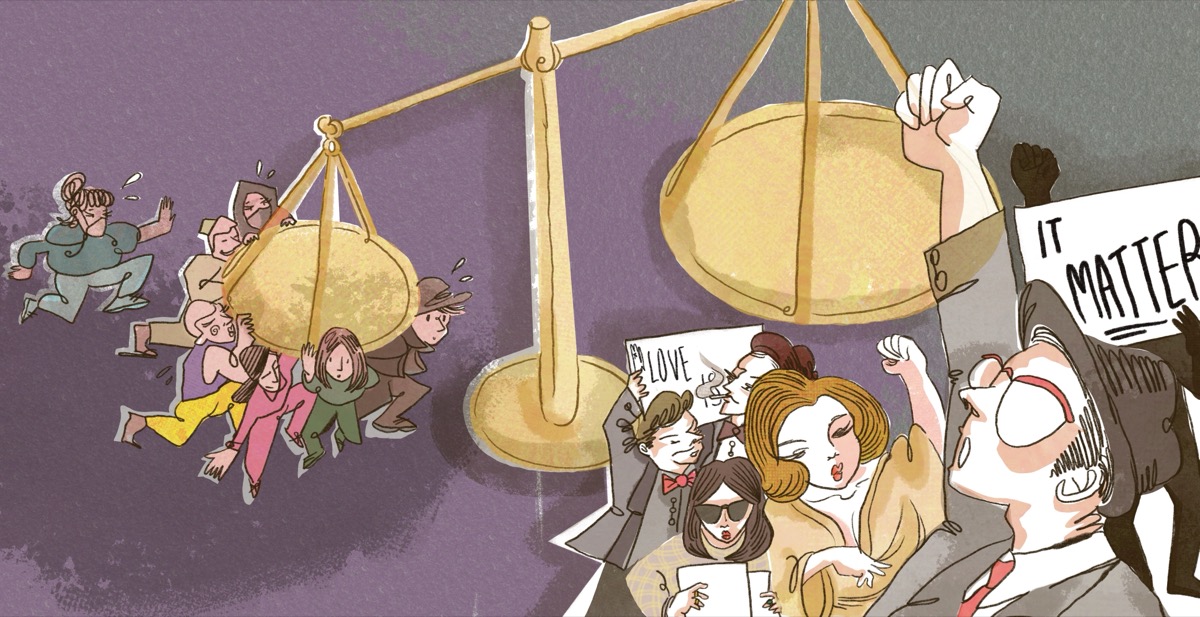
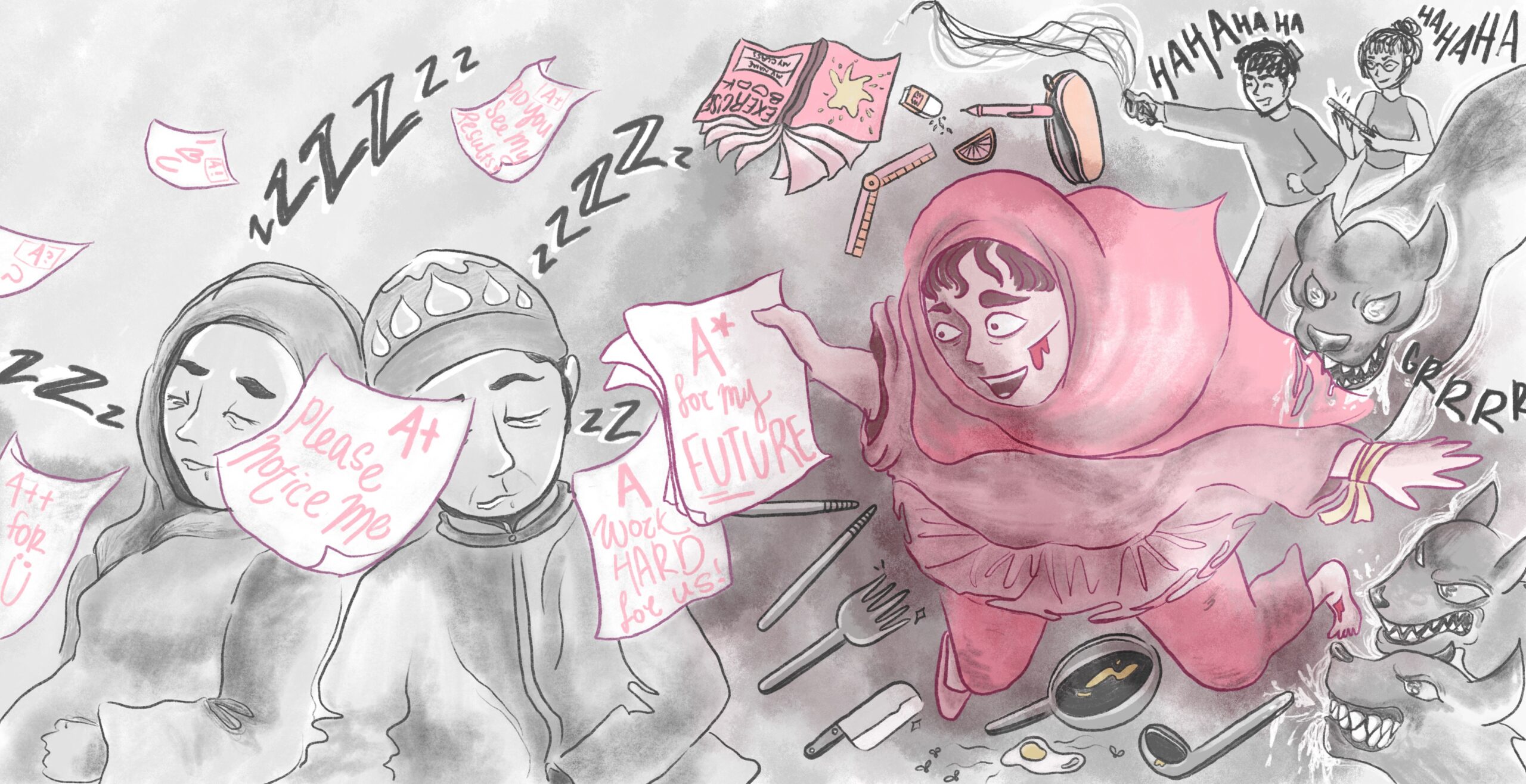
    Illustration by Elisa Tanaka

  • Editor’s Letter: Justice

    Editor’s Letter: Justice

    It is without a doubt that justice is one of the most foundational aspects of Islam. When I think of Islam, I think of the fact that it is a religion that was revealed to our Prophet Muhammed (peace be upon him), someone who fought resolutely throughout his life against tribal injustice and steadily worked to introduce reforms to improve the material conditions of women. 

    In the Qur’an, the words qist and adl give us an understanding of what justice means within the context of Islam. Qisṭ refers primarily to its application within the socio-economic domain, whereas ‘adl refers to an essential quality of fairness, equality, and divine justice that can be emulated and practiced in our interactions and behaviours. The Qur’an thus offers an understanding of justice that is directed towards society as well as the self and others, one that is systemic and societal as well as personal.

    This duality makes perfect sense to me: in order to change and improve society, it is important that we also work to improve ourselves, and even as we work on changing our own behaviours, it is important that we do not close our eyes to the injustices of our society and the world around us. In fact, often times when we look closely enough to the suffering and injustices that we face, we see that it is linked to the suffering of others. We do not struggle in a vacuum or in isolation. We struggle under the same system that benefits from us being isolated and passive, accepting of our lot.

    Throughout his life, the prophet exhibited this duality. He not only embodied justice through his fairness, kindness and just behaviours even to his enemies, but he also stood resolutely against injustice in his own community. He was not a passive bystander by any means and actively participated in speaking up to power and standing for the oppressed. His approach was also significant since he moved away from punitive methods of settling conflict and harm in favour of consultation and reform. This reformist and non-punitive approach to justice is reflected in a submission to our series by Ryaihanny Sahrom about why Prison Abolition is a Muslim Issue.

    I have constantly sought comfort in remembering the Prophet’s (PBUH) behaviour. He was a person who had to struggle his whole life within a society that had a predatory, capitalist economic system. In its place, he had instituted within Islam a more socialist ethos of wealth redistribution and the belief that the well-being of all was a collective responsibility. When it came to the condition of women, even his own sahabah were at times resistant to the reforms that he wanted to enforce, indicating just how radical his vision was and how fierce his commitment was to justice. He was constantly moving against the tide of opinion and behaviours and practices that society was uncomfortable in addressing and questioning. It is not an easy task. Similarly, I am inspired by the pieces by ‘A and Anisah in their commitment to speaking up about female genital cutting in the community as well as the “hijab issue” respectively. ‘A’s vulnerability in sharing the mean-spirited comments that she has received due to the passion she has in challenging harmful practices moved me deeply. Here is a young woman who has chosen to speak up, even at personal cost, and I am moved too to know that she has found an accepting community who can support and do this work with her.

    I take comfort too in the following verses in Surah Al-Nisa:

    O you who believe! Stand firmly for justice, as witnesses to God, even as against yourselves, or your parents, or your kin, and whether it be (against) rich or poor; for God can best protect both. Follow not the lust (of your hearts), lest ye swerve, and if ye distort (justice) or decline to do justice, verily God is well acquainted with all that ye do.
    – Surah Al Nisa’ (4), Aayah 135

    I see in this the call for a commitment and dedication to justice so pure and devoted to the universal value of a human life and their rights, that it is imperative to disregard hierarchy in any form—whether within the family, within socio-economic standing, or within society. It is a beautiful reflection of the concept of Tawheed, where all are equal before God. Hierarchy in itself, I believe, is vulnerable to perpetuation of injustice.

    I have learned from the Islamic conception of Justice that in order to live in this world, we must engage with our community and its political realities. My faith is not simply about a transactional relationship with God where I do good deeds with the sole desire to enter heaven. Instead, I see my faith as giving me guidance on how to live in a difficult and painful world, it gives me guidance on a path of struggle, of jihad, against the many injustices that are perpetrated against vulnerable communities.

    There’s been a strange thing I’ve been doing after my daily prayers. As I sit on the mat and supplicate, my usual requests for contentment, safety, and direction for myself and my loved ones have steadily been replaced by larger requests that are no longer individual in nature. To me, in a period of such intense suffering as this pandemic had brought, it felt insufficient and empty to request for only myself and my loved ones.

    When I was young the concept of prayer has always been about requesting for myself and for others, but these requests are always somewhat personal and largely individual in nature. There is of course strong encouragement to pray for others, but they were still largely individual requests—I pray that my grandmother will get better, I’ll pray for my friend’s recovery, I’ll pray for my family’s security, I’ll pray for late relatives. We don’t really ask for bigger things that are more structural in nature. Can I pray for universal healthcare? Can I pray for a world without fascist leaders? I have been doing that these days, even if it feels strange and impossible. Why be stingy in your requests the one who can make all things possible?

    It sounds strange, but I ask for the collapse of our current system that sacrifices the lives of the poor and marginalised, and pray for a world where all can have an opportunity to thrive. I pray for the end of the pandemic, that humanity survives climate crisis, and that we can bring forth a way of organising ourselves and our society that prioritises universal access to basic necessities and human rights.

    As we ride out a pandemic that has seen mostly the poor and marginalised bearing the brunt of political failures, where vaccines are hoarded by richer nations and lacking in poorer ones, where the disease of racism has resulted in attacks against South Asians in Singapore, I think it is as good a time as ever that we take a deep look into how committed we are to journey of justice. To survive this pandemic as a global family, to survive climate change, to survive the persistence of poverty, and bigotry in all its forms, I cannot imagine a journey more imperative than the journey towards justice.

    __

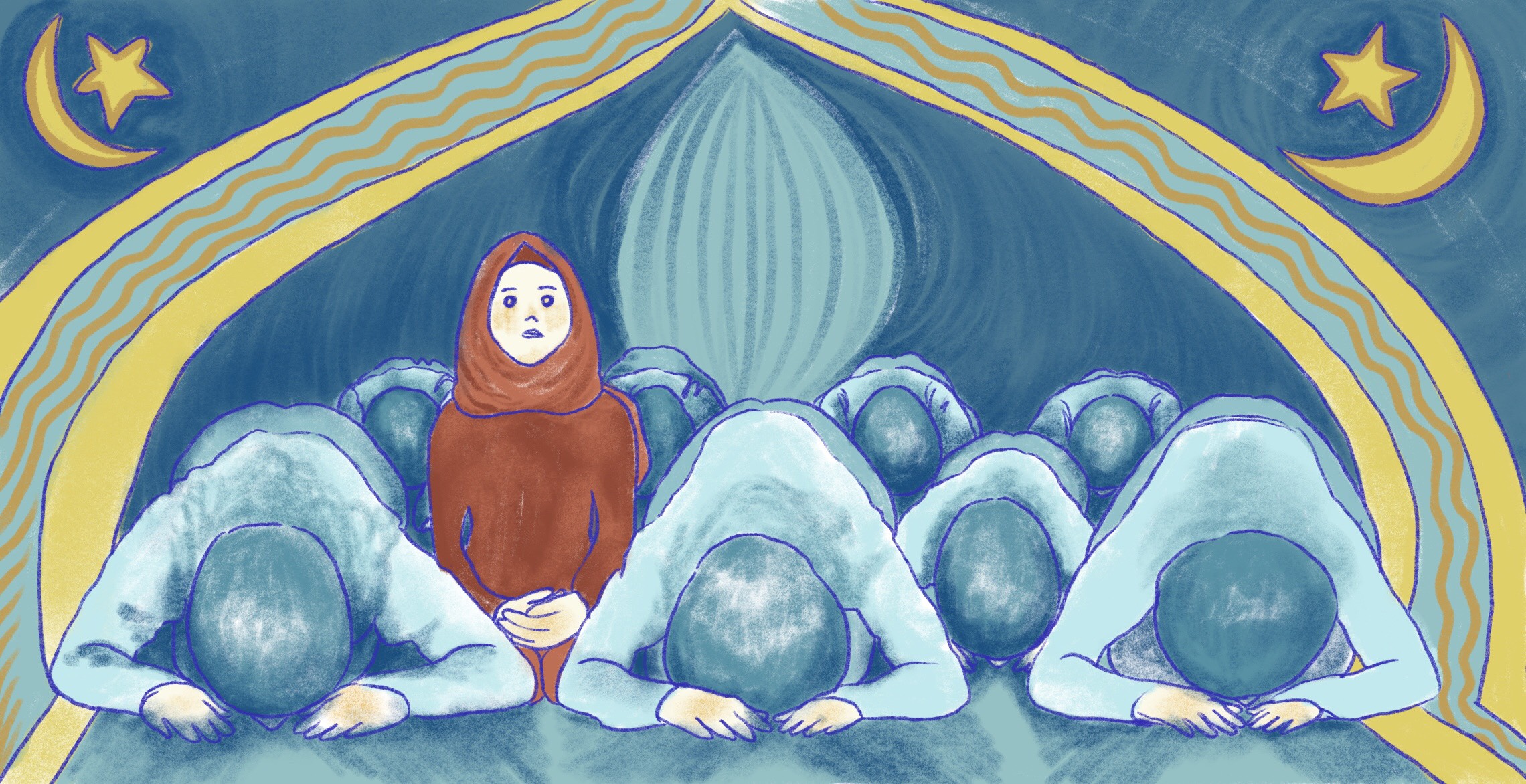
    Illustration by Ishibashi Chiharu

  • Editor’s Letter: South Asian Muslims

    Editor’s Letter: South Asian Muslims

    by ‘Afifah Shameemah

    __

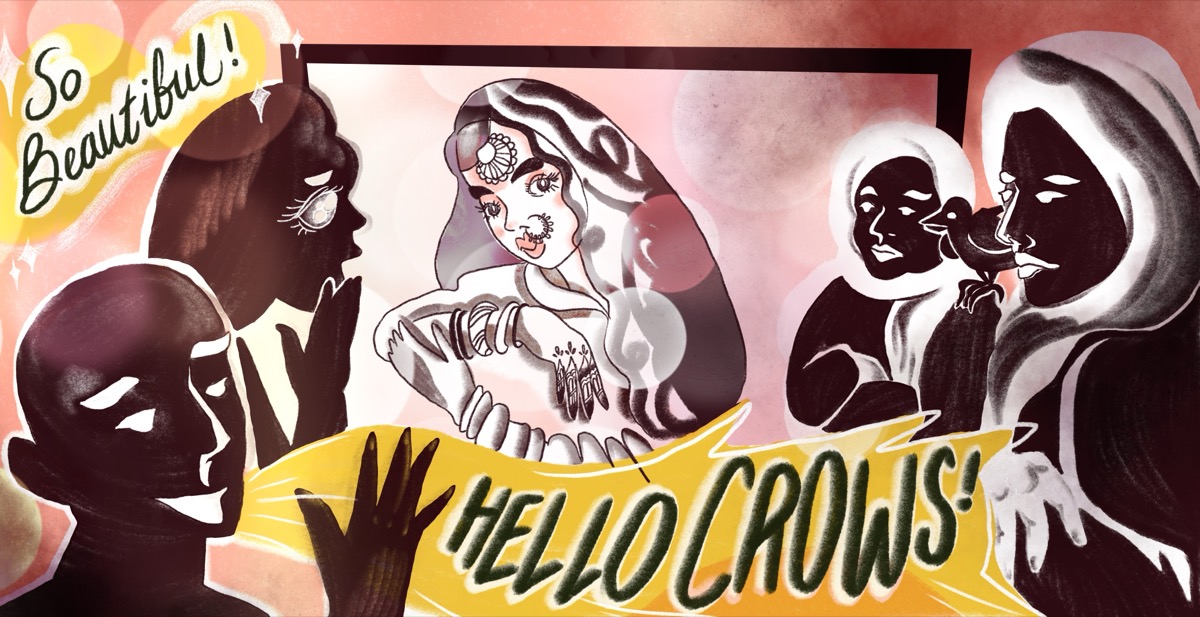
    “They call us crows; black, ugly, noisy. ‘The crows have descended’, they’ll joke among themselves.” – M. A.

    A friend, M, reached out to me to share her experiences as an Indian Muslim woman in Singapore through an insightful yet disheartening email. Much like her, many other South Asian Muslims have taken to Social Media to share their personal experiences with racism in the Muslim community.

    My own earliest recollection of a racist encounter was as a 10-year-old. I had to wear slippers to school with my baju kurung uniform because I had a toenail injury. A teacher called me out when she saw me and said something along the lines of “Jangan pakai selipar macam gini. Nampak macam anak keling.” (Don’t wear slippers like these. It makes you look like an Indian child). I didn’t know what to tell her. I am Indian, and proudly so, but at the time, I thought that I shouldn’t tell her because she sounded so condescending, like being Indian was a bad thing, and I didn’t want to be treated as less than.

    My ancestors are Indian and they married into Malay families when they settled down in Singapore. I am more in tune with my Malay roots than my South Asian ones, with my mother tongue being Malay, my social circle being consisted of primarily Malays, wearing traditional Malay clothing, partaking in Malay cultural practices and etc. For this reason, I am privileged in a sense where I can pass off as Malay and fit into the Malay community, the race that makes up majority of the Muslim population in Singapore. But from time to time, I get racist remarks from the people around me about my dark(er) skin, my ‘angry’ and ‘unapproachable’ demeanour, loud voice and my temper – traits people associate with being Indian. I believe that this is a shared experience many other Indians feel because we no longer fit into the CMIO model so easily.

    I was incredibly honoured to be invited as a guest editor for this edition, but I was honestly contemplating whether I should take up the offer. Some people think that I am not ‘Indian enough’ or that I’m not a ‘real Indian’ because of how disconnected I am from my Indian heritage, which means that I don’t have the right to speak about the complexities of being a South Asian Muslim in this country. But what pushed me to do this is my privilege. I am privileged enough to be accepted by the Malay community as a Malay while at the same time being tethered enough to see and understand the marginalisation South Asians face, even if my personal experiences haven’t been ‘extreme’.

    The objective here is simple: To provide a platform where we can amplify the voices, experiences and concerns of South Asian Muslims, the minority within the minority, if you will. Hopefully this experience can be liberating and cathartic for our fellow South Asian Muslims. Beyond that, hopefully, after listening and reading, we can work towards positive changes by reflecting on our personal prejudice, internalised racism and even systemic injustices that oppress our own Muslims.

    This series is dedicated to South Asian Muslims, people of Afghan, Bangladeshi, Bhutanese, Indian, Maldivian, Nepalese, Pakistani or Sri Lankan origins and/or decent. It was imperative that we used the term ‘South Asian’ instead of just ‘Indian’ because one of the most common forms of microaggression is the racial grouping of all brown people as Indian, when in actuality, the variety of ethnic groups in South Asia goes beyond that. When any individual insists that all brown people are the same (read: semua pun sama: India), they are invalidating and disrespecting the origins, heritage and ancestry of South Asians, the differences that distinguish their cultures and their diversity, even if there are some similarities.

    This microaggression is not only seen in day to day experiences, but in media as well. It is important to acknowledge the existence of this casual racism in mainstream media because media has a big role in influencing the masses, especially those who are not exposed to the racial diversity of South Asians. Let’s look at Disney’s rendition on Aladdin.

    While they took steps to be more mindful of racial complexities in the 2019 version as compared to the 1992 animated film, there were still many instances where they mixed Middle Eastern culture and South Asian culture. Granted that these two cultures may have influenced each other to a certain extent due to some of our shared history, there are still very stark differences between the two that should not be cherry picked at the convenience of white producers for entertainment. Between the dance scene that was clearly inspired by Bollywood dance numbers to the clothing worn typically by South Asians (not Arabs), the movie being filmed in Jordan and the casting of both South Asians and Arabs, the movie lumped many different races and cultures into one: Exotic Browns.

    While the racial diversity of the cast was admirable, we have to ask: why? Was the cast racially diverse for the sake of appealing to people to reap a larger audience or was it for the sake of empowerment and representation? How can we claim to appreciate and respect different racial groups, diversity and cultures when we don’t even bother to learn and portray their differences properly? If proper representation wasn’t the goal of creating these movies, what is? Entertainment? At who’s expense?

    For a more localised context of the portrayal of South Asian culture in media, let’s look at Malay social media. In recent months, a Malay celebrity/model advertised for contact lenses by donning the lehenga, a large nose ring, bangles, with henna on her hands while lip syncing to a Hindi song. This was inspired by her appreciation and fascination for Bollywood films. Many questions were raised from this incident: Is this cultural appropriation or cultural appreciation? Is this fetishizing South Asian culture or is this appropriate for a multi-racial country like Malaysia and Singapore? In his Facebook & Instagram posts, writer Alfian Sa’at asks three important questions: Where do we draw the line? Who gets to draw the line? What would our country be like if we loved South Asians as much as we love their movies, food and fashion?

    Perhaps in this case, the intention of the model and the company should not be put under scrutiny. Perhaps what is more important is that we ask the bigger questions like as part of the majority, how does one show appreciation for a culture that is not theirs? Is it enough to appreciate the culture and their people simply through wearing traditional costumes and eating their food? Do we go the extra mile to speak about difficult topics and address the racism within our own communities to truly be allies and supporters of South Asian people? How can we do better by South Asian Muslims in our countries?

    The issues faced by South Asian Muslims in Singapore is a non-exhaustive list. While it is simple for me to sit down and write about the struggles we face, I hope to remind people and myself that the experiences of our contributors should not have to be here for intellectual discourse. These are their lived realities. I urge readers to read their words, internalise them, ponder on the questions asked and think of how we can do better as part of the majority so that the lived realities of South Asians can shift away from what it is in our present day.

    ___

    ‘Afifah is an aspiring Social Worker who is passionate about Social Justice and holding up safe spaces to discuss anything and everything for anyone and everyone.

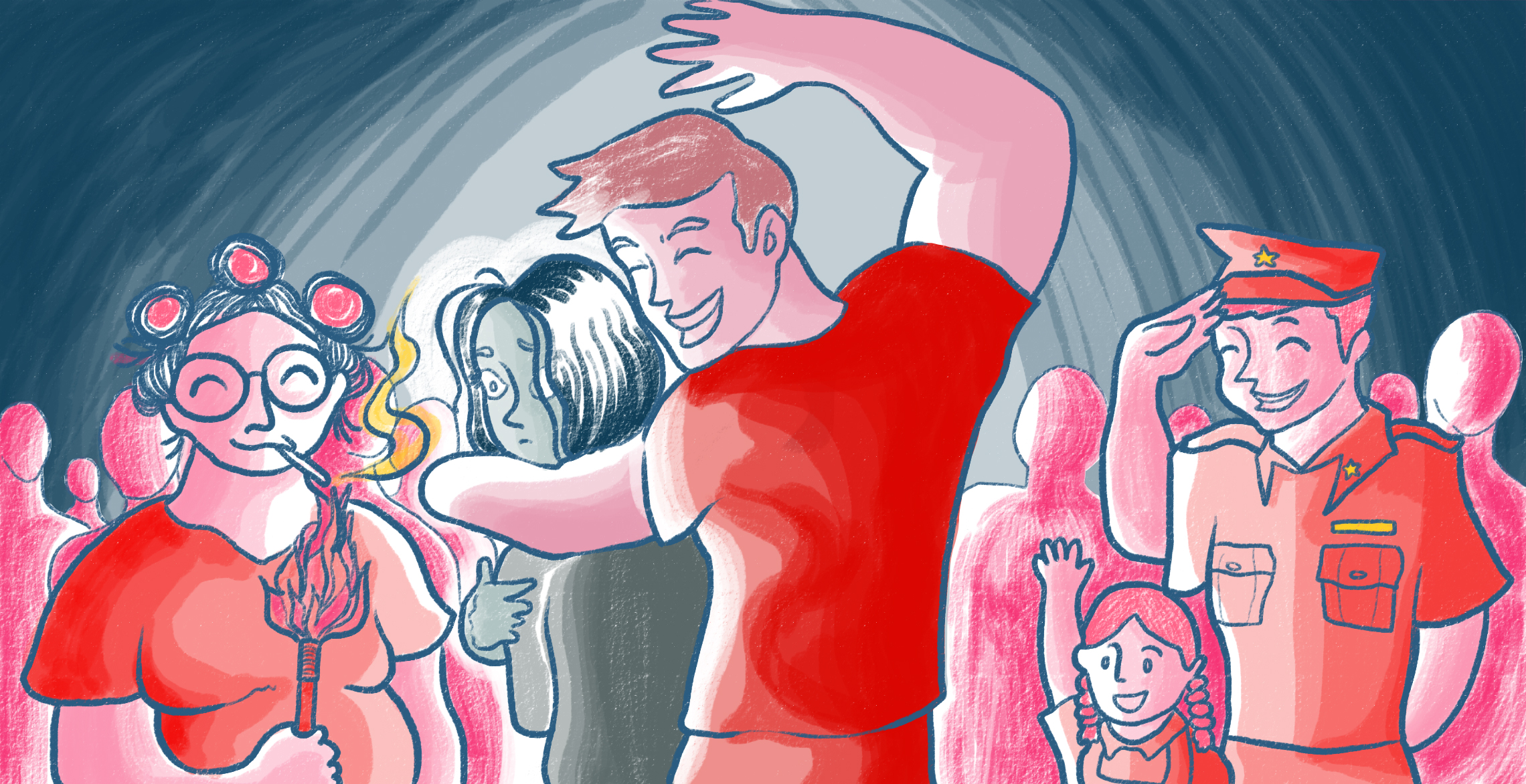
    Illustration by Ishibashi Chiharu

  • Editor’s Letter: Hope

    Editor’s Letter: Hope

    by Diana Rahim

    _

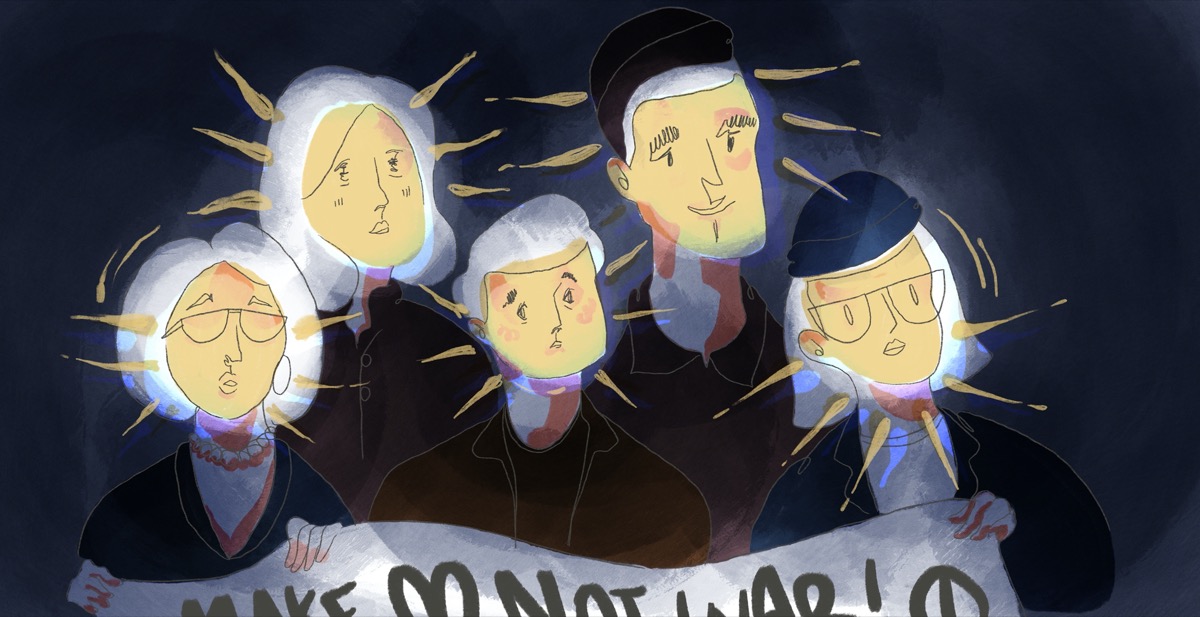
    “Resistance is first of all a matter of principle and a way to live, to make yourself one small republic of unconquered spirit. You hope for results, but you don’t depend on them.” – Rebecca Solnit

    I know you will believe me when I say I had a hard time figuring out how to write this letter. It felt absurd that I have to write about hope in these times. On the other hand, it is precisely in these moments when hope becomes far more real, far more threatened, and far more precious. It’s not simply a topic that I can discuss with an intellectual distance anymore, but a real source of motivation that I am struggling to understand and hold on to. 

    Sometime back when I had been obsessively thinking about the concept of hope, I had a strange dream. I was having a conversation with someone when they suddenly asked: “What if everything from this moment on stays exactly the same? From now on, nothing changes, nothing improves anymore”. Immediately things began to fall apart. The lightbulbs began to burst, things began to malfunction, and even the walls began to crumble. I woke up the way we usually wake up from nightmares, suddenly and with immediate relief. Relief that things were not (physically, literally) falling apart around me.

    The message of my dream was that our present reality and what happens right now is dependent on the conviction we hold for our future. If we give up on the future or believe that things will never change, we determine that things will fall apart. More importantly, the loss will not only be felt when we reach the future–It will be felt immediately. Relinquish the future and you relinquish the present. 

    Rebecca Solnit had discussed this difficult tangle that is hope in her book Hope in The Dark. Her book was written during the Bush administration, a context in which the US government had invaded Iraq but also when the world saw the largest ever protest against that very war with 600 cities protesting in unison on February 15, 2003, numbering an estimated of 6-11 million people. It was a moment of great international solidarity, and yet it seemed as if they (we!) failed. The troops had been sent in anyway. But this resistance was still necessary. Solnit wrote that those months of protests delayed the eventual invasion of Iraq, which gave time for civilians to evacuate or brace for onslaught. She added that protests also successfully deterred the Bush administration from using the “shock and awe” saturation bombing in Baghdad. These may seem like small wins in the face of the larger loss that was the eventual invasion, but these “minor wins” translate to thousands, possibly even tens of thousands of lives saved if the US government were allowed to proceed as they please.

    To have and to move with hope is to move and act without the need for the certainty of pure victory. It is to understand that we are acting not just for specific results, but out of a larger principle that will not be quashed even as we are met with defeats. Every move, action, and attempt matters because no matter how “small” a victory seems, a life is a life, and it is always worth it to have avoided the worst possible outcome that would have happened if nothing was done.

    A lot of the times, the people who are dismissive about attempts for change are people who are not oppressed by the realities of the present. They are not as invested with change because they don’t see the need for it since their state of affairs will remain undisturbed anyway. But if I may quote Zadie Smith from her book of essays Feel Free:

    Only the willfully blind can ignore that the history of human existence is simultaneously the history of pain: of brutality, murder, mass extinction, every form of venality and cyclical horror. No land is free of it; no people are without their bloodstain; no tribe entirely innocent. But there is still this redeeming matter of incremental progress. It might look small to those with apocalyptic perspectives, but to she who not so long ago could not vote, or drink from the same water fountain as her fellow citizens, or marry the person she chose, or live in a certain neighbourhood, such incremental change feels enormous.

    But of course, it’s not only the privileged and obnoxious who turn their noses away from attempts for change and the courage to hope. Some are allergic to attempts for change not because they are comfortable, but because they are traumatised. They have suffered deeply and they believe that to give whatever little energy you have left to a cause that they believe is doomed to fail is not worth it. Personally speaking, I have felt burned-out many, many times while engaging with the issues I care about. Does it matter that we do this? Will things change? Many times I have felt utterly dispirited and defeated because I do not see any tangible returns that reflect the amount of mental, emotional, and physical effort that I’ve given for the causes I care about. I know many others share this feeling.

    But what use is this despair at the end of the day? What kind of life will we lead if we carry with us this feeling of inevitable doom? Is there a way to understand the reality of pain, difficulty, and brutality so endemic to human life, in understanding that the arc of justice and peace has always been long, uncertain and non-linear, while also refusing to cave to totalising despair? And even if we do despair, can we harness the energy of this anger and sadness into a force that makes us move against oppressive forces in our world, instead of consigning ourselves to immobility and defeat?

    Ronald Aronson had written in the article “The Privatization of Hope” for The Boston Review about how Hope is something we understand primarily as something we need to have for ourselves. We have our personal hopes, but what about collective ones? It seems that there has been a dwindling of collective forms of hoping and this is due to seismic shifts in social systems that have privileged individualism and the dismantling of collective forms of living and relating. He explains it as so:

    We have not lost all hope over the past generation; there is a maddening profusion of personal hopes. Under attack has been the kind of hope that is social, the motivation behind movements to make the world freer, more equal, more democratic, and more livable.

    Not only does this privatization weaken collective capacities to solve collective problems, but it also deadens the very sense that collectivity can or should exist, as the commons dissolves and social sources of problems become hidden. This leads to pathologies that, according to a sociologist Edsall cites, “undermine solidarity as the glue of social life.

    Individual hope may be powerful, but it is limited, especially when confronted with failure. When we hope in individual terms, we suffer in individual terms too. Social and structural failures are subsumed into an individual who then has to bear all blame and cost. We already see this in the way the individual is often made to bear the mark of personal failure for things like poverty, depression, and other forms of distress that have in fact been deeply aggravated by our current unequal systems. 

    Recently, as we are all going through this pandemic, I’ve seen an article telling people that it is a great time for upskilling. Even in a pandemic made worse because of our extractive, capitalist system, the logic of personal responsibility and pushing ourselves to be more productive workers for capital still manages to slip in. We don’t need to upskill to be better workers. We need to be treated as human beings whose basic needs should be met regardless of our capacity to meet the ableist demand to be “productive” in a way that is compensated and understood by a capitalist system. The social systems that have aggravated this crisis need to be radically changed. The way we relate to each other needs to radically change.

    What does collective hoping look like? It looks like making demands beyond the fulfilment of individual needs and towards collective betterment and liberation. It is not enough that if I were to get sick, I can have enough money to access healthcare. No, that is merely a personal hope. To hope collectively means that we want healthcare, and a host of many other basic human rights, to be accessible to all unconditionally. It is not enough that I can survive, I want us all to survive.

    Here then, at least to me, is the answer: I know for sure that I have been able to keep moving despite the burnout I sometimes feel not just because I understand I am moving for something beyond myself and beyond the pleasure of immediate returns, but because I have received care and solidarity from friends and others. We move, act, try, and celebrate incremental victories when they come because we understand that we do all of these things for something beyond our individual self and needs, but we are only able to sustain ourselves when we have each other’s support.

    This is not a romanticisation of heroic self-sacrifice for the “greater good,” this is understanding that moving collectively and in solidarity is a far fiercer, sustainable, and far-reaching force than individual hope. This is understanding that the burden of trying, of demanding and creating change, is not something that we shoulder individually, but together. To refuse isolation, to practice care for each other, to refuse advancement in individual terms as we are conditioned to, is to move in a disruptive way in a neoliberal, capitalist society. 

    It seems we are in terrible times now, just as humans have always been hit with terrible times. More uncertainty and suffering will come as we will confront the reality of climate breakdown. But what I am certain of is that to hope stubbornly together, we are already making the life we want right now in the present, bit by bit. We refuse the despair of the present by believing in bringing the future we want right here, right now.

    _

    Illustration by Ishibashi Chiharu

  • Editor’s Letter: Divorce & Single Motherhood

    Editor’s Letter: Divorce & Single Motherhood

    [This editor’s letter is guest-written by Zubee Ali, the wonderful coordinator and collaborator of our recent writing workshop 🙂 ]

    by Zubee Ali

    _

    “I feel like I have no voice!” Natasha*, a young single mother with a four-year-old shared after her harrowing experience in court trying to claim regular maintenance from her ex. The experience left her shaken and disappointed with the outcome. She is worried that her daughter will grow up hating her for the difficulties they will face. 

    As a single mother, she is trying to ensure that her family receives regular support from her ex to pay all the bills, but in her case, the system is not supportive of her appeal. In other words, she lost. Outcomes like these are not unheard of. Although Singapore is well known for its progressive legal system and policies are in place to help ex-wives claim maintenance, the reality may not be so. Systemic issues and judgements that are not favourable to single mothers do occur. In this case, she was told by the judge that she should not be coming to court so often as this might cause her ex to lose his job and then where will she be? After the court session is over, her ex smirked and laughed as he walked away in victory.

    You do not get to hear stories like these until you stop to ask about the experiences of single mothers and the journey they have to go through.

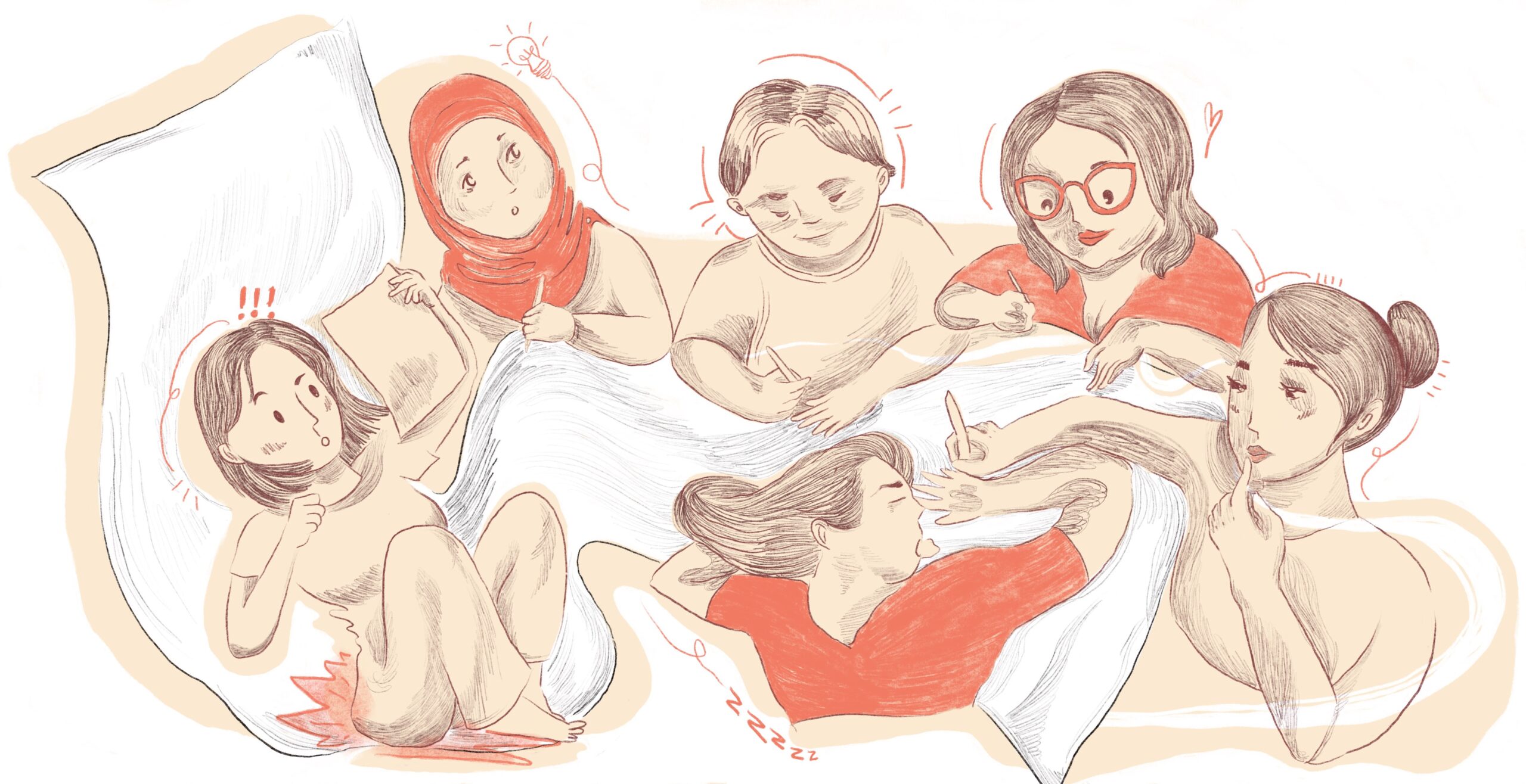
    Beyond The Hijab and Daughters Of Tomorrow collaborated on a writing project on The Experiences Of Single Mothers for Mothers’ Day 2019. The motivation to start a single mothers’ writing workshop is to give the women a safe space to process the emotional dimensions and events that led to the breakdown of their marriages and how they coped in the aftermath. 

    We hope that this workshop will not only be cathartic but can lead to further growth and a deeper understanding of their experience. By writing their stories, the authors wanted to help readers understand that the choices they made were created out of complex and interwoven issues. These issues could range from societal expectations, family needs, and sometimes even for safety and survival. Whether they made the choice themselves or because their partner decided to leave; the stigma, marginalisation and “how people see and talk” about them is bound to happen. They will, through no choice of their own, fall into the grey area of “ibu tunggal” or “single mother” and face the judgement and sometimes condescension of people they meet.

    The one single myth to dispel about single mothers is that all of them are poor, disempowered human beings in need of help from the public. This may or may not be the case. 

    Just like any other demographic group, diversity exists within the group. Women who are married could still have the same social problems and economic issues as single mothers as well. Some single mothers co-parent with their ex-spouses while others do it alone. Some are financially stable while others struggle to maintain jobs and pay their bills. Seeing single parents with its myriad of similarities and differences is to see them beyond just the label or stereotype. 

    My friend Khatijah* chose not to tell anyone at her workplace that she is divorced, just pretending that her family is “intact” to maintain a sense of normalcy and dignity. She did this until the day she died of a stroke, and not one of her colleagues knew she was hiding this dark secret for almost twenty years. Another friend also kept her divorced status a secret for fear that her adult children will be thought of as less favourable, and could not get married. 

    I remember during the first three years after my divorce I could not identify with the label of being a single mother or feel comfortable telling anyone about it. I carried the heavy weight of failure on my shoulders alone. I felt that I, and I alone, have destroyed my marriage and brought shame and disgrace to my family and community. 

    Other women shared the same story. They could not look at other people in the eye, and many went into depression and isolation. Many lost jobs and opportunities because of the shame and sense of failure. I now see that this contributed to the spiraling downfall of single mothers. The psychosocial impact of a divorce, the emotional upheaval that comes with separation and loss, and society’s poor opinion of divorcees impact women negatively. It is not the act of divorce that leads to the economic and impoverished state of single-parent families (if it happens) but the lack of support and opportunities to enable single parents to cope with the pain of loss and “fall from grace”. The difficulties they face that range from managing their families and finances, and the over exhaustion of caregiving responsibilities, usually caused by an acrimonious relationship with an ex-husband or shuttling children back and forth, should not be dismissed or minimised. 

    It was only many decades later that I could surmise that single mothers or divorced women should not carry this blame alone. Our Malay community celebrates marital unions and to a family’s sense of achievement, seeing their child step into adulthood by getting married or “naik pelamin” is a proud milestone. One minute they are celebrated as “raja sehari” or “royalty for a day” and the next minute they are shunned and marginalised when their marriages fail. 

    When a young adult reaches their 20s, the questions and expectations surrounding marriage began. We are a society that thrives on a culture of marrying young and in most cases, unprepared, without stopping to ask, is this practice harmful to the community. Weddings, whether held at void decks or in more fancy places, are communal affairs, celebrated with music, rituals and feasts, a source of enjoyment and celebration with guest lists of thousands. Whereas divorces are silent, unspoken and hushed up, and adult children (usually the women) return home cloaked in shame to live with their parents, with their baggage full of stories of abuse, infidelity and financial lack instead of bliss and happiness. 

    Thousands of children are forced to go through the trauma and disruption of unhappy marriages. They are raised by women who are dazed and hurt by the emotional trauma of the experience but trying their best to provide a stable home and life for them. Women have to go to court and the legal aid bureau (if they cannot afford a lawyer) often to seek help to fight for custody of their children, claim maintenance and seek school placements for their kids as they move houses. They have to tell their stories of shame at social workers’ desks to ask for financial support, find a place to live and if there is abuse, seek protection and justice. In many cases of mental or physical abuse, the women left the marital home with the children thus leaving the man who refuses to leave. The process of regaining the marital home or settling housing issues could take years of going “up and down the court house” or “naik turun mahkamah” for the single mum and children. 

    Often, they have to deal with multiple agencies and systems, spending precious time waiting and attending court sessions, counselling, mediation, making lengthy applications and the process often repeats itself. Having and keeping a permanent job while all this is going on, is hard, and will be the first to go. It is important and timely that the community knows more about these real-life stories.

    The call to participate in the writing workshop by Beyond The Hijab started in March 2019 and drew six participants, ranging in age from the 20s to 50s and number of kids from one to four. Although the writing workshop was meant to help them with the technical aspects of writing like how to craft a good story etc., it was inevitable that pain and laughter were the tools used to tell the stories. There were some self-care measures like stepping away, literally, if the emotions get too overwhelming or just holding the space as memories and tears spill onto paper and our soul sister needs time to come back to the present. 

    After a period of two months where we met regularly, we were a little bit surprised that the stories flowed easily and smoothly. Turns out it was there all along. As the programme coordinator, I was amazed by the quality of writing, the earnestness in wanting to tell a good story and the commitment needed in time and effort to produce this series. 

    By putting out their stories for you to read, they risk inviting your judgement, biases, but also maybe for some of you, awareness and understanding as well. For many of you, the stories will resonate, either as single mothers yourselves or children of such families. If that is the case, these six writers will tell you that it is worth it to share and talk about your experience. There is nothing to be ashamed of.

    _

    *Names in the post have been changed for confidentiality.
    _

    Zubee Ali is a single mom of 4 children from 29 to 22 years old and grandmother of a 5-month-old. She works in Women Support and Development at Daughters Of Tomorrow, a community-based organisation that helps underprivileged women to be job ready.

    Illustration by Ishibashi Chiharu


  • Editor’s Letter: Education

    Editor’s Letter: Education

    The theme of education, to my surprise, elicited the most responses so far. Submissions range from women who have studied in Madrasahs, to mainstream schools, to those who have been through the Gifted Education Programme. The theme of education was also interpreted outside the parameters of school to include meditations on the informal education we may receive while living as a Muslim woman in Singapore. Cultural conditioning, after all, can be considered as an “informal syllabus” that gives us lessons on how we are to acceptably exist within our communities and even the world at large.

    I suppose the abundance in submissions is not so surprising when we consider how challenging and soul-breaking the education system can be in Singapore. Built on the hard pragmatism and ultra-competitiveness of the post-independence period and cemented with the eugenicist policies privileging graduates who marry each other (graduate mothers scheme), we have received and sometimes painfully internalized the message that our value in this system depends on how well we perform according to its standards. When the news came out that schools will start to phase out streaming, I was happy for future students who would not have to feel as intensely the shame and stigmatization that comes from being streamed to a “lower” class.

    This shame, sharpened when stratification intensifies existing social inequalities, is such a key experience of schooling in Singapore that we have had landmark creative productions detailing the experience. If this were not true, there would not have been such an explosive popular reception to the I Not Stupid movie or the critical appreciation for the theatre play “Normal” by Faith Ng.

    Of course, doing away with streaming will not end the way inequality seeps into schools and how it affects a child’s educational path, be it social or racial. In fact, these two things often interact with each other since a disproportionate percentage of the poor are also Malay. Malay students often suffer from the prevailing stereotype of being lazy and performing poorly in academics. These are then attributed to their culture instead of any consideration or sensitivity to more complex structural issues. Lily Zubaidah Rahim has documented this brilliantly in ‘The Singapore Dilemma’. I would like to share some passages I have never forgotten:

    “Encumbered by the double burden of class and ethnicity, socially disadvantaged minority youth often become alienated and disillusioned with the education system when their self esteem has been dented by their placement in the slower streams. . . Stigmatised as a ‘failure’, many ethnic minority students have responded by acting out their label and like a self-fulfilling prophecy ensured their ‘failure’. Frustrated with school, many Malay youths . . . wage cultural forms of resistance by resorting to various forms of disruptive behaviour as a means of striking back against the school system.”

    This tendency for Malay youth who ensured their own failure as if through a “self-fulfilling prophecy” due to the alienation they feel was something I noticed when I was in school, noticing how Malay students who did not do well and would have predictably felt insecure about their grades would try to redeem their self-esteem through rebelliousness.

    Lily Zubaidah Rahim would go on to say:

    “The common problems and impediments shared by the poorly educated and socially marginal across all ethnic communities suggest that the socio-economic and educational marginality of Malays cannot be simplistically explained away as a ‘Malay problem’ requiring Malay solutions. Such an explanation has engendered a truncated and fragmented understanding of a complex phenomenon that is strongly rooted in the historical, ideological, and institutional processes of Singaporean society.”

    *

    Growing up in a working-class family, intense importance was placed on my education. My family believed firmly in the state narrative of meritocracy and education as a social leveller; that it was a way out of our social strata into a more comfortable life (of course the past five years have seen intense critique on the myth of meritocracy and suggests that the education system only deepens existing social inequalities).

    My childhood was filled with memories of my mum saying what I know so many children from working-class and underprivileged backgrounds hear: when you’re older, buy mama a big house. Sometimes the house is a car. Holidays overseas. An oven, or any expensive kitchen appliance in general. Whatever it was, it signalled the fact that the future was a site of idealised possibility and wealth and the path to that future was through the educational ladder. I have sometimes often felt intense pressure to live up to their expectations. Like many Singaporean children, I have often felt like their approval rested on my ability to excel. Till today, I have internalised this demand and slip into intense self-criticism where I consistently feel like I have not succeeded enough in the education system, even if intellectually I know that I would never impose such vicious standards onto anyone else. I have to say though that the pressures I feel do not compare to the intensity of pressure faced by other students who are even more stigmatized and whose intelligence or abilities are not captured by the education system.

    Fueled by the image of an abundant future, I had my mother’s involved commitment in my education when I was younger. However, as my sister grew up and my youngest brother came into the picture, my mother no longer had space or time to be as involved as she would like. Even when she later quit her job, she could not be as directly involved since the school assignments were pass a stage where she could understand them enough to help us. This is a common problem and I learned that there was even a program started some time back where parents are taught according to the syllabus so that they are better equipped to help with their children’s homework (if they even had the time)!

    For many Singaporean children with parents who do not have the privilege of offloading caregiving and home duties to a domestic worker, or the financial ability to purchase supplementary and tuition lessons, so much of their educational journey depends on available public resources and communities: the school, its environment, our teachers, our friends, available (or lack of) support systems, public spaces for studying. It is for this very reason that paying attention to these public resources and the welfare of teachers is important. It matters that in an already unequal society, we try our best to make sure the available resources to students is decent and dignified.

    My time in secondary school has taught me so much about the ways in which class can distort a person’s educational journey. I went to a “neighbourhood school” which had a population of students whose class background generally matched mine. Though I don’t wish to romanticise the working-class or the poor as more “authentic,” I can safely say that I look back at that period fondly. I was in an environment where I did not feel the pressure or awkwardness of my class background so strongly as alien or undesirable–feelings that cropped up when I went into junior college and felt even more keenly in university, where racist jokes and elitism punctuated my time in school.

    Secondary school was also a time when I saw how school was not just about studying and getting good grades, but about navigating what can feel like a complex, precarious minefield of social life that can intensely affect your mental well-being and shape your sense of self. These things which may seem trivial and unimportant as adults were undeniably felt so much intensely in youth: wanting to feel included, to make and keep friends, to be able to pursue the interests you were developing, to feel loved and appreciated by your parents, to feel affirmed for who you are.

    In an environment where everyone is subjected to obey established rules and punished if they don’t; a space that is touched by the biases of the world–imagine how additional pressures can compete to take up your mental and emotional space. How these things can eventually interfere with someone’s deserving future since the path is ruthless is discarding those that don’t meet its standards.

    So much happens in a school aside from an education, and it was intensely clear to me back then that not everyone was on an equal starting point. I remember a friend streamed into a better class than I graduate with mediocre grades for O levels because even during the exam period she had been working part-time at Mcdonalds. I even heard of a boy who was working at KFC earning $4 per hour just to be able to pay the already heavily subsidised school fees. I had a classmate who disappeared for months due to family problems and only returned to school later in the year, his education disrupted.

    When people sometimes speak of youths from underprivileged backgrounds as being unmotivated to study, as difficult to control or teach, as aimless, I know that they are either willingly ignorant, or have chosen to ignore the fact of how the totally absorbing emotional toll of present difficulty can make one lose the luxury of considering the long-term implications of their decisions. When you’re going through intense moments in your life, or when the daily stress of finances place a weight on your ability to function, when home is not a safe place, and when there is little proof around you that society cares for your existence, how much mental space do you have left to allocate to studying or to think about the future? When the present is always an emergency, how can you look away and spend the time needed on other things? Willpower alone is often not enough to get you where you need to be.

    Being able to have an education, and to focus on it, is an immense privilege. I know I have had immense privilege to be able to pursue it without debilitating distractions, even if my class background does not present me with ideal options or an easy journey (my university journey was sometimes tiring as I juggled multiple part-time jobs along with school), but I know I was very lucky to have had the chance to pursue a higher education.

    I mention this because as someone who was lucky enough to have a family who supports my education and wants me to pursue it as far as I am able, I was rudely shocked to realise that even in the year 2018, there are still women and girls who have to struggle painfully with their family when they want to further their education or to simply take it seriously. There are still women and girls who are pressured with the message that their priority lies not with their education, but with gendered expectations like getting married (and how often have I heard female friends/relatives telling me they are re-considering further studies because it threatens the egos of their husbands!), having children, or being the primary caregiver for the family. It’s not that these things are not important, and certainly, some women do prioritise these things. The problem is not what is prioritised, but the element of choice. A person should always have the freedom to make their own informed choice about what they wish to prioritise for their version of a fulfilling life.

    I’m really pleased to see that many of our submissions came from women who recounted their experiences in the education system, and were able to articulate the structural issues they saw or faced. In fact, I would say that a good education is one that results in a person being able to critically engage with the knowledge or experience presented to them and question whether the dominant or received interpretation is one that they can accept.

    We learn so much when we hold up things to the light, turning it this way and that, and trying to figure whether it holds up to honest, critical scrutiny. In Singapore, even this perfectly normal and healthy desire to critically analyse, to scrutinise, to critique, can be seen as disruptive, negative, and undesirable. It is, therefore, all the more precious when we insist on our right to question, which is something I think our submissions all have done. They refuse to settle for prevailing narratives that may tell them how they should feel about their education or certain myths and stereotypes that are abundant when it comes to education and the school system in Singapore. They have articulated their stories so poignantly, so strongly, and so honestly. I can only hope that people will listen.

    _

    Illustration by Ishibashi Chiharu


  • Editor’s Letter: Sexuality

    Editor’s Letter: Sexuality

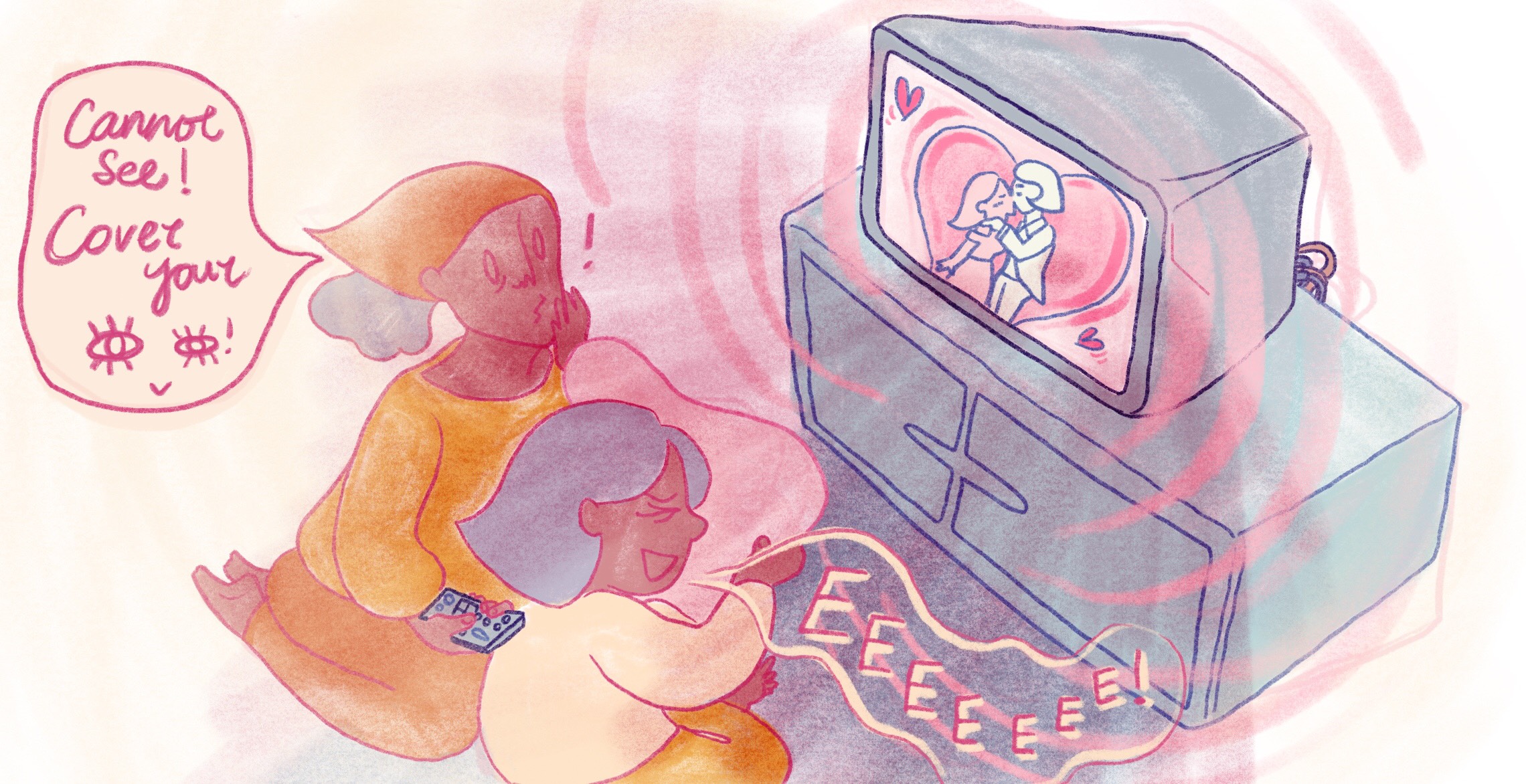
    Cover Your Eyes!

    I watched Titanic for the first time at home with my parents. Jack and Rose are running, a respectable bourgeois lady and working-class man, away from the assistant of her insufferable, arrogant fiance. Rose with her tight ginger curls free from the usual chignon with her wild glittering eyes. Leonardo still baby-faced with 90s dreamboat hair. They run along narrow corridors, knocking over silverware. Rose’s virginal white dress somehow remains pristine after they run through the fire room. They run into a room, then into a car. What happens next, after their giggles quieten and their faces neared, would be preceded by mother’s shrill directive: “don’t look, cover your eyes!”

    Being an obedient child, I never looked. I never peeked, not even once. I genuinely associated intimacy with sin and even a feeling of disgust for a long time. Those moments felt painfully awkward and it didn’t help that I never got an explanation or discussion about sex or sexuality from my parents, nor from schools, as far as I remember.

    The sex education class I had in secondary school was focused on abstinence and I remember the girls being made to watch a video of a fetus being sucked out by vacuum during an abortion. It was, to us, another perturbing thing overzealous adults wanted to show us. Afterwards, we went back to our world,  saturated with gossip about couples, whispers about notorious toilets and spaces people were seen kissing, and mean-spirited bitching about the school “slut,” (unsurprisingly, the boys she was with escaped moral condemnation).

    All of this was, of course, symptomatic and consequential of the larger refusal to properly acknowledge and explain the reality of sex and sexuality. As if in not looking at scenes of kissing couples, the reality of intimacy would cease to exist in the child’s mind. As if simply stating the imperative to turn away from sexual desire would automatically result in obedience and a reduction in teen pregnancy.

    Growing up, especially during the period of teenhood, shame is abundant: in how our changing bodies are perceived, how our feelings of attraction and desire begin to confuse us, and all the complications of growing into our individual selves.

    It shouldn’t be taboo to talk about sexuality, our changing bodies, and the development of sexual desire and attraction. They are, after all, completely natural. Yet for so many, these changes were seen as much a marker of growth as they are the beginning of heightening anxiety. Especially for teen girls, our parents would begin to fuss and obsess over the presentation of our bodies, sexual precociousness, and the company we keep, especially of the opposite sex. The overbearing dark cloud of sex before marriage was a threat that loomed, defining so much of how we were to behave. This cultural and social surveillance of female bodies leads predictably to a deep feeling of shame when it comes to our own bodies and sexuality.

    This is quite ironic since the religion is very much “sex-positive” and encouraging of healthy sexual relationships. The Islamic tradition, sunnah, and hadiths are full of advice and stories around the importance and joys of sexual relations between married couples and how it is an important facet of an intimate relationship which strengthens the bond of a couple. Muslim scholar Al-Ghazali calls it a blessing from God and in a hadith, our prophet Muhammad s.a.w. is reported to say that God rewards Muslims for “sexual play.”

    Yet why is there this discrepancy between the sexual frankness in the religion, and the intense, anxious suppression on the discussion of sex and sexuality within Muslim communities?

    Perhaps what is sad is how many have to peel away layers of shame to even begin to healthily associate sex and sexuality as something that can be joyous, fun, and full of love. For so long this aspect of the human experience has been swathed and chocked with shame, guilt, and a swirl of toxic mystery, that it can be a journey to see its reality.

    Sex Education

    Imagine what happens to the mind, what the mind does, when it doesn’t have the limits of reality to control its wanderings. What nebulous, misguided images of sex and sexuality it festers when you’ve only heard the sounds, caught snatches of images, and listened to the experiences of others. What kind of distorted image would be pieced together from these fragments?

    What happens to a woman when she is demanded to be innocent, even sexually naïve for most of her life up until she is married? One can only imagine the difference in power between partners when one is conditioned to be less sexually knowledgeable than the other. How anxiety-inducing that first sexual experience of hers will be, and how vulnerable she might be to instances of sexual abuse!

    Sex education, one that is thorough, accurate, and not filled with messages of guilt and shame, is important. It’s important so that prevailing myths around sex and sexuality can be addressed and young adults are educated on their sexual rights, take necessary safety precautions, and limit the dangers they may face.

    For example, it’s often said that a woman’s first penetrative intercourse will result in bleeding due to the rupture of the hymen. However, this belief is grossly inaccurate and perpetuates the erroneous belief that your first time is necessarily painful (which then leaves little responsibility to the partner to be mindful of their partner’s readiness and comfort during sex). This article provides a helpful, easy-to-understand primer on the question of whether the first time should hurt.

    Of course, sex education is a contentious topic, one that has been a site of struggle between “conservative” and “progressive” camps since it involves the values and opinions we hold regarding female sexual autonomy.

    The facts, however, regardless of opinion, is clear. Young adults are going to have sex, regardless of the messages pumped into their minds about how sinful it is. The only thing that can be controlled is how we respond, and whether we provide them with the information they need should they do it.

    If abortion and teen pregnancy is a fear, then abstinence-only sex education has the opposite intended effect, since it has been proven to result in the highest rates of abortions and teen pregnancies. What works is if they are given accurate information about safe methods of contraception, how to access it, and how to take precautions from STIs (Sexually Transmitted Infection).

    Consent and Healthy Relationships

    The other issue, far more nuanced than the obvious, stark topic of sex and desire, is consent and healthy relationships.

    I would like to share the following quote from a post by HEART Women & Girls about how consent is fard (religious obligation):

    It is narrated from the Prophet (SAW: peace and blessings be upon him) that: “Do not engage in sexual intercourse with your wife like hens; rather, firstly engage in foreplay with your wife and flirt with her and then make love to her” [Alliyatul Muttaqīn] and narrated from Imām °Alī (AS): “Whoever wants to get close to his wife must not be hasty, because women before engaging in the act of love making must be engaged in foreplay so that they are ready for making love to.”

    Sexual activity and intimacy without consent violates its sacredness revealed by God. This is also marital rape. Across all types of relationships and interactions, consent is fard.

    Beyond the quick and dirty information about sex, more sensitive conversations around consent, coercion, and emotionally healthy relationships are important so that people will be able to identify when they are in abusive relationships, and where they can go should they need to seek help.

    When there is a lack of comprehensive, evidence-based sex education, young people would naturally seek other avenues. Consider the fact that in the digital age, many youths turn to porn, and that porn has become the unofficial source of sex education. (As an aside about the link between repression and porn, think about the fact that six Muslim-majority countries are in the top 10 global consumers of porn).

    Porn is also abundant with images of unhealthy, unrealistic depictions of sex, with frequent images of coercive, even violent sex, where women are often depicted in submissive roles. This leads to higher instances of unrealistic expectations, high-risk behaviours, and a higher risk of being a victim of sexual aggression. Of course, there are instances within the porn industry to provide healthier depictions of sex, but they are not the dominant image that is seen in the flood of images and videos available.

    It is important that there is a counter-point to such images, and that accurate, sensitive information is accessible to young adults will naturally be curious due to their burgeoning sexuality.

    A Mother and Her Baby: Both Children

    Not too long ago, an incident in our neighbouring country made me grieve for the kind of loneliness, shame, and emotional turmoil that the topic of sexuality often brings to young girls. On the 14th of October, an 18-year-old girl died in a toilet during childbirth in Ipoh Her baby was found dead too, in the toilet bowl. For six hours, she kept telling her mother that she was constipated.

    I keep wondering about depths of shame and fear she must have had from having a child out of wedlock. How deeply lonely she must have felt throughout her pregnancy, and especially during the last moments of her life. She died alone in a toilet because going through the intense pain of childbirth alone was more tolerable than facing the shame of having a baby outside of marriage. Up till the end, to come out and admit it was too scary for her.

    To imagine her weight of repression and psychological oppression was intensely sad. Regardless of what one might feel about the rightness or wrongness of what she did, the result surely ought not to be her own death, along with her baby’s.

    The safety of our children, the limit to abuses, and ensuring that our intimate and sexual relationships are as healthy as possible, should be prioritised. It can be, as we have seen in this fatal case, a matter of life and death.

    __

    Illustration by Ishibashi Chiharu

  • Editor’s Letter: Religious Spaces

    Editor’s Letter: Religious Spaces

    by Diana Rahim
    _

    When I was an undergraduate, I don’t think I missed a prayer if I could help it. My university had a prayer room for its students. All you had to do was to bring your card to an office tucked obscurely in the basement of a building and requested them to allow you access to that room.

    Each time I had time to pray, I would walk to that prayer room located at the North Spine. I had no complaints. It was a good space with carpeted floors, a rack of prayer garments, and a small shelf of books. It was an upgrade from praying at the top floor’s staircase landing back in junior college.

    Then one day, while I was praying, I heard two girls talking loudly from the back of the room. Loud conversations have happened before, and they’re not that big a deal to me. What was more uncomfortable was the content of their conversation. In the safety of that prayer space, they were gossiping about a girl they felt was inadequate in her faith because she did not wear the hijab. They were judging her piousness in hostile tones. I tried to bring my mind back to my prayer but I knew it would be awkward when I take off my prayer garments. I was dreading the hostility they might have for me. The moment came. I took off my prayer garments and walked back to hang it. I retrieved my bag and left the room, which was far more silent and conducive for prayer now that the girls were no longer talking. They realised I did not wear a hijab and probably heard their conversation the whole time.

    After my initial feelings of upset passed, I told myself that it was probably just the both of them. I told myself most of the women I’ve come across probably do not feel that way. I told myself that because I didn’t want to assume the worst. Still, that feeling that I was not truly welcome has made me feel uncomfortable since. After a few more incidents, including at mosques, I prefer to pray alone at home where I can perform my ibadah without anxiety.

    I don’t think my experiences are that bad but I do think they reveal the kind of environment that exists today that can drive people away from religious spaces because they have been made to feel unwelcome. When people are driven away from such religious spaces, they are driven away from their own communities. It is a deliberate act of exclusion. It is an exclusion sometimes actively carried out by people who feel like they have the authority to deny people access to the house of God.

    What is notable about the experience I just shared is the fact that they felt safe gossiping while someone was still in the room. It revealed their assumptions about what kind of person would be in that space, or rather, who would not. They did not expect that someone who did not wear the hijab would even be in that prayer room. Remember an earlier submission to this blog by a Shi’a Muslim? She too shared about how she heard Muslims around her gossip about Shi’a muslims because they simply automatically assumed that everyone around was Sunni.

    It reveals the fact that spaces like these are easier to navigate and exist if who you are, how you look like, does not resist against the dominant image that good, reliable Muslims are expected to have.

    And of course, this is a conversation we have been having for a long time! I remember when I was younger an Ustaz shared with students how mosque-goers would sometimes refuse to stand beside bangladeshi migrant workers during Friday prayers, deliberately, and blatantly avoiding them. It made him upset, and he led by example by making sure to welcome them with a hug, talk to them, and pray beside them. The fact is that our mosques are not free from bigotry simply because it is a holy place. Humans are fallible. And when they come into the space, sometimes they bring their racism, their sexism, and other discriminatory biases with them. And sadly, those who are not within the status quo are made to feel it.

    We live in a world where certain individuals are given more space than others. When space is made more comfortable and more accessible to certain types of people, exclusion exists. It means that for those from a different sect, citizenship status, socioeconomic status, gender identity, etc, it is harder to access the same spaces. The restrictions, pressures, and lack of encouragement they face means that they have to work harder, bear more microaggressions, and little indignities just to occupy the same space. These spaces are not as open to them, and may even feel hostile, which in turn limits their participation.

    If you want to know if the religious space is truly inclusive, and truly reflects the ideals and principles of the religion it was built for, then who you should be looking at and talking to are the ones who are not included.

    In theory, for example, the mosque as a religious space is meant for all Muslims. It’s where they go to perform acts of ibadah (worship), and connect with their community. In reality, however, many women have expressed that they do not feel that it is a space equally made for them. This pertains not just to physical space, where women are often relegated to areas that are not as spacious or convenient as their male counterparts, but in terms of whether they have any say at all in the community, and whether their needs and concerns are addressed or even asked for.

    In 2013, Hind Makki kickstarted a global conversation in the Muslim community with her project Side Entrance. The project basically collects images of female prayer spaces in mosques all over the world. Some are comfortable, some are alright, and some are downright disappointing. In any case, the difference between male and female prayer spaces is undeniable. Accompanying these pictures, women shared their stories of sadness, frustration and difficulties when simply wanting to be in a mosque. In speaking about her project, hind Makki shared:

    “The main point (of Side Entrance) for me is that the spaces that women occupy in a mosque is actually reflective of the values that the community believes that they add,”

    In other words, whether someone is included in a space reveals the degree of respect that we have for them. It reveals whether we value their inclusion, their being, and whether we acknowledge that they can contribute something valuable to the community.

    I remember feeling really happy when I found out that the Waria community in Indonesia have managed to set up their own mosque. Finally they can have their own holy space where they can pray without being harassed, and where they know they belong. They can perform their ibadah and strengthen their relationship to their faith and to God. But in my heart, I find it sad that marginalized communities have to go through the difficulty of finding the resources to set up their own mosques just so they can have what so many Muslims take for granted. It’s sad that they have been prevented from simply being in a mosque, and that people were willing to prevent another human being from performing their ibadah, and made the environment hostile for another person. For me, it is unthinkable to get between someone and God when a connection between the two is about to be made. I don’t think God would appreciate us pushing away one of their creations from worship and connection.

    It’s important to mention that when we talk about “religious spaces,” it does not simply pertain to the physical space of the mosque or even the Muslim community. It’s also about whether there is space in dominant, mainstream religious narratives and culture for the presence, importance, and appreciation of those who are basically not just Muslim men. Is there space for them in positions of authority, in cultural spaces, in the family? Is their history told alongside the history of “great men”? Are religious interpretations done with them in mind too?

    And of course, it’s important to think about what kind of spaces are available when it is made available. For example, a benevolent sexism and the idealisation of Victorian ideals of femininity is often used to soothe and assure women that they have a special place in the culture. But this sends the message that only a certain type of woman is valued. It makes access conditional, far more conditional for some than it is for others. This is against the tradition in Islam where women are accorded equal dignity.

    The spaces we keep as a community says a lot about us. Who are included in our spaces, and perhaps more importantly who are not included, can reveal our actual values in practice, versus what we may insist our values to be.

    In the future, I truly hope that every Muslim who seeks to deepen their connection to their maker, to visit the house of God, and to participate in their religious communities can do so without any anxiety or feelings of inadequacy. I hope they can do so without feeling like they are unwanted.

    For the present, I hope that those who have felt rejection from Muslims can know that it is not rejection by God. That even if the communities may not, or even do not want to make space for them, that this cannot take away the connection they have to their maker.

    The beauty of Islam, to me, is in the fact that it was to be a non-hierarchical religion. That every person is equal before God, even if on earth they are not seen as equal to other human beings. After all, in the Qur’an, in Surah Qaf, we are given the beautiful reminder: We are closer to him than [his] jugular vein.

    And that is a closeness that nobody can take away from you.

    Illustration by Ishibashi Chiharu

  • Editor’s Letter: Intimate Partner Violence (IPV) & Domestic Abuse

    Editor’s Letter: Intimate Partner Violence (IPV) & Domestic Abuse

    by Diana Rahim
    _

    (Content Warning for Partner Violence and descriptions of abuse)

    Reading the submissions for the call-out on Intimate Partner Violence (IPV) has been the most affecting experience for me so far in editing Beyond The Hijab. The stories shared are heartbreaking, not just because of what these women have experienced, but how their suffering was treated by those around them. These are women who have seen or experienced partner violence and had to contend with the added trauma of being dismissed, of seeking help and not receiving it, and at times even being disappointed by legal institutions and the police.

    It really goes to show how the problem of IPV is one that extends beyond the individual. It is not just the abuser who is guilty and implicated. It is also the people around the victim, the society they are in, and the institutions that were supposed to help them that are guilty and implicated as well. These external factors have a part to play in how the victim’s suffering is perceived, whether it’s taken seriously, if they feel safe speaking up, and if they manage to get the help they need.

    It is often difficult to even admit that you are in an abusive situation in the first place, and victim-blaming only adds to the suffering. Love should never feel full of fear, humiliation, and pain. Abuse can come in more than just its physical form, but also in the form of emotional and psychological abuse, financial abuse, spiritual abuse, sexual abuse (currently there marital rape immunity in Singapore law), verbal abuse, isolation and intimidation, amongst others.

    This article provides a breakdown of the different types of abuse and how to detect them. This graph by Project Sakinah gives a visual aid to understanding the cycle of abuse and this exhaustive list of signs will provide you with an understanding of what domestic violence looks like.

    It is also important that we learn how to adequately respond to victims of domestic abuse as well, take the time to read this article breaking down how you can support and listen to them. These 12 steps are also incredibly helpful to keep in mind in case you know a loved one has an abusive partner.

    *

    The Problem of Perception

    There’s an older female relative that comes immediately to my mind when I think of domestic abuse. She has been through so much, too much, in her marriage. The last I saw her during Raya visiting, she was characteristically herself: loud, energetic, and opinionated.

    My female relative’s vocal, opinionated nature was something her husband often could not withstand, and my mother often told me that he would beat her when she expressed disagreement. He would beat her in public. He would even beat her in front of her own mother. Those decades ago, people were often reluctant to interfere even when they saw abuse happening in broad daylight. They viewed it as a personal matter. Her mother did not say anything because she felt she could not interfere with her son-in-law’s authority. She did not report to the police because it was tacitly understood that when it comes to family matters, the police were unhelpful or reluctant to intervene.

    Once, after being physically punched, she went to the shariah court with a bruised eye to file a complaint. She was hoping they could talk to her husband. It did not happen and nothing changed. She is now 70 years old, and still married to the man. He has since taken on another wife.

    There are several things to note in the experience of this female relative of mine. Firstly, if one were to hear her story, one might be surprised to see that she is not a “perfect victim”—one who is visibly battered, traumatised, and fragile. She was loud. She spoke back. The truth is a lot of victims of abuse do not fit under the narrow conceptualisation of the “perfect victim.” Any person can be vulnerable to partner violence. We are, after all, talking about an intimate partnership.

    There is often the trouble of perception in the problem of partner violence. Not only do victims sometimes not appear as “real victims” but abusers sometimes do not clearly seem like abusers. In the submissions, the women sometimes talk about how their abusers were seen as exemplary to the other people in their lives. They did good deeds and were kind in other situations. Perhaps it is a problem of how we are unable to view humans as complex beings who can sometimes still do terrible things in private even if they perform what they know are socially-respected behaviours in public.

    This problem of perception is a serious thing because it is what often leaves the victim with the trauma of being suspected and even disbelieved. It gives abusers the benefit of doubt. Remember that just as anybody can be vulnerable to partner violence, abusers do not come in a single profile too.

    Secondly, victims of IPV or domestic abuse often suffer in silence, but with her, the violence was visible to those around her. Her mother saw her get beaten. Members of the public saw her get beaten. She went to the shariah court. At each of these points, someone could have intervened, but most did not. And even institutions that were in place that we would assume could help, were not trusted. The police are notorious with victims of assault and abuse for not taking their pain seriously, and for being reluctant to interfere.

    One might say that institutional changes are needed, and certainly, they help. Back when she first married for many years of her marriage, the family violence bill in 1995 (which was rejected by the parliament) and the amendments to the women’s charter which took effect in May 1997 had yet to take place. The bill and the amendments were both the efforts of Nominated Member of Parliament at the time, Dr Kanwaljit Soin. Before these amendments took place, it was incredibly difficult for abuse victims to turn to legal institutions to make a case.

    I personally think it would have been great if the bill was passed. The bill suggested wider powers to the police to arrest abusers and follow up with responsibilities to the victim such as securing medical attention, safe accommodation, and helping to retrieve her belongings from her home. The bill, however, was debated with a measure of fear by a state that is besotted with “family values.” Narayanan Ganapathy had noted in his book Policing Marital Violence in Singapore (Brill, 2008):

    “It is not in the interest of a patriarchal and paternalistic State to effect wide-sweeping structural changes that may contribute to a rewriting of gendered power relations that exist in contemporary Singapore society. While the State, through the organisation of the police and the criminal justice system, must and be prepared to offer protection to victims of violence—the majority of whom are women—the State’s primary concern is to safeguard the institution of the family that would reflect and normalise women’s subordinate status within the hetero-patriarchal family. Even ‘radical’ initiatives such as the ‘facilitated complaint and referral system’ is essentially designed to relocate both the offender and the victim to the family after undergoing a period of rehabilitative counselling.
    […]
    Reforms introduced in such a political climate remain tokenistic and divisive, without addressing the fundamental bases of gendered social relations of power that generate violence towards women in the first place, and the rank-and-file police’s contribution to the exclusion of marital violence from the ranks of ‘real crimes’”

    Today, the first step a victim can take is to file a Personal Protection Order (PPO) against the abuser. Without the PPO, a lot of the cases would remain categorised as a family dispute, which leaves no possibility of legal intervention.

    Institutional changes help, but whether it is practiced on the ground can be a different story. If there is no parallel improvement and advocacy for a change in the way women are regarded and treated, change can only be painfully slow. Narayanan Ganapathy had noted in his book, in fact, that the institutional changes do not match with how police officers react to domestic abuse cases on the ground. The fundamental issue of how women’s pain is regarded, of her subordinate status in society, remains unchallenged. As long as this remains unchallenged, domestic abuse will still be considered as not a “real crime” by police officers. If the prevalent idea on marriage is not challenged, then the manipulative rhetoric for women to try their best not to “break up” the family will also remain unchallenged.

    *

    An Islamic antidote to abuse

    In looking at the problem of IPV, we need to see the ideological bed upon which the violence rests. For Muslim women in Singapore, it is not just the cultural and ideological mores of Singaporean society that has to be taken into account, but also religious culture.

    Salma Elkadi Abugideiri, a therapist and founding board member of a domestic violence national organization for the Muslim community called Peaceful Families Project shared in an interview that a lot of domestic violence is backed by “traditional customs that you may find in some parts of the Muslim world that have no connection to the Qur’an.”

    He goes on to say abuse has been denounced in the Qur’an many times, but somehow the topic remains taboo and rarely touched upon by imams in their sermons. He also noted that:

    “Culturally, it can be shameful for a woman to leave her family, to live by herself or to initiate a divorce . . . Whereas from the religious perspective, the shame is on the person who is oppressive and divorce is not a sin—it’s actually a peaceful alternative to a marriage that’s not working, even if it’s not abusive. That’s something that a lot of Muslim women don’t know.”

    Muslim women might face spiritual dilemmas when they go through domestic violence and are thinking of how to react or leave the situation. There is often guilt associated with divorce and religious communities might stigmatise a woman who initiates one.

    Spiritual abuse is also an added dimension they may experience from men who might justify their behaviour and intimidate their wives, believing that their superiority is supported by the religion. One of the coming submissions for this series will detail how the writer’s father, who had cheated on his wife, somehow still managed to maintain his sense of superiority and exercised control through spiritual abuse.

    Spiritual abuse in Muslim communities in the context of a marriage is sadly often backed by the belief that the man as the leader of the household has the authority to enforce his own will on his wife. The wife may feel guilt in “transgressing” or “disobeying” her husband even though by all objective standards he is the one transgressing morally. In the submissions, I’ve noticed how the abusers weaponized Islam to their own advantage, utilising it as a tool to guilt their wives in order to get what they want.

    There are many verses in the Qur’an that call for marriage to be an equal, peaceful, loving partnership. Men and women are regarded as equal in eyes of Allah (Qur’an 49:13), that men are to tend to the needs of women without controlling, abusing, or hurting them (Qur’an 4:34) and that any verbal abuse is not tolerated (Qur’an 49:11). Yet somehow the abusers’ behaviour did not take any of these scriptures into account while they quoted other verses while abusing their wives, or used spirituality to control them. There’s a famous Christian saying that comes to mind — even the devil quoted scripture.

    Perhaps the most violent thing I found is how abusers even weaponise religion to justify marital rape. In almost all the submissions received for this call-out, the victims had experienced marital rape. This sexual violence is routinely dismissed not just by the harmful idea that the husband is entitled to sex by virtue of being a husband, regardless of the wife’s desire, but also by the fact our law currently does not view it as a criminal offence due to a partial immunity for marital rape. This immunity is currently being reviewed.

    The problem, personally, to me, is not in the religion. If a person is not abusive, they would not find ways to justify abuse through hadiths or cherry-picked verses in the first place. Ideas of male superiority in the context of a marriage, or of having to “obey” a husband are propagated without properly talking about how such a blanket rule makes women vulnerable in abusive situations, must actively be denounced by community leaders consistently. For some, hearing their suffering validated by institutions they trust means everything. It can be what gives them the confidence to know that if they decide to take action, they will be believed and supported. It must be discussed openly and it must be discussed without making women feel guilty or ashamed of their situation.

    So much of partner violence is perpetuated not just by individual actions, but by all the ideological, social, cultural, and institutional factors that still require challenging and work. Most victims of partner violence are women, and this fact attests to the fact that as long as a society is still guided under the harms of patriarchy, where women are still regarded as subordinate both by individuals and by systems, women will continue to suffer even in the most intimate situations. Having concurrent identities such as being Muslim also make the experience particularly different requiring different solutions.

    The world as it is now is certainly not perfect, and I don’t want to spend too much time despairing. We can do a lot to support victims of abuse even if they have been failed by others. It is important that we listen to them, and that they are able to speak their stories and to be able to inspire others who are currently suffering that there is a way out and that there is a future beyond the current trauma. I am very thankful for the writers who have contributed stories for this call-out, and I hope that whatever we learn in this series of posts will help at least one person, and push others to take partner violence more seriously.

    __

    If you or someone you know is facing partner/domestic violence don’t hesitate to call the Women’s Helpline at 1800 777 5555 (Mon – Fri, 10am – 6pm, excluding PH). If you are facing any kind of sexual violence, call the Sexual Assault Care Centre (SACC) hotline at 6779 0282 (Mon – Fri, 10am – 6pm, excluding PH) or email sacc@aware.org.sg.

    Women’s Care Centre (WCC) Women’s Helpline
    – Phone: 1800 777 5555 (Mon – Fri, 10am – 6pm, excluding PH)
    – Text Chat and Call Back (by appointment only): Clients can book an appointment through their website before accessing this service.

    Some organizations you can turn to:
    Centre for Promoting Alternatives to Violence (PAVE)
    Blk 211 Ang Mo Kio Avenue 3, #01-1446
    Tel: 6555 0390
    Email: admin@pave.org.sg
    Website: http://www.pave.org.sg/

    TRANS Centre
    SAFE Programme (Stop Abuse in Families)
    Address: Blk 411 Bedok North Avenue 2,
    #01-106, Singapore 460411
    Telephone: 6449 0762
    Email: transbd@trans.org.sg
    Website: http://www.transcentre.org.sg/

    Syariah Court of Singapore
    Address: Family Link@ Lengkok Bahru,
    8 Lengkok Bahru #03-01,
    Singapore 159052
    Telephone: 63548371, Monday to Friday, 8:30 am – 5:30 pm
    Website: www.syariahcourt.gov.sg

    A PPO can be applied for at:

    Centre for Promoting Alternatives to Violence (PAVE)
    Blk 211 Ang Mo Kio Avenue 3, #01-1446
    Tel: 6555 0390

    TRANS SAFE Centre
    Blk 410 Bedok North Avenue 2, #01-58
    Tel: 6449 9088

    Care Corner Project StART
    Blk 7A Commonwealth Ave, 01-672
    Tel: 64761482

    _

    Illustration by Ishibashi Chiharu
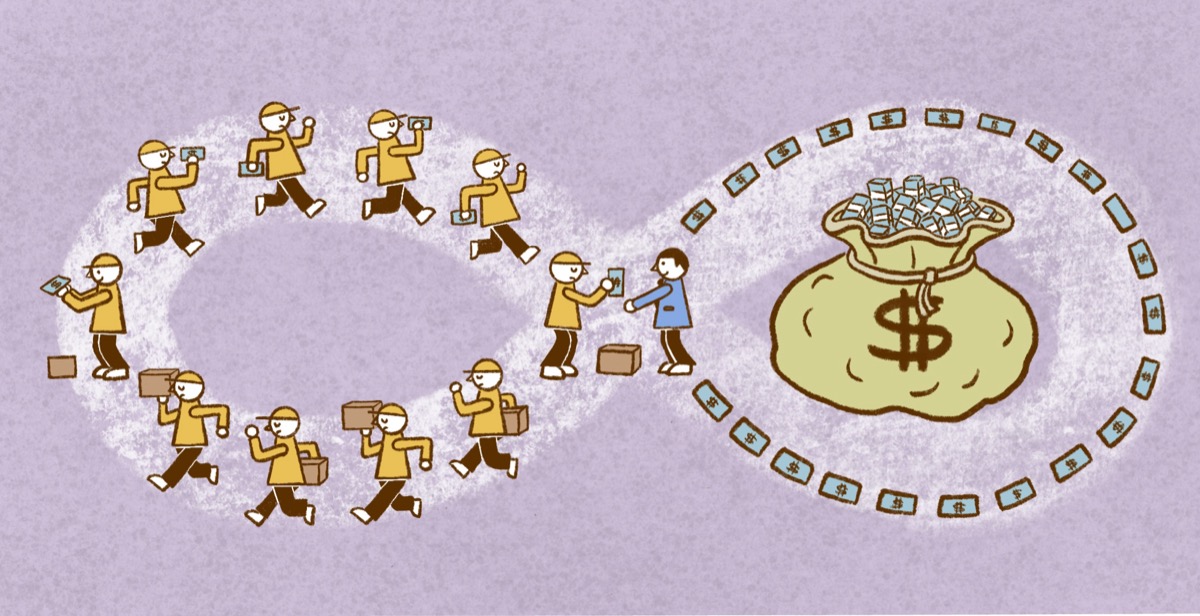
  • Editor’s Letter: Mental Health

    Editor’s Letter: Mental Health

    by Diana Rahim

    It’s hard being a person. Nobody truly tells you this, nor are we really encouraged to look into this fact deeply. As a society, we are uncomfortable with confronting sadness and despair, and would rather concentrate on a superficial, easy-to-understand pursuit of happiness. We are taught to meet our basic material needs, to obsess over our educational and career paths, and to succeed in our society. Far less emphasis is placed on meeting our very important psychological and emotional needs, and in fostering the kind of habits that are emotionally healthy not just for us, but in our reactions to others as well. Very often, even basic emotional responses and sensitivity is stigmatized. Just think of common, dismissive phrases one often hears – “Don’t be so sensitive,” “You’re being oversensitive,” “Why can’t you take a joke?”

    In truth, I truly believe that to see someone express emotion, sensitivity and vulnerability threatens the stability that some people have taken pains to sustain to cope with living in world that can be insensitive and indifferent.

    In describing what I feel to be the deep undercurrent of despair that I think lies within so many of us, especially younger ones, I often mention the fact that every school I have been to has had a suicide. I say this because the epidemic of mental health crisis, depression, and unbearable anxiety, is rooted very much in the way modern (especially capitalist) societies are organized and how people are treated, and it is experienced as early as childhood in the schooling system.

    It is there where we experience the pressure of group dynamics, the shame of classism, the neoliberal demand to succeed as individuals and to have our worth defined solely by our ability to be successfully productive. It is there where we learn that in order to feel respected and valued by those in authority, we have to live according to their rules no matter how painful, unnatural (or even unnecessary) such rules can be. And of course, some people are less aligned to the enforced standard than others, and such people are considered wayward and face more stresses.

    I have to mention the fact of a person’s identity in relation to power because it is undeniably connected to the issue of mental health. While it is true that mental health issues affect people of any class, racial, or gender background, people from marginalized groups are disproportionately affected by mental health problems.

    A recent study by the Institute of Mental Health (IMH) for example revealed that women in Singapore are more prone to depression than men, a pattern that is consistent in other countries (men however have higher rates of completed suicides). Women in the younger age group – between 18-34 years old — are more than twice as likely than men to suffer from major depressive disorder. Queer children (and certainly this very likely leads into adulthood) report staggeringly high rates of abuse and discrimination that in turn leads to mental health issues and even places them at high risk of suicide. There have been studies that also tracked Islamophobia to lead to long-term mental health issues (Islamophobia is also a gendered issue, with women who are visibly Muslim facing the brunt of hate crime attacks).

    Behind these statistics lie real social causes and explanations. Gendered issues shore up when mental health professionals explain women’s higher rates of depression. Experiences of discrimination for LGBTQ+ youth also unsurprisingly figure into higher risks of suicide. The point is that alleviating the inequalities in our systems, and seriously working towards a society that is less discriminatory is not only an issue of justice, but of public health.

    It also means that it is unwise to individualize someone’s mental health struggle as simply a personal problem or just an issue of chemical imbalance. It’s an easy cop-out of interrogating deeper, more systematic issues at play. Those who struggle are often victim-blamed for their own condition, being told that they are at fault for their own suffering. But a lot of times, this is simply not true.

    One of the most moving pieces I’ve read recently on pursuing a more holistic approach to understanding mental health problems was by Johann Hari. I will share the following quote from his article “Is everything you think you know about depression wrong” on The Guardian, though the whole piece is worth reading in full (please do!):

    “In its official statement for World Health Day in 2017, the United Nations reviewed the best evidence and concluded that “the dominant biomedical narrative of depression” is based on “biased and selective use of research outcomes” that “must be abandoned”. We need to move from “focusing on ‘chemical imbalances’”, they said, to focusing more on “power imbalances”.

    After I learned all this, and what it means for us all, I started to long for the power to go back in time and speak to my teenage self on the day he was told a story about his depression that was going to send him off in the wrong direction for so many years. I wanted to tell him: “This pain you are feeling is not a pathology. It’s not crazy. It is a signal that your natural psychological needs are not being met. It is a form of grief – for yourself, and for the culture you live in going so wrong. I know how much it hurts. I know how deeply it cuts you. But you need to listen to this signal. We all need to listen to the people around us sending out this signal. It is telling you what is going wrong. It is telling you that you need to be connected in so many deep and stirring ways that you aren’t yet – but you can be, one day.”

    If you are depressed and anxious, you are not a machine with malfunctioning parts. You are a human being with unmet needs. The only real way out of our epidemic of despair is for all of us, together, to begin to meet those human needs – for deep connection, to the things that really matter in life.”

    People are often unkind or unable to better empathise with those who struggle with their mental health because they reductively view it as a personal affliction. But if we can see that the epidemic of suffering today is a natural psychological response, our brain’s way of telling us we can’t cope with such a world, then we could perhaps see that more can and should be done to make our society a more bearable and healthier place. One where discrimination is acknowledged and tackled. Where people won’t have to be driven to high levels of stress due to low wages. Where living a decent life is an affordable thing to have instead of considered a privilege. Where school systems are better refined to respect a child’s creativity and autonomy instead of stifling or resenting it. Personal worth has to not be tied to personal productivity, which in our times is leading to more mental distress and isolation.

    It is not just stigma that has to be unlearned, but better responses to suffering that has to be learned. We need to actively learn how to respond when someone has an anxiety or panic attack. How to respond to someone who is depressed or who is having a psychotic episode. And just as importantly, we also need to learn how to take care of ourselves if we act as caregivers or support systems to loved ones.

    *

    Those who struggle with their mental health almost always additionally suffer from the ignorance of those who shame it. And just as mental health struggles can stem from very specific experiences pertaining to our identities and the subsequent challenges it brings, the stigmas faced can be very specific too.

    As Muslim women in this society, the conversation on mental health revolves around some big specific issues. In the submissions that will be published in this series, we can see how the language and framework of religion unfortunately can and has been used to invalidate or diminish a person’s suffering. There is often no theological basis to such dismissals (“you should pray more!” “Depression is shaitan”) but simply a more specific way to express the discomfort that people have when dealing with someone who is struggling with their mental health.

    The common invalidating and shaming responses that a Muslim woman receives can often be cloaked in the garb of the faith. For this reason, we must pay attention to the language or behaviour that is often employed against those who suffer.

    Perhaps it is because mental illness is an invisible affliction that reveals no bleeding wounds. A sickness that ails the mind. Perhaps its non-corporeal nature renders it susceptible to being invalidated through the lens of spirituality and religion. Historically, we do know that those who suffer from mental illness have even been thought to be possessed, spiritually afflicted, or beset by bad spirits.

    Of course, it is unsurprising that for people who organise their lives around their faith, a religious explanation is sought after in explaining mental trauma. It’s not that the lens of religion and spirituality cannot be used at all in trying to figure out a way to deal with mental health struggles and trauma. In fact, there is some acknowledgement here perhaps that mental illness is something that requires more than just a medical explanation and solution (it has to include, as aforementioned, one’s own personal history and experiences).

    The problem is that the tendency to simplistic and damaging methods or explanations (like possession) fail to truly and holistically understand the individual’s condition. The problem is that it can result in further trauma, impeding the person’s healing.

    Perhaps mental illness can be seen in some way as a kind of spiritual affliction, but not the kind that denotes possession or being haunted by bad spirits. Psychotherapist Michael Cornwall describes the experience of going through madness as a ‘transformative journey’; an extreme emotional state that occurs often due to the immense stresses and despair of alienating modern existence.

    Grief and confusion can be so profound that it destabilises us and cause great existential shifts that insists on being endured. The profoundness of these experiences are seen as ‘spiritual’ for some because it feels personally transformative. Such a reading would demand a solution that is far more acknowledging of this complex reality and addresses it, instead of simply thinking of the illness as a possession.

    Understanding this, there could be a way that religion and spirituality can be specifically used to the benefit of someone who wants such an approach in their healing process. For example, Stefania Pandoifo provided a more informed way of including Islam into the understanding and treatment of patients. Through researching history and patients in Morocco, she shows how there is a space for the relevance of contemporary Islamic cures for madness.

    *

    So many times, we know that to struggle with your mental health as a Muslim includes battling against accusations that you are spiritually weak, or that you have somehow invited this despair upon yourself through a lack of prayer, or a lack of faith. Of course this has no empirical basis, but such a conviction is not based on reason. It stems from a lack of understanding and ignorance about the reality of mental health issues and what living with it is like. To be depressed is not simply to be ‘very sad’ and to suffer from anxiety cannot simply be healed by surrendering to the will of God, especially since your anxiety can make it impossible to do that in the first place.

    The Islamic faith is replete with stories of prophets and sahabahs struggling with great despair in their lives. There were no words to pathologise any (if any) of their conditions at the time, but we would never deign to call these revered figures weak-willed or lacking in faith as they mourned the loss of wives, friends, family, or as they went through great sorrow, great pain, and the horrors of war (how many of them probably suffered from PTSD!).

    In fact the courage of our prophets in being able to overcome great sorrow and tribulations have always been an inspiring example to emulate.

    Religion can be part of the healing or coping process when it comes to struggling with one’s mental health, or supporting someone who is. But perhaps we should look towards these stories that affirm and validate the reality and difficulty of suffering instead of using the same, tiring religiously-laced platitudes that shame and invalidate someone’s suffering.

    Due to the exposure to so much damaging and invalidating attitudes, it is not uncommon for those who have suffered or who continue to suffer with mental health issues to have a difficult, even hostile, relationship with the faith. To be shuffled from one spiritual doctor to the next without your consent (this happened to a friend of mine) is a kind indirect violence that leaves you feeling powerless. To be consistently told that you are not pious enough by those around you when you were in need of love and validation can leave you insecure and coping with immense guilt.

    Often times, the employment of religion in the shaming and invalidation of your experience can leave you associating the faith with the trauma of your condition. It is understandable if the religion then is associated with pain to you.

    It is okay to have this difficult relationship, and you don’t have to feel guilty. The fact is, of course, it was employed wrongfully by people who prioritised judgement over truly understanding and giving you the care that you needed. Your piousness has no bearing over the reality of your mental illness. Unfortunately, unlike humans, mental illness does not discriminate amongst the religious or non-religious.

     It is not uncommon for you to have to completely re-evaluate your relationship with the faith during and after your journey with your mental health struggle. For some, their understanding and relationship of the faith deepened as it provided a support system that those around them failed to provide. For others, their relationship with the faith has been too damaged by the invalidation and pain that has been associated with it. None of this wrong. The only true thing is the reality of your experience.  

    If you are struggling with your mental health, I want you to know that your suffering is real, that your feelings are real, and that I know you are trying your best to survive. You are not selfish or lazy. There is no shame in your struggle, and I hope that you are taking healthy steps to recovery. There is a place for you in this world, and you are capable of helping and providing love and understanding for others too. You are not alone, though it might feel like that so completely. We are often isolated enough in this world. Though it may be hard, identify those who care about you in affirming and healthy ways, and don’t be afraid to reach out.

    May we take better care of each other, and may our good intentions, especially when laced with the language of religion, be full of love, not judgement.