Category: Body Image

  • Re-thinking Disability in Islam

    Re-thinking Disability in Islam

    by Sya Taha

    __

    Disability and Islam

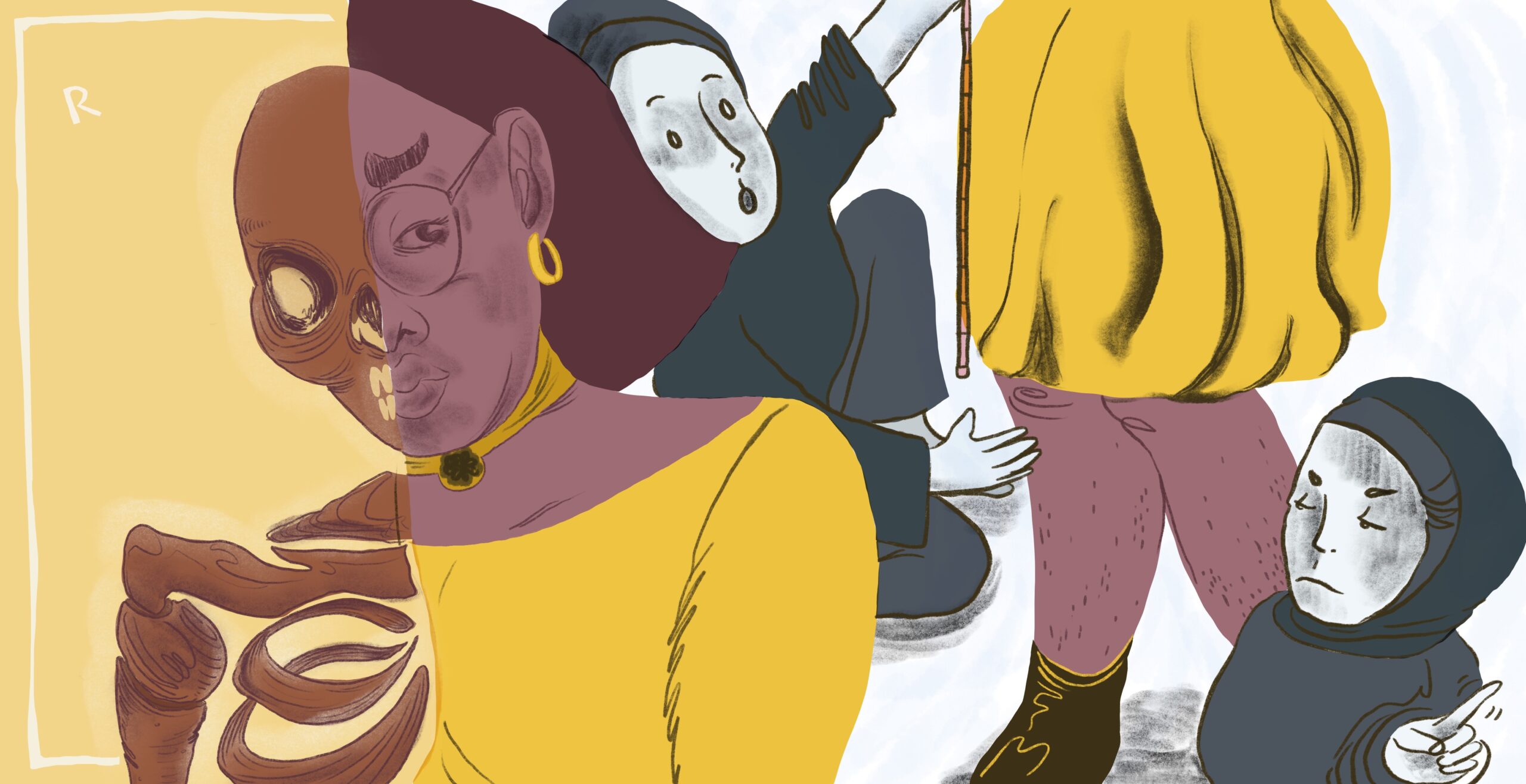
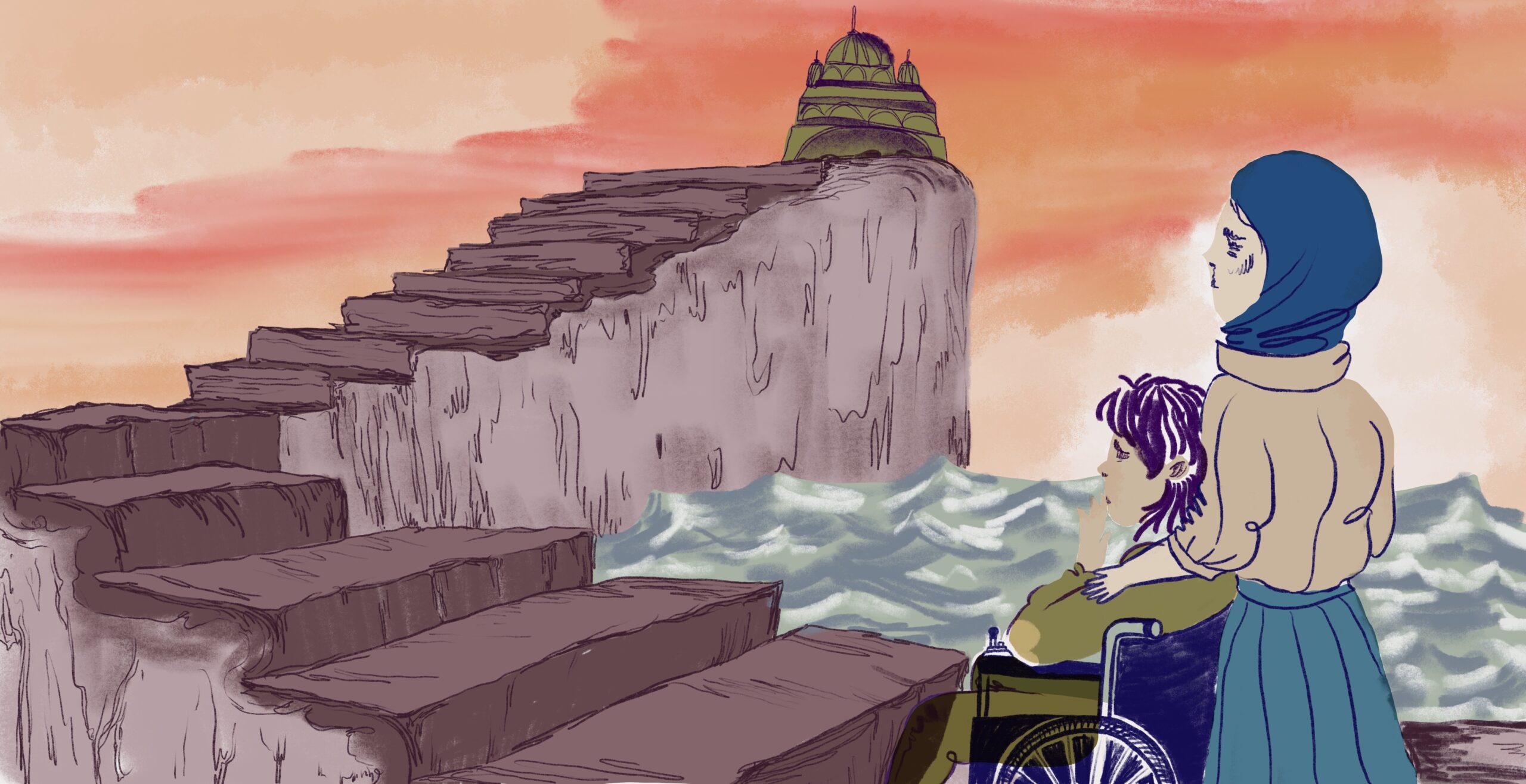
    My sister, Syiqah, gets around on a wheelchair. When we used to attend Islamic classes in our younger days, the mosque we went to was not accessible. We had to gather two or three young men each week to carry her wheelchair down three big steps to where the classrooms were, before rearranging the wall panels to let her into the classroom. This process was reversed after class. Many thanks to these young men, but sometimes I wished that we didn’t have to make such a grand entrance into class every Sunday.

    I often wonder though, how the people who worked at the mosque and madrasah viewed my sister. To start with, I will look at discourses and examples of how people with disabilities (PWDs) have been represented in Islamic theory and practice in history, and also in the contemporary period. For a basic understanding, I then turn to the Qur’an to come up with a nuanced understanding of disability. Finally, I will take Syiqah’s experience as an example to provide insights and suggestions on how to embrace Muslims with disabilities in our communities.

    Ideas about disability in Islam today

    In mainstream Islamic discourses, people with disabilities (PWD) are often said to be “special” or closer to God, with the reason given that they may never have the capacity to do any wrong. While disability is often not differentiated, accountability requires mental capacity. Hence, this should only apply to those with mental disabilities, and even then, only some types. This logic states that some of them will always remain in an innocent, child-like state, and therefore cannot be held accountable for their actions.

    However, there is also the notion that they are “imperfect” or “special”, but this is often two sides of the same coin. This logic states that there is a perfect model of a human body, created by Allah. A deviation from the norm is what is often identified as a disability. Nevertheless, it implies that when Allah deprives a person of a certain ability or gift, Allah may bestow upon them other, special gifts to compensate for this imperfection. For example, those who are deprived of sight may have ears that are so sensitive they can hear very low beats or movements around them. They are given excellence in many other abilities to compensate for their imperfection.

    In the Malay archipelago, there are several dua related to children that are taught to parents. This supplication from Surah Al-Imran, in particular, stands out: 

    At that, Zakariya called upon his Lord, saying, “My Lord, grant me from Yourself a good offspring. Indeed, You are the Hearer of supplication.” (Qur’an, 3:38)

    This verse describes Prophet Zakaria’s supplication God for offspring that is tayyib (good, righteous, or pure). Tayyib is used in the Qur’an to describe land (34:15), Paradise dwellings (61:12), food (2:57), properties (4:2), upright men and upright women (24:26), as well as an abstract concept that is the opposite of evil (3:179, 5:100). However, in Malay translations of this verse, tayyib is often translated and explained as sempurna (perfect or complete) or tidak cacat (not imperfect). In parallel, Muslim parents are also taught a dua before having sexual intercourse asking God for protection from Shaitan harming one’s baby. Following this logic, disabled or deformed newborns are seen as a trial or burden from God for the parents, or the result of Shaitan’s influence in the womb or at conception.

    Mental illnesses, in particular, are the most susceptible to being viewed in many cultures as possession by jinn. Although this has no basis in the Qur’an, it remains a controversial topic among Muslims globally. My deceased niece had schizophrenia and many relatives used to speak of her as being possessed before she was given medication. In mainstream jurisprudence, ‘aql or a rational state of mind is required for acts of worship to be valid. Hence, those with mental disabilities growing up in Muslim families are often exempted from fasting, prayer, or going to the mosque.

    PWDs are not discouraged from taking part in communal Muslim life, but physical barriers often stop them from doing so. In Singapore, mosques (as any other building) built after 1990 have to be accessible, and older mosques are being slowly upgraded to include lifts and ramps. However, there are still some mosques in older or historic neighbourhoods that remain inaccessible. The second oldest mosque in Singapore provides a tent-like, fully-curtained space outside the male main prayer space for women who cannot climb two flights of stairs to the women’s space. But Muslims who cannot even climb the stairs to enter the main prayer hall will have no way of accessing the mosque at all.

    The success of organisations that work on providing religious access to the blind depends on their country’s infrastructure and levels of awareness. For example, Al Fitrah Foundation, a Malaysian non-profit organisation for visually impaired Muslims runs a Braille Quran Initiative, but dependence on private donations means that it will be some time before every blind Muslim in Malaysia can have access to one.

    However, in countries with more developed infrastructure for PWDs, organisations like Kitaba (United Kingdom) and Dirasa (Norway, Denmark, Sweden) have been producing and teaching in Braille and audio, as well as even organising assisted umrah trips for Muslims with visual impairments and other Muslims with disabilities.

    Malay Islamic discourses have a certain perception of PWDs with regards to their characteristics and life purposes, and these are often a fusion of pre-Islamic culture and Islam. A look at the perspective mainstream Islamic history helps us to enlarge our perspective on this topic.

    Disabilities in Islamic history

    Julaybib was one of the Ansar, the first community of Muslims surrounding the Prophet Muhammad in Madinah. The name Julaybib means “small-grown”, suggesting that perhaps he had dwarfism. He was also described as being damim (ugly, deformed, or of repulsive appearance). Most importantly, his parents or lineage was not known – a serious limitation. He could not expect any help, protection, or support from a society that heavily stressed family and tribal connections. 

    His physical and financial difficulties meant that Julaybib was ridiculed and shunned, to the point of being prohibited by a certain Abu Barzah of the Aslam tribe, from entering his home. However, the Prophet being aware of Julaybib’s needs and sensibilities went to one of the Ansar and suggested that his daughter marry Julaybib. While her parents protested, the Ansari girl trusted the Prophet’s decision-making process and married Julaybib. She is lauded by scholars for having ‘readily agreed to be the wife of a physically unattractive man’. While this is indeed an honourable attitude to emulate and promote to Muslim women, the opposite does not often happen today. The emphasis on the reproductive abilities of Muslim women could partly explain the dearth of marriages between Muslim women with disabilities and able-bodied Muslim men.

    Historically, there was even a religious position which favoured those with disabilities. Blind men were deliberately employed as mu’azzin in Muslim-majority countries to give the call to prayer from the minarets of mosques. Their disability was an advantage: they could preserve the privacy of surrounding houses as they could not look into these courtyards. After the advent of loudspeakers in the 1950s, being blind was no longer a requirement for mu’azzin. Could it be possible that since no one reaches out to engage PWDs, today’s mosques may have overlooked accessibility in designing, building and organising their spaces?

    As the acceptance of PWDs in practice is fluid and changes across time and space, it is always useful to go back to our basic source of divine knowledge.

    Theoretically speaking: A Qur’anic analysis

    The Qur’an gives us a comprehensive and nuanced understanding of disability. I did a search in various translations of the Qur’an for any verses that made a reference to PWDs. A general reference was al-darari (4:95), or ‘disabled’. Coming from the root d-r-r, it can connote ‘harm’ or ‘suffering’. Humans can suffer or be harmed, but this only occurs with God’s permission because only God can harm or benefit us. The actions of shaitan, hypocrites, disbelievers, or disobedient believers (through magic for example) cannot harm us (2:102). This already clearly counters the idea that mental illnesses are the cause of jinn possession or black magic.

    The form ud’turra means ‘force’ or ‘compulsion’. Doing something forbidden by force or by necessity, such as eating forbidden food, has no sin. Another form, darraa connotes ‘affliction’, ‘hardship’ or ‘adversity’ is a type of force or compulsion because it comes from God and it not under our direct control. 

    And [mention] Ayyub, when he called to his Lord, “Indeed, adversity has touched me, and you are the Most Merciful of the merciful.” (Qur’an, 21:83)

    Like Prophet Ayyub, we should acknowledge that adversity in the form of disabilities as an example, as coming from God. It is helpful both for those with disabilities and those without to remember that only God can remove afflictions from people. 

    For those of us with disabilities, we may interpret that when God gives us hardship, it is meant for us to remember and call on God (10:12, 16:53, 30:33, 39:8) and be patient (2:177) because it is just a trial (2:214, 39:49) aimed to humble us (6:42, 7:94). God only gives us what we can handle, and even provides supplications for us (2:286). Everyone will experience hardship and ease, it’s only whether we realise it or not (7:95). If we are in the position of ‘ease’ in that we are healthy, we should be empathic towards those in the position of ‘hardship’, because it can easily come to us someday.

    Taking all these nuanced meanings into account, al-darari (4:95) is thus a person who has either been hurt, harmed, or born with a disability, making her unable to fight in the way of God by necessity. These conditions are a kind of adversity or hardship in their lives because society is mostly adapted and geared for the able-bodied and the neurotypical.

    However, being exempted from striving in the way of God does not mean that they are forbidden, as shown by the historical example of Julaybib. Julaybib contributed in his own way to the cause of Islam, managing to kill several in a battle before dying. The Prophet was so moved by his contribution that he prepared Julaybib’s grave himself.

    My sister

    My sister was born with a genetic condition called spinal muscular atrophy. This is a group of inherited diseases that cause muscle damage and weakness, which worsen over time and eventually lead to death. She has Type II, which means that her condition was not apparent until she was about a year old. This led my family to think that something had happened to her because she appeared healthy until that age. This condition was also only recently recognised in medical books, so when she was young, my family went to different people to try and find a cure. 

    I remember a bomoh, or a traditional healer, performing rituals on my sister in my home. In the Malay culture, traditional healers may combine Qur’anic recitation with other pagan practices, making this practice perfectly acceptable to many Muslims. At the same time, she also went for regular physiotherapy sessions.

    Eventually, when she was in junior college and researching her medical condition, she read about the disease’s shortened life expectancy. From then on, she decided to make full use of her life. She has been fortunate in this respect because my parents supported her fully. My mother used to carry her to the bathroom, wash her, and dress her. From primary school to university, she always had a friend to help her with taking out her homework, pencils, or bringing her specially-made table around to the next classroom. My father advocated for her to enter a high-ranked school (which she was not eligible to enter) because it was the only one that had a lift, provided the financial means for her to go to school in a London taxi that could accommodate her bulky power wheelchair. They also later hire a domestic helper to help her with caregiving at home.

    My parents used to exempt my sister from fasting or praying, saying that she didn’t have to. However, as she got older, she became more interested in attending seminars, conferences and additional classes on Islam. We did start attending one class together in a mosque, but stopped going when we realised that the bus between the mosque and home was not accessible. (We could take the train, but that took too much time.)

    My sister wears the hijab because she believes that is part of being a good Muslim. She also told me that she would like to get married and have a family someday, but she realises that her disability does stand in the way. The right partner would have to be willing to take care of her, and any future children, because she cannot do any of the physical care herself.

    Most importantly, she says she does not feel disabled because she was born with her disability. To her, asking her if she would like to walk is like asking us if we would like to fly. Today, she leads the best life she can, in the present. She has been able to excel in her studies, her work and her sport. She works and supports our family, she can get around on her own, and have a social life.

    Rethinking disability

    Firstly, there needs to be nuance when thinking of PWDs, because they are not a homogenous group. There is the matter of family support and financial ability to provide caregiving and transport. There also needs to be a differentiation between physical and mental disabilities. Many PWDs are eager for a sense of community, too.

    The visibility of Muslims with disabilities, in general, is low. This is probably because of the predominant ideas about them and their spiritual capabilities, as discussed above. For example, using a guide dog to help them live independently is something virtually unheard of in the Muslim community. It would effectively bar the person from entering religious spaces. Another possibility is that of overworked caregivers, who may place going to the mosque as low on the priority of needs.

    Saying that all Muslims with disabilities are ‘special’ and do not need to fulfil religious obligations is counterproductive for inclusion. How many mosques are accessible with ramps, lifts, railings and larger toilets and ablution areas? How many mosques have Braille Qur’an, or television screens to visualise khutbahs?

    … “[A]dversity has touched us and our family, and we have come with goods poor in quality, but give us full measure and be charitable to us. Indeed, Allah rewards the charitable.” (Qur’an, 12:88)

    When a PWD expresses their wish and interest to participate in a Muslim community, it becomes our duty to be charitable, to make our best efforts in making things easier for them. In particular, a masjid should be a refuge and not a place that causes divisions (9:107). 

    Today, there is the widespread availability of Islamic knowledge through online Qur’an and hadith databases, as well as live-streaming of seminars, sermons, and Friday prayers. More than ever, those with disabilities can connect with other Muslim communities across the world.

    Ultimately, the empathy we cultivate for Muslims with disabilities should extend to empathy towards other marginalised Muslims. Let’s make sure we are not overlooking an integral part of our community.

    __


    Sya Taha writes about the media representation of Muslim women through race, disability and other intersectionalities. Her current research looks at Malay women’s experiences of maternity care. She has facilitated workshops on gender, interfaith and human rights issues.

    Illustration by Ishibashi Chiharu
     

  • Naked Face and Bare Feet: Language and the Body

    Naked Face and Bare Feet: Language and the Body

    by Atifa Othman

    _

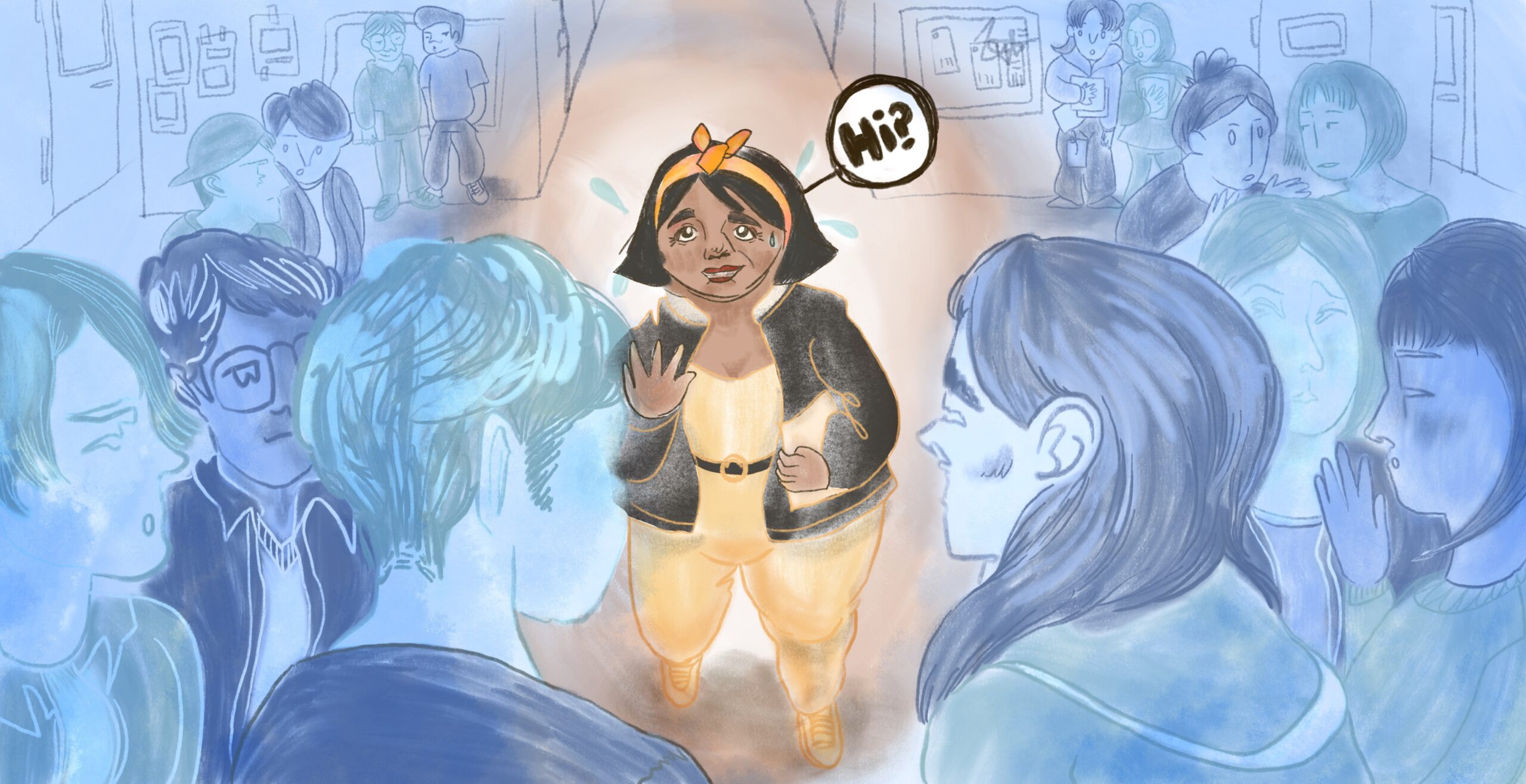
    There I was, bare feet and naked face, drenched in salty sweat after a 1-hour workout. I was a regular at that gym and I always tried to make it a point to look approachable and friendly. I never had a problem frequenting exercise spaces on my own (apart from the occasional random anxiety about my body), but I did sometimes hope to seek simple acquaintances I could get along with on a “Hi!” “Bye!” level. 

    After frequenting the gym for three months, I still never managed to attain that with any of the gym members. Most of them would speak to each other in Mandarin. The Asians sporting Westernised accents found more interest in the White expats (who also only spoke to one another). It wasn’t an unfamiliar situation. Even now, after exploring new fitness spaces with various kinds of profiles, it still isn’t. 

    *

    I used to think that only intellectual conversations were worth opening my mouth for. All the way from secondary school to university, I was exposed mostly to people from middle-income families and above because of the profile of the schools I went to. I made some friends, several acquaintances, and a few enemies, but honestly, most of us shared a common thirst to be intelligent and worthy of a conversation. 

    However, I learnt that people only find you worthy of deep conversations if they assess you to be of a certain profile. 

    I am a brown-skinned Malay girl. My accent shifts depending on the people I’m around. I play up its ambiguity (cultivated after watching a variety of movies and shows over the years) whenever I’m around Chinese people or snobby Malay people who think they’re too good for common folk. With Malay-speaking Malays, I speak my language more and use Singlish liberally without restricting myself. They often laugh at how awkward I sound, and I laugh along with them.  

    Language has a way of interacting with the body to bring out the worst in people who are prejudiced and don’t even know it. There were countless moments when people in the university I went to would leave me out of conversations during seminars while flocking towards all the White and light-skinned Asian people in the room. I used to wonder if it was because of my introversion and social anxiety until I mustered enough courage to start saying “Hi” to students from other divisions who would, to little surprise, stare at me blankly and give me a strange smile. (And then flock to the White and light-skinned Asian people in the room.) 

    *

    We were at a cafe in Raffles City. There was a quiet, charming bustle in the air. Sal and I don’t usually hang out alone very often, so we were chattering loudly and excitedly. What began as lighthearted talk about cute babies developed into both of us talking passionately about how Malay women are always underestimated in the workplace or assumed to be lazy once we are seen taking a damn break.

    We were sharing a buttery almond croissant and I was sipping a butterfly pea drink that was an appealing indigo but didn’t have enough taste for my tongue. Once we were done, we stood up to leave. 

    Behind us, a pair of lean Chinese girls who had been chattering as loud as we were had their eyes fixed on us while we got ready to go. 

    “Finally,” one of them scoffed in the fake American accent a lot of wealthier Chinese Singaporeans like to sport. “They’re leaving.” 

    I don’t think Sal heard them. I didn’t want to bring it up either, because I had enjoyed that short time we spent together alone. I remember wondering if I should have spoken less Malay. But I realised that when you and your friends are excited, you shouldn’t have to think about controlling your volume in a space where noise is all around. On that day, it became ingrained in me that even being socially accepted enough to chatter in excitement can be a privilege. 

    *

    Sometimes, if people hear me speak a mixture of Malay and Singlish the first time they meet me, I predictably receive shifty eyes and get spoken over whenever I try to contribute to “intellectual conversations” until I manage to correct them on a linguistic mistake they made, or call them out on an opinion I find problematic in a way that destroys their idea of what the capacity of my brain is. It used to make me feel so proud to easily shift between different modes of speaking, to alternate between the organic vernacular and the contrived formal, to gloss over the natural accent of my ethnicity and show off that I can sound like a snooty and proper English-speaking person if I want to. I had a lot of pride thinking of how the world saw me whenever I did that: Here is a dark-skinned Malay girl who can talk intellectually, and isn’t like the others. Here is the rare exception to the norm. 

    But I hate it now.

    I began to disgust myself whenever I had to switch my modes of speaking. It sickens me whenever I have to conceal my identity by sounding like I possess a certain class and level of education. It sickens me that speaking a certain way makes others view me as more worthy of intellectual conversations because it somehow cancels out the starkness of my brown skin and dark features. A colour problematically associated with failure, leisure, lack of complexity, and traditionalism by the majority. 

    During the Singapore Writers Festival, in a panel about language and the body, South African writer Kagiso Lesego Molope said she dresses to the nines just to go out and buy bread. She was sick of being followed around in supermarkets and shops in Canada, to the point that she herself questioned whether she accidentally stole something. Of course, even dressing up did nothing to solve the problem of racist assumptions and profiling. This became so common that she eventually stopped going out to shop, and did most of her shopping online. What she said felt familiar to me. I have had one too many experiences of being tailed by a Chinese shop assistant, even if I was holding a jarringly full bucket of things that would be impossible to sneak out of the shop. Even if I was dressed to the nines.

    *

    I had on my favourite red lipstick that I only wear when I feel like dressing up. I had been waiting to buy a new phone case for a long time. Bugis Street was heavily crowded that day. I chanced upon a small booth with several phone cases that stood out to me. Immediately, I walked towards it. 

    A Chinese salesgirl appeared by my side out of nowhere. I noticed the harshness of her stare before that of her voice cut the silence between us. 

    “Yes?” she spat. 

    Instinctively, I retracted my hand from the phone case I was holding.

    Still trying to be patient, I asked, “Do you have Google Pixel 2XL phone cases?” 

    “Huh? No, don’t have,” she quickly replied and continued to stand beside me and stare. 

    I was tempted to be sarcastic about her exceptional service like I had done before to similar salespeople in the past. But I was tired. 

    “Nevermind.” 

    *

    Even when people like me do not speak, we are assessed. To the prejudiced individual, our silence is as dangerous as our voices. And if it is not dangerous, then it’s unnecessary. Us creating an image that pleads for society to integrate us into a presentable, educated norm cannot erase the classist, racist mentalities that are so pervasive yet insidious in our society. I used to seek only intellectual conversations, but I now find them a chore and a bore. It sometimes ends up just becoming a game of who sounds smarter than whom anyway.

    It took me years of having my voice undermined to understand that the knowledge you gain and the lessons you learn from people are not defined by how eloquent or educated they are. Human connection is sometimes the most genuine when you can talk about the most mindless things. Honestly, the desire to only have intellectual conversations is, at times, a convenient excuse for a discriminatory social circle anyway. 

    *

    My mother robustly walked around the Louis Vuitton racks of Galeries Lafayette in Paris. The wide sleeves of her jubah circled the air with every step that she took. Like any street-smart auntie, she immediately noticed a foreign sign that mainly said: “20%”

    Of course, she approached the nearest salesperson to enquire what the sign meant, as the noticeably smaller words were in French. 

    “This one is 20% discount?” she asked timidly, in a soft voice completely different from the confident, commanding one she uses around her family. 

    A pause, and a blue-eyed glare. 

    “For French people only,” replied the salesperson curtly. 

    *

    I once longed to be confident enough to wear slippers and the most comfortable, casual outfit I could think of, and stroll along a high-class place like Orchard Road without feeling all eyes on me in judgment. I thought I could somehow do that by losing weight to look more brown Lana Del Rey-esque and by magically becoming a less nervous person. Perhaps bringing out more cheekbones with a contour stick and shimmery highlighter would somehow make me have more presence in any space. Or maybe my shoes were the problem. Perhaps I needed a certain height of heels to have the power to simpy walk without people wondering why I should exist in a bougie area. 

    But scrap that. If I cannot be regarded equal by another human being as my natural self, I don’t see why it’s me who has to change. If I were to appear before someone with my naked face and bare feet and have my existence be seen as an annoyance or a threat, then my silence, my body and my voice are not the problem. 

    __

    Atifa is how she likes her coffee—severely caffeinated. She is so proud of this statement that she lifted it from her Instagram bio. Her works have been published in TAYO literary magazine and Perempuan: Muslim Women Speak Out.

    Illustration by Ishibashi Chiharu

  • What Happens When Your Body Is Not Your Own

    What Happens When Your Body Is Not Your Own

    by Aria

    My body is not my own. Growing up in a Malay Muslim household, it took me a while before I realized that my body was not my own. Since young, my body has been policed by everyone around me; my self-worth reduced to my physical appearance as though I had nothing else to offer. That’s not true – as much as I am reminded of my intelligence (a trait identified by my kindergarten teacher who told my mother: “Wow, your daughter is different. She’s gifted.”), I am also reminded of my fair skin and my beautiful hair. And, how I have it so much better than other Malay girls.

    “Don’t you know that your skin is fairer? You’re so lucky.” Am I? What does that mean? I have always been troubled by this question. When I was young, I thought the lightness of skin excluded me from being Malay. I could not identify with my Malay friends, their skin shades darker than mine. Nor could I identify myself with my Chinese friends because simply, I knew that I was Malay. And I didn’t want to be anything else. Yet, I was neither here nor there but somehow, this supposedly better skin tone that I had was desirable. I remember watching my cousins and my friends turn to skin lightening lotions and creams, telling themselves that they would look better with fairer skin. While on the other hand, I found myself running around in the hot sun, playing soccer and just burning, just so that I could feel more Malay. I remembered how thrilled I was when my skin finally got darker, only to come home and hear that, “Kenapa your skin so dark? Tak lawa.” It still haunts me how I wanted to be recognized for being active and happy and not burning in the hot sun (because of melanin), only to be reduced once again to the aesthetic value of my physical appearance. Am I not worth more than that?

    And the thing is, I never really noticed when my skin tone changes. Living in my body, I was mostly occupied with how happy I was, how I was doing the things that I wanted to do and trying to strive to be better. Yet, everyone around me seems to be fixated on my physical appearance. When I was eight, my friend’s mother came up to me to tell me that I was beautiful. It was sweet, it really was. But, then, she began to push me to spend more time with her son – something that I continuously resisted. And it also made me question why she said that to me, and not everyone else. Were my other friends not worth her comment? What made it different? When I asked the adults, they said that I was just different – a child born out of Chinese and Malay blood. Naturally, you are prettier, they said. Now that I am older, their comment just reeks of exoticism, of colourism – that the stranger someone looks, the more desirable they are. The slimmer and fairer someone looks, the more desirable they are. It is what it is – bullshit, and it always has been.

    But now, that I am older, I found myself going through other forms of prejudices. I went through several depressive episodes, my weight increasing and decreasing depending on my happiness. When my family lost three important people in our lives, my weight was at its highest. And so were my academic results, surprisingly. So, people congratulated me on my academic success but they also commented on how big I got. I remember this particular uncle who made the effort to comment on my weight every time we met. It doesn’t matter that I was successful in my academic pursuits; he only commented on how big I am. I hate to think how hard he must have been staring to see that I gained weight, how fixated he must be to think that his comment was of importance. It hurt me. It did. Because once again, I never truly noticed. I was overwhelmed by responsibilities and grief, and my body weight was the last thing on my mind. And suddenly, it was the first.

    So, it began. I found myself researching on diets. I found myself recognizing the new way my skin folds because of the excess fat. I found myself fixated on the roundness of my face, the fullness of my thighs, the flabbiness of my arms – and all because of him. I turned to diet pills and ate them, not caring that they were not health-approved and that I got them from a carnival. I became embarrassed of my body, hiding them behind baggy clothes and shielding my face whenever a camera turns on me. I became someone I did not recognize – a large girl – and it was difficult, especially when I would turn to my friends and tell them that they were beautiful as they are. And yet, I hated every inch of myself.

    I eventually lost the weight when I got happy. No amount of diet pills could remove the weight, not when I was still clinging onto my grief and depression, not when I was still turning to food to distract myself from my problems. But, I lost the weight and the uncle stopped commenting. Instead, everyone is praising my new weight, praising the fact that I was returning back to my usual physical appearance – normal weight, fair, myself. Yet, I am still angry. I am still angry that my physical appearance is holding any importance in my conversations with others, that my other successes can be blinded by weight gain or the current shade of my skin, or my hair, or other inconsequential things that are not determined by me. I am angry that this is not only directed to me, but to every other girl or guy around me – that our physical appearance is just as important as who we are.

    It has never been important to me but it has become important through comments and unsolicited advice from the older members of my family. What I wear is deemed important, that the shortness of my school skirts is the reflection of my upbringing, that the lack of hijab on my head is the reflection of my lack of faith – once again, numerous physical representations that do not and should not define who I am inside. My philosophy is that the only ones who matter are the ones I love, and these individuals should know me enough to know that my physical appearance does not reflect my faith and my character. And that I have always been more and beyond my physical appearance. 

    This is the body that I have been chosen to live in. As much as I am grateful, I wish that it had never been the defining reason behind actions that I have chosen to do. I wish I was strong enough to live beyond the comments, to know that my self-value is more than them. But as much as I wish for all those things, the pressure from public comments, media and people that I know have heavily influenced me to gauge my self-worth based on my physical appearance. And every day, I am fighting against that influence. 

    I know: I am more than my body – more than my skin color, my weight, my features and everything else, and so is every other woman. We have our intelligence, our independence, our spiritual faith; we have so much more to us that is uncontainable by our physical appearance. And yet, we are still being policed and contained, our bodies reduced as the key to who we must be – but I believe that we can fight it. I play my part in advocating for that now, in reminding my friends that they are more than their temporary physical selves, as well as reminding myself of that fact. I will continue to live authentically, unbothered by my physical appearance and the comments that it might bring – because bodies change and that’s just a natural thing that happens, and in doing so, I hope that slowly but surely, we will change the societal preoccupation with our bodies. 

    We are all beautiful; that’s how it has always been. 

    _

    Aria believes in the empowerment of women and other marginalized groups. She has written essays on social inequality and other feminist issues in university and has a very strong passion for advocating for equal human rights. Apart from that, she feels at home in the world of screenwriting and watching philosophical films with her old cat.

    Illustration by Ishibashi Chiharu

  • Of Boobs and Babat: A Story About My Body

    Of Boobs and Babat: A Story About My Body

    by Raudah

    __

    As a plus-size woman, body image is an inner demon that I have fought, lost and have a love-hate relationship with over the years. Heck, sometimes we have brunch on weekends. 

    I dislike my body. Everything is too much; my feet are too big and I am not able to buy cute shoes. My boobs are too big and jiggle when I walk. I have more than one chin. My thighs are too big and I have lost one too many favourite pants due to this. My mid-section makes people sitting in the reserved seat do a double take. On bad days, I even hate the two moles on my chin (I named them ‘cindy’ and ‘fatimah’).    

    As a Muslim woman who dons the hijab, I am unsure of the impact that societal pressures of body image is supposed to have on me. On one hand, I feel immune from the body image concerns that are forced upon women due to my non-conformance to it but yet as a woman I am also part of the narrative. 

    Has my poor body image become a mirror in my self-image? Perhaps. I am well known for being invisible; it’s my superpower. In meetings, I am not seen and people do not make eye contact with me. Individuals whom I have never met before tell me I look familiar when they have never met me before. I am a copy-paste; I am just another fat brown woman like the many others alongside me. 

    It started at a young age when I was constantly mistaken for the older child because of my bigger frame and round stature. 

    “oh, ni anak number dua, badan besar eh”

    (“oh, this is the second child, big-sized eh”)

    Statements as such were casually passed with looks from the adults especially the aunties. I never did connect the dots until much later in life. It took me many years to finally comprehend the ‘look’. The look was one of sympathy; sympathy because a fat girl does not get the best in life. Being fat makes her less desirable as a woman and as a prospective wife. Fat girls do not win in life.  

    Throughout my formal schooling, I was a lifetime member of the Trim-and-Fit (TAF) club. From primary school all the way to Pre-University level.

    “Eh you know TAF club backwards is what?”

    “F-A-T!!”

    Bless you physical education teachers for your creativity.

    I recall attendance for TAF club was compulsory; should one miss a session of TAF club; their name would be called out during morning assembly. Not only are you punished for being fat, you are also punished if you do not acknowledge that you are fat.  

    In secondary school, I became very aware that my breasts were bigger than they were supposed to be. Girls and boys would talk about them. The girls would mock them and ask me where I custom tailor my bras. Boys would stare at my breasts. This confused me greatly as I thought of breasts as just lumps of fat; just like what camels have. It was not helpful that they would speak about my body in a language that they assumed I did not understand. It was only in secondary two when I was standing outside Malay class when I was spotted. 

    “Eh siak ah, dia paham melayu siak”

    (“Eh siak, she understands Malay siak”)

    In pre-university level, I proudly took on the title of Vice-President of Fitness Club, a designation given to me based on the fact that I was the second biggest person in the club. The fitness club was a co-curricular activity club for the ‘badan besar’ people in the school. It was a daily activity club that required the members to expel a certain amount of calories before we could be released for a recess break.  

    I had associated big with bad and small with good. As a girl; as a woman, the smaller you are, the better and more desirable you become. I had been warned with cautionary tales that fat girls do not end up with husbands or that boys do not like fat girls. Tales were spun about a fat girl whose could not find love or lost out on love to a slimmer smaller girl. Fat women were participation prizes in a male competition when slimness is the ultimate prize. 

    I have my phases of ‘I’m-going-to-get-slim-and-people-will-discover-my-true-potential’ phase. In my head, it would be my Cinderella moment; as the layers of fat peel off and out emerges a slim Raudah with only one chin. In this fairy tale, I would be noticed; waiters will see me and serve me first, people would give way to me and I would finally get attention from non-senile men.  

    To date, I do get statements urging me that I would be more desirable if I lost weight. This makes me more rebellious as if I do want to get desirable, I would do it on my own terms and not because you asked me to.   

    I am a lot more comfortable with my body. At work, the big boob-ed ladies would exchange information on where to buy good bras and any upcoming bra sales. We would compare boob sizes. We have intense heated debates based on whose boobs are bigger [Ok, not all the big boob-ed ladies participate in the debates, mostly me and a couple others…. Ok and these debates and conversations are initiated by me]. 

    “Asalkan tetek lebih besar daripada perut”)

    (As long as your boobs protrude more than your tummy)

    However, I would be lying if I say I am 100% comfortable with my body. I do have bad body days when I reprimand myself for staying on being fat. Perhaps it is not too late to get slim and be noticed. I would binge download fitness app that would set off alarms reminding me of my weight goals. After a few days, I would delete the apps and decide to cut sugar and white rice from my diet. Another few days later, I would resume eating white rice as the hawker centre near my office does not have a wide selection of halal food. I personally prefer wanton noodles, kway teow, and yong tau foo but it is difficult to find halal food stores that sell anything other than nasi padang. 

    “Everyday makan nasi padang, badan pun besar macam padang”

    (“Every eat nasi padang (field), body also become big like field”)

    My body image journey was a tumultuous one and I doubt it will end anytime soon. Just earlier this week, I waited patiently for 45mins for my Hershey ice-creams at MacDonald’s. I have also made attempts to inculcate my body insecurity into part of my sassiness.  

    P: You walk fast for someone who doesn’t look like she can walk fast.

    Me: You mean fat?

    P: No, I didn’t say that. I just said you don’t look like you can walk fast.

    Me: * walks faster*

    At my age now, I feel that I have lost out in the genetic race of beauty, looks and body. The younger girls also seem to be more versed in the act of looking good. Taking the train to work every weekday morning and seeing the Shenton girls with their high heels and immaculate dressing and make-up; I legitly wonder how they walk in those stiletto heels. Most importantly, I hope that they wear stiletto heels not because it is expected of them but because they want to. I hope they did not have aunties who looked at them with sympathy and told them they need to look and dress in a certain way to ‘win’ in this world.  

    __

    Raudah is a plus-size Indian Muslim woman single woman who mostly wears black of dark-coloured hijabs because she gets food stains on them. Dreams of garnering an army of social workers to change the world and advocate for social justice and equity for all.

    Illustration by Ishibashi Chiharu


  • Editor’s Letter: Body Image

    Editor’s Letter: Body Image

    This editor’s letter is guest-written by Nurul Huda Rashid

    _

    Pertumbuhan tubuhku / Seeds & the Soil  

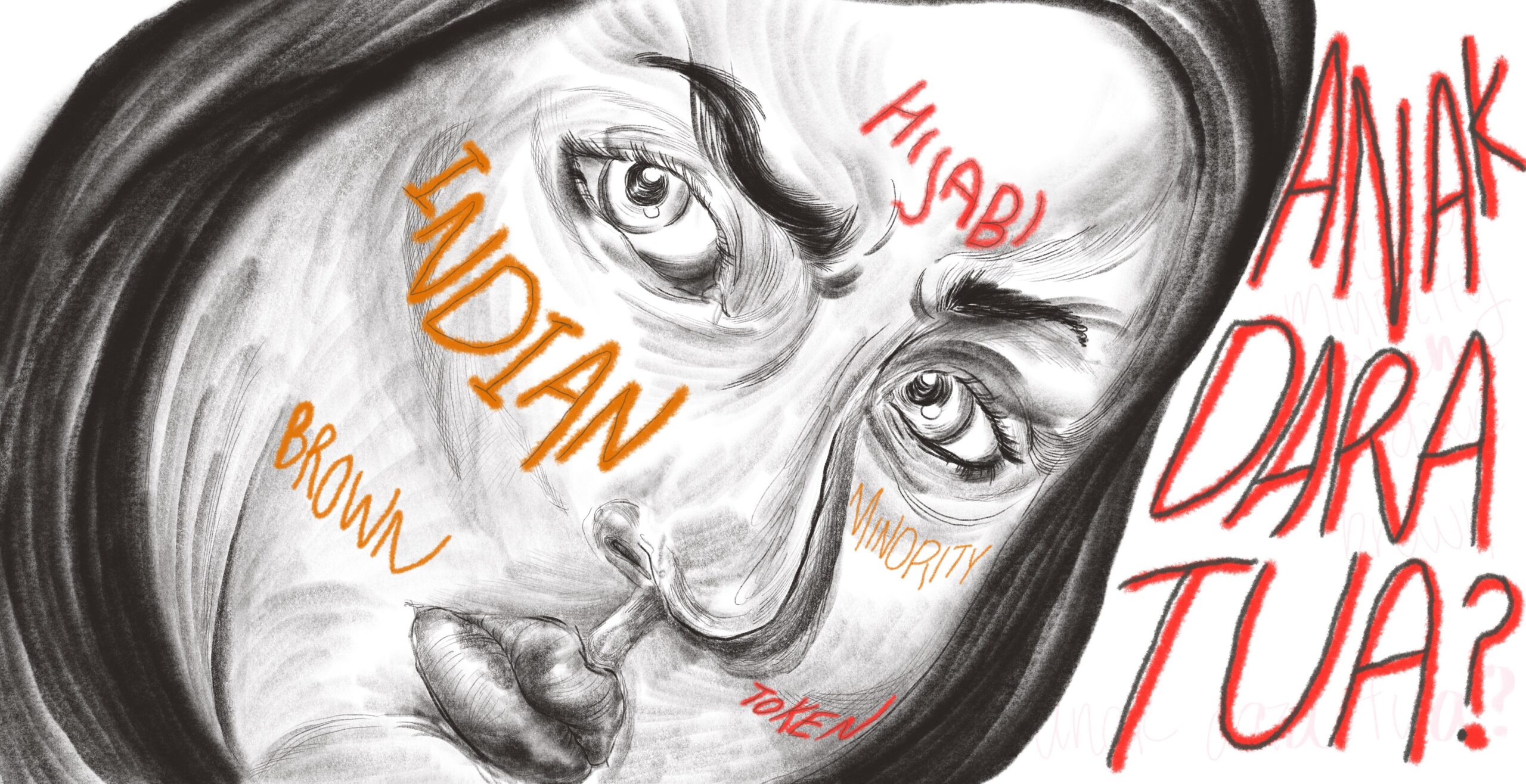
    I was in primary school when I was made aware of the darkness of my skin. Its hairiness was identified as ‘gorilla’ and  I was told that I could never be as beautiful as a ‘Malay’ girl. The ‘Indian’ in my “race” had contributed to my bodily grotesque; something I repeatedly tried to shave off but to no avail. I quickly learnt that traits on my body, mapped against my “race” positioned me not just as a ‘minority’, but a ‘double minority’ and that this would lead into a lifetime of justifications for those who insist on seeing through difference.

    It continued into secondary school when they asked why the corners of my lips were pigmented and not pink, when I was told to pull up my socks to hide the hair on my legs, and that boys would never fancy me because I was fat. I grew up very much aware of what it meant to not fulfil prerequisites of being ‘beautiful’, and that it had everything to do with how I looked. This was something other girls planted onto me, tagging my body, my skin, with words shoved into their own minds, for they too were being measured through such language of “beauty”. We all were. Semua. 

    When I reached puberty, I was told to cover up, to don the hijab because I was now a woman, although, nobody bothered to explain to me what being a woman meant, except that now, all my sins would be counted. Every wrong deed I did would be punishable and eventually lead me to neraka jahanam (hell): because somehow, women’s bodies would be held accountable for the actions of men. I was now made a visible Muslimah, a walking form made to embody my religion, unaware of what I was to contain. In that one night, in those drips of blood trailing down my thighs, I was made to believe that it would miraculously sprout awake my womanhood. But it did not, and it felt like a betrayal. 

    I remember looking to my mom, my aunties, realizing that they too did not have the answers. We were all reformed into ‘woman’ through the narrative of ‘religion’, uttered through tongues of society. They dictated us into roles of anak dara (virgin), wife, mother, but did not bother to delve further into what this meant in Islam: both out of convenience, but also ignorance of those times.

    I remember growing up in the 90s and following my mom to her kelas agama (religious classes) where men repeated the roles and duties of the wife to her husband. But what about the roles and duties of the husband to the wife? I would often question this, but was always met with silence. Looking back now, I realize how we were and still are measured through our bodily transformations, which would determine the display of culture and religiosity, the potential to bear child, and the assumed nature of motherhood. This is not something unique to my community. The body female is overly-determined by biology to the point that if she/they are not able nor willing to perform those allocated roles, shame, exile, and sin is sown into her/their name and being.

    Mandul or infertility was another word I learnt very early on in my days as was anak dara, and it frightened me. For it was another possibility of my body’s betrayal. That it would not take me through the rites of passage into womanhood; that in not being able to embody and perform these roles, I would be incomplete.

    My body moves in this world through your classifications 

    Dan aku benci  

    *

    Sewangi-wangi Bunga / The Body Symbolic 

    Anak dara: virginal, ripe, ready. But actually meaning: hymen, blood, menstruating, vagina, sex. And alongside these: honour and shame. These labels swirl around me every day, awaiting some encounter that would send them tightening upon my skin, scraping away any evidence of me, for I was merely reduced to a symbol.

    I recall an instance during my weekend madrasah classes when the ustazahs would gather us to prepare for zuhr prayers. I was having my period that day, and that meant not having to perform prayers. There were a number of us who couldn’t pray and this meant that we could stay in class as everyone gathered in the prayer hall. That day, there were too many of us in the classroom; the ustazah grew suspicious. We were made to line up, to head to the toilet, to be checked. We were told to go into the cubicles, swab ourselves using tissue paper to show proof of our menstrual blood: to prove that we were not lying, that we were not just using our periods as an excuse to not pray.

    I was traumatized. I had always been told to hide and throw away all evidence of my menstrual blood, but here was a woman who demanded proof of it, so that she could determine whether or not I was sinning. I stood in the cubicle, questioning what right this authoritative figure, a religious woman, who was not my mother, had to seeing a part of me. That day, my blood became a sin, a vestige of shame presented on the tissue paper I handed over. That day, I learnt that my body, my menstruation was not mine. And it would take years of growing and self-love to reclaim her. 

    The phrase anak dara is also one that older Malay men like to use when addressing younger women. There have been too many a times when my taxi ride is soured because the driver, an older Malay man would address me as anak dara. 

    Nak pergi mana anak dara ni?
    O you sweet young thing, where are you going? 

    It is hard to really translate anak dara into a single term for it embodies all the above-mentioned qualities of womanhood. When a woman uses it, it sparks judgment and insinuations about marriage and when I would bear children. But when salivated through the tongues of strange men, it becomes a vile, lecherous phrase that instils both anger and danger, two words cast alongside each other, as instances of vulnerability are also when we are most triggered and driven into rage. There have been times when I would immediately exit the taxi when greeted as such, but in my younger days, it meant having to sit through the danger brought upon me by that man’s articulation of my body, and although, there was no physical harm done, it was an infestation that was emotionally scarring. 

    In these days of being in my 30s, women no longer speak to me as anak dara, but would instead whisper, anak dara tua (old maid) to mark resignation of any endeavour in getting me married, for my body has passed its prime. I am also purposefully vicious against older Malay men in their utterance of that phrase to me because it reveals more about their lack of shame than it does mine. And it is time that both men and women learn how they speak about our bodies: how they use the supposed ‘language of religion’ as means of honouring or shaming us, and how value is not rooted in bodily forms and traits that adopt homogenous ideals and displays of ‘beauty’ or productivity. Enough of:
     
    She is beautiful, you are not. But she is not as smart as you.
    She doesn’t wear a hijab, I do. I am the more religious one. 

    You don’t use the hijab, it means that you don’t pray.
    They have a nice body, mine is too fat, bulges everywhere. I will never be beautiful.
    When are you going to bear children? Don’t waste time!
    Your lipstick is too bright, macam perempuan jahat (like a nasty woman). 

    You are pretty, but sadly, you’re too dark.
    It would have been easier to marry you off, had you not studied so much.
    Anak dara belum kahwin? Macam mana ni? (Not married, how like that?)
    She took off her hijab, what a hypocrite! Tak takut dosa! (Not afraid of sin!)

    Enough. I am tired. We are tired.

    *

    Bernafas sekali lagi / Me, We: Powering through New Vernacular

    My experiences as a child, a young woman, made viciously aware of her body through demarcations of “race”, beauty, womanhood, difference, is one that many of us, unfortunately, go through. I believe that it has shaped many of my preoccupations as an adult: that I will always feel enraged when persons are attacked because of perceived difference in their bodies, their identities; that my presence in a room filled with a majority group will always ready my defence/offense shields, initiated when needed; and that I will always find a way to shed light on how issues of intersectionalities resonate in almost every instance. I also recall my experiences growing up as a Muslim girl because it made me realize how severely lacking Islamic education was at that time. Sure, there were classes about Islamic history and law, but there has been a lack of Islamic education with regards to aspects of gender and sexuality in our society. I hope that this is changing, that young girls, women, as well as young boys and men, are being introduced to stories and rights of women in Islam. That in reference to hijab, the veil, it was also directed towards men: that they would also govern their bodies, their behaviour and gaze with respect to women. All these are central to how we can hopefully re-narrate an understanding of our bodies, our identities through the religion, that is not one just coded within power structures of organizations and family through the utterance of sins, but more so, through compassion for the self, and those around us. 

    In this age of new vernacular, I was also introduced to myself as a ‘minority’ person, a ‘minority’ body, a ‘double minority’. That I am not just ‘Indian’, but also a ‘brown woman’, a term borrowed from feminist and subaltern movements across the world. Thus, when I think and write in reference to myself as a brown woman, as a ‘minority’, I tend to use a collective ‘we’, gathering from a community of womxn who is no longer imagined, but very much real. And our realness is not something we will allow to be spoken about through stereotypes or tropes, words attributed to our bodies, our being-ness. It is a collective that we are constantly working on to correct, not just for your education, but more importantly, for ourselves, so that we may gather from a larger and more inclusive breathing of bodies, of selves. 

    We, as brown and minority womxn, have always been reminded of our otherness. It stems from that perspective of difference that filters and assigns us as residual bodies, existing to labour through your stereotypes, which not only reside within everyday society but also within the digital virtual space of the Internet. This is something we witnessed during the brown-face ad a few months back, which revealed a lot about the mind-set of those in our society have about our bodies, how they perceive their representation of us. And this representation is one that highly permeates into the digital world, where our bodies become visual-digital, created and configured alongside tags and narratives that build up a depository of editorials, reports, campaigns that end up discriminating or further polarizing us: that one display of bodily identity is better than the other. They speak of their representation of us like it is a good thing. But we know that it comes with its own baggage that we, as brown womxn, are made to shoulder. It pits us against each other, having to use it as means of questioning degrees of whose ‘Islam-ness’, whose ability to speak a ‘better language’, which versions of bodies better fit categories of ‘CMIO’, ‘Hijabi’, ‘Muslimah’, etc. etc. etc. tak habis habis. 

    We are thus no longer content with words and approaches of ‘representation’ for the sake of your ‘diversity’. We are not your token minority other. Our bodies are not to be used a part of your line-up to display inclusivity, because that is all we are to you: bodies on display, digital data for your online campaigns and hashtags; yet another hijabi lady, whom you would have on your posters to celebrate National Day, but forbid as part of uniformed occupations. Are our bodies to be made representative of unity, or fragmentation of your ‘multiracial’ policies and cultural imagination? Make up your minds. 

    I am, therefore, highly critical of platforms that seek to use us for their displays of ‘representation’, ‘diversity’, ‘plurality’, ‘togetherness’, ‘multiculturalism’, etc. especially if we are invited to fit their checklist of other. I also believe that we have to constantly do the work, for ourselves, in how we gather and who we include, based not on bodily difference, but through offerings of empathetic solidarity towards each other’s’ experiences. Because, in truth, one person will never be able to fully understand how one body experiences their world, for society (and even, we, as the community) uses different yardsticks of measure for each of us, offers different words to describe us, and have incomplete infrastructures to fully facilitate us all. There is thus much energy and labour needed to overcome these structures, to decolonize tongues and minds even from parochial ideas of ‘culture’. We need to grow our own we community, with new utterance that will displace ideologies of difference, for expressions of inclusive nurturing. For every body. 

    _

    Nurul Huda Rashid is a researcher, photographer, and is currently pursuing her PhD in Cultural Studies at NUS. Her research interests focus on images, narratives, visual and sentient bodies, feminisms, and the intersections between them. In her practice, she is keen on exploring methods and strategies of knowledge production through acts of archiving and annotation of both text and visuals. She has exhibited and mentored in programs with Objectifs and The Substation. Nurul loves smelling old books and building on her collection of books and plant babies.

    Illustration by Ishibashi Chiharu
  • The Disease of Womanhood.

    Exiting the bathroom stall
    Sweat drips from forehead
    absorbed by cotton hijab
    Red drops drip from skin
    absorbed by cotton pads
    I lift my jumper and check my butt in the mirror
    Leggings stained with spots
    The marker of my womanhood
    It is here.

    I scurry outside
    to the sea of white and blue
    Clenching my tummy tightly
    I whisper in her ear
    “do you have Tylenol?”
    Access granted.
    She slips me pills from her pocket
    They were always there.

    The ringing of the bell
    summons our quarantine
    Locked up in a cell during the afternoon prayers
    Aliyah stands guard
    A male passes our door
    She sends us a signal
    and we duck in shame
    We were never there.

    Avoiding exposure of our disease
    we run to the entrance of the mosque
    but careful not to make noise
    Just as the Imam finishes praying
    we slip back into the women’s section
    We were always there.

    Mariam falls behind and gets caught in the act
    She runs into a male classmate
    The stares are awkward.
    They both know it but won’t say it
    The distress of being an adolescent
    lingers in the air
    They both sit in their desks fiddling thumbs
    When the rest of us reach the class, Omar calls over the boys
    Huddles, whispers, points, giggles
    She’s been exposed
    A woman is here.

  • Exodus 3:14 or Decolonizing the Multi-Racial Body

    By Diana Rahim

    My body is the world because –
    You won’t let me be myself.
    History won’t let me be myself.
    Cultures won’t let me be myself.

    My skin holds down blood
    that does not know which ocean to return to.
    Creases on my skin demarcate borders
    between countries.

    When I shift my bones,
    continents groan in movement.

    My grandmother placed China on my cheeks
    My grandfather placed Pakistan on my nose.
    I have India in my eyes and
    Indonesia on my tongue.

    The borders between countries compete for meaning.
    I am a hundred civil wars at once when you ask –

    “What are you?”

    I was whole before you forced these borders on my body.
    Other my limbs and tell them they have lost
    their mother country.
    You forced your language on my ancestors, now
    I speak with the colonialists’ tongue.
    Sanskrit ripped from my language.

    My great-grandmother died with the last ‘Khan’ in her name.

    Isn’t it funny how we broke God, made “him”
    a man; white, distant, fearful, before we said –

    “We were created in God’s image“.

    Why do we break God
    to fit him in the ego of the man.
    Why do break the body and force it
    to choose a name. A country.
    There is space enough here for refugees.

    My body is the world
    You will not colonize me.
    Anglocize my deity.
    Create difference so you can feel special.

    My blood will break the borders
    you’ve drawn on me.
    Reclaim every sign you’ve bastardized
    as submission.

    My body is the world
    and I carry it whole.
    Ask me again who I am and I will no longer
    carry wars on my skin.

    Ask me again and
    I will dare to say that
    “I am who I am”


  • The Normalization of Body Damage

    In second grade, I joined a co-ed Islamic school. I was happy to be around girls and boys who looked more like me. I was no longer the only Big Bird with awkward lanky bones. I could hide my untamed hair under a white cotton hijab. My chai colored skin was mid range on the spectrum of skin tones and my hairy arms and legs were covered thanks to our strict uniform.

    There were instances, however, that made me feel extremely insecure about my body even amongst my “own people”. There is a scale in terms of hairiness in my Muslim community. You have those who are fair with hair – but it’s blonde, so nobody cares. Then you have those who have darker skin and dark hair so it isn’t as noticeable. You then have the hardest category – the girls with a medium skin tone and dark thick hair. The extent to which the hair shows can differ person to person.

    When I was 10, I got picked on for being on one extreme of this scale. The hair on my arms – or rather – fingers – became the subject of scrutiny for my less hairy friends. I stopped wearing rings and bracelets. I stretched my long sleeves to cover the back of my hand. I was tired of being embarrassed. One day, I came home to find my older sister waxing her arms in the kitchen. “Can I try?”. I scraped the hot wax onto my skin with a butter knife. I pressed down a rectangular cloth strip with one swipe and pulled in the opposite direction with the other. It hurt. The hairless rectangle on my arm felt smooth and shined under the light. That was the first day I ever felt pretty. The black thorns jutting out of my honey colored skin needed to be removed in a regular fashion from then on. Eventually, the removal of body hair became as normal as showering.

    In 7th grade, my boobs were non-existent, I was taller than almost all the boys in my class and my glasses and braces only emphasized my growing unibrow and moustache. By 8th grade, my moustache was comparable to my male counterparts in class. It was then that I started experimenting with bleach to address my “excess” facial hair. Just a dab in between my eyes, right where my eyebrows met and a line across the top of my upper lip. It stung. My eyes filled with tears as I stared at the clock waiting for 10 minutes to pass. When it was finally time to wash it off, I looked back in the mirror. Like an invisible marker, the bleach erased the unwanted characters off my face. “Oh wow, I can see your face now” my sister joked. As if making invisible the hair on my face somehow showed my real identity. I internalized this manufactured identity and ran with it.

    Fast-forward to 11th grade. It was Friday night and we had a girls party to attend for my sister’s wedding. This was one of the few times my hair and all the flaws associated with my bare head were in plain sight. I brought out the curler, hair straightener and tried to do whatever I could in the 10 minutes I had to make my hair not look like a bird’s nest. The curler grazed the back of my ear. It burned. Only completing half, I pulled the rest back with a clip, covered my bald spot with my bangs and threw a dupatta back on my head. As I got to the party, my friend exclaimed “You look nice!”…I sighed and gave an excuse “I didn’t have any time to get ready, my hair is such a mess”. I found it hard to accept the compliment because I didn’t believe it myself.

    Upon graduating from college, I was once again bombarded with parties. This time, for my own wedding. I was dolled up with make-up every week. The bright lipstick emphasized my yellowing teeth. The natural color of my teeth was pointed out to me by friends as a defect. I made an appointment with the dentist to undergo teeth whitening. I sat in a reclined chair, unable to move an inch for 2 hours. After the appointment, I drank a glass of cold water to help cope with the heat of the summer. It throbbed. The once soothing drops of cold liquid now icicles jabbing at the surface of my teeth. “All worth it” I told myself later, as I looked satisfied at the wedding pictures on facebook with hundreds of likes.

    Years later, I am writing this post at my desk as a self-identifying feminist with chipped bright red nail polish at the tips of my unwaxed fingers. I will be giving a presentation to a room full of women tomorrow with my expressive, unwaxed eyebrows and bright pink lips shaping my discolored toothy smile. I’ll be sure to take a selfie. I still wax, do my hair and wear make-up – when I feel like it – for me. I have learned to tune out the societal murmurings that blemished the love I have for my body. The wounds of my damaged body are still healing and may never fully recover, but I try to be the best caretaker I can be. I now value the days where I feel healthy over beautiful. I have identified my own sense of style independent of the latest trends. I compliment the little girls I know on their skills instead of just their pretty dresses and accept instead of fight compliments from my own friends. The only type of woman I have to be, now, is the woman I already am.


    Written by an American-Pakistani Muslim living in Singapore.

  • (Wo)man in the mirror

    By Sharifah Fadhilah

    En Vogue sang, “I wear tight clothing, high heel shoes. It doesn’t mean I’m a prostitute”.

    While I am not saying tight clothing is Islamic, I have to agree it doesn’t make you someone who sleeps around and make money out of that service.

    When it comes to reaching righteousness,  to quote Miley Cyrus, it’s the climb. Actually… More accurately, it’s a climb but she’s almost there. What I’m saying is that it’s a gradual process.

    If you ask me, revealing your neck, collarbone and ankles is far from making a mockery of Hijab and Islam in comparison to ridiculing others and calling them names.

    We’re all in this together *winks at High School Musical/Zac Efron fans*. We’re all trying to improve and hope Heaven embraces us in the Hereafter. The sense of sisterhood needs to be heightened.

    We all want to maintain the purity of Islam, I get it. Policing other women’s attire is your jihad. All I’m saying is, there’s a better, more positive way of doing this. If you think she’s not dressed properly, you could buy her an outfit as a gift. Instead of going “THIS IS NOT HIJAB” and hating on every Muslim girl’s Instagram, start your own hijab/Islam compliant account. Inspire and lead by example. I’m sure we’re all now wearing oversized tops because we saw Dina Tokio working it.

    Keep the holier than thou attitude in check. No one promised you paradise. If someone isn’t covered up right, say a silent prayer for her salvation and then make one for yourself. Everyone sins in a different way.

    In my opinion, and evidently Weapon X’s too since I’m about to rip lyrics again, we’re all humans, skip the arrogant comparisons. It’s time we listen to the late Michael Jackson and start with the (wo)man in the mirror.