Category: Spirituality

  • Editor’s Letter: Monolithic

    Editor’s Letter: Monolithic

    by Diana Rahim

    It is not surprising that the term ‘Monolithic’ can have negative connotations. It brings to mind an understanding that is reductive, and absolute. A sweeping, generalised way of perceiving a reality that is much more complex and nuanced.

    Not all Muslims are Arabs after all, or even from the same denomination, or necessarily share the same cultural practices. Not all women have the innate quality of being gentle or nurturing nor are men necessarily tough and pre-disposed to supposedly more ‘analytical’ thinking. Malays are not essentially lazy. Any kind of essentialism; any kind of belief that a person by virtue of belonging to a certain subgroup is innately anything is bound to be not only unscientific and untrue, but indicative of a serious lack of understanding. It could also be an indication of a refusal to understand, since present evidence is always available to debunk myopic, flimsy stereotypes.

    *

    The trouble with insisting on a singular, or monolithic, understanding or interpretation, is that it is almost always accompanied by an admonishment or even a hostility to diversity. We often hear it, for example, when some perceive the immense tradition and diversity of Islam in a simplistic and reductive way. They might call you a terrorist. They might call Islam a barbaric, patriarchal religion that endorses stoning and head-chopping. But of course we’re thinking, which Islam? The Islam of ISIS? The Islam revealed in patriarchal 7th century Arabia? The Islam that had gay and intersex custodians in Mecca? The Islam of the Nusantara (the Malay world)? The Islam of the Uyghurs?

    But Muslims too, despite being subjected to Islamophobia, can be guilty of believing, or demanding that Islam is a Monolithic tradition. A monolithic mode of understanding or belief in Islam can lead not only to a loss of diversity, but also cause damage for interfaith, and especially intra-faith relations.

    Since we’re on the topic then, let’s consider the issue of Monolithic perception when it comes to Islam. As a monotheistic religion, the centrality of the concept of Tawhid (oneness) may lead one to think that there can only be a single ‘true’ way. That in order for us to be as authentic as possible, it necessitates a ‘sameness’ or a single prescribed way of worshipping, or living, as a Muslim. This might explain why some Muslims even find themselves influenced by a creeping Arabisation, stemming from the perception that adopting the lifestyle, language or even the garb of a foreign community would make one closer to “true” Islamic practice. 

    Simply said, the urge may be strong to perceive and understand Islam as monolithic, leading one to shun everything that does not fit the narrow and restrictive view that is seen as the only legitimate way. But such a view simply cannot hold for a religious tradition spanning over 1400 years and 1.8 billion adherents. Any kind of obsession for a ‘purist’ form of ideology is a red flag for dogmatic thinking. It also leads to a disinterest in communities or people who do not practice the same way as you do, since they are not considered ‘legitimate’ and therefore not worth knowing. This may be as benign as ignorance, but even as hostile as outright rejection and demonisation.

    For example, if you are Sunni, which most Singaporean Muslims are, think of how much you actually know about your fellow Muslims from the Shi’a sect. What little Sunni Muslims know of the Shi’a sect is often from untrue stereotypes that insinuate, or directly accuse them of being ‘orang sesat’ (deviant). The image of Shi’ism is often crassly reduced, for example, to an image of a group self-flagellating themselves during ashura (a practice, which by the way, is condemned and outlawed by the highest Shi’a religious authorities).

    Rarely do Shi’a-hating Muslims get over the fear of difference, the fear of seeing a group that practices Islam in a way that seems so different (regardless of whether it is really so different), to actually find out and read a basic article that explains Shi’ism. But then, people rarely respond rationally to irrational fears that have, more often than not, been socially conditioned through the language and imagery employed by the dominant community. It would feel easier after all, if all Muslims were to follow the same path that you believe is the ‘right’ one.

    Recently, a letter called for MUIS to debunk Sunni-Shia fallacies, citing the fact that a fatwa supported by 500 Muslim scholars that accepts Shi’as within the fold of Islam. But if such a strong statement of the validity of Shi’ism is not enough, one wonders if the endorsement by a religious body is enough too. It may seem natural, in Singapore, to appeal to the authorities when it comes to a problem rooted in group differences. But perhaps it would be more powerful if we could envision another way. The option is always open to debunk those fallacies ourselves. To do the work on the ground of reaching out, sharing stories, information, and debunking stereotypes. Hopefully, that’s what we can do in our small way with the upcoming blog posts. And let’s keep the momentum when it comes to sharing marginalised voices, supporting them, and giving them visibility and space

    *

    There is this prevalent belief and almost instinctive conviction that peace is to be found in ‘unity’ or ‘sameness’. That a feel-good idea of ‘unity’ where conflict is not visible is the ideal situation we want in society. But these are just kinder, vague, and camouflaged ways of desiring for some kind of hegemony, and hegemony almost always comes with an abuse of power. In order to enforce the dominance of one social group, or one dominant framework instead of another, others are necessarily subdued, whether through coercion or through direct violence. In other words, Monolithism is enforced.

    There is a tendency towards a kind of universalistic ethics when it comes to our conception of peace. We can be so discomforted by diversity that we think that an imposed hegemonic order that breeds monolithic views is one that is preferable. But dominant consensus is not necessarily indicative of peace, especially if such a consensus was enforced instead of being arrived at together. Such an order, if it is peaceful for us, almost always means that it is harmful and painful for others. True peace is perhaps a situation where we are unafraid of disagreement.

    For this reason, if our understanding of something, whether it is religion, ideology, or a group of people, is monolithic, it is often a cue that our understanding has been the result of power dynamics. To insist that a group of people can be reduced to a single story or image is an act of dehumanisation, and it is often a group with power that has the ability to dehumanise. To recognise that we might be given an impoverished, reductive view is thus a cue for us to seek more truthful, nuanced answers that will restore humanity to our society and relationships with different communities.

    The reality of our world — our communities, our countries, our religion, our gender, the experience of being part of any sub-group or identity — are often complex things that are difficult to reduce to a single image, word, or even a sentence. No person who understands this would feel comfortable to be made representative of a whole community. Yet those who insist on monolithic understandings, ways of seeing, and being, often do that for whole groups of people, beliefs, and experiences. It is perhaps time to consider that peace is perhaps not to be found in pressure to conformity and sameness, but instead in the acceptance of the diversity that is natural to the human experience.

    Perhaps we are not pure white light, we are the full spectrum of colour. There’s beauty in that too.

    __

    illustration by Wan Xiang Lee
  • Where are you, God?

    Where are you, God?

    by Zarifah Anuar

    It’s 3am and my alarm goes off. I don’t jolt awake, because I’ve been awake for the past 30 minutes or so. There is a special kind of silence at this time of the night. You’re very aware of how alone you are — everyone in the house is asleep; outside, your neighbours’ windows are void of lights; you strain your ears to hear the usual scrape of tires on the road, but it is rare. You are alone.

    It’s almost 4am when I manage to drag myself out of bed to the bathroom. Running water always sounds too loud, too sharp, at this time. I watch it run, delaying the inevitable. When I finally stick my hands in and start my ablutions I immediately shiver. It’s cold, but I’ve been told that we shouldn’t use warm water — the cold should wake us up and freshen us.

    I do not feel fresh.

    My telekung and prayer mat lie waiting in their usual spots — one in the cupboard and the other folded in front of the wall. I pull out my telekung, slip it on, then unfold my prayer mat. I stand on it, wriggling my toes on its soft, velvety surface, making sure that my skirt covers the bottoms of my feet and my top covers every strand of hair. Only when I’m convinced that everything is covered do I stare down at the top of the prayer mat and recite in my heart: I am starting my optional night prayers.

    I was told that these prayers are the most sacred, and that those who do them will be rewarded any and all of their wishes, which is why only the most loyal and needy of His servants will be able to find this special night: Laylatul Qadar. You can’t cheat by praying every night of Ramadan; but you can do the optional terawih prayers instead. There are clues, though, and only those who seek it will be able to find it. You never truly know if you’ve found it, because the clues are so subtle: it is on the last ten days of Ramadan, the day of Laylatul Qadar will be filled with calm weather, peace and tranquility, and the night even more so.

    I’ve been seeking it every Ramadan since I was 16. I’m never sure if I’ve found it, and I’ve never asked my parents either; it just seemed like something that would be deeply personal. I was sure that my parents sought it out too, and we would make casual conversation of it afterwards, but never talked about whether we prayed and what we prayed for.

    If you couldn’t wait for Ramadan to ask God for something, you could also do the same prayers any time of the year, though they wouldn’t be as potent as Laylatul Qadar. I did them sometimes, but they feel especially lonely. At least during Ramadan you could comfort yourself with the fact that so many others would also be chasing Laylatul Qadar, but outside of it lies a deeper silence and a deeper sense of isolation.

    There is a special kind of desperation in these prayers. The night makes it especially lonely and silent, making the troubles I felt feel all-consuming. Sometimes I felt like I was the only person on earth kneeling before my Creator.

    It would feel like I’m just following my body through the motions of prayer: raising my arms in takbiratul ihram, bending my back in rukuk, going down onto my knees for the sujud, sitting up in the iktidal before pushing myself to my feet before doing it all over again.

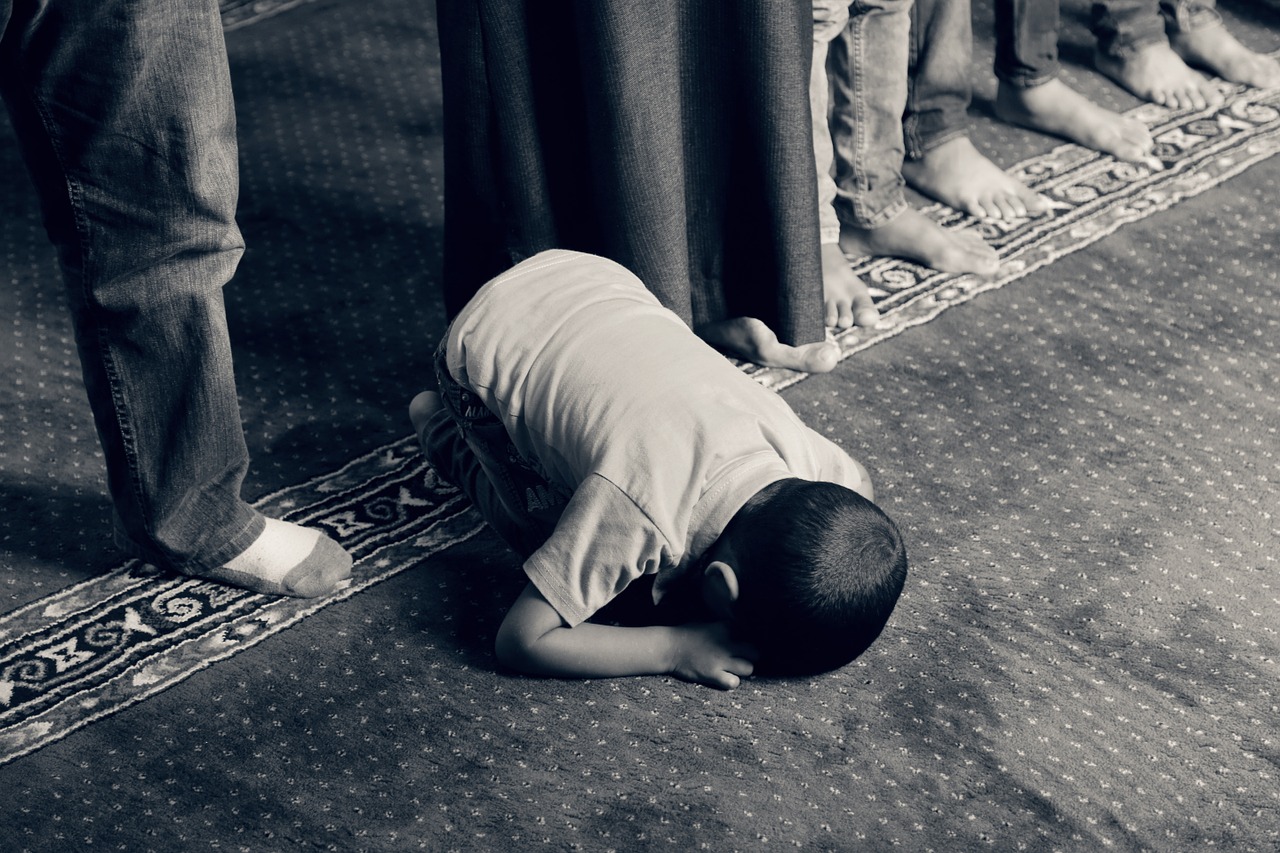
    I would cry in sujud: a figure on her knees, clothed head to toe in loose white cloth forehead pressed to the prayer mat. Your tears don’t slide down your cheeks when you’re in sujud. If you cry enough they’ll drop like rain onto the prayer mat. Sometimes you’d feel like you can’t breathe, choking on your own desperation. I would stay so long in sujud that my head would feel light and I would feel nauseous and faint, and that would be when I’d force myself to sit up and finish my prayer with salam.

    After that I’d sit on the prayer mat, doing zikir through my tears until they’d stop and all I’d be left with is the overwhelming weight of emptiness and loneliness. I’d stare at the splotches of tears I’d left on the prayer mat after that, until I could pull away and head back to bed.

    I’d wake up a few hours later, tired to my bones and lonelier than ever, wondering why I didn’t just sleep through the night, because it’s been years and years since I started doing these prayers, and I am no less calm, no less heard. My problems get bigger and bigger, and I’d feel smaller and lonelier. I’d try not to actively think the one thought in my mind: where are You, God? Where were You last night, and where are You now? How many more of these prayers do I have to do before I get to feel You here with me?

  • The Transient Path

    By Mabel

    Background story: I’m a Chinese and have yet to convert, but am on my way to learning about Islam and embracing it. This article was just a mini-epiphany experienced after a tough day.

    Today I sit in front of my notebook determined to write, because there is no other way I can adequately express this emotional journey I’ve been on.

    I’ve always been adventurous and rebellious in a way. I conform to societal norms (most of the time), yet there is this tiny part of me that enjoys doing something deviant. Doing something deviant like getting a tattoo. Doing something deviant like dyeing my hair. Doing something deviant like getting piercings. Doing things that leave people in awe from the unpredictability of my actions. I’m a good kid and a bad kid.

    This is why I find it hard to reconcile Islam with my identity. I’ve been told to keep my body pure. I’ve been told to be disciplined. I’ve been told to be demure, to be constrained with my words and my actions. With the way I dress. With the food I eat. But why? Why should I? I know I’m a good person; that’s all it takes for me to lead a meaningful life, no?

    Yet today I’ve also realised that it’s not about all this, not on the level that I’ve always been seeing it. It’s not about what I can or cannot do. It’s not about how people see me. Instead, it’s about how I can tame my heart and mind beyond these needs, these yearnings for expression of self or attention; of egocentrism. Beyond a focus on ‘me’, these needs are…nothing.

    Cliche as it may sound, it was really about finding this inner peace. The discipline Islam teaches is to help us to let go. Let go of this need for expression, this self-centered egocentrism, and to focus on living a simple and pure life. To see beyond the focus on the self, and the need for people to see us. Only with such a heart and mind divorced from worldly attachments will we be in the best state to pray for His blessings for others and ourselves.

    All this dawned upon me when I stopped to ask myself why I couldn’t pray for others around me when they were going through such hard times. The helplessness overwhelmed me. Why is it that I can’t pray, because I have a tattoo? Why is it that I can’t pray, because I have yet to convert to a halal diet? Why is it that I can’t pray, because I’m not a disciplined, ‘pure’ Muslim? Then I realised that these things didn’t really matter. It was was simply because my mind wasn’t free of these worldly attachments, and hence my mind and heart wouldn’t be suited for prayers with the purest of intentions.

    And so, ‘be in this life as if you were a stranger, or a traveller on a path…’ because life is simply a transient path, that will eventually pass with the natural cycle of life and death.

  • How Sufism Healed My Islam

    My love for sufism is well-known amongst my friends. But my love for it transcends beyond the customary nod to the poetry of Rumi, stories of Rabia Basri or knowing the distinction between the different Sufi orders. I think what really compelled me towards sufism and the way it communicates Islam, is that the language used, the metaphors, everything, seems more “feminine”. I feel more at home with the language of Sufism. Sufism is built on stories of radical empathy, compassion and forgiveness. It’s built on radical inclusiveness, extending welcome to people of all faiths into the house of God and your own heart.

    This may be hard for muslim men to understand, but the messages and practices propagated by institutional Islam today, or at least here in Singapore, feels patriarchal. A fair number of them, in fact, are patriarchal. If from young I am only allowed to inhabit the space behind the male or behind a screen and I am told in madrasah that the good wife is one that supplements her husband’s every whim and desire — then you get a very clear and consistent reminder every day that your presence in this culture is secondary. I have struggled in my faith because of this feeling. I remember sitting in Madrasah one day and listening to my ustazah give an example of the ideal muslim wife. In the story she told, this wife sat waiting for her husband at the door, a whip in hand for her husband to punish her if he was dissatisfied with her work in the home.

    It is an extreme example, and yet this extreme example was taught in class to impressionable children like me. I could only imagine what sort of ideas it gave to the boys in the classroom. Watered-down versions of that extreme example is communicated in stories, advices and social pressures to the muslim woman every day. It did not seem right to me. I know other female muslims who also faced the same struggle for the same reasons. For those who simply could not accept and live the narrative of this ideal, subservient muslim woman, it is a struggle. At times, she is viewed as a lesser Muslim for refusing to accept this narrative.

    I had only really gotten out of the struggle when I came across sufism. There was this beautiful, tender, giving side to the teachings of Islam that I hadn’t seen stressed in my years in Madrasah(s)! Growing up, what was emphasized was teaching and demanding obedience through fear of consequences, fear of hell, fear of God. But they never really stressed as much to us faithfulness for the love of God, the love of other human beings and for the very joy of these actions in themselves. Sure, they taught us to do good, but it was always pre-empted with the idea that we do good because we don’t want to go to hell. We do good because we do not want to anger God. In Sufism however, and I believe in Islam itself, doing good is to be done because it is good in itself. It’s not conditional. You do good because it makes you a better person, and therefore grow more attuned to God. It did not seem right to me that this whole beautiful side to Islamic teachings (not so much Sufism but the stress on a more loving, giving, ethos as opposed to demanding obedience through fear) was swathed by the more scary, fear-inducing image I and many people I knew grew up with.

    And it is not right. Because if we look to the way our prophet treated his wives, the way he shared the workload, the way he abolished laws and customs detrimental to women, the way women and men prayed side by side in mosques during his time without difference, then what’s happening right now is an aberration. I have never doubted that Islam is egalitarian and treats women with respect. But Islamic culture, the way the faith has been interpreted by humans for centuries, is a different matter. Of course it is. When you see that a majority of scholars who issue fatwas and other matters are males. How could they possibly understand things like menstruation, pregnancy, abortion, and other things that are specific to the female experience? Yet they get to speak authoritatively on such matters.

    This, amongst many reasons, is why I’m a reformist. Because God should never feel alien to a woman as she is growing up. She shouldn’t feel guilty for asking questions. She shouldn’t feel like she is taking up too much space when the love of God is supposed to be limitless. She shouldn’t be told that she is dirty and that her presence is sin. She should have an equal say in matters that concern her. What I have always loved about Islam is that it is a religion devoid of mediators. Yet how many times has it been felt that the male muslim is somehow closer to God. How can it not? They’ve reserved the front seats.

  • The Difficulties of Praying in A Mosque for a Muslim Woman

    The Difficulties of Praying in A Mosque for a Muslim Woman

    By Filzah
    Because I’m a Muslim Girl
    I pray behind a wall
    I pray behind curtains
    I pray behind men
    Because I’m a Muslim Girl
    I don’t go to the mosque on Fridays
    I don’t go to the mosque on my period
    My presence is not necessary
    So I shall go home.
  • An Evening at Hong Lim

    An Evening at Hong Lim

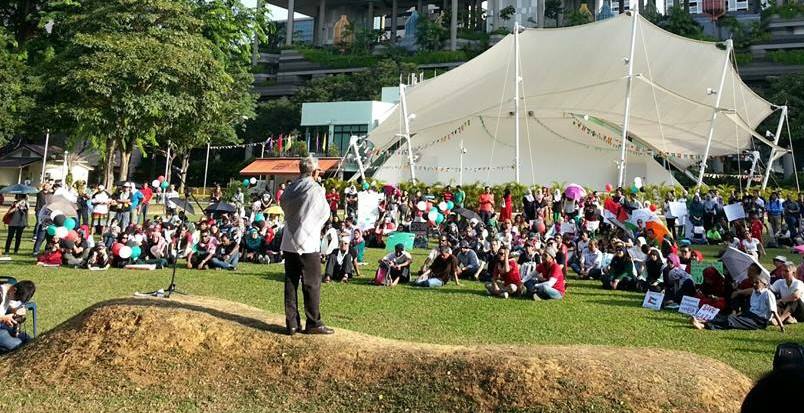
    Photo credit: #sg2gaza

    I have now been to three separate events at Hong Lim Park, each with a different agenda and each, extremely close to my heart.

    The first event was held on March 8th, International Women’s Day. It was the first ever celebration for IWD at Hong Lim Park and it was my introduction to how “gatherings” work in Singapore. There were permits, rules and regulations that needed to be followed in order to secure the space and make the event happen. Although the event was “All Fired Up!,” the passion from the crowd was missing. Participants of the march were rather confused as to how a march works but I figured this was something novel for most who were there so I lowered my expectations. Channeling your emotions in the form of a protest is something that is a part of who I am. I have protested budget cuts at my university, joined in celebratory street marches when Obama was elected (only the first time) and angrily marched to city hall in solidarity with global movements. Although All Fired Up was not as grand, it was still a space where community was built and felt. The most touching and beautiful part of the event was our candlelight vigil in the end which included lighting tea candles in plastered bellies and singing in unison to “We Shall Overcome”. Overall, the event was intimate and meaningful for all in attendance.  It was a space where issues were discussed and personified. It was a celebration of the women’s movement, how far we’ve come and a reminder of how far we have yet to go.

    My second event was Pink Dot. As a Muslim woman who wears hijab and also identifies as an ally of the LGBT community, I knew my attendance at Pink Dot was unconventional to say the least. I was conflicted whether I should actually go or not because it was the first night of Ramadan and I didn’t want to miss Taraweeh prayers. I also knew that because of the Wear White campaign, my presence in that space was important. I ended up going for a few hours, but missed the formation of the dot. Nevertheless, I was glad I went. The sense of community, of love and of belonging was absolutely amazing. I had never seen so many people from so many walks of life join hands to celebrate acceptance, family and love. I floated through a crowd of pink and witnessed the diverse families that make up Singapore. My experience of Pride events has always been much more blatant and extravagant. In San Francisco, Pride was more than just a space for the LGBT community. It was a space for engagement on issues pertaining to the LGBT community and beyond including HIV/AIDS, cancer, homelessness and animal welfare. The vibe was much lighter and there weren’t any critical discussions taking place about the legitimacy of the space created, yet it was still very powerful. It made a statement – we are here, we are real and we are Singaporeans.

    My third event, and the event I was the most emotionally invested in, was the Singapore to Palestine Peace Gathering for Gaza. This took place organically over the span of 24 hours. In response to the rising violence against the Palestinian people in Gaza, a facebook group, known as From Singapore to Palestine, rallied up a group of volunteers to organize a peace gathering to show solidarity to all those who are suffering. They only confirmed the acquisition of the police permit 24 hours before the rally was supposed to take place, yet the attendance was astounding. Close to 1000 individuals attended the event with signs, t-shirts, balloons and clothing all showing their support for the Palestinian people. Although the speeches were not representative of Palestinian voices and some of the speakers misinformed the audience about certain issues, it was still a very well done event. Everyone that was there truly believed in the cause and the need for such a space to exist. It had been stifling for me to be in Singapore and watch my friends around the world march, protest and visibly speak out against the loss of life and violent war crimes taking place in Gaza. This event at Hong Lim Park provided many of us who have been feeling paralyzed, a place to be visible. A place to make the issue visible in Singapore, and for Singaporeans to show Palestine that we also care and we are with you.

    Hong Lim Park has now become a sacred space for me. It is a place that symbolizes freedom from the regulatory culture of Singapore. It is a place that symbolizes community for Singaporeans who believe in real issues. It is a place I can now associate with belonging, family and home.

  • Difficult Questions

    I had stumbled across the beautiful words of the Prophet’s (PBUH) last sermon this past week. This sermon was delivered by the Prophet during his pilgrimage to Mecca.

    The sermon contains universal values of justice, fairness and equality. It touches on, among others, the themes of ‘freedom, equality and human rights’.

    Finding the sermon was a balm that soothed what had seemed like a rough day. However, a part of it left a tingling feeling of (for the lack of finding a better word to describe it), ‘unease.’ The part in question (highlighted below) reads:

    “O People it is true that you have certain rights with regard to your women but they also have rights over you. Remember that you have taken them as your wives only under Allah’s trust and with His permission. If they abide by your right then to them belongs the right to be fed and clothed in kindness. Do treat your women well and be kind to them for they are your partners and committed helpers. And it is your right that they do not make friends with any one of whom you do not approve, as well never to be unchaste.”

    I searched in vain for variations of translations. Instead, I found a piece written by an Imam regarding this sermon. He provides a disclaimer that the sermon could be seen as one of the ‘earliest declaration of human rights in written history’, if you can drop your ‘21st century cultural baggage’.

    Is my ‘baggage’ causing me to overlook the bigger picture that the sermon is asking us to reflect on? Am I then second-guessing my principles?

    Embarking on a journey to learn more about your faith raises a lot of hard and difficult questions about yourself that only you can answer. It is even more of a challenge when you seek gender equitable interpretations. I can only pray that Allah leads me down the right path, iA. Allah knows best.

  • I finally understand why I fast

    Fasting without my family is not easy. Fasting as a traveller has its problems. But fasting beside people who can barely afford food, and eat just to survive is beyond humbling – I finally understand why I fast.

    All I think of is how many people fast for more than Ramadan, or those who do not get to break their fasts when it is sunset; how will my zakat this year of helping feed a person for iftar do any good to my ummah? Oh this world.

    I know I am truly blessed in this life. Alhamdulilah.

    Ramadan Kareem