Category: South Asian Muslims

  • The Arranged Fairytale Wedding

    The Arranged Fairytale Wedding

    by Begum
    __

    What is the first thing that pops to your mind when you think of your wedding (if you do want to get married, of course)? Your significant other? Applying for BTO? The expenses? Strangely for me, none of those things come to my mind. What it actually reminds me is the scary process of matchmaking that would eventually be initiated by my family. 

    As an Indian Muslim, I was brought up the same way many other South Asian girls were brought up – realizing that we are pretty much screwed if we were ever caught with a boy before we get married. Romantic relationships, regardless of the race or religion is still heavily frowned upon among some families in my community, including mine. I was so sensitized to the idea of arranged marriages, it took me a long time to realise that this type of arranged marriages is actually not the norm anymore and that Indian Muslims are one of the very few communities that still actively follows this tradition. 

    My family still follows this tradition and they have made it clear that they would prefer me getting married through the arranged marriage (aka no boyfriends for me). Initially I had a lot of issues with this concept and it took me a few years to analyse this concept and finally, form my own perceptions of relationships. I also identified the flaws in some of the marriages around me, the main one being my parent’s relationship. Therefore, a lot of my thoughts and opinions in this article have been formed from my own observations. 

    Islamically, arranged marriage is allowed. However, the religion also encourages the prospective bride and groom to get to know each other and have a say on whether they like each other enough to get married. And this is exactly the step that many Indian Muslim families conveniently ignore. 

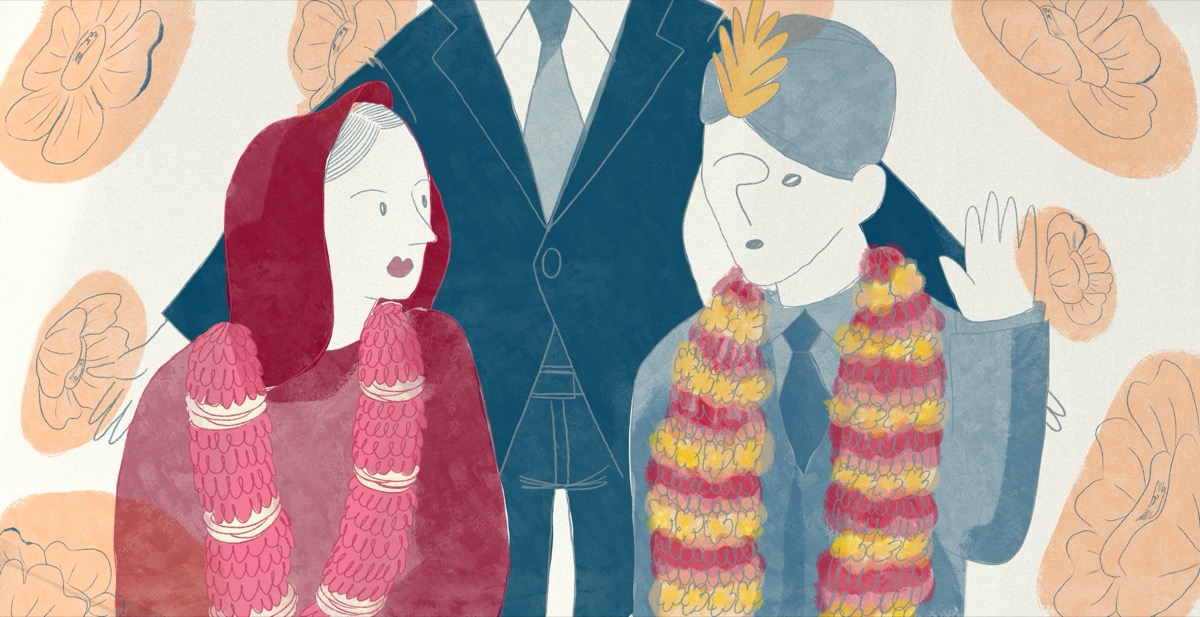
    Before the issues, let me break down the process of how this works. Let’s assume, the bride is a girl named Fathima and her parents are looking for a prospective groom for her. It starts with her parents engaging a professional matchmaker, or “broker” as how the Indian Muslim community call them. If the matchmaker has found any family that is interested in Fathima, they would visit her house where Fathima would be dressed to the nines so that the groom’s family would like her. If they find Fathima to their liking and fitting for their son, they would discuss further with her parents and the marriage is fixed. This would come as a shocker, but some brides and grooms do not even meet or talk to each other until the day of the wedding. 

    I know way too many couples who have not met or spoken to each other before they got married, including my parents. Many of these couples do have a happy marriage, I won’t deny that. However, there are many couples who could have avoided an unhappy and toxic relationship if they had gotten the chance to speak to each other. In a time where couples date for years before they get married, the least these parents could do is to let their daughter get to know her prospective groom and let her decide whether she would be happy with him. 

    Fortunately, many parents in the current generation are starting to understand the importance of getting their children’s consents and allowing them to get to know each other before proceeding any further. However, not everyone has the privilege of understanding parents and if you are one of them, I pray that your parents gain the understanding soon enough and allow you to marry whoever you want to. 

    My second and biggest issue, in fact, is how much arranged marriage has stifled Indian Muslim women’s growth. There is so much of misogyny and patriarchy that an Indian Muslim woman faces within her family and I definitely consider arranged marriage as one. This is especially true for our mothers. Previous generations prioritized their daughters’ marriages over their education, and it is something that still bewilders me. From the time a girl is born, the parents prepare their daughters to be an ideal wife and save up for their marriage and jewelries, instead of their education. After attaining a certain level of education, the girls would be asked to stop and then get married. Like I said previously, yes, some of them do have happy marriages. But what about those couples who are not compatible? 

    I grew up in an environment where my parents could not get along at all. There were more days of them being in an argument than days they were happy, or at least, holding a united front. I spent years questioning if they would have been happier if they did not have me and constantly being the middle person whenever they gave each other silent treatments (which would last for weeks). I also wonder, maybe, if they were given the chance to know each other before they got married, would they be even married? I don’t think so. 

    It saddens me that there are many women out there who are stuck in unhappy and toxic relationships because they are not financially independent and hence, have to rely on their husbands indefinitely. The current generation is changing for sure; they are becoming more open-minded and allowing their daughters more freedom, but I still believe that a girl has to work harder than her brothers to ensure she gets the extra education because of the misogyny in Indian Muslim families. 

    I feel it is also important to explain the extent Indian Muslim parents would go to get a groom for their daughter. If the parents do not find a suitable groom locally, some families have a habit of extending this search to finding grooms from their native village in India or Malaysia. They connect with their relatives in India to find prospective grooms for their daughters and if they do find one, the family usually heads to India to conduct the wedding. This concept is something that is still prevalent among certain families and something that still surprises me. Is it really necessary to go the lengths of finding a groom in a whole other country? Is it really worth all the process of applying for PR for the new groom? Would you really trust a man with your daughter who does not have the similar backgrounds? I really don’t know. This just shows how much emphasis families place when looking to get their daughters married.

    I do know one thing for sure. In a typical arranged marriage, the woman is definitely more vulnerable than the man and as a society, we must do better. If a marriage does not work out and the couple gets divorced, the women are more affected by this action than their ex-partners, in terms of how they are treated in the society and the chances of them getting remarried are also generally lower.

    I am not against arranged marriages, in fact, I have made peace with the fact that I would most probably get married through one. I also have friends within the community who are experiencing the same thing and honestly, we are okay with it because we have been prepared for this situation ever since we were kids. However, we just want our families to understand the need for us to get to know our prospective matches before choosing who we want to marry. We should not be persuading our parents to let us to get to know the prospective grooms, because it should be a given.

    Things are changing for the better, yes, but we must constantly ensure that the women are not shortchanged in a relationship. 

    Ensure she pursues the education she wants, allow her to get the job she has dreamt of ever since she was a child and become financially independent. Get her consent before proceeding with anything. Most importantly, realise she is a woman who knows herself the best and let her choose her life partner. Let her speak to the men and make the decision for herself. Prioritise her needs and wants before the expectations of the society.

    __

    Begum is a brown girl who makes way too many self-deprecating jokes, cries a little too easily and laughs too loudly. She is also always trying to be the best version of herself.

    Illustration by Ishibashi Chiharu
  • Confusing Rigidities in a Multi-Racial, Multi-Religious Nation

    Confusing Rigidities in a Multi-Racial, Multi-Religious Nation

    by Rukhshana Maufiqah

    __

    As an Indian Muslim, Tamil-speaking 20-year-old, I have come to learn over the years that the locals here tend to mix race, religion and language together. They have this mindset that the Malays will speak Malay and that they are Muslims; Indians speak Tamil and that they are Hindus; Chinese speak Mandarin and that they are Buddhists. Many or I dare say almost everyone knows that it is definitely not true that the Chinese speak only Mandarin and they are only Buddhists. They have different dialects such as Hokkien or Cantonese. Furthermore, there are many Chinese Christians as well! However, sadly it does not apply the same way for us, the minorities. I made a speech when I was 16 years old in my Secondary school about this topic and I would like to re-iterate some points that I think that are very important to be spoken about.

    Firstly, your religion does not define your race and your race does not define the language you are speaking. This is very important for Singaporeans to grasp. Ever since primary school, many has been shocked to find out I am a Muslim when my mother tongue is Tamil. The first question I am always asked is “Oh are you half Malay, half Indian?” and I would reply, “No, I am just an Indian who is a Muslim.” Still being confused, the next question being asked would be “Does all your family members speak Tamil like you, too? There must be Malays for sure!” and I would reply, “Yes all of my family members speak Tamil like me and are Muslims and yes I do have non-Indian relatives as well but they are not all Malays.” This confuses them even more. Some may say, “Of course it would be difficult for children to understand this at a young age, I’m sure adults do!” Sorry to burst your bubble but they don’t as well.

    Secondly, I am a Muslim, who follows the religion, Islam. You don’t have to be a Malay to follow Islam. In fact, I am glad that more people have come to realise now that there are Chinese Muslims and many other Muslims from different ethnic groups now, but definitely not enough. It doesn’t matter what language you speak to follow a religion. Yes, often a race is linked to a specific language. However, not all the time and especially not for Indians.

    Now, I would like to get into the details of this term “Indian” that we Singaporeans use. I would like
    to clarify that Indian is not a language but a race; and importantly, Hindu is not a language but a
    religion. We do not speak Indian or Hindu that some do ask. We speak Tamil or Hindi or many other
    languages. Did you know that there are more than 19,500 languages or dialects spoken in India as
    mother tongues, according to the latest analysis of a census released?

    When I was younger, when my peers or even teachers asked me if such questions, I would just laugh it off and correct them. However, as I entered secondary school and especially JC, I realised how us minorities know so much about the majority ethnic groups but it is not reciprocated to us. That is when I realised how ignorant people can be. We take so much pride that we are a multi-racial and religious country, but how well do all of us know about the races or religions outside of our own? A question that has always been bugging me is, if all Singaporeans are treated equally, why do mostly only the minorities take the initiative to learn about the different races and religions of our neighbours but not them? Do not mistake me, I have many friends from the majority ethnic groups who are educated about others races and religions. You not knowing does not make you ignorant.

    We are all more than pleased to let you know about our races and religions. You choosing not to find out more from what you know and making your own assumption makes you ignorant. I have accepted after denying for very long that I tend to identify myself as a Muslim more and not Indian, just to escape the racist remarks of being an Indian. I have even let strangers think I am a Malay since I don the hijab and understand the Malay language. I have heard remarks from my friends such as “You are fair for an Indian, probably because you are Muslim” or “You are my only Indian friend, probably because you are not exactly like them”. I am so disappointed to say that I took pride in those remarks and did not see how racist those remarks were, just because it was meant as a compliment to me. I would like to apologise to my Indian friends for not sticking up for us. I have learnt from my past mistakes and have been using whatever opportunity I can get to educate people about this.

    Lastly, I would like to say, I am proud to be an Indian, proud to be a Muslim and of course, proud to
    be a Singaporean, as should any other South Asian Muslim be respectively for their race. However, it is time for us to take action and speak up about this matter which has been pushed aside as maybe a taboo subject for too long. In this unprecedented time, it has shown us how united as a nation we are and I am sure if we all play apart to spread awareness and knowledge, we can improve further as a multi-racial, multi-religious nation.

    __

    Rukhshana Maufiqah is a 2nd year student at SIM, University of London, studying BSc Business and Management. Volunteer at Indian Muslim Social Service Association(IMSSA)

    Illustration by Ishibashi Chiharu

  • Baha(r)sa

    Baha(r)sa

    Baharwaali ladki
    does not need to know where she stands from where she sits in a class
    learning a language in a tongue that isn’t hers

    although the only place where she belongs
    is Malay words in karangan with double ticks
    for Peribahasa
    and her favourite topic of death and its test
    which gets her the highest marks among the rest

    “Cikgu kenapa budak India boleh dapat markah tinggi?” 

    could it be that she can only talk about her loved ones dying 
    to one-up an exam?
    Come on, she’s trying
    but lying about knowing how dying is a trauma
    is lying about lying about what she knows is an Indian aura

    It’s a colloquial slang to be able to converse
    but when I talk its strange just a show of how diverse
    my mouth can bend and twist like in a show of a circus
    Peribahasa queen once risen
    but now in reverse
    a list of deeper meanings, something I traverse
    as I memorise and speak to teachers, greetings I rehearse

    berapa berat mata memandang,
    berat lagi bahu memikul

    shoulder hunched when I answer for oral, 
    I describe a picture one round, my head never shaking
    a task to make sure; I never stop talking
    outside I am told, why I don’t do its opposite
    “Yelah kan dah takde titik, sebabtu lah tak tau diam”

    Indian, who thought she was a part of the geng
    when I didn’t know the answer to why Keleng
    felt wrong to my core but no detailed retort
    for nicknames that have stuck
    Michael Jackson terbakar just out of luck

    dropped out of Urdu school from just learning too many
    languages that confused the rest
    on why my father would marry
    a Madarasi who was just not Desi,
    the origin mistaken but the insult readily given
    Amma is Mummy, waiting in a canteen for her daughters
    alone and friendless among women with expensive taste
    for chauffeuring husbands and gossip gluttons

    Perhaps I could’ve written about the separation we all feel,
    when forced into the almost impossible task
    of blending in to find where we belong
    in a crowd of people who knew nothing
    of how much of ourselves they’d taken from us,
    when they only gave us so little

    We only seem to be able to understand that
    much later, and sometimes too late.
    when the ones who’ve taunted can barely remember.

    *

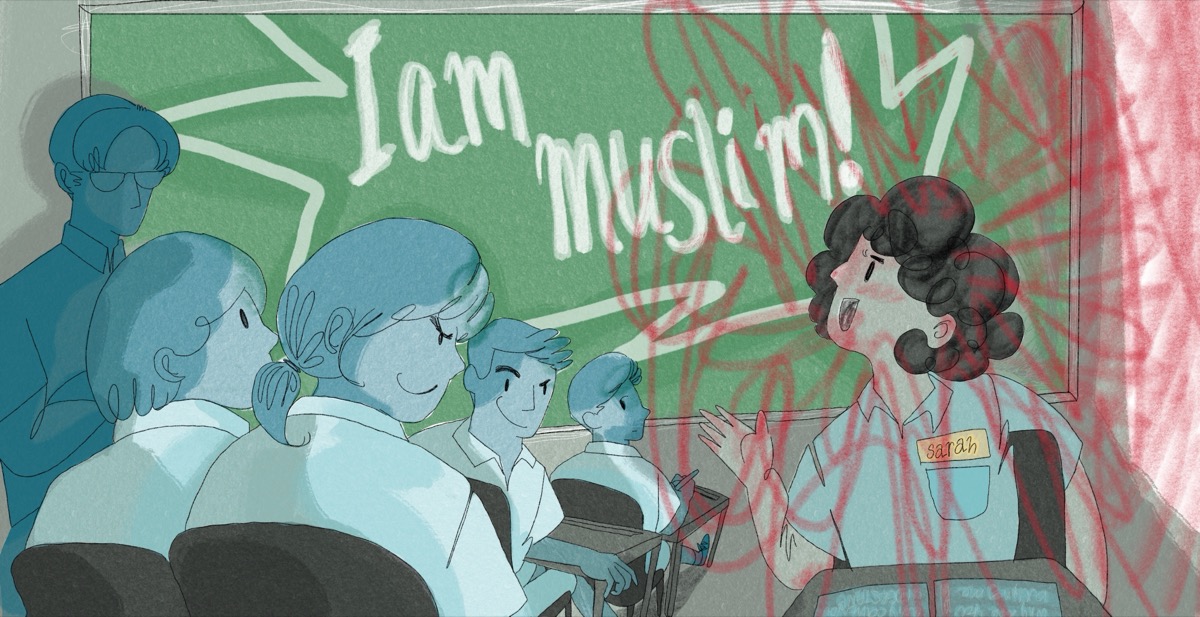
    I’ve always noticed the way race and religion have seemed more separate for some and synonymous for others. Being Malay and Muslim to me, in my experience, has been a commonly understood norm in society, where race and religion overlap. However, being Indian and Muslim is always perceived to be antonymous. One is the opposite of the other instead of sharing the same space. 

    Even till now, I notice the ease of which other Muslims who look the part, can do things while someone like myself, am restricted socially by odd looks or sometimes the inability of others to comprehend how an Indian can be Indian and Muslim. 

    I usually have to introduce myself as Indian to which later on – I will somehow interject with, “but I’m Muslim.” There are people who are aware of the spectrum of which race can belong with religion, but I guess, sometimes we’re not sure if that’s enough. I take being Muslim, as a metaphorical sphere where it’s clock radius allows me to move around a little within myself. Where I get to evolve with my identity without ever being questioned if I am Muslim enough just by the way I look or what I practice. Religion is subjective and yet for an Indian, it is a heavier task to prove how Muslim I am at times as compared to another who is presumably a Muslim just by appearance. This is accompanied by the common misunderstanding that a person needs a physical identifier to be Muslim, like a Hijab to show that an Indian can be Muslim, or the need to wear a Baju Kurung or Kebaya on Eid too. 

    My piece is called Bahar(sa) because Bahar in Urdu means outside, playing on the word Bahasa. An outsider speaking a language that is more associated to being Muslim than her appearance. I hadn’t intended for this piece to go to a sombre place where bullying seemed a huge part of my identity, more so than the space my race lived in. Yet somehow, the two always seemed connected, that what I’d experienced felt at times unreal and made up when they weren’t. I see people appreciating the things I’d been made fun of. 

    Long hair, the Bollywood dream, the tan skin, glitter from bangles and dupattas in the limelight. It’s odd because these aspects were seen opposite when worn by me, “too curly” hair, such “dark” skin, “village girl” with an “accent”. When I see the sudden spike in Indian outfits being worn for Malay weddings, it seems foreign to me – because I don’t see any similarities with what I identify as my race or culture. It seems like caricature at certain moments, because it feels like I’m a costume – worn for times when someone needs to look beautiful and taken off for when it is of no use. I’ve often times gone head to head with people, calling them out for their offhanded statements about transforming into an Indian for a while, or wearing a drape and identifying it with being Indian, or worse calling on one Indian friend to show they aren’t doing something unacceptable. 

    I find myself angry at times when I see the difference, in how things on me and what I own are more likeable, more wearable and embraced when the part of me that it represents, is not. 

    *baharwali ladki – outsider girl

    *karangan – composition

    *Peribahasa – Malay idioms

    *“cikgu kenapa budak india boleh dapat markah tinggi” – Teacher, how come a kid from India can get high marks?

    * berapa berat mata memandang, berat lagi bahu memikul – sesusah-susah orang yang melihat penderitaan seseorang itu tentulah tidak sama dengan penanggungan orang yang menderita itu sendiri – as difficult as it is to witness someone else’s pain, it is always harder for the one experiencing it

    * Yelah kan dah takde titik, sebabtu lah tak tau diam – Yes lah, now don’t have full stop, that’s why don’t know how to shut up.

    *geng – is slang for gang

    *Keleng – derogatory term for Indians

    *terbakar – burnt

    __

    Sarah Farheenshah Begum writes from the middle of a North-South Indian magnet. With her experiences of multiple conflicting and overlapping parts of what she sees and feels, she writes for herself, her past selves, and the way her future imagines itself, whether continuous or in pause.

    Illustration by Ishibashi Chiharu
  • Pride and Prejudice: Anecdotes from South Asian Women in Singapore

    Pride and Prejudice: Anecdotes from South Asian Women in Singapore

    Gathered by ‘Afifah Shameemah

    __

    These pieces are collections of candid responses from South Asian Muslim Women. These pieces were written to share some of the experiences of ladies in the community and to hopefully inspire some type of change. These pieces were written by South Asian women, for South Asian women. 

    This is for us, Brown Skin Girls.

    What is the most prominent memory you have of a racist/prejudiced encounter as a South Asian Muslim woman?

    MA. Indian.

    The most impactful incidents happened in childhood. Feeling ashamed that my mum was wearing the black abaya because it was seen as ‘off-the-boat’, poor, uneducated, standing out for wrong reasons. Another instance was Chinese classmates and teachers not understanding what indian muslim is. I had to explain throughout pri,sec, tertiary why I was Indian but not Hindu.

    MK. Pakistani.

    I was in class one day and as we were discussing where to go for our graduation trip and when India came up everyone started freaking out and saying they’re scared of going there. When I asked some of them why they said that they’re tons of rapists over there. Of course I think we ALL have encountered the occasional “south asian stinks” slurs and people around you have made fun of how south asians speak English like it’s funny!

    FM. Indian.

    I think a better question would be to ask how all of it had/has affected me. It doesn’t feel right to state just one when it’s obvious that so many of us minorities have faced racist/prejudiced encounters all our lives. 

    Personally, I can’t choose one because what affected me the most was the continuous, repetitive microaggression that I had faced from young. It was the upfront racism, when people would call me slurs and throw insults structured just for Indians, that eventually made me feel ashamed to be an Indian. My insecurities stemmed from all these encounters. I started to hate the physical attributes of me that people would associate/stereotype with being Indian. For a long period of time, I completely disassociated from my heritage as much as I could. It took me years just to step out of that sense of inferiority that focused on the negatives and to learn to embrace my culture.

    FZ. Sri Lankan.

    The first memory that pops into my mind is when I was in primary 3 and could hardly understand Malay. I had not done my malay homework on that day. Knowing very well that Malay was a new language to me, my Malay teacher chose to scold me in Malay instead of English and stopped every once in a while so that my friend beside me could translate what she was saying. Finally, she said that I could only sit down if I said “I love you ” to my friend in Tamil. I was so embarrassed and shy as I could feel everyone staring at me. It took me sometime to finally get the words out of me. That incident still scars me till today 

    On another occasion,  a girl came up to me in school and asked “So do you celebrate Deepavali?”

    When did you feel the most proud to be a South Asian Muslim woman?

    FM. Indian.

    I can’t think of an exact moment. It kind of was a journey. I grew up watching my relatives and family friends be so confident in their skin, comfortable with their ethnicity. I was always envious of that. 

    A year or two back, I realised there wasn’t much representation of South Asian Muslim women in mainstream media. I wanted to meet people like me who shared similar interests and passion. So I started searching and slowly found a whole community. These people whom some I’ve got to know are nothing short of inspiring and amazing. I’ve learnt so much about South Asian cultures through them and the more I was exposed to it, the more I wanted to be part of it. 

    It was inspiring seeing them be incredibly proud of their own heritage. Watching them be unapologetically vocal about the good and bad within our culture, witnessing this community start painful, but very much needed, discussions so as to bring about positive change. It all made me want to be a part of it. I was so proud to see them redefine all the stereotypes and negative encounters they had faced into something absolutely beautiful and positive.

    FZ. Sri Lankan.

    I was probably the most proud to be a south Asian Muslim woman when I’m in the presence of my family, and still am til today. To be honest, I never felt proud to be south Asian when I was in school. I always felt a little left out. Some teachers would purposely fake an indian accent (even though I wasn’t Indian) in front of the whole class when talking to me, and classmates would talk about me while being in my presence, thinking I didn’t understand a word they were saying. Being in such an environment made me feel embarrassed about my ethnicity.

    MA. Indian.

    I haven’t faced any outward stuff. More of intrinsic pride. I’m proud that my family has done well in SG considering that we had no help/relatives in singapore when we came. We have done very well with our limited resources and network. Me and my siblings are all doing well alhamdulillah:)

    MK. Pakistani.

    Ever since I realised that I was different from the people around me, and that was quite early on actually, and I’ve NEVER stopped being proud! I’ve always felt proud to have such amazing ancestors who had the courage to come all the way from Pakistan to Singapore, and did pretty significant things in their lives! For instance, my great grandfather was a detective and passed away while in office here, and I’ve always admired his bravery!

    Do you have anything you want to say to other South Asian Muslim women who might be struggling with their identity?

    FZ. Sri Lanka.

    Try as much as possible to educate those around you so that they can educate others and so on. Don’t ever feel that those of other ethnic groups are far more superior to you.

    FM. Indian.

    Your skin colour and ethnicity is part of you, but don’t forget there is more to you than just that. Don’t let anyone tell you who you can and cannot be. You are enough. Your identity is yours to create. Don’t conform and lose parts of yourself just to make the ignorant feel comfortable. In fact, take pride in making them squirm in their seats as they watch you reach your dreams and goals. 

    Our culture, heritage and traditions are breathtakingly beautiful. There is so much we can learn and benefit from once we learn to accept and embrace that part of our identity. Carry that identity with pride and give it life.

    MK. Pakistani.

    Embrace the beauty and diversity of our culture! Growing up, I used to, at times, feel SO out of place because there’s not many of us here, especially in the community I was from. I used to question why my friends don’t love qawwali like I do, why am I the only one who knows who Abida Parveen is, why am I the only one who wears salwar kameez, I was SO confused! I have felt unaccepted too, by people around me, because of this difference, and I used to get so upset over this. However, once I realise the beauty of being different, and the richness of our culture, I’ve embraced ME so fiercely and wholeheartedly! Give it time and eventually you’ll realise how blessed we are!

    It’s very important to surround yourself with people who not only accept you, but celebrate you for being ALL of you! You don’t have to be friends with people who are the same as you, who have the same background and culture as you do, in order to feel accepted and to feel motivated. You CAN be friends with people from all walks of life as long as they are people who uplift you!

    At the same time, it is essential that you have role models who share the same background as you are, someone who is relatable and approachable, who can not only understand, but empathise and give practical advice in situations when needed!

    MA. Indian.

    To not dismiss their roots in order to fit in. Having a long family history, two cultures and two countries is a gift. Integrating does not mean giving up unique parts of your background. I have family in India who aren’t educated. That doesn’t mean they’re any less than me. It was their rural setting and the fact that I got lucky to be brought to a developed country. We downplay our history and laugh it off so that it is more palatable for others. Be proud of where you’re from, and where you’re right now.

    ___

    ‘Afifah is an aspiring Social Worker who is passionate about Social Justice and holding up safe spaces to discuss anything and everything for anyone and everyone

    Illustration by Ishibashi Chiharu
  • Who Are You?

    Who Are You?

    by Soorma Bhopali

    __

    “What are you?” “What is your race?” These are questions that are thrown at me frequently, the latter of which was only asked recently at a small family get-together. I was stunned to be asked such a personal question in front of people I had just met that day. As a sensitive introvert, I took the question as a personal affront. Nevertheless, I took it in my stride and answered the offensive individual, all while the rest of the people who were gathered around looked at me with what I would like to believe was purely engrossed anticipation.

    I got asked the same question twice that evening. The same question that was asked in the earlier part of the gathering was by a newcomer to the family, who whispered to someone else, “What is her race?” As a newcomer, I understood her wanting to know more about me. The second individual who had asked me the same question was my husband’s relative, whom, despite the fact that my husband and I have been enjoying marital bliss for more than ten years, still had questions about my lineage. And it wasn’t just them. At family functions and gatherings on my husband’s side, there are whispers of (in a language foreign to me), “What is her race?” Although I do not blame them for their curiosity, such questions speak volume for the need of society (especially those from the older generation) to place individuals in pre-defined boxes based on the CMIO categories.

    Perhaps I should sweep my frustrations aside and start from the beginning. I am, dare I say, a blessedly unique individual of mixed heritage. I have Peranakan Chinese and Pakistani ancestry on my maternal side and Indian heritage on my paternal side. For the most part of my formative years, up until I was in my 30s, I grew up confused and having an identity crisis for never being able to fit in the CMIO mould in school and in Singapore. According to the typical Singaporean who would try their best to place me in a box, I am too fair to be Indian. Since I look Malay, I must also be one, and thus will be spoken to in Malay. Since I celebrate Hari Raya, I must be Malay and to quote the aunty who recently cut my hair verbatim, “If you are Muslim, you cannot be Indian, so you must be Malay lor.” Thank you for explaining to me who I am aunty.  Trying to explain my unique diverse heritage to a random local of the majority race group here has become such a cumbersome undertaking that I have resorted to simply saying I am Chindian. However, this response will invite more questions such as, “Oh, so you speak Chinese?” I had the exact conversation two weeks ago and when I replied in the negative, the conversation pretty much stopped there. It seems like no matter how much I try to explain my mixed ancestry, it only opens up a myriad of questions that are themselves so confusing that it is easy to just say, “I am Indian.”

    However, this is not entirely true. I do not feel purely Indian. At home, we do not converse in any traditional Indian language, unless we want to gossip about you in your presence! We also do not eat typical Indian food every day. Being Singaporeans first and foremost, we eat a variety of food that come from the different cultures in Singapore. My grandmother, aunts and mother all enjoy unhealthy bowls of glutinous chee cheong fun for breakfast. Apart from the usual biryani, we also feast on sambal sotong and lontong at Eid/Hari Raya gatherings.

    On the other hand, thosai and prata are the best comfort food on lazy days. When we crave for something to munch on at tea time, there is always sugee cake, ang ku kueh, char kuey rojak or Indian rojak to pick from. Nonetheless, I have to say it feels the worst when my ‘own’ —fellow Indian-Muslims—doubt my ethnicity just because I cannot speak Hindi well, having studied Malay in school. It is hurtful to hear comments like, “So your Mother Tongue is Malay lah!” as if doubting my ‘Indian-ness’. To be clear, I have nothing against the Malay Language (I scored A1 in Malay Literature in junior college, thank you very much!) but I strongly resent reductive comments about my identity and lineage just because I cannot speak the language of my forefathers well and I do not fit the mould of what a typical Indian or Chinese individual should be (i.e. being able to converse in Indian or Chinese languages/dialects). 

    You see, when my ancestors migrated to Singapore from India, they naturally needed an anchor, a community to belong to. Being a minority community of Indian Muslim traders, it was easy for them to integrate and assimilate into society if they belonged to a certain group. Since the majority of Muslims in Singapore are Malays, moving into Malay kampongs and living amongst the Malays made pretty good sense especially since they were trying to make a living in a foreign land. Being Muslims, they thus had something in common with the Malay community here. Although my forefathers wore their ethnic clothes, they were still also able to converse well in their adopted Malay Language and get along well with their Malay neighbours and friends. This would explain why, while most of my older relatives were able to speak their Mother Tongue, the younger generation either have pretty much lost their ability to do so or speak broken Hindi or Urdu. We may understand what is being said, but we may not be able to reply fluently, because we were never formally taught. However, this varies across the different families here. I do know of third- and fourth-generation Indian Singaporeans who are still able to converse in their original Mother Tongue thanks to classes and family exposure.

    On the other end of the spectrum, there are Malays who assume I am Malay. When I reply in English to the questions they ask in Malay, they assume I am consumed by my arrogance and do not want to converse with them in a common language. How do I explain to the nasi padang aunty, “Pardon me aunty, but having grown up in a household where English is predominantly spoken, and having being brought up by my late grandmother who spoke Hokkien and the Peranakan patois, talking in Malay just does not come naturally to me.” This is especially true after I was made fun of for my funny Malay pronunciation in primary school by a schoolmate.

    Needless to say, my growing up years were filled with poignant questions like, “Who am I? Why don’t I fit the mould? Where do I come from? Am I really an arrogant person because I cannot connect with people based on a common language?” Imagine grappling with such an identity crisis for almost thirty years of my life. Imagine grappling with such questions as a teenager, the phase in my life when I deeply needed to belong somewhere. Transitioning into adulthood wasn’t easy either. At company dinners, Muslim staff members are usually grouped together in one or two tables since we have the same dietary requirements. Why? Why is the group I am allowed to eat and socialise with limited to the people who share my religion? Why do we as adults allow society to limit how and who we socialise with based on what we are allowed / not allowed to consume? Needless to say, company dinners are usually four hours of boredom for me because I am always separated and seated far away from my close colleagues who all do not share my religion and dietary requirement.

    The ignorance of society does quite a number to one’s self – esteem especially when you are growing up with so many questions and concepts that are beyond your comprehension. Now, after more than thirty years of existence, I am finally grasping and embracing my unique identity and I finally understand why I feel the way I feel. It is okay to not fit in anywhere because of social circumstances that are beyond my control. On the other hand, for the sake of our future generation, society should stop trying to fit us in pre-defined boxes. We are all special and unique individuals with a myriad of stories to tell. Just ticking the Chinese, Malay, Indian, Others box is over simplistic and does not do any justice to what a distinctive and beautiful individual each and every one of us
    is. It does not do justice to the story that each of us has to tell. It definitely does not do justice to the stories of our forefathers.

    __

    Soorma Bhopali is an educator of young children. She enjoys her roles of being a daughter, sister, wife and aunt. In her free time, she enjoys eating cupcakes and dreaming of unicorns.

    Illustration by Ishibashi Chiharu

  • Fitting In

    Fitting In

    by Mahina Shareef

    __

    In 2000, my parents migrated to Singapore from a conservative rural town in India with three young kids in tow. While the Indian Muslim community here has a long history, I want to explore my experience as a first-generation immigrant in relation to the Malay community. The presence of the Malay community here had given my parents reassurance that they could raise their kids with religious values in a westernized society. It gave them the strength to go against the tide of their relatives with conservative attitudes who had warned my parents that raising a girl child overseas was wrong. One can earn in any country but to raise a family required more.

    Life overseas was perceived as wrong because it supposedly exposed a child to immoral behavior and thus encouraged such behavior; a girl child had to be protected. They stood firmly on their moral high ground. This was the circumstance under which we, as a family, migrated to Singapore, but the solidarity and Muslim brotherhood that welcomed us was complicated. Firstly, the religious sphere in Singapore is dominated by Malays with less consideration for Indian-Muslims. To my parents, the option of Madrasahs meant they could raise their daughter with both religious and academic schooling and the long, covered uniform Madrasah students wore appealed to them.

    However, Madrasahs here only had Malay as a second language and so, much to my parents’ disappointment, I had to eventually enroll in a mainstream primary school. This was their first experience of realising religion was more Malay-centric here. As I grew older, the pictures of me receiving awards in school clad in a shirt and skirt stopped reaching the eyes of my relatives back home for the uniform was considered immodest. The influence of family back home extended into our lives despite the physical distance and more intensely so because of my gender. My father was considered an arrogant man for dismissing relatives’ advice so there was an increased pressure to conform to modesty, to continue religious practices, and more importantly to succeed and prove my father had made the right choice. I had to win, be it in school, exams or getting a good job while conforming to a strict sense of religion and tradition held by our extended family. My family played a game of hide-and-seek, only revealing our success and concealing our everyday life that was normal to us but unpalatable to relatives.

    Indian Muslims’ religious practices were also considered inferior and less holy. There was thus the opinion that the higher and more pious practices of the Malays should be followed. For instance, I was told by my Malay Quran teacher that I had an Indian tongue that had to be corrected, that I was lucky to be taught by a MUIS accredited teacher and that Indian-Muslim asatizahs were not good enough to be recognized by MUIS. Presently, the rise of religious teaching in English has opened doors to religious education that had been restricted previously. The asatizh recognition scheme (ARS)’s requirements can be completed via either English or Malay courses as far as I have understood.

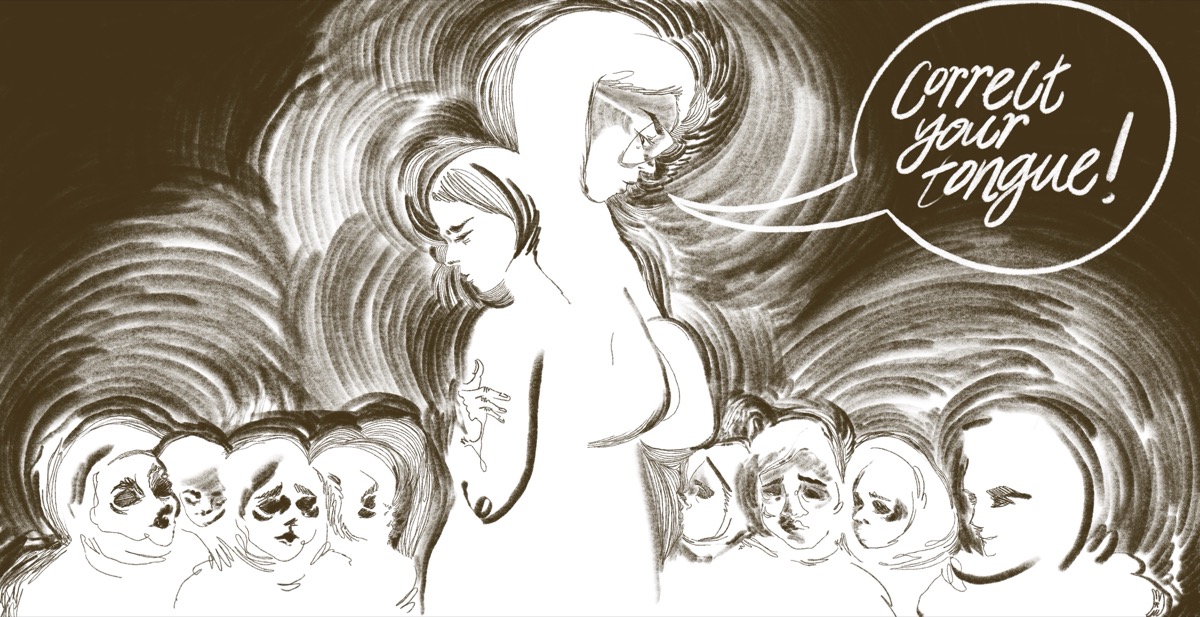
    Personally, I have been introduced to evening and weekend religious classes in English by university friends so perhaps level of education is also a factor in these English classes. Secondly, there was a strong desire and necessity to emulate the Malays physically to integrate into this country. The CMIO categorization did not recognize Indian-Muslims. Integrating meant fitting into one of the categories so that the majority of Singaporeans could identify us as part of a race and part of the social fabric. The black abayas (and the dark skin tone) which had coined the slur, crows, by some Malays, was shed. Baju kurung and maxi-dresses were worn to the mosque. The loose shawl draped over the head was replaced by the tudung (hijab) which most people in Singapore recognized. If you had fair skin, you were lucky and you could pass for a Malay. If I wanted to be seen as a Singaporean, I had to look the part of the Malay. This was important to a first-generation immigrant who wanted to be seen as a citizen and to espouse the loyalties their parents had for their home country.

    While Indian Muslims have integrated into the country’s fabric, we remain independent of the Malay community. There is little mixing between the two communities. Having Malay friends is the same as having Chinese friends in that the bonds are forged only at a certain level. These are unlike bonds of marriage which are complex and a sign of welcoming another fully into the family and community. I personally have seen very few marriages between the two and it can be attributed to two reasons. Firstly, Indian Muslims are very vested in their culture and language. There is pride and identity associated with the native places/cities that their family originated from. We have great grandmothers who spoke of the war against the British, of grandfathers who sailed to Ceylon. Our history in Singapore is short and our roots in India deep. Such a strong sense of identity runs in us which is so distinct that we do not expect Malays to understand the big importance we place on the cities we come from. This contributes to Indian Muslims preferring those who speak their own language, who follow their own customs and importantly, those who are willing to keep the connection to home alive.

    The second reason for the low rate of inter-racial marriages, I am ashamed to admit, is the belief in the lazy Malay myth. We are fed the same assumptions and prejudices as other Singaporeans. To some extent, Indian-Muslims have faced less discrimination compared to Malays because of the cushioning effect of economic wealth. The young are more aware of these biases and have been more discerning which is heartwarming.

    However, the truth remains that these poisons against Malays had been repeated and ingrained in the past. Intentional efforts to understand the Malay community are still lukewarm because a grudge remains among Indian-Muslims that they are a mere afterthought in matters of religion. Having to forsake a part of their own identity in exchange for belonging is a sour spot. The lack of organic interaction between the two communities might be due to a brush of egos and not seeing a tangible benefit in having deeper bonds with the other. Yes, our place in Singapore might be rocky but there is no threat. Therefore, there is no need to step out of our comfort zones to do more, we Indian Muslims reason.

    However, I hope we realise we do not lose out by giving in, by going out of our way and by helping our Muslim brothers and sisters. This was the Muslim brotherhood my parents had anticipated back in 2000. Finally, I hope readers understand the crux of the issue extends beyond engaging the Malays to the bigger picture of being identified, acknowledged, understood, valued and simply seen as a distinct identity in our own rights in our home, Singapore.

    ____

    Mahina is a medical student who credits education for giving her the strength to go against patriarchy and to stand up for herself. It took her time to accept that there are multiple facets to one’s identity. She writes fiction and poetry in Tamil and expresses her occasional anger in English.

    Illustration by Ishibashi Chiharu
  • Editor’s Letter: South Asian Muslims

    Editor’s Letter: South Asian Muslims

    by ‘Afifah Shameemah

    __

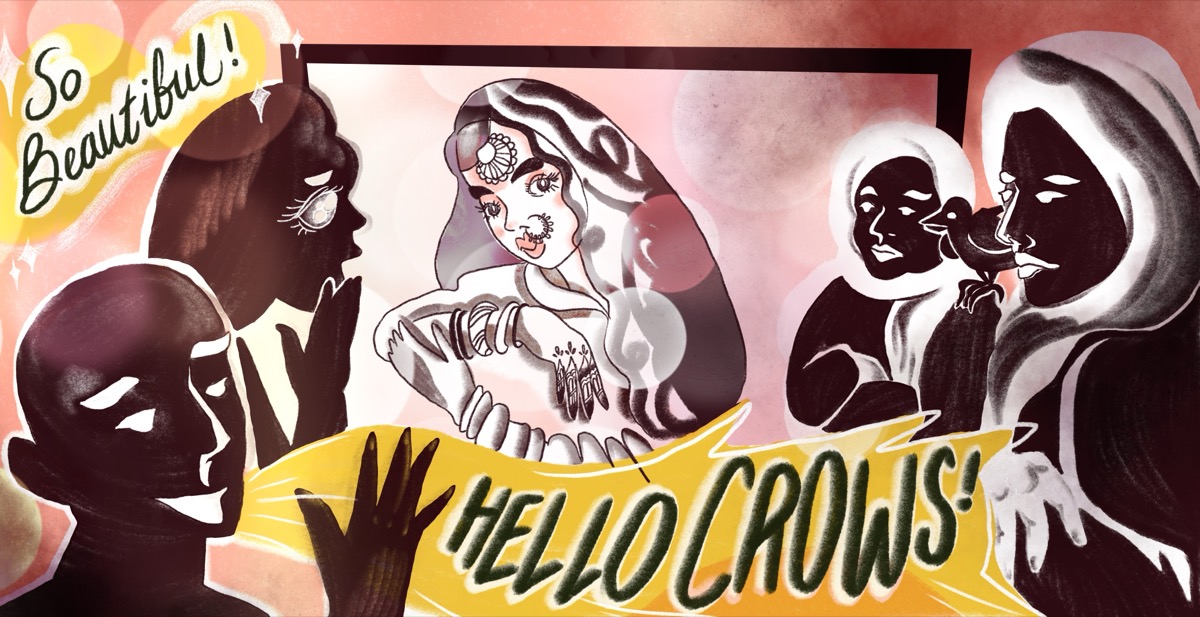
    “They call us crows; black, ugly, noisy. ‘The crows have descended’, they’ll joke among themselves.” – M. A.

    A friend, M, reached out to me to share her experiences as an Indian Muslim woman in Singapore through an insightful yet disheartening email. Much like her, many other South Asian Muslims have taken to Social Media to share their personal experiences with racism in the Muslim community.

    My own earliest recollection of a racist encounter was as a 10-year-old. I had to wear slippers to school with my baju kurung uniform because I had a toenail injury. A teacher called me out when she saw me and said something along the lines of “Jangan pakai selipar macam gini. Nampak macam anak keling.” (Don’t wear slippers like these. It makes you look like an Indian child). I didn’t know what to tell her. I am Indian, and proudly so, but at the time, I thought that I shouldn’t tell her because she sounded so condescending, like being Indian was a bad thing, and I didn’t want to be treated as less than.

    My ancestors are Indian and they married into Malay families when they settled down in Singapore. I am more in tune with my Malay roots than my South Asian ones, with my mother tongue being Malay, my social circle being consisted of primarily Malays, wearing traditional Malay clothing, partaking in Malay cultural practices and etc. For this reason, I am privileged in a sense where I can pass off as Malay and fit into the Malay community, the race that makes up majority of the Muslim population in Singapore. But from time to time, I get racist remarks from the people around me about my dark(er) skin, my ‘angry’ and ‘unapproachable’ demeanour, loud voice and my temper – traits people associate with being Indian. I believe that this is a shared experience many other Indians feel because we no longer fit into the CMIO model so easily.

    I was incredibly honoured to be invited as a guest editor for this edition, but I was honestly contemplating whether I should take up the offer. Some people think that I am not ‘Indian enough’ or that I’m not a ‘real Indian’ because of how disconnected I am from my Indian heritage, which means that I don’t have the right to speak about the complexities of being a South Asian Muslim in this country. But what pushed me to do this is my privilege. I am privileged enough to be accepted by the Malay community as a Malay while at the same time being tethered enough to see and understand the marginalisation South Asians face, even if my personal experiences haven’t been ‘extreme’.

    The objective here is simple: To provide a platform where we can amplify the voices, experiences and concerns of South Asian Muslims, the minority within the minority, if you will. Hopefully this experience can be liberating and cathartic for our fellow South Asian Muslims. Beyond that, hopefully, after listening and reading, we can work towards positive changes by reflecting on our personal prejudice, internalised racism and even systemic injustices that oppress our own Muslims.

    This series is dedicated to South Asian Muslims, people of Afghan, Bangladeshi, Bhutanese, Indian, Maldivian, Nepalese, Pakistani or Sri Lankan origins and/or decent. It was imperative that we used the term ‘South Asian’ instead of just ‘Indian’ because one of the most common forms of microaggression is the racial grouping of all brown people as Indian, when in actuality, the variety of ethnic groups in South Asia goes beyond that. When any individual insists that all brown people are the same (read: semua pun sama: India), they are invalidating and disrespecting the origins, heritage and ancestry of South Asians, the differences that distinguish their cultures and their diversity, even if there are some similarities.

    This microaggression is not only seen in day to day experiences, but in media as well. It is important to acknowledge the existence of this casual racism in mainstream media because media has a big role in influencing the masses, especially those who are not exposed to the racial diversity of South Asians. Let’s look at Disney’s rendition on Aladdin.

    While they took steps to be more mindful of racial complexities in the 2019 version as compared to the 1992 animated film, there were still many instances where they mixed Middle Eastern culture and South Asian culture. Granted that these two cultures may have influenced each other to a certain extent due to some of our shared history, there are still very stark differences between the two that should not be cherry picked at the convenience of white producers for entertainment. Between the dance scene that was clearly inspired by Bollywood dance numbers to the clothing worn typically by South Asians (not Arabs), the movie being filmed in Jordan and the casting of both South Asians and Arabs, the movie lumped many different races and cultures into one: Exotic Browns.

    While the racial diversity of the cast was admirable, we have to ask: why? Was the cast racially diverse for the sake of appealing to people to reap a larger audience or was it for the sake of empowerment and representation? How can we claim to appreciate and respect different racial groups, diversity and cultures when we don’t even bother to learn and portray their differences properly? If proper representation wasn’t the goal of creating these movies, what is? Entertainment? At who’s expense?

    For a more localised context of the portrayal of South Asian culture in media, let’s look at Malay social media. In recent months, a Malay celebrity/model advertised for contact lenses by donning the lehenga, a large nose ring, bangles, with henna on her hands while lip syncing to a Hindi song. This was inspired by her appreciation and fascination for Bollywood films. Many questions were raised from this incident: Is this cultural appropriation or cultural appreciation? Is this fetishizing South Asian culture or is this appropriate for a multi-racial country like Malaysia and Singapore? In his Facebook & Instagram posts, writer Alfian Sa’at asks three important questions: Where do we draw the line? Who gets to draw the line? What would our country be like if we loved South Asians as much as we love their movies, food and fashion?

    Perhaps in this case, the intention of the model and the company should not be put under scrutiny. Perhaps what is more important is that we ask the bigger questions like as part of the majority, how does one show appreciation for a culture that is not theirs? Is it enough to appreciate the culture and their people simply through wearing traditional costumes and eating their food? Do we go the extra mile to speak about difficult topics and address the racism within our own communities to truly be allies and supporters of South Asian people? How can we do better by South Asian Muslims in our countries?

    The issues faced by South Asian Muslims in Singapore is a non-exhaustive list. While it is simple for me to sit down and write about the struggles we face, I hope to remind people and myself that the experiences of our contributors should not have to be here for intellectual discourse. These are their lived realities. I urge readers to read their words, internalise them, ponder on the questions asked and think of how we can do better as part of the majority so that the lived realities of South Asians can shift away from what it is in our present day.

    ___

    ‘Afifah is an aspiring Social Worker who is passionate about Social Justice and holding up safe spaces to discuss anything and everything for anyone and everyone.

    Illustration by Ishibashi Chiharu

  • The Woes of an Indian Muslim Sister

    The Woes of an Indian Muslim Sister

    By Nurul Deanna

    –

    I am an Indian Muslim. No, I did not convert. No, I am not Hindu (did I already mention I’m Muslim?). I am Indian and yes, I’m very sure that I’m Muslim.

    I remember when I was in a Grab on the way to work for my internship. The driver took one look at me and the first thing he asked me was, “Eh, you Indian ah?” When I replied that I am Indian, he was shocked. “You don’t look Indian eh,” he said. I began to think. What is an Indian supposed to look like? You mean to say each person has specific biological features that determines their race?

    Oh man, here we go again.

    I hoped the conversation would end there and I could pretend to be asleep. But alas, the driver was an extremely curious man.

    “So that means you Hindu, right?”

    “Uh… No, uncle, I’m Muslim.”

    “Huh? But I thought you said you Indian?”

    At that point of time, I begged to be thrown out of the car. I imagined the road would open up and I would be swallowed into the black hole, never having to deal with this kind of situation ever again. But this is real life, and Singapore’s roads are smooth and efficient and probably one of the best in the world.

    And then he tried to convert me to Christianity because according to him, “Islam very restricted, right?”. I thank Allah SWT for giving me the patience to sit through that ride.

    Fast forward a few years later and I was sitting in an interview to qualify for my University’s bursary that would help with my tuition fees. In front of me sat four Chinese women. For some reason, I felt extremely nervous and my brain was subconsciously preparing me for some kind of fight. I remember telling myself to keep calm. I remember reminding myself that I had to stand up for my rights too if something were to happen. But I was also confused. I am in a room with women. I should be comfortable, but why was I scared?

    Turns out my instincts were right.

    The interview lasted about 10 minutes, but it was the longest and most painful 10 minutes of my life. To sum up, I felt attacked and violated. In the first few minutes, they asked me about my religion. When I told them I’m Muslim, they must have assumed I am Malay too. I had to explain how I am actually Indian, but it looked like they couldn’t seem to grasp the idea that I am both Indian and Muslim. The kinds of questions they were asking after that made me feel like I had to prove that I am Muslim. I was quite taken aback by all this. As an educational institution, shouldn’t their priority be helping the students get the best education they deserve? What has my religion or my race got to do with my chances of getting a bursary? My fight or flight mode began to kick in. I felt like I was being interrogated instead.

    “Why do you need the money?”

    “How hard is your family’s condition financially?”

    “How do you get the money for your daily expenses?”

    “Why didn’t you apply for a bank loan?”

    “You’re Muslim, right? Apply for Mendaki lah.”

    “What’s the difference between Malay and Muslim? Same what.”

    For every answer I gave, they had a counter for it. And for every counter they gave, I felt my hope diminishing. I felt smaller and smaller. It was four against one, what could I do? By then, I was already preparing an explanation for my parents. I did not want them to know that I might not get a bursary because of my race or my religion. I began to list down in my head some other ways I could do to get more money to help pay for my tuition fees. All this while they were shutting me down with every question asked.

    Half of the interview was them trying to convince me to apply for a bursary with Mendaki. To my knowledge, the bursary under Mendaki is only for Malay-Muslim applicants. So, the other half of the interview was me trying to convince them that Malay and Muslim are two different identities, and that I am Indian and not Malay. From anecdotes I heard, I knew my chances of getting accepted by Mendaki were extremely low. If someone I knew had to change his race from Indian to Malay just to receive financial aid from Mendaki, what makes you think I don’t have to do it too? If someone I knew, a convert, had to put in voluntary hours on the weekends to receive the financial aid from Mendaki, what makes you think I don’t have to do it too?

    I felt like the weight of representing the Malay, the Indian and the Muslim communities fell on my shoulders. My answers and my explanation would determine what they would think about race and religion in Singapore. This was not a responsibility I wanted nor am I ready for. But they were ruthless. I had been silenced countless of times during the interview. By the end of it, I became quiet. What was the point of trying to defend myself anymore, I thought. I left that room thinking that I will probably never get that bursary. (I got it in the end. I guess my defence left some kind of impact on them.)

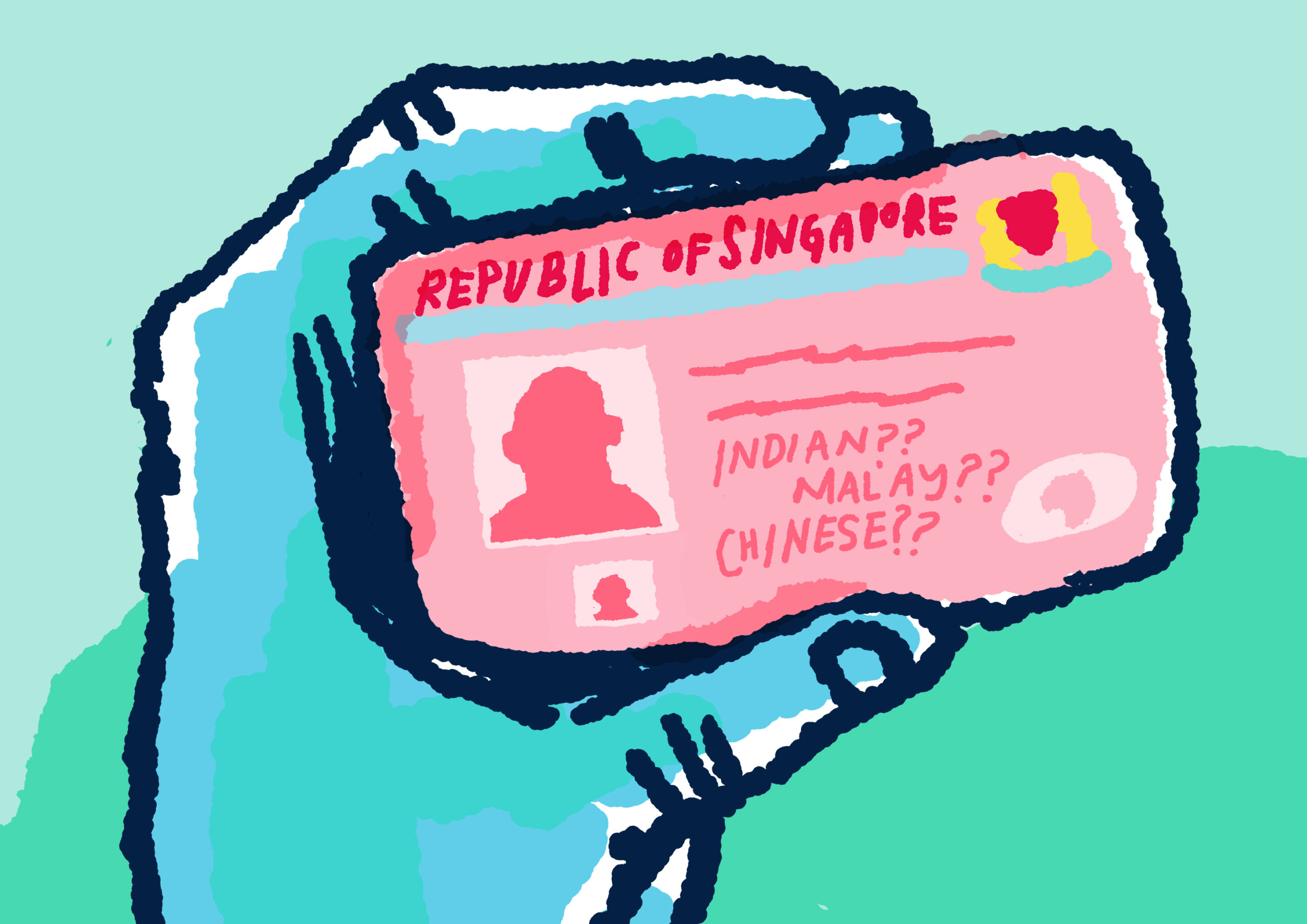
    The fact that race plays a vital part in determining your access to services and opportunities is problematic. The CMIO policy, for example, continues to frame our national policies from housing to education, including public housing ethnic quotas.

    With the brownface incident involving the E-Pay advertisement and local online star, Preetipls and her brother, rapper Subhas Nair, it shows that conversations on race are long overdue. Avoiding such discussions by censoring them does not help deepen our understanding about racism and the offensiveness of brownface. It only entrenches our fear of talking about race. By avoiding and censoring issues, it limits knowledge and prevents the exchange of ideas. As a society, we need to mature and learn how to have a civil conversation about a difficult topic. We need to have more open discussions and debates to talk about these issues without the risk of censorship, and in a safe and non-threatening environment. This includes sharing stories from minority communities by giving spaces and public platforms for them to be heard.

    Not only that, sharing and reading stories from minority communities allows us to practice empathy. It forces us to analyse the thoughts and feelings of the person in the narrative, putting ourselves in their shoes. Hearing their experiences and the troubles they face can teach you not to judge, but to listen actively and understand. From these stories, it answers the question of what it’s like to be ignored and sidelined by society.

    Similarly, in the Muslim community, it is important that we not only giving air time and platforms to just the Malays or just the Sunnis. A Muslim in Singapore is not always someone who is Malay or Sunni. They may not always be wearing the hijab. They may not even be heterosexual.

    We shouldn’t censor the diversity in our community by choosing to present only one kind of “acceptable Muslim” and ignoring everyone else that do not fit within this restrictive and arbitrary category. In her talk at TEDGlobal 2009, Chimamanda Ngozi Adichie talked about the danger of a single story, wherein a community or a group of people are only shown as one thing and only one thing over and over again. It reduces people to one single identity and robs them of their dignity. It emphasises how we are different rather than how we are similar.

    It is important that we continue questioning the narratives, stereotypes and assumptions that has been fed to us. From these powerful diverse stories, we can become a more inclusive and empathetic community.

    –

    Nurul Deanna is an undergraduate pursuing her degree in Criminology. Her interests include studying marginalised communities and risk societies, looking at colonial and postcolonial literature, and learning about intersectional and transnational feminism.

    Photo credit: Firqin

  • Kuralgal

    Kuralgal

    Kuralgal
    by Nadyanna Majeed

    “Half Indian, half Chinese,
    how come Muslim?”

    “Your IC what race?”
    Indian, following grandfather.

    “Mother tongue what then?”
    Malay. “Huh?! Why?!”

    The questions never end,
    even from myself.

    老师,早安。
    Selamat hari, Cikgu.

    Why can’t I complete
    that last one-third?

    “Indian cannot speak Tamil?
    How can liddat?”

    “Take Malay because easy,
    that’s why right?”

    “HUH YOU MUSLIM AH??
    Don’t look like!!”

    “Oh half Chinese? No
    wonder so smart.”

    Incensed, I ignore implications
    and go home.

    Ramadan comes and goes;
    Raya starts soon.

    “Wear sari for Raya,”
    my mother says.

    “Selamat Hari Raya Puasa,”
    greets the Chindian.

    Chinoiserie and curry creates
    the atmosphere here.

    I’m always so torn
    between three communities.

    __

    1. Is there a reason why you have chosen the poetic form of the Kural for this particular poem?


    The Kural is an important form of classical Tamil language poetry and is very short (exactly two lines) and exact (four words in the first line and three words in the second line) in its form. Being of Tamil descent myself, I found it apt to write about my heritage using a Tamil form of poetry.

    I also found that the rigidity of the form reflects how, for many people, the relationship between race and religion is rigid (“You’re Muslim? So you must be Malay ah?”). Being forced to fit each encounter in only seven words also corresponds to how people of mixed heritage often feel forced to fit into certain ‘boxes’ or categories (Malay-Muslim, Indian-Hindu, etc) by the people around them.

    2. Your poem reveals how Singaporeans often view race and religion in a simplistic way. Where do you think such parochial views come from?
     
    This simplistic view stems from many different factors influencing us as we grow up, but perhaps the most concrete example (and one which I remember very clearly) would be from Singapore’s moral education textbooks and lessons. Often, once the topic of racial/religious harmony is broached, it’s presented as Ali the Malay celebrating Hari Raya and explaining the need to fast to his non-Malay friends (because he must be Muslim), while Bala the Indian explains why he doesn’t eat beef (because he must be Hindu), etc.
    As children, we absorb and internalise everything and these assumptions we make are difficult to break if we don’t grow up being exposed to those who break these (although possibly statistically true) stereotypes.

    3. You mention how the scrutinisation of your identity comes not just from without, but from within. Are the questions you ask yourself different from the ones that are asked by others, and if so, what is the difference?
     
    The questions that others ask are usually quite superficial and neutral, and are in relation to stereotypes common in Singapore, like “Huh you Indian then why Muslim?”

    Occasionally, there’s a comment that’s much more problematic, like “You have Chinese blood, no wonder you get good grades!” These comments obviously reveal some kind of negative sentiment towards another group when people express relief that I’m not part of that group.

    As for myself, the scrutiny often comes in the form of contemplating whether I truly belong to any community. In school, I was never part of the Malay-Muslim community who would often go visiting together during Hari Raya, or break their fast together during Ramadan. I’ve also met people who have refused to acknowledge my Chinese heritage, instead insisting that I must be Malay or Indian (or Malay-Indian). So I often ask myself, what does it take for someone to be part of a community? Is it just enough for me to identify as part of it, or do other people get to decide what I am?

    4. How has the perpetual interrogations on your identity shaped the way you understand race and religion?
     
    To me, race and religion have never been linked. As a child, I saw so many different combinations that I could never put people into boxes. However, I’m now much more aware of the perceptions that other people may hold, whether positive, neutral or negative.

    I’m also more conscious now that there are always people who will refuse to acknowledge you as part of their own community (be it racial or religious or both) because you don’t look like them, or you don’t eat what they eat, or you don’t fulfil some other arbitrary criterion that varies from person to person. What you consider yourself to be may not tie in with what others perceive you to be.

    It’s not really a “best of both worlds” situation; you can be of a certain race and religion but if they don’t fall neatly into place with what others expect, you’ll often find it difficult to belong.

    _

    Nadyanna Majeed is a young Singaporean poet of mixed Chinese and Indian descent who also speaks Malay, much to the confusion of others. Having been immersed in Literature during her time at Victoria Junior College, she started writing poetry at the age of 17 and has continued since then. 
    Illustration by Wan Xiang Lee