Category: Sexuality

  • Swim Good

    Swim Good

    by NL

    __

    Awakening Story

    At the age of 8, I used to take swimming lessons at the Clementi Swimming Complex. For merely twenty dollars a month, many students, or rather their parents, willingly signed up for the swimming courses programmed by the school. On Tuesdays after school, a lot of us would leave class excited as ever and make our way to the chartered buses. We would enter the buses completely sweaty with our neon-lined swimming suits hidden under our PE t-shirts. The bus trips were the most fun as girls would pass around their journals on the bus while we wrote testimonies for one another. Funniest testimony I ever read in a journal was the one meant for Atikah, a batchmate of mine. Someone had written “Ayam”, meaning chicken, in glittery pink ink under the line “First impressions:”

    When we were in the swimming pool, my swimming instructor would repetitively say week after week “Children, I promise you all by the time we complete the course, you all can confirm plus chop survive any type of swimming pool, but first, you all better listen to me!” I was not much a listener. It was involuntary considering my command in English was not too great back then. I only knew when it was time to kick my legs like a frog when I saw everyone else doing it. I also learnt that it was time for us to do our own free swimming when everybody else had their hands free from the sides of the swimming pool. Even with the intensity of having to pay attention constantly to make sure that I would not end up drowning, I would end up looking at everywhere else instead of being fully present. I would end up daydreaming about being a mermaid and swimming in make-believe cities underwater.

    There was a boy named Fit. His mother and my grandmother were friends and on the first day of school, my grandmother had told me to make friends with him. Except, he was not much of a friend. He was a bully. For weeks, I would give him 50 cents out of my 2 dollars pocket money and did not think it was a problem. It only became a problem when Nenek began wondering why I never had leftover money. I was told to stay away from Fit afterwards and I think both his mother and Nenek quarrelled over it.

    After staying away from him, I was not quite sure if I had any friends from the age of 7-8. I was quite the introvert and never knew the right words to say in any conversations, be it in English or Malay. The only friend I recall having from Primary 1 till Primary 2 was a bespectacled Chinese boy named Ken. The friendship only lasted a week because he ate from the store with the green bowl and Nenek said I could only eat from the store with the red bowl, or else “Tuhan marah”. When I found out Ken ate from the store with the green bowl, I felt really sad because God would be angry with him and I could not be friends with him. When I asked him why did he eat from the store with the green bowl, he said “What bowl? Toilet bowl ah!”

    Imagine the familiarity I felt when I found out Fit was in the same swimming course as I was! In fact, he would end up being a partner for a lot of things. Fit never apologized for bullying me. I doubt he ever realized it was bullying. In hindsight, he probably really needed the extra 50 cents from me. Fit was a great swimming partner though! He often introduced me to the other boys he hung out with and they seemed like a lot of fun.

    Whenever I was in the swimming pool, I felt like I could be a lot of things. As much as I understood that I had a “beberd” in between my legs and according to both Atok and Nenek that meant that I was a boy, I felt like I was one of the girls whenever I swam. In my mind, my short hair in the water would grow down to my waist and my legs would become a mermaid’s tail. As I floated in and out of my mermaid fantasies, I would often watch the boys do their tricks in the swimming pool. They did flips, handstands and everything else I did not dare imagine to do with my 8-year-old body.

    Fit had a neat little trick he called the “waterbomb”. Basically, all you had to do was to keep your arms folded on your chest like an Egyptian mummy and turn your body 360 underwater, over and over again to the point it looked like an underwater tornado. I wanted that type of power! I was so fascinated by the fact that our bodies could do that and I really wanted Fit to teach me the “waterbomb” so badly. Nevertheless, I was a slow learner and while the boys were moving quickly to do other things I could never get the “waterbomb” right.

    After a while, I would just float off from the rest of the boys and went into my mermaid daze. During one of those occasions, Fit probably felt bad for me and asked that I joined the rest of the boys. In all of my stubbornness, I refused him. Out of kindness, Fit offered to teach me the “waterbomb” and if I could do it right, I was to join the boys.

    This time his approach was different. Instead of doing it once and then watching me do it, Fit decided to literally hold my hands through this tutorial. He held my hands while we both stood up and he went through the motions of rotating our bodies above the water. Then, he would take me underwater and tried it.

    My body was not liking this “waterbomb” trick. Each time I tried rotating underwater, water would go into my nose. I would come out of the water with eyes red and gasping for air and Fit would end up laughing at me. Fit would say “Cute lah you” then laughed at me. At this point, I really just wanted to tell Fit to go play with the other boys and to leave me alone. But Fit persisted.

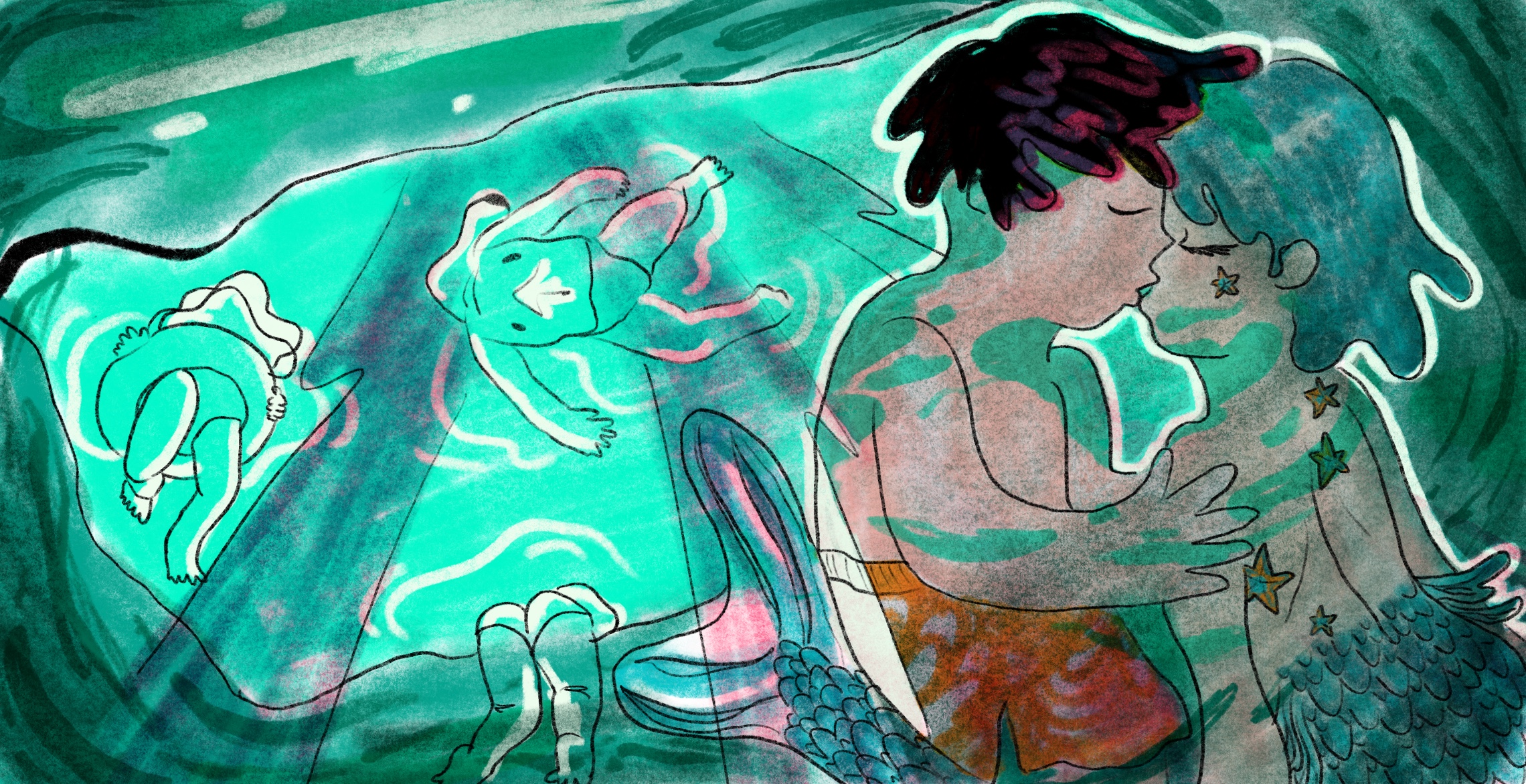
    So we went down underwater once more. Hands in each other’s hands while our bodies rotated. I learnt to relax. Fit kissed my lips. When we went up underwater, instead of gasping for air like I did the previous times I said “Can we do that again?”. So we did. Fit, of course, kissed me again.

    I did not think there was anything wrong with Fit kissing me. Or me wanting to kiss Fit again and again. I mean, it felt nice! I did not think of it as anything else. When Fit’s friends found out, the story suddenly became about me kissing him first! When the girls on the buses found out, they said “What’s wrong with you?”.

    To be fair, it was not normal for kids at the age of 8 to be kissing. Especially underwater. Especially kissing your bully. This boy kissing boy story did not spread like wildfire thankfully, safe for the six to eight people who found out about it only because they were so curious why Fit and I was so far away from everyone in the pool. We all kept quiet about it. I wanted to be quiet about it too.  

    Pressure

    Learning to be quiet about what my body wanted was something that I had suddenly learnt at a young age. Being quiet was absolutely necessary to protect myself. If my friends at the age of 8 would have reacted badly towards two boys kissing each other, imagine if I had told my grandmother about what had happened between Fit and me.

    Fit was not the only boy to kiss me. It happened again with a different boy when I was 15. Perhaps, my awakening story with Fit was far more interesting than the actual journey of me navigating through my own sexuality. By the time I was sixteen, most of my girl friends shared with me stories of what they had done with their boyfriends and when I turned 18, my gay friends were all sharing their adventures with me too. There was a lot of pressure to keep up with everyone when the only experience I ever had were kissing with two boys in my life.

    The first time I had done “it” was absolutely terrible as well. Despite the sex positivity I had around me, no amount of storytelling done by my peers could have prepared me for the disappointment that would come afterwards. Sex for the first time was painful, lousy, weird, smelly and a lot of things that everyone seemed to leave out when sharing. I remember calling my friend and crying on the phone because my partner had continued with penetrative sex despite me asking him to stop. I had read online that sex positivity has become a double-edged sword despite its original intentions of liberating women and gender non-conforming folks. Eagerness to explore what your body could do suddenly became a measure as to how open-minded you are. The more kinks you have, the more progressive you are. Sometimes, I believe that we might have been pressurized into trying things we are actually deeply uncomfortable with just for the sake of not being accused as “vanilla”.

    There were moments I really wished I could share about my sexual experiences with my family members but I understood that sex as a conversation in itself was taboo within a Malay-Muslim household, what more a conversation about sex between two male bodies. Despite making sure that I was adhering to safe sex practices, there were often times when I felt paranoid afterwards.

    In 2014, Health Promotion Board released an FAQ (Frequently Asked Questions) page with regards to sexuality. While this might have been an act of bare minimum that was a long time coming, it really brought immediate attention to the normalcy of sexualities beyond ‘straight’ and a nuanced look at sexuality, beyond just sexual intercourse. It also helped me unpack a lot of self-internalised stigma as a male person having sex with other male individuals.  

    Reclaiming my sexuality

    Sexuality education that was very much centred on the cisgender-heterosexual experience of sex and ideas of abstinence resulted in a lot of my repression and later on, the pressure to “liberate” myself resulted in my eagerness being taken advantage of.  

    Over the years, I have learnt about what I like and what I wanted to avoid and as a friend once told me “Nobody can make you come like yourself”. It was also important that I eventually learnt to stop romanticizing sexual intercourse and to not necessarily conflate it with sensuality – because sensuality can be found in a lot of things beyond sexual intercourse.  Having a partner that cares for and respect what works for you is just as important. I can count with my fingers the number of times I had pleasurable sex – three times, among many experiences in my life. All three times were a result of partners who were willing to understand how differently my body could work with theirs and learning. I have also learnt to laugh amidst sexual intercourse – it is okay to laugh when things don’t work out so long as nobody gets hurt.

    To end off my story, it is also perhaps important to see how we view sex positivity – not as a mere competition to be more “liberated” and pushing our tolerance levels for the sake of being more progressive, but to learn more about what works for us, what is safe and having proper access to information.   

    _
    NL is a trans woman who occasionally writes, performs and is unabashed about her love for Beyonce!
    Illustration by Ishibashi Chiharu


  • The Pain and Guilt of Pleasure

    The Pain and Guilt of Pleasure

    by Naima Khan

    _

    I was 14 when I had my first orgasm. It happened by accident and I was completely unprepared. I wasn’t precocious as a teenager. At that stage, other girls were starting to grow into their adult bodies and learning the ways in which their clothes and mannerisms affected the boys around them. I was preoccupied with school and never even thought of boys as anything but a mild nuisance. 

    Then one night, while I was in my room rocking against a pillow during some game, something suddenly gushed from between my legs. The pillow was soaking wet. No one was around at the time, but I still felt embarrassed. I didn’t understand what had happened and managed to convince myself in the immediate aftermath that I had peed. But over the following weeks, the memory of the tension and heat I had felt in my belly lingered, and I started chasing that feeling.

    My initial forays into self-pleasure started with the same fully-clothed gentle rocking that got me there the first time. Gradually, my body grew hungry for more and I started exploring with water jets, sliding objects against my skin, and finally using my fingers for stimulation. It was fun, it felt great, it helped me unwind when I was stressed or helped me sleep when I had trouble dozing off. I also just loved having that time to myself. But even at that time, I knew that there was something dark and shameful and dirty about the pleasure I was giving myself.

    I knew that having sex outside of marriage was a terrible sin which would result in eternal damnation, but I also knew that masturbating to provide myself with relief was probably not allowed either (a conclusion that I had to reach myself based on all the online literature which only addressed men’s needs, as if women were not capable of feeling the urge to have sex). I didn’t know what I was supposed to do because there seemed to be no acceptable way for me to deal with those urges apart from fasting and praying them away or getting married.

    I was raised in a conservative Muslim household where just the thought of sex felt sinful, so talking about these new feelings to my parents was entirely out of the question. It didn’t help that the only times I ever heard discussions (even tangentially) related to sexuality was when we discussed those girls – the ones who had been up late taking to boys, or who had worn that extra short skirt to attract male attention, or (heaven forbid) had kissed their boyfriends in hushed judgemental tones. The message was clear – only “bad girls” had these feelings or did anything about them, and I didn’t want to be a bad girl.

    But I also had no other way to understand what was happening to my body: all the sex education I had received in school was primarily abstinence-focused and convinced me that sex (and any form of sexual pleasure or experimentation) was bad and should be avoided at all cost. There was no easily accessible information, I didn’t feel like I could talk to any of my sisters, I had no mentors (Muslim or otherwise) that I could confide in, and none of my friends ever even hinted at that desperate hunger I kept feeling.

    I started to feel isolated in my experience and was convinced that something was terribly wrong with me – there must have been some kind of genetic or hormonal anomaly which was causing me to feel that way when no one else around me did. Maybe I wasn’t praying enough. Maybe my iman (faith) wasn’t strong enough. So I prayed and prayed for God to take away those feelings and help me stay pure but nothing really changed. For years, every self-induced climax was chased by an equally intense feeling of shame and guilt and that I had let my family and my God down.

    I never spoke about any of these things until I was well into my 20s. Then one night, many years later, a friend secretly confided in me that she had sex with her boyfriend. Through tears, she told me about how she had been plagued with the same guilt that I had suffered, that it felt so natural to express her love for him physically, how good it felt, how she wanted to stop but didn’t know how, and that was worried that God wouldn’t ever love her again. I was shocked by how frank she was about it, and how honest she was despite her apparent embarrassment. But hearing someone else talk about sex so bravely and honestly finally gave me the permission to discuss and confront my own experiences.

    As we clung on to each other for hours, sobbing through the pain that we had both carried alone for so long, we talked about our bodies, our emotions and our relationships with God. We didn’t have any concrete answers then, but knowing that I had someone who understood and been through the same things took such a huge weight off my shoulders.

     That night was the first step in my journey of forgiving myself and reconciling my sexuality with my faith. It has taken me years, and I’m still in the process of learning and growing through it, but it took that one radical act of honesty and trust for me to confront my own actions, feelings and fears. 

    That’s why I’m writing this even though it is difficult and it makes me feel exposed. I know that so many of us, including my sisters and my friends, have probably been struggling with these issues in silence without the benefit of each other for support. I want the other women reading this to know that they aren’t deviant freaks and that they aren’t alone in their experiences. I hope this piece helps them start these difficult conversations with the women around them.

    _

    Naima is a young professional who is learning to find her place in the working world and in the grander scheme of things.

    Illustration by Ishibashi Chiharu

  • Navigating Asexuality as a Muslim Woman

    Navigating Asexuality as a Muslim Woman

    by Ayda

    _

    I thought I was a good Muslim for not wanting to look at shirtless guys. I’d mostly look at my feet at the beach or cringe whenever a male lead exposed his abs in a drama. My friends would call a guy “hot” and I’d nod but internally, I couldn’t care less. I thought I was practicing hijab but these acts didn’t have anything to do with being a good Muslim. I didn’t look at men that way (and still don’t) because I am asexual.

    The first time I came across this term was during my early polytechnic days. It didn’t click in the beginning that I was ace but something inside me stirred. I felt it in my gut. A year passed and I became more comfortable with the term. I was able to tell my friends that I was “leaning” towards asexuality. And now, I’m confident enough to share that I am asexual to people I’ve just met. However, I still hear the same responses as I did years ago.

    “How do you know?”

    “You won’t know until you try.”

    “Maybe you just haven’t met the right guy yet.”

    As an asexual, I’ve heard these statements far too often. I’ve grown to expect it. This was why I avoided divulging this information. I was unsure of whether the person I was talking to would be able to understand me or at least try to. It was easier to keep mum about this. There is nothing to judge if there was nothing said.

    I’ve made one too many statements that have been deemed controversial.

    Once, I was explaining to my close friend about my sexuality and what it meant to me. I told her that I wouldn’t mind being a second wife. If I had an emotional and romantic connection to a man, I could marry him. He could have emotional, romantic and sexual connections with another woman. As long as he accepted me for who I am, I wouldn’t mind. Her face was appalled. She questioned why I would subject myself to that kind of treatment. She told me I deserved better than that. However, it didn’t feel like mistreatment. It made sense to me.

    Even though I knew who I was, my asexuality continued to confound others, even my closest friends. Last year, I found out about female genitalia cutting (FGC). I was unaware of its prevalence in the Singapore Muslim community. Both my sister and I did not know that we went through until I asked my mother about it. I shared it with my non-Muslim friend and her response was not what I expected. She asked me whether this was the reason why I was asexual. I was taken aback. She thought there had to be a reason for my asexuality and linked it to an unnecessary cultural tradition. 

    For me, emotional and sexual connections are two different things. The latter, I don’t even experience. However, as another friend explained to me, this was not the case for everyone else. For others, it was difficult to separate emotional and sexual connections. It was intertwined and the lines convolved. It seemed that everyone else drew their emotions in abstract swirls while I drew mine in small neat boxes. I didn’t see it as a problem until I started to feel trapped in them.

    I had my own view of how relationships worked. However, it seemed nearly impossible to find someone who felt the same way. I was going to be alone and I had to accept that. I did but I also fell prey to self-sabotage.

    I glared at the people I was interested in instead of giving a friendly smile. I insulted people until their fancy turned into aversion. I pushed people away when my heart yearned to pull them closer. I didn’t want to be rejected because of my asexuality so in my mind, I had to reject them first. I reasoned that it was “better” for them. They should be with someone “better” and “better” meant not complicated, not asexual, not me. I convinced myself that this was necessary.

    However, a part of me was also afraid; afraid that I might be forced into doing something I didn’t want to do. One night at a club, a man approached me and asked to dance with him. I didn’t want to but he was persistent. Eventually, I agreed and that was my first mistake. After a few minutes of uncomfortable dancing, he asked for a kiss. I didn’t want to but he asked until I agreed. His lips were on top of mine but my lips refused to open and I pulled away. He was livid. He couldn’t fathom why I agreed to dance with him but was reluctant to kiss him. He believed I had played him. My apologies flew over his head as he continued to berate me. Afterwards, in the toilet, tears wanted to fall but I held them in. I felt guilty for leading him on and angry that I felt guilty. I had a right to say no. But among the guilt and anger, I felt repulsion the strongest. It was because of that vomit-inducing kiss.

    This was a sign. I couldn’t give people what they wanted and I didn’t want to be forced into doing something I might regret. It was a reminder. There is pressure for girls to please boys and for wives to be readily available to their husbands. Some people even believe it is one of the duties of a Muslim wife. A duty I would never want to be forced to do.

    I knew it was better to be alone. It didn’t matter that I wanted a life partner. It didn’t matter that I wanted to stare into the eyes of someone I loved, to cherish and support them, and to build a life with them. I’ve built a life of my own already and it was one of solitude.

    I tried to brainwash myself that I was content with living this way but it was a lie. I felt it my gut and my gut feelings are never wrong. I don’t believe I need a partner to be happy but I love love. It’s who I am. My stomach does tiny flips when I see people in healthy, loving relationships. I love the way they radiate. I love the unabashed loyalty and honesty they have. I love partners who support each other as they strive for their dreams. They make sure their partners feel loved every step of the way. I wanted to be that person for someone. And I started to hope that I could find a man like that for myself one day or so I thought…

    Self-discovery is a life-long journey. I thought I knew myself but a revelation strikes when you least expect it. One night, I had a dream that I was intimate with a woman. We weren’t having sex. In my dream, she wanted to but I declined.

    I woke up and thought “Huh, even in my dream, I’m ace.”

    But I realised something else, I was bi too. I was a bi-romantic ace.

    A part of me thought that I’ve definitely solidified my place in hell. However, I’ve grown from the child that had these lessons ingrained into her. I don’t believe homosexuality is unnatural. My dream didn’t feel wrong. I felt that I was me. It helped me realised that I do want a romantic relationship and it could be a person of any gender.

    Many things have changed since I first started identifying as asexual. I’m not as sex-averse as I used to be. I am still single and still don’t like at looking at shirtless men. However, I don’t hide behind lies such as “I’m not looking for a relationship,” or “I want to focus on school.” I’m more sure of myself to say that I identify as a bi-romantic ace. I may face judgment but I’m more willing to clarify the doubts that people may have.

    Some days, I do still feel alone but I’ve come to understand and love myself. And if I can do that, one day, maybe someone else will too. I don’t have a gut feeling about this but I do hope I’m right.

    __

    Ayda recently started her tertiary education but is having trouble navigating her university life. When she’s not attempting to study, she fills her time with her three loves: volunteering, theatre and scriptwriting.

    Illustration by Ishibashi Chiharu

  • My Journey With Sexuality: Part 2

    My Journey With Sexuality: Part 2

    by ASMY

    __

    Dear reader,

    The definition of sexuality, like sexuality itself, lies on a spectrum. There are many different understandings of what Sexuality is and I would love to share my journey of exploring my sexuality based on two of the many definitions. I am by no means a great writer, but I do believe that simply by seeing and reading the experiences of others, we are able to form our own opinions and come to terms with our reality. By seeing that other people are going through something similar to what we do, we feel a certain form of closure, almost as if through the simple act of sharing, we feel validated. I hope that you read this with an open heart and that in a way or two you get to benefit from my stories! Enjoy!

    Second Definition

    Sexuality: A person’s sexual orientation or preference.

    I should have known of my bisexuality from long ago. I was 7, just enrolled in Primary 1. We sat in rows of three. My best friend sat beside me. And beside her was a really hot girl. (Let’s call her V) Well, she was attractive to me. Every time I made eye contact with her or if she walked past, I would be smitten. This crush continued until I was 18.

    We were in the same class for 8 years, 2 years separated into different classes, and back together for another 2 years. I tried to relate to her. She was a quiet girl who hung out with the cool kids. She was smart, watched American TV shows on FOX, and her dad worked for the airlines as a flight attendant or pilot or something. Me? I was mediocre and watched Singapore Idol on Channel 5 and my dad fixed cables for a living. Not that I wasn’t proud of his hard work, but financially, socially, in every other aspect, we were worlds apart. She was everything I wanted to be and adored. So I tried convincing myself that it was adoration and not a crush. Still not convinced.

    The next sign that I was also into women was probably when I was 8 and my small fingers tapped on the heavy keys of the keyboard: “Ashley Tisdale Naked”. Yeah. BIG sign. But well, like I mentioned in Journey – Part 1, I was raised extremely religious. So I was also extremely homophobic up til about Secondary 2. I used slurs and EVERYTHING. That was when I started opening up my mind to the diversity of the world. Being part of a strictly Malay-Muslim Community at home and in school and not being able to join camps or tuition because of financial strains kept my mind closed. But in Secondary 2 something happened that changed my life and my understanding of my Sexuality.

    Cory Monteith, the main actor of GLEE by Fox passed away due to a drug overdose. My crush, V, as I have mentioned, loved American TV shows. She loved Glee and she loved Cory even more. Being a reserved person, she never showed much of her emotions besides being happy and normal. But that day, she cried. I wanted so desperately to make her feel better but I wasn’t exactly her friend. I never had anything much to talk to her about. So I decided to watch Glee.

    Watching Glee opened my mind. I was exposed to LGBTQ+ identities and issues such as poverty, teen pregnancy, and racism. I was suddenly exposed to a different world that wasn’t all that different — I was exposed to MY world. There was a lady trio – three cheerleaders called the Unholy Trinity who danced to “Say a little prayer” in the second episode. I said ALL the prayers. There was a character named Santana Lopez (EXTREMELY hot) who was gay, but she couldn’t come out for a long time. I cried watching her. I cried so much because not only did I like her, but I WAS her. I love girls too. I love girls as much as, if not more, than I liked boys. But the difference between us is that she could be with the woman she loved, but I couldn’t. Not in a million years.

    Everyday. Every single day, I pray that the love of my life wouldn’t be a woman.

    I cry at the thought of not being able to marry the woman I love because I love God too.

    I don’t want to transgress.

    But, I am very thankful for V. Simply by existing, she has unconsciously and indirectly made me understand and come to terms with my identity as a bisexual Muslim woman. It wasn’t an easy journey, but now I don’t hide my sexuality from anyone (besides my parents and a few other exceptions). I came out to my classmates and my teacher in class. My Teacher, unsurprisingly, was the most uninformed of us all. She asked me what it meant to be bisexual. She asked me if it meant I like boys and girls “half-half”. I told her I like both in no particular ratio. She couldn’t understand that. She also approached me when another student in her class had girl crushes and asked me if she should be concerned. I told her it is literally none of her business if her student was gay or not and that that isn’t what having a Girl Crush means. She also told me she doesn’t mind the LGBTQ+ community but they shouldn’t try to preach their lifestyle to her. I couldn’t tell her off, because I would have been kicked out of school.

    I remember a talk we had in school. Our teachers, who were from religious backgrounds and, to my knowledge, had little experience with the “outside world” conducted a forum for graduating classes on how to maintain their spirituality and religion without compromise once we stepped out of the Madrasah community. They talked about normal things like relationships, covering Aurah, and being cautious around the opposite gender. Nothing new. But then one student raised her hand and asked: “My best friend told me she likes girls. How do I tell her that it is haraam and she can go to hell because of it?” The panel basically said: “I am unfamiliar with this topic.” Of course you are.

    Now, I never doubt the level of knowledge my teachers have about Islam. They went to university, they have studied Islam their whole lives. I really respect their spirituality and level of knowledge in that field. What I cannot tolerate, however, is how they are very uninformed of every other thing. How they are so absorbed in their tiny worlds filled with people like them and only them. So I raise up my hand and said: “I am familiar and I would like to answer, should the panel be okay with it.” They gave me permission. I took a deep breath. This is the most vocal I’ve been about my beliefs and it would be in front of the very people who have educated me to think otherwise.

    “Your friend told you that she likes girls. How do you tell her she’s going to hell for feelings she can’t control? You don’t. You are in no position to judge her and where she will be placed in the future. Your job as a friend is to help her be a better Muslim and that entails you not judging her. She is still your friend and she is no different than the person you knew five minutes before she came out. She trusted you enough to tell you and it is your job to keep it a secret and to respect her because her sexuality is none of your business.”

    The room fell quiet. Nobody said anything. Not the teachers, not the students. Noone. I guess it was too soon. I wasn’t expecting a round of applause, but silence is definitely better than being interrogated further. But all that proved to be meaningful because all of a sudden I had juniors come to me to tell me that they were secretly gay or bisexual and they started sharing their troubles with me! Again, I am no therapist or professional, but I am incredibly grateful that people trust me enough to want to share the experiences with me, and if I am ever able to make any safe spaces for anyone, I would be incredibly honoured.

    Safe spaces are really important. It helps alleviate the burdens on your shoulders and it gives you the affirmation that you are not alone. Treading the path of being an LGBTQ+ Muslim will never be easy. I personally don’t think the journey will ever end. Having to choose between my Bisexual identity and my Muslim Identity is by far one of the hardest things I have had to deal with thus far, and I am still dealing with it. Here’s some unsolicited advice if you’re going through a similarly rough time:

    1. Open your mind. The world is filled with diversity and there are so many people like you. Listen to others — their happiness and their struggles — and hear all that the world has to say. Through listening to people and their experiences, you may be able to clear your mind and settle on your own concrete beliefs. 
    2. Find safe spaces. No one can tell you what to do about your sexuality or what you should believe in. THAT you have to decide for yourself. But having safe spaces and people to talk to will unravel your mind and help you throughout your thought process. 
    3. Learn. Do your research and find some really concrete ideologies that you stand by. As long as it makes sense and it doesn’t harm you or anyone else, you can be who you want to be. 
    4. Know that you don’t have to choose. You can be a Muslim. You can be Bisexual or Gay or whatever. I’m telling you that that is possible because that is what I am. A Bisexual Muslim Woman. What you have to choose is your identity. Figure out your individuality. Think about what makes you, you. That’s all that matters.

    Right now I am in a state where I believe that I can be bisexual and have bisexual feelings, but I can’t act on them until credible scholars tell me that it is okay. I have done my research and this is what I stand for now. But I will never stop anyone from loving who they want to love. I won’t preach my ideologies (unless I’m asked to) because I know that if someone chooses to do something in life, it is because they have thought about it carefully and that is their happiness and I will celebrate it. But this is just what I think. You don’t have to agree. Nobody has to. People should form their own beliefs and learn to respect others. And that’s all there is to it.

    I am incredibly proud of my journey towards figuring out my sexuality. I choose to believe that by understanding myself I have helped others and if I manage to make at least one person feel ever so slightly better, then, I too shall be happy.

    I am a religious, sexually aware, Bisexual Muslim woman.

    I love God and I love him through loving myself enough to love who I want to love.

    _

    ASMY is a young lady who is trying her very best to figure out her life’s calling and place in the universe.

    Illustration by Ishibashi Chiharu

  • My Journey With Sexuality: Part 1

    My Journey With Sexuality: Part 1

    by ASMY
    __

    Dear reader,

    The definition of sexuality, like sexuality itself, lies on a spectrum. There are many different understandings of what Sexuality is and I would love to share my journey of exploring my sexuality based on two of the many definitions. I am by no means a great writer, but I do believe that simply by seeing and reading the experiences of others, we are able to form our own opinions and come to terms with our reality. By seeing that other people are going through something similar to what we do, we feel a certain form of closure, almost as if through the simple act of sharing, we feel validated. I hope that you read this with an open heart and that in a way or two you get to benefit from my stories! Enjoy!

    First Definition

    Sexuality: The capacity for Sexual Feelings.

    I was sexually awakened at a very young age. My awakening at a very young age often scared me. I grew up in a very religious household, went to a full-time religious all-girls’ institution, and even taught in a weekend Islamic School. Hell, I’m even writing this in a mosque. I remember knowing about sexual intimacy at the age of 6. How young! There were some days I would lie naked on the bed and imagine men coming into the room through the window to have sex and I’d say “next”. I also remember being 8 years old and typing “Naked” into the old YouTube search engine. It was WILD.

    I have no idea how I came to be so aware of my sexuality at such a young age. But one thing that was for sure is that I was not proud. Just as much as I was aware of my sexual awareness, I was aware that my thoughts were shameful in the eyes of our Malay-Muslim community.

    Because I had early exposure to the concept of sex, I would be the girl in class who would openly talk about it, sometimes in a joking way and other times for education’s sake, while all my friends became flustered and embarrassed. When we were studying the basics of reproduction back in Primary 6, my friends would ask me about things they didn’t understand. I would be the one to teach them, but I would also be the one whom they sneered at for having a “dirty mind”.

    In the community I was in, people did not know how to differentiate between sex education and having sexual feelings. It did not matter that growing teens ought to understand about safe sex and contraceptives. No, what mattered was that as young Muslim girls, we must be pure, polite and moral. Sex is never pure but vile and sinful. Abstinence was far more superior than education. And because of that, until now, I have friends who are still oblivious about sex. Once, in Pre-University, a classmate even came to me to ask about sex. She was not aware that people had to have sex to have children. She thought that they just laid in bed and the sperm swims into the woman’s vagina via the bed. 17. Has she never seen a textbook? God.

    Another friend recently asked our group of good friends about how we deal with being turned on and horny before marriage. I still don’t know the correct answer, which upsets me, as it reveals the fact that there has never been a safe space for us to openly discuss our sexuality as young Muslim women. We were taught that the solution to ‘horniness’ was marriage, but that’s obviously wrong. And the truth remains that up til now, a lot of Muslim youths don’t know how to channel our pre-marriage sexual feelings without feeling sinful.

    Although I was aware that the school needed more people who were willing to discuss sex in a non-lustful and normalised light, growing up, I still felt so ashamed that I knew so much. Sometimes, although very rarely, I still do. The words of my friends and family really got to me. I hated myself for so long and beat myself up about wanting sex. Every time I watched porn I would hate myself so much. Every time I felt even slightly aroused I’d curse myself. I tried so much to abstain but that only made me fall deeper into this rabbit hole of pornography. That was the only way I knew how to control my desires without blatantly transgressing. But that made me develop porn addiction that was so bad that I would break school rules to go to the toilet to watch porn in the middle of class. I developed porn addiction that I had to overcome alone.

    I am very thankful that I am in a place of control now, and I’m proud to say that I did it! It took a lot of reflection and forgiveness for myself but I made it. Here are a few tips for those who may be facing similar problems:

    1. Remember that it is completely OKAY to want sex. It IS human nature. It is NOT sinful.
    2. Learn and do your research. There are many opinions about porn and masturbation in the Islamic point of view which is far different than the norm. Come to an informed conclusion about what is okay for you and slowly work towards that. Rationalise with yourself and help yourself understand the lines that you have drawn.
    3. Forgive yourself. Sometimes we mess up. Sometimes we relapse. It happens. Don’t be so hard on yourself.
    4. SEEK HELP. If there is one thing I regret doing, its not getting help earlier on. I was surrounded by people who did not want to understand me and who shunned people like me, so I really needed people to talk to who can help me understand my problems. There are many Sex positive centres out there and all we have to do is search. If not, get online, find support groups there. You are not alone.

    Now, I am incredibly proud of my knowledge and my journey. Because I was shunned in the past, I forced myself to be educated instead of conforming to dangerous norms. And because I decided to educate myself, I have created a safe space for my juniors to come and ask me about sex and sexuality should they ever need to. I am by no means a therapist or a sex ed teacher and I still have so much to learn, but I am a Young Muslim Woman with High Sex Drive and Knowledge. I have my own story and I am able to comfort and encourage those around me who have questions to not be ashamed for wanting to know more about the basic human need.

    More importantly, I have come to terms with my sexuality and sexual awareness.

    I am no longer ashamed.

    __

    ASMY is a young lady who is trying her very best to figure out her life’s calling and place in the universe.

    Illustration by Ishibashi Chiharu

  • Zinaphobia: Our Love-Hate Relationship With Sex

    Zinaphobia: Our Love-Hate Relationship With Sex

    By Nurul Fadiah Johari

    _

    We live in a society that loves and hates sex at the same time. We love, desire and want to possess it, and yet, we loathe, fear and reject it all the same. And we would do what it takes to assuage our own insecurities towards it, especially through the mechanisms of religious and cultural norms.

    Growing up in a predominantly Malay-Muslim society, I was taught from an early age that, as women, we should desexualize ourselves as much as possible. We are not supposed to look sexy in any way, and as much as we can, to control our sexual feelings. In other words, just kill off any semblance of sexuality from the get-go.

    Young girls are taught that their body is a source of sin and that if they are not covered in proper Islamic attire, their fathers will be held accountable in the Hereafter. At the same time, we are somehow supposed to please our husbands sexually once we are married. As a woman, our self-worth is ultimately tied closely to our sexuality—how well we guard it before marriage and then how well we use it in marriage.

    Women in my community are told many things in order to desexualise ourselves, and yet to sexualise ourselves within marriage. Once, a teacher told us women to not dress sexily at the workplace, because if a man were to fantasize about us, we would have to bear his sins.

    And if our husbands were to think about finding a second wife, we are supposed to try harder to please him. In religious classes, having to shave one’s pubic hair is emphasised, the point being to please one’s husband. Our dignity is thus measured by our husband’s pleasure. A woman’s desirability is to be earned, while the husband merely gives.

    When I was younger, I was taught by an ustazah [1] that women are supposed to cover their feet with socks, because men can tell by looking at their feet if they are virgins or not. I am still curious as to how men can tell the status of my “virginity” (simply understood as vaginal penetration by a penis) by looking at my feet, and why that mattered so much.

    Clearly, it still does matter. After all, a woman is devalued once she loses her virginity. She is a used product. A divorcee, or janda, in the Malay community, is still viewed with suspicion and sometimes contempt. Only recently, my aunt lamented to my mum about her misfortune of having a future daughter-in-law who is a divorcee. It does not matter that she may be a good partner to my cousin; all that matters is her status as a divorced or previously married woman. I don’t know which is worse—the fact that she is divorced or that she was previously married to another man. In my observation, a divorcee is not as valued as a previously unmarried woman when it comes to entering marriage. It may seem to some that her being divorced means being a failure at marriage, while being previously married to someone else simply meant that she is not a blushing virgin anymore. Either way, it is just an unsavoury position for a woman to be in.

    This fear of sex outside the legitimate boundaries of marriage means that marriage is deemed as the solution and justifier for all sexual desires. How often do we hear today of people saying “Dah halal!” to newlyweds, thereby alluding to the halal (permissible) status of their relationships? As though any form and expression of love that arises prior to the solemnisation is less legitimate and therefore less valuable.

    Pre-marital romantic relationships are sometimes even touted as “haram” (forbidden) relationships. And suddenly, everything becomes okay at the point when the groom accepts the bride’s hand in marriage. The same goes for people who claim that the main aim of marriage is to legalise their relationship, and by relationship, it means sex. Sex becomes the sole purpose of marriage, and so by that, marriage is equated to sex. The binding marriage contract thus grants people sexual access to their partners, so that they would not have to feel guilty for wanting to release their sexual desires.

    I remember discussing with some friends during my teens about what we would do on our wedding nights, the kinds of games we would play with our husbands. It is a form of a naïve anticipation of sex that is conditioned by a society that represses sex. The wedding night itself is viewed with so much anticipation because of the excitement about having sex, that it probably ends up quite a disappointment for many people. Perhaps, what we need to think about is not the mere act of sex per se, but the act of building love and trust, which is then expressed in various ways. Sex is just one way of expressing that love.

    Thus, as an extension to this fear of sex outside of marriage, we have developed an unhealthy obsession with marriage. Our obsession with marriage is primarily rooted in our repression of sex. We seem to love marriage, especially weddings, even more than love itself.

    Of course, this means that marriage and wedding planner agencies can capitalise on our unhealthy obsession with marriage. It certainly has become a multi-million dollar industry here. People are willing to scrimp and save, simply to buy into this romance of extravagant weddings. To me, one can say that you get married once, but the financial burden of a lavish wedding and other costs lasts a long time. It may even cost one’s marriage. I have heard of stories of people getting into fights and even divorcing their spouses due to financial constraints, starting from debts incurred from the wedding.

    What is more worrisome, however, is when the fear of sex outside of marriage and the myopic solution of marriage is used to endorse young or early marriages. It is common to see in social media how some groups of Muslims, in response to the prevalence of young Malays having romantic relationships prior to marriage, come out with slogans such as “Bercinta selepas nikah”[2] and “Say no to couple”.

    In trying to deal with issues of sexual promiscuity and its ensuing problems amongst Malay youths, these groups, instead of talking honestly about sexual and marital responsibilities in the modern context, choose to idealise the idea of the marriage institution and romanticise the notion of “love after marriage”.

    Some also glorify the idea of young marriages, as though this would easily solve the problems related to sexuality amongst Malay youths. The idea is simplistic in that it assumes that marriage, just simply because it legitimises sexual relations, would be the ideal solution to sexual promiscuity.

    In seeking to preserve an idealised notion of Islamic marriage as a reaction against sexual promiscuity, these groups promote marriage rather than trying to analyse and understand the reasons for teenage sexuality and premarital relations. So instead of promoting comprehensive sexual education with an emphasis on mutual consent, trust and respect, we end up leaving youths unprepared to live with the responsibilities of marriage and parenthood.

    At the heart of it, marriage is used as a tool to control and police sexuality in our community. We repress our sexual desires, and in the process become obsessed with sex. Many religious classes are used as a free access to sexual discussions—where people ask the Ustaz questions on the permissibility of swallowing their husband’s semen and so on. This merely reflects a pubertal understanding of marriage, sex and intimacy. We have not moved on from this. We still fantasise about sex like teenagers and therefore romanticise love and relationships like lovelorn youths. So we rely on and succumb to legalistic and authoritarian confines of marriage in order to cope with our inability to live with our sexuality.

    We need to move toward a more mature understanding of love and sex. And for that to happen, we need to challenge head on the taboos and fear surrounding sex. As Muslim women, the first step is to take ownership of our bodies, from the very core of how we dress, present and conduct ourselves in society. All talk of self-love and care comes to nought if we do not love our physicality and sexuality.

    We need to move away from the idea of living to please men, and this starts with the idea of pleasing an anthropomorphic and masculinised God. We need to make that radical break, and we need it now, more than ever. Only when we stop fearing our own body and its capacity can we then stop fearing and policing sex.

    *The term “zinaphobia”, or the fear of sex outside of marriage, was used in this article by Julia Suryakusuma in The Jakarta Post, “’Zinaphobia’, homophobia and the ‘bukan-bukan’ state”, 7 September 2016.

    [1] Female religious teacher

    [2] Fall in love after marriage

    This piece was first published in Growing Up Perempuan (2018)
    __

    Fadiah co-runs Penawar, a support group for women/non- males raised in the Muslim community, dealing with negative experiences from patriarchal interpretations of religion. She has also written for local publications such as Perempuan: Muslim Women in Singapore Speak Out (2016), Growing Up Perempuan (2018) and Budi Kritik (2018).

    Illustration by Ishibashi Chiharu

  • Editor’s Letter: Sexuality

    Editor’s Letter: Sexuality

    Cover Your Eyes!

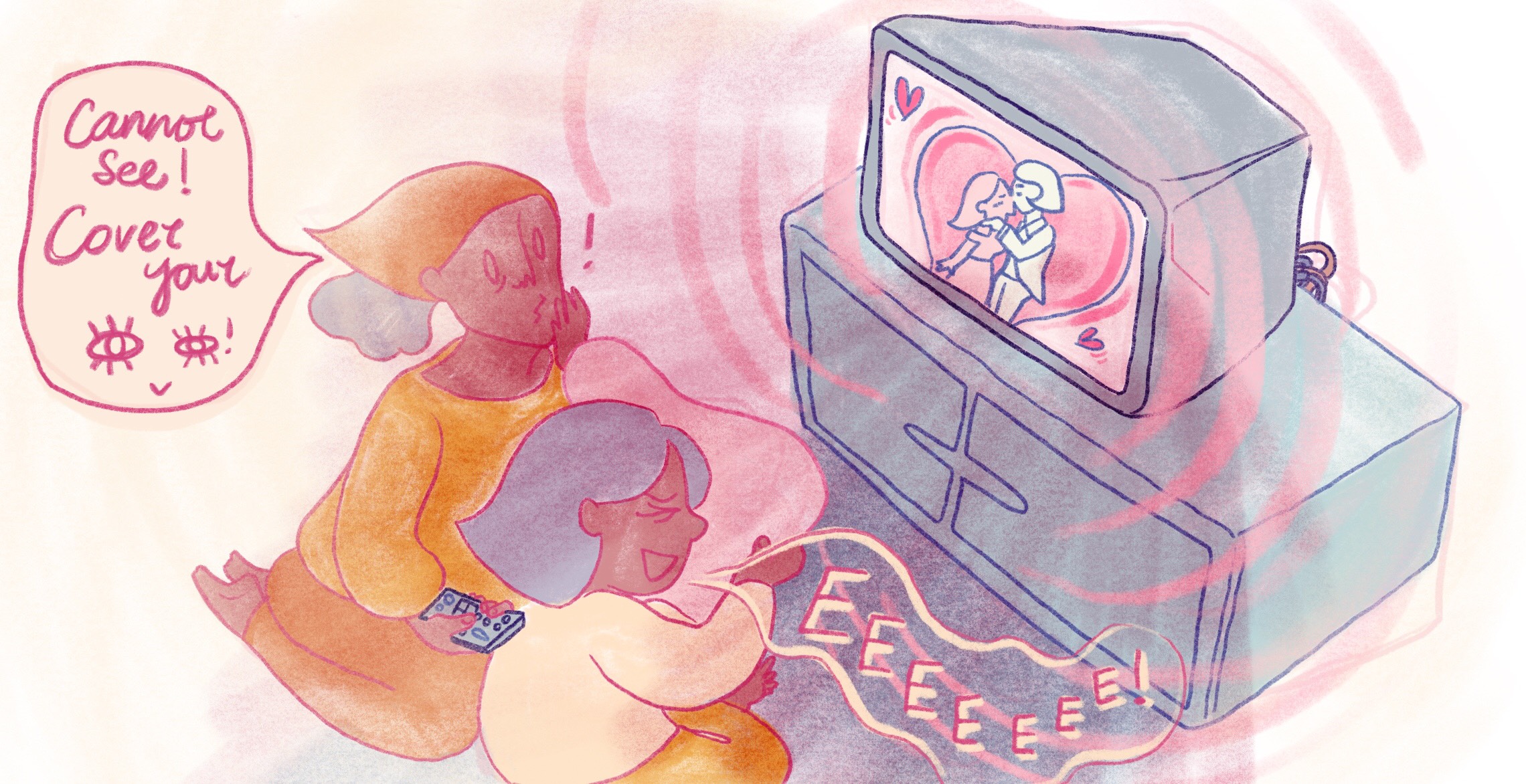
    I watched Titanic for the first time at home with my parents. Jack and Rose are running, a respectable bourgeois lady and working-class man, away from the assistant of her insufferable, arrogant fiance. Rose with her tight ginger curls free from the usual chignon with her wild glittering eyes. Leonardo still baby-faced with 90s dreamboat hair. They run along narrow corridors, knocking over silverware. Rose’s virginal white dress somehow remains pristine after they run through the fire room. They run into a room, then into a car. What happens next, after their giggles quieten and their faces neared, would be preceded by mother’s shrill directive: “don’t look, cover your eyes!”

    Being an obedient child, I never looked. I never peeked, not even once. I genuinely associated intimacy with sin and even a feeling of disgust for a long time. Those moments felt painfully awkward and it didn’t help that I never got an explanation or discussion about sex or sexuality from my parents, nor from schools, as far as I remember.

    The sex education class I had in secondary school was focused on abstinence and I remember the girls being made to watch a video of a fetus being sucked out by vacuum during an abortion. It was, to us, another perturbing thing overzealous adults wanted to show us. Afterwards, we went back to our world,  saturated with gossip about couples, whispers about notorious toilets and spaces people were seen kissing, and mean-spirited bitching about the school “slut,” (unsurprisingly, the boys she was with escaped moral condemnation).

    All of this was, of course, symptomatic and consequential of the larger refusal to properly acknowledge and explain the reality of sex and sexuality. As if in not looking at scenes of kissing couples, the reality of intimacy would cease to exist in the child’s mind. As if simply stating the imperative to turn away from sexual desire would automatically result in obedience and a reduction in teen pregnancy.

    Growing up, especially during the period of teenhood, shame is abundant: in how our changing bodies are perceived, how our feelings of attraction and desire begin to confuse us, and all the complications of growing into our individual selves.

    It shouldn’t be taboo to talk about sexuality, our changing bodies, and the development of sexual desire and attraction. They are, after all, completely natural. Yet for so many, these changes were seen as much a marker of growth as they are the beginning of heightening anxiety. Especially for teen girls, our parents would begin to fuss and obsess over the presentation of our bodies, sexual precociousness, and the company we keep, especially of the opposite sex. The overbearing dark cloud of sex before marriage was a threat that loomed, defining so much of how we were to behave. This cultural and social surveillance of female bodies leads predictably to a deep feeling of shame when it comes to our own bodies and sexuality.

    This is quite ironic since the religion is very much “sex-positive” and encouraging of healthy sexual relationships. The Islamic tradition, sunnah, and hadiths are full of advice and stories around the importance and joys of sexual relations between married couples and how it is an important facet of an intimate relationship which strengthens the bond of a couple. Muslim scholar Al-Ghazali calls it a blessing from God and in a hadith, our prophet Muhammad s.a.w. is reported to say that God rewards Muslims for “sexual play.”

    Yet why is there this discrepancy between the sexual frankness in the religion, and the intense, anxious suppression on the discussion of sex and sexuality within Muslim communities?

    Perhaps what is sad is how many have to peel away layers of shame to even begin to healthily associate sex and sexuality as something that can be joyous, fun, and full of love. For so long this aspect of the human experience has been swathed and chocked with shame, guilt, and a swirl of toxic mystery, that it can be a journey to see its reality.

    Sex Education

    Imagine what happens to the mind, what the mind does, when it doesn’t have the limits of reality to control its wanderings. What nebulous, misguided images of sex and sexuality it festers when you’ve only heard the sounds, caught snatches of images, and listened to the experiences of others. What kind of distorted image would be pieced together from these fragments?

    What happens to a woman when she is demanded to be innocent, even sexually naïve for most of her life up until she is married? One can only imagine the difference in power between partners when one is conditioned to be less sexually knowledgeable than the other. How anxiety-inducing that first sexual experience of hers will be, and how vulnerable she might be to instances of sexual abuse!

    Sex education, one that is thorough, accurate, and not filled with messages of guilt and shame, is important. It’s important so that prevailing myths around sex and sexuality can be addressed and young adults are educated on their sexual rights, take necessary safety precautions, and limit the dangers they may face.

    For example, it’s often said that a woman’s first penetrative intercourse will result in bleeding due to the rupture of the hymen. However, this belief is grossly inaccurate and perpetuates the erroneous belief that your first time is necessarily painful (which then leaves little responsibility to the partner to be mindful of their partner’s readiness and comfort during sex). This article provides a helpful, easy-to-understand primer on the question of whether the first time should hurt.

    Of course, sex education is a contentious topic, one that has been a site of struggle between “conservative” and “progressive” camps since it involves the values and opinions we hold regarding female sexual autonomy.

    The facts, however, regardless of opinion, is clear. Young adults are going to have sex, regardless of the messages pumped into their minds about how sinful it is. The only thing that can be controlled is how we respond, and whether we provide them with the information they need should they do it.

    If abortion and teen pregnancy is a fear, then abstinence-only sex education has the opposite intended effect, since it has been proven to result in the highest rates of abortions and teen pregnancies. What works is if they are given accurate information about safe methods of contraception, how to access it, and how to take precautions from STIs (Sexually Transmitted Infection).

    Consent and Healthy Relationships

    The other issue, far more nuanced than the obvious, stark topic of sex and desire, is consent and healthy relationships.

    I would like to share the following quote from a post by HEART Women & Girls about how consent is fard (religious obligation):

    It is narrated from the Prophet (SAW: peace and blessings be upon him) that: “Do not engage in sexual intercourse with your wife like hens; rather, firstly engage in foreplay with your wife and flirt with her and then make love to her” [Alliyatul Muttaqīn] and narrated from Imām °Alī (AS): “Whoever wants to get close to his wife must not be hasty, because women before engaging in the act of love making must be engaged in foreplay so that they are ready for making love to.”

    Sexual activity and intimacy without consent violates its sacredness revealed by God. This is also marital rape. Across all types of relationships and interactions, consent is fard.

    Beyond the quick and dirty information about sex, more sensitive conversations around consent, coercion, and emotionally healthy relationships are important so that people will be able to identify when they are in abusive relationships, and where they can go should they need to seek help.

    When there is a lack of comprehensive, evidence-based sex education, young people would naturally seek other avenues. Consider the fact that in the digital age, many youths turn to porn, and that porn has become the unofficial source of sex education. (As an aside about the link between repression and porn, think about the fact that six Muslim-majority countries are in the top 10 global consumers of porn).

    Porn is also abundant with images of unhealthy, unrealistic depictions of sex, with frequent images of coercive, even violent sex, where women are often depicted in submissive roles. This leads to higher instances of unrealistic expectations, high-risk behaviours, and a higher risk of being a victim of sexual aggression. Of course, there are instances within the porn industry to provide healthier depictions of sex, but they are not the dominant image that is seen in the flood of images and videos available.

    It is important that there is a counter-point to such images, and that accurate, sensitive information is accessible to young adults will naturally be curious due to their burgeoning sexuality.

    A Mother and Her Baby: Both Children

    Not too long ago, an incident in our neighbouring country made me grieve for the kind of loneliness, shame, and emotional turmoil that the topic of sexuality often brings to young girls. On the 14th of October, an 18-year-old girl died in a toilet during childbirth in Ipoh Her baby was found dead too, in the toilet bowl. For six hours, she kept telling her mother that she was constipated.

    I keep wondering about depths of shame and fear she must have had from having a child out of wedlock. How deeply lonely she must have felt throughout her pregnancy, and especially during the last moments of her life. She died alone in a toilet because going through the intense pain of childbirth alone was more tolerable than facing the shame of having a baby outside of marriage. Up till the end, to come out and admit it was too scary for her.

    To imagine her weight of repression and psychological oppression was intensely sad. Regardless of what one might feel about the rightness or wrongness of what she did, the result surely ought not to be her own death, along with her baby’s.

    The safety of our children, the limit to abuses, and ensuring that our intimate and sexual relationships are as healthy as possible, should be prioritised. It can be, as we have seen in this fatal case, a matter of life and death.

    __

    Illustration by Ishibashi Chiharu

  • The Pain of Sex

    By anonymous

    For the past few years, I have struggled with pain associated with vaginal intercourse. I visited doctors but none could provide me with the answers I was looking for. “Have more sex, it’ll open up…it is supposed to hurt…try different angles.” The advice was never helpful and only reinforced my worry that there was something wrong with me. I was unable to find help or an escape, but I wasn’t necessarily looking for one. I was content not having my vaginal issues resolved because I wasn’t in a hurry to have children. I was able to enjoy other sexual activities and had a patient and loving partner. I knew I would have to figure it out eventually and waited until I had the emotional and financial capacity to dig deeper for the answers I was looking for.

    A few weeks ago I visited a new doctor. She had me hold a mirror as she took a look down there and pointed out the problem. “Now sit still, does that hurt? Hmm have you ever touched yourself before, you are pretty fidgety. Oh there it is – I see what the problem is. Can you see that – you have two tiny holes instead of one big one.” A septate hymen. Clear and visible to me and the doctor – a nostril in my vagina.

    As the doctor typed on her computer, I sat uncomfortably still trying to process what she was saying. “We’ll need to see what’s going on through an MRI and given how difficult it is for you to be touched, we’ll have to knock you out for the procedure.” I nodded in agreement. There was no way in hell I wanted to be awake for this.

    My doctor recommended me for physical therapy. The physical therapist took me in at around 8:20am. She had me walk, sit, lay down, move around until the big reveal moment when she herself poked around. I was watching her face as she observed my pelvic muscles and knew in an instant that this was complicated. I asked her what was wrong and to just tell me what she thinks honestly. “Honestly, my patients with just a septate hymen do not react like this. My patients with vaginismus do. Go through with the surgery and then talk to your doctor. We may have to bring you back for regular sessions. In the meantime, here’s a list of exercises I want you to do twice a day.” I thanked her and walked out.

    As the weeks passed, I visited the hospital for various appointments. Each time I got back to my car, I sat in silence taking deep breathes, then drove to work in tears while jamming to Adele on blast to get all my emotions out of my system. You see, you can’t talk vag in the office. Sure, you can talk about how you caught a cold, or need to get a root canal – that’s all work appropriate. But to bring up your vag problems is awkward to discuss with anyone really.

    Being that I’ve been married for a few years, I often get asked if I want to have children or if I am planning to have kids soon. You can plan all you want, but the reality is that nothing is in your hands. Even after all the treatment, surgeries, therapy and healing – Will I be able to have kids? Will I be able to experience vaginal intercourse without the pain? Only Allah knows. All I know is that this is fucking hard and I can only try my best. I am exhausted and emotionally drained and want it all to be over. I want to not have to worry about missing work for my medical appointments or budget a portion of my salary for medical expenses. I want to not have to hold back tears whenever anyone asks me if I like kids. I want to let myself be vulnerable with the ones I love and not have to show that I have everything under control. I can’t wait for the day when I can finally be excited about the possibility of being pregnant. About the possibility of painless sex! And surprise my patient partner with the news of our own little one. I want a lot of things in life. But I’ll make do with what I have for right now. My story, this space to share it and your duaas, iA.