Category: Religious Spaces

  • Mercy To All Creations: The Muslim LGBT’s dilemma in Religious Spaces

    Mercy To All Creations: The Muslim LGBT’s dilemma in Religious Spaces

    by Zuby Eusofe

    _

    As Muslims, when it comes to religious spaces, the best place is the mosque. A sacred place where every Muslim goes to be one with Allah. A place of seeking peace and calm in a serene environment where you can go into the holistic vortex of communication with Allah.

    But not for LGBT Muslims like me.

    It’s different, even weird, for us to be in a mosque when many people will look at us as if we’re aliens. Firstly, our physical appearance usually shuns us away from the ‘normal’ muslim community.  Secondly, there is too much ‘dakwah policing’ from those who are not even selected nor elected by any mosque committee and their eyes are glued on you as if you’re a criminal that has committed the greatest sin upon Allah’s eyes.

    One of my friends, for example, was chased away because of her butch appearance. She was chased away while trying to put on the prayer garment (telekung). One makcik came towards her, looked at her from head to toe, and gave a sneering remark: “Kamu ni bukan perempuan tulen, tak leh sembahyang kat sini.”  (You are not a “real” woman, so you can’t pray here.)

    My friend’s intention to be in a mosque to find solace with Allah was halted by this makcik, who thinks that what she did will gain her reward in Jannah (Paradise).

    It’s sad but true. This incident is just one of many others that I can tell you about the dilemma and obstacles we, as Muslims from the LGBT community, are facing daily.

    Due to this, some of us will even go to the extent of leaving Islam because some Muslim people within the sphere are convinced that what they did is not wrong.

    During the days when I was closeted and in my hijab, I remember there was a woman in a mosque who specifically policed ladies who just came back from the office and were wearing corporate clothing in short skirts. She would just say bluntly in an authoritative manner: “Ok, if you ladies are coming here, please have the decency to bring along a sarong before entering the mosque, or else don’t come and do your prayer here.”

    Seriously, why do these makciks or pakciks (aunties and uncles) think they have the ‘rule of thumb’ on telling people what to wear and when not to pray within the mosque?

    Since when did Allah need these kind of people to protect Allah from seeing indecency?

    Allah sees us from the beginning of our soul to the day we died, and that is as naked as Allah has seen us as human beings – Allah’s creation.

    [On the authority of Abu Hamzah Anas bin Malik (may Allah be pleased with him) – the servant of the Messenger of Allah (peace and blessings of Allah be upon him) – that the Prophet Muhammad (peace and blessings of Allah be upon him) said :

    “None of you will believe until you love for your brother what you love for yourself.”

    Related by Bukhari & Muslim]

    This hadith is strongly correlated with the Golden Rule which is “do as to others what you want to yourself.”

    Would these makciks and pakciks want that to happen to them, being hostile and aggressive towards others whom they may assume to lack Islamic knowledge just because they didn’t dress up the way other mosque-goers do?

    Where is the love and kindness that are seemingly obligatory for Muslims to show to everyone, regardless of race, culture, religion, or creed? As mentioned in Quran:

    “We have not sent you except as a mercy to the worlds.” – Surah Al-Anbiya 21:107

    And our Prophet Muhammad (may peace and blessing be upon him) reiterated in the hadiths:

    Those who are merciful will be shown mercy by the Most Merciful. Be merciful to those on the earth and the One above the heavens will have mercy upon you.

    Source: Sunan At-Tirmidhi 1924, Grade: Sahih

    In the word Mercy according to the Islamic context, it derives from two words: Ar-Rahman (Most Gracious-Merciful) and Ar-Rahim (Most Compassion).

    It is the most common name occurring in the Quran. Rahman and Rahim both derive from the root Rahmat, which refers to tenderness and benevolence.

    Thus, this shows that for Muslims, it is important to treat everyone with kindness and tenderness, and this will not happen if the individual does not have the feeling of compassion and love for one another.

    Going back to the issue of religious spaces for LGBT muslims here in Singapore, I can simply state that it is difficult for us to be in the mosque and commune in religious congregations with other Muslims as their ‘fear’ leads to discrimination towards LGBT muslims. They have the privilege to be with the rest of the Muslim community who are already a minority in this country. Us LGBT muslims do not have that privilege. We are the minority within the minorities.

    We are being alienated and accused as an apostate (due to our gender marker) unless the higher Muslim authority are willing to give us that religious space for us to be in oneness with Allah in peace, and to be part of the congregation without prejudice and discrimination from other Muslims.

    I remember the moment I did my umrah (pilgrimage to Mecca). It was around 3 am in the wee hours of the morning. I was wearing a morroccan taub (Morroccan Long Garment for Men) and I also wore my hijab. I was mocked by a young Arab man.  He tried to pull down my hijab and said that my attire did not represent a true Muslimah dressing. At that point of time, I was not comfortable wearing the telekung (the prayer gown worn by muslims women). I was more comfortable with wearing something that is masculine but loose.  I believe that regardless of the attire I am wearing, if I a covered myself decently, it is enough for me and no one has the right to judge or discriminate me whatsoever. My decency belongs to Allah and Allah alone.

    And only Allah that I seek mercy and repentance…

    Rahmatan lil’alamin (Mercy to all creations)

    _

    Zuby Eusofe is a LGBT Muslims activist and the founder of The Healing Circle.
    She and her inspiring team hope that one day, LGBT Muslims will be accepted within the community without prejudice and discrimination from other Muslims.

    She is also a writer and a blogger.  She has written two stories for Perempuan and Growing Up Perempuan.

    Illustration by Ishibashi Chiharu

  • Not Muslim Enough

    Not Muslim Enough

    by Marina Rosli
    _

    For most of my life, Islam felt like conditional love: I had no right to call myself a Muslim (nor would others call me one) because I hardly prayed, am not too concerned about halal food, constantly challenged longstanding interpretations of the religion and questioned the existence and validity of certain beliefs and rituals.

    Raised in a pious, religious household, I grew up following the rituals to a tee. I spent my youth following a creed that I thought was essential to my self-worth, humanity and spirit; but I never felt good enough to be considered a Muslim. Furthermore, society also always seemed to reinforce this feeling of inadequacy, where our prayers are never proper enough for God, where we will never pray enough, nor will we ever be as humble as the prophets.

    As I grew older, a sense of uneasiness and conflict grew. I constantly felt punished for doing things I enjoyed that were not harmful or hurtful to me or anyone. I felt as if religious people never seemed to care about women or they “care” too much by wanting to control and have power over us. It slowly got increasingly harder to commit to praying every day. It was not only the tediousness of the rituals but also the contradictions I felt about what I knew the religion to be, and the values I held.

    I slowly began to distance myself from the faith. It began as me believing that I will go back and regain my old life as a dedicated Muslim someday. However, I soon realized that I was not someone who was invested in the rituals any longer albeit, I still stayed steadfast to my faith.

    I took a more rational approach to my spirituality and faith. I no longer associated any of my mishaps or misfortunes to my lack of rituals. I was no longer ruled by the fear of balak tuhan (God’s punishment). I was finally making decisions and being accountable to my own self. It was liberating! I was free to enjoy a glass of wine with my friends, without the guilt. I was free to go out in clothes that I thought made me look good, without the guilt. I was free to live my authentic life, without any guilt. Although I did not practice all the traditional rituals, I still identified as a Muslim. I fasted every Ramadhan, went for terawih prayers without fail and did my prayers when I felt like it. I balanced the life of sin with some of the rituals I was taught and expected to perform.

    Not Muslim enough for him

    That was until I met Adil. He seemed progressive, his circle of friends equally so. However, as our relationship progressed, he obsessed about my lack of ritualistic practice. He was convinced my lack of wont to pray made me a ‘deviant’ Muslim and ultimately an immoral person.

    Not only he, but also his friends, and family slowly coerced me to work on my “religiosity”. It began with the constant shame couched through encouraging tones of advice, and the passive-aggressive remarks when I did not publicly announce I was going to pray. My choices often drew eye rolls, sighs of disappointment and the condescending line “what is 5 minutes of your time”.

    Yes, 5 minutes of my day is nothing. However, the imposition of the task, the patronizing tone, the coercion framed as advice – that is not just “nothing”. These are acts that chip away and slowly disempowers a person’s spirit. I was made to believe that I was not a good Muslim, good friend, good girlfriend and a good person. And I believed it.

    Not Muslim enough for the pulpit

    Eventually, I succumbed. The burden of having to accept their judgment with a smile (pretending that I appreciated their dakwah) was too much to shoulder, so I did my prayers (to pray that the control would stop).

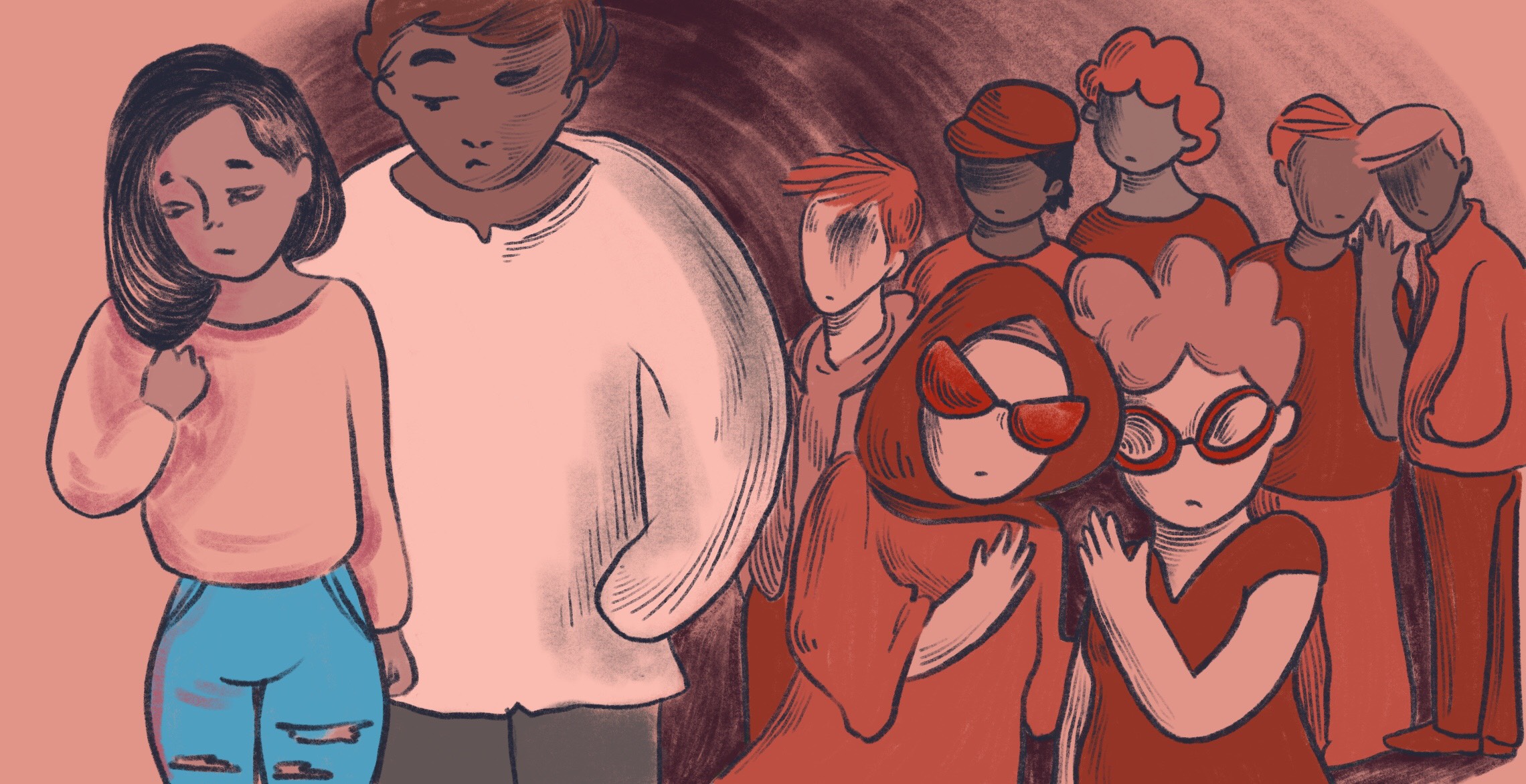
    Whenever we went out, I was careful to dress “appropriately”, because we would often pray together at the mosque. Mosques in Singapore have never felt safe to me; I constantly worried that I would get chided, scolded and humiliated because I was not dressed ‘modestly’. People at the mosque have chided me publicly for wearing torn jeans, a dress, or for the wind blowing through my hair. Once, at Masjid Sultan, thinking my long sleeves and jeans were modest enough, I decided to enter the house of God. Instead, I was stopped and publicly humiliated by their entrance guard. I was told to cover up before entering because my knees were showing through the fashionably and well-placed tears on my jeans… The accumulation of stressful experiences has resulted in me staying away from the house of God.

    Not Muslim enough for the community

    To placate Adil and also to prove to him and his peers that I was taking steps to ‘improve myself as a Muslim’, I decided to sign up for a religious class. It was a weekly nightmare. The ustaz would insinuate or point out that I was not wearing the hijab every other week. If not me, he would talk about how women who wore the turbans or any fashionable style of hijab were wrong. He would make intensely misogynistic and controversial remarks and no one would bat an eyelid. The older women in the class would accuse me of wanting to attract men’s attention for what I wore. It was always an accusation that I made these men commit sins, without personal accountability demanded from these perverts. I eventually left the class for the sake of my mental health.

    Some of Adil’s peers were not helpful in calling him out for his spiritual abuse nor did they recognize how mentally, emotionally and psychologically toxic he was. They repeatedly convinced him that I was “not good enough” for him or kept silent throughout my ordeal. These claims were based on the facts that I was not a ritualistic Muslim. Their assumptions on my character were not based on my values, ethics, or beliefs, rather on what I did or did not do as a “Muslim”. No one saw the imposition of religiosity as spiritual abuse, because to them, being ritualistic was a positive thing that will bring me to heaven – even though they made my life a living hell.

    It was an isolating, dehumanizing experience because the community I called myself a part of did not want me. Self-identifying as Muslim, acting on all the Islamic values and virtues (like kindness, compassion, challenging injustices) was not enough. I had to behave in accordance to their perception of a Muslim, which meant following all the suffocating rules. It felt like Islam had no place for me. But I trudged on and tried to work towards being a ‘good’ Muslim.

    ***

    Things became clearer when I found out Adil was cheating on me with someone who prayed five times a day, never questioned the rituals and religion, and was also cheating on her partner of 8 years. Ha, the hypocrisy of these outwardly religious people! I was shattered not because I was betrayed by the person I thought I loved, but that I had sacrificed a large part of myself to be seen as a ‘good Muslim’ and lost a large part of who I was in the process.

    In order to heal, I decided to leave my community and fly halfway across the world. I suspended my beliefs, slowly unlearnt the doctrine and dogmatic structures of what I thought was my religion, and left the faith and community behind. I did not want to be associated with a community that pretends to love me but beats me into submission to conform.

    It was when I was in Toronto that I decided to pray at an open mosque, El-Tawhid Juma Circle. As much as the self-righteous religious Muslims had betrayed, disowned, and consistently reminded me that I was not one of them, I still needed to heal spiritually. I wanted to reconcile the steadfast spiritual abuse I had endured and not hate my faith. I did not feel it was healthy to hate something that I saw was an integral part of my identity.

    The mosque I chose to pray in prides itself as a gender equal, LGBTQ affirming place of healing and learning. It was in this space where I saw people prioritize interpretations of faith over acts of faith. I felt safe – spiritually and physically. I also found others who were escaping the same spiritual brutalities and coercion that I had gone through. And it dawned on me that I have finally found the types of Muslims I want to be with. They were inclusive, compassionate, did not enforce their understanding of Islam onto others and did not care if I was “Muslim enough” or not.

    I finally felt accepted, validated and included.

    Perhaps it was because of the isolation, abandonment, shame, enforcement, coercion in those few months that I started to think of Islam differently. My prolonged period of agnosticism turned into a holy act of re-learning my faith and what role I wished for it to play in my life.

    With this new perspective comes my own understanding that faith is what you make of it, and everybody has the right to practice it in their own personal ways. My faith transcends rituals. It is a personal act between God and me. Ultimately, my faith is not fragile. The different ways others practice their faith will threaten my own personal beliefs. In some ways, I have never felt more Muslim than I do now. My relationship with God is not one centred on fear and rituals, but on a healthy and spiritual understanding.

    I grew up unaware that I had a say in the management of my own religious affairs. However, I am not an anomaly. Many Muslims grow up instructed to live and understand religion and their relationship with God in terms of fear and blind obedience. Unfortunately, it has resulted in an unhealthy perspective of Islam. It has allowed believers to see the religion as a monolith and ultimately cultivated an obsession to perform the ‘purest’ form of Islam. Rituals, which were meant to be personal and an opportunity for self-reflection, devolved into a transaction – an activity you perform to get the points to enter heaven. This monolithic, myopic and narrow understanding of how Islam must be practiced has emboldened people to discriminate and discipline anyone who went beyond the constructed boundary of a ‘good’ Muslim. While those of us who lie beyond that boundary are labelled as ‘illegitimate’.

    The exhortation of a single, valid, Islam has reduced the magnanimous nature of the religion and the diversity of its people. It has given believers an arrogant self-satisfaction that one is unlike the other, and the right to demonize others for not falling into the dominant image of what a good Muslim is.

    Religious spaces are meant to be sacred and safe. Religious communities are meant to be loving, kind and accepting. If the heart of Islamic teachings are based on compassion, peace and love, then they cannot coexist with abuse or hatred. If we were to pride ourselves as a community of peace, then we cannot condone spiritual coercion, discrimination, rejection or the deliberate exclusion of some of our people on the basis that they are “not Muslim enough”.

    _

    Marina Rosli currently works in academia and has found some peace in her life. She is a mother to 1 cat.

    Illustration by Ishibashi Chiharu
  • If Every Nook and Cranny Could Speak

    If Every Nook and Cranny Could Speak

    by Shaf Ghani

    The Prophet (peace be upon him) said, “The whole earth is a masjid (mosque). Except for the graveyards and the washrooms.”

    Never have I thought that this would spur real-life creativity and innovation. To be able to pray anywhere except graveyards and washrooms. The possibilities seem to be endless. Is it really so?

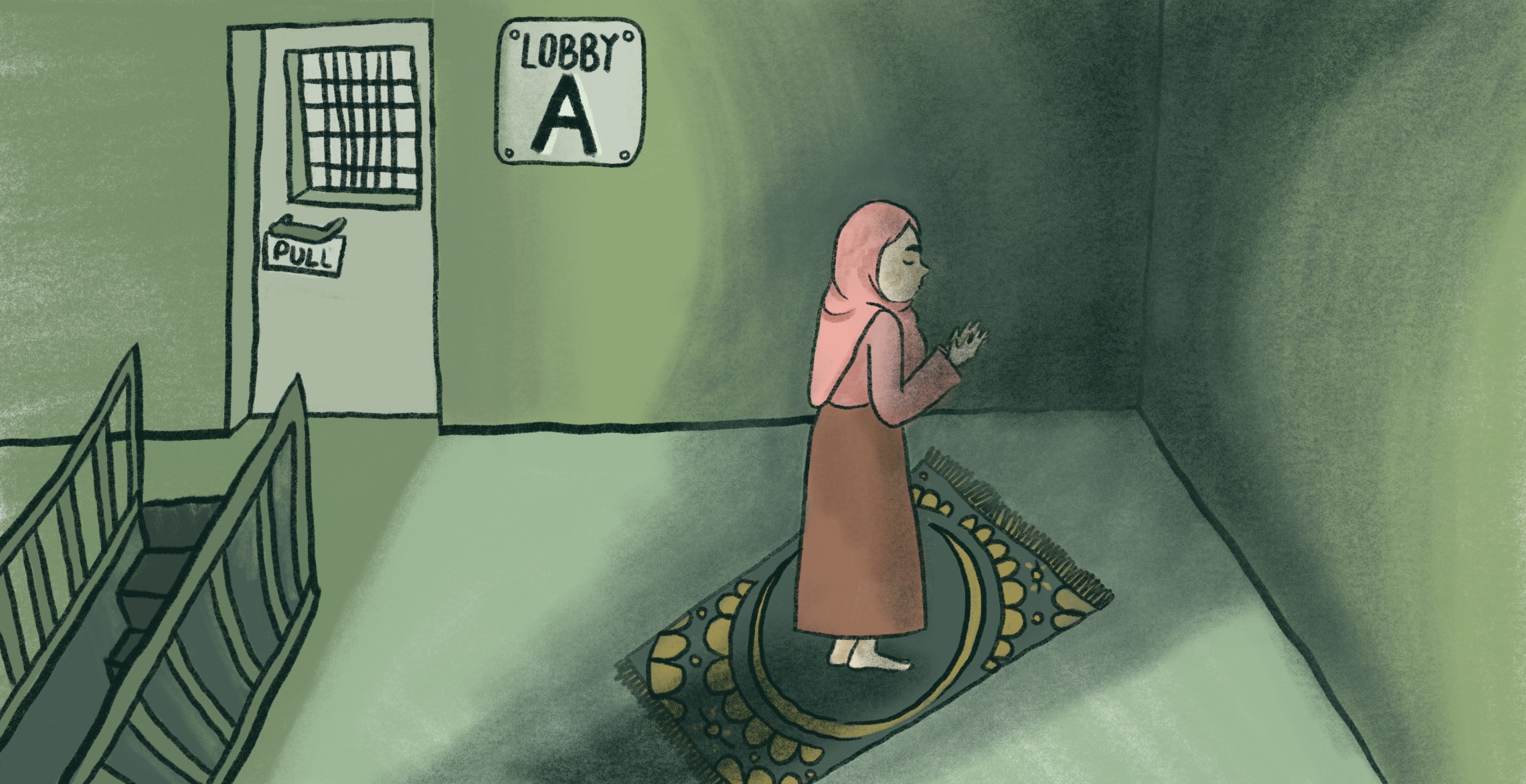
    Then how come there is this compelling need to hide the prayer space? Have you prayed? Is the deed done? Yes, I have. Near the fire extinguisher, at the last level. To be part of the minority race and religion in a country which recognizes the Islamic faith and its practices but still a worshipper of God can feel like a wrong piece of jigsaw puzzle. My name is Nook and my best friend, Cranny, have seen so many worshippers make themselves home for 10 minutes at a time. We have witnessed the quick as lightning prayer and heard the anxious mumbling or the re-doing of prayer over and over again. Sometimes a worshipper would knock his head on the fire extinguisher and we do not know if we should laugh or cry.

    Nook and Cranny, both of us are a democracy. We accept anyone not just the Muslim worshippers but others like the texters, those in need of respite and the smokers. Sometimes they are the same people. But often the people who come to pray get annoyed of the latter because of all the cigarette butts they leave behind. Nonetheless, there is not much of a choice. One day I heard a young tudung-clad executive exclaim that it is not that she does not want to pray in the office but the boss might think that she is not doing her job. Or that other Malays might wonder: how come she has so much time to pray? Or god forbid, what if people think that she is trying to show she is religious. So here with us, she feels that it is the best place to pray. It is a little dusty sometimes because the cleaning auntie does not come up all the way upstairs but they would bring their own colourful praying mats so it is alright. It becomes our duty to provide refuge and sanctity for the five to ten minutes that these people need.

    My friend, Cranny has seen a teenage girl restart her prayers at least four times because Katy Perry was playing over the speakers. She thought where there was not so much prying eyes near the mall staircase, she can pray in peace. Turns out there was the other battle for attention. In the name of God the most Beneficient, the most Merciful. Do you ever feel like a plastic bag? Drifting Through the wind. All Praise to the Lord of the Worlds. Where her prayers laced with song lyrics, it was a dubs mash she could not handle. She did finish her prayers eventually but did not always feel too good about it. Maybe it is good that you do not feel too good about doing good deeds. The things we tell ourselves. So you see, there is only so much that Cranny and I can do.

    Cranny and I both do not think that these people hoped to be catered for or tended to, like certain bumiputras in Malaysia we know of. But we hear the inner thoughts (or sometimes rather loud mutterings) of these secret worshippers that they wish they had an easier time. Sometimes, the management is thoughtful. They introduce a plastic divider or put curtains to mark or segregate a praying space. It becomes slightly better though some contorting skills have to be put into practice. Sometimes the prayers become too rushed because one always has to think of the other person waiting in line to pray. In some sense, it becomes like using the public toilet. Maybe it will not be beneficial to build prayer spaces in all malls or public areas considering the small percentage of Muslims against the larger community. Or there is the reason of already having grand and beautiful mosques, so why do we need more prayer spaces in public areas?  For every person who regards the church and state to be separate, there is another who truly wish that their love for God need not seem so forbidden.

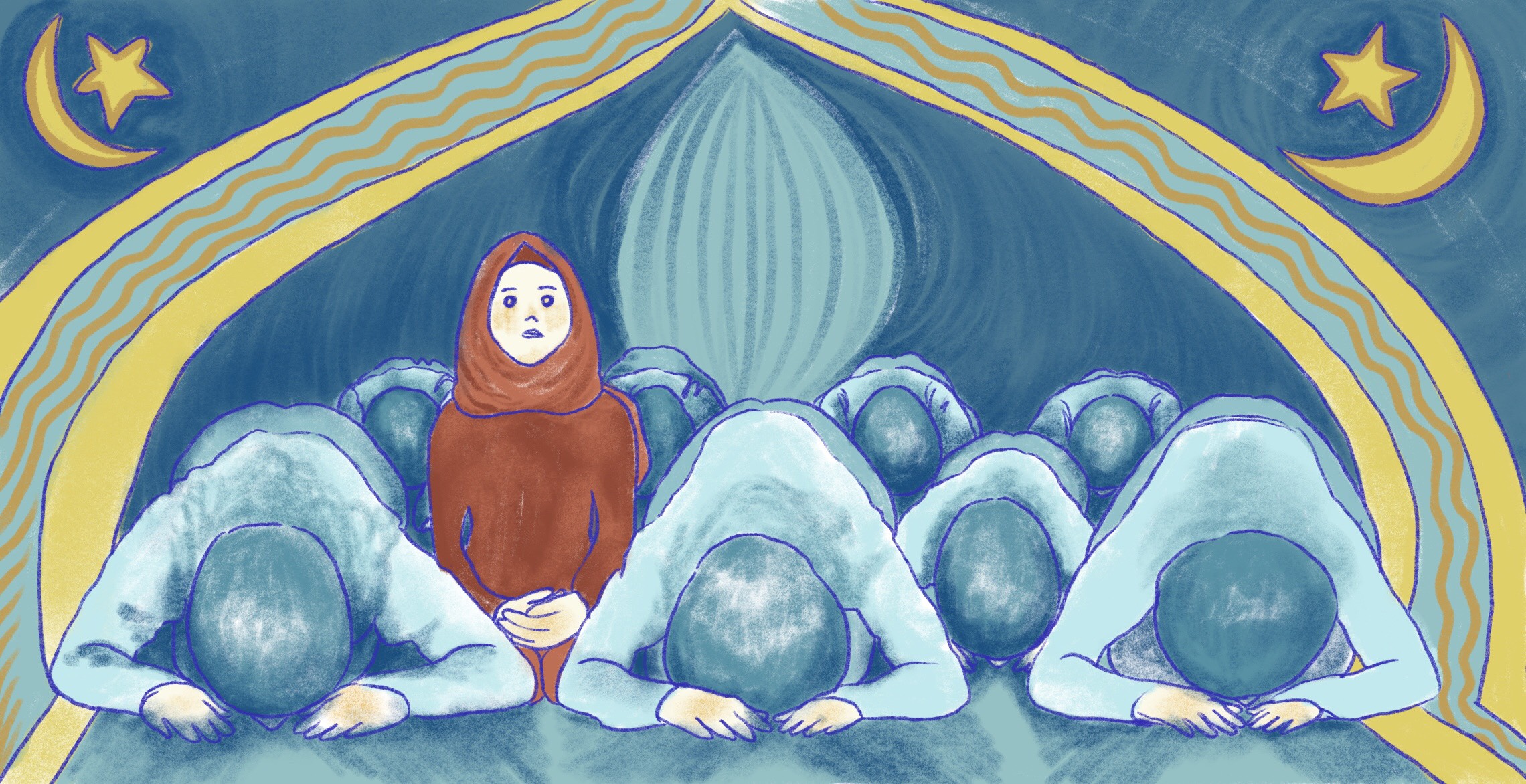
    Women worshippers have it bad. They can still already be in a mosque but not find space for themselves. Take Friday prayers for example. Everybody knows that it is the day men go for prayers and they dutifully do, dressed to the nines no less. But what about the womenfolk who want to celebrate the end of the week, or some may even call the Eid, or celebration of the Islamic end of the week. Many a time we see male gazes, darting at the sole woman worshipper who has come to bask in the words of God. And so these same males will occupy the said women’s section, leaving the women no choice but to be shoved into a corner or go home. There is much understanding about the compulsory nature of men and Friday prayers but what about these women who have come to seek solace. Female worshippers come to neighbourhood mosques on Friday afternoons only to end up being displaced and driven back to where people think they should be. Yes, the best place for a woman to pray is at home and the mosque should also welcome her if she wants to go. In the eyes of God, aren’t men and women equal guests?

    The prayer place of the woman is at home, really it is. Because there is nowhere else to go. No, a person cannot pray anywhere he or she wants to. Such a democratizing religion might not always manifest in its practice. So as a bulwark of peace, we, Nook and Cranny, will always be ready to accept the man and woman who craves peace which a legal space cannot provide. We are no man’s land. Like in an airspace. Blurred boundaries. Self-made rules. For the secret five to ten minutes, the worshipper is granted asylum.

    _

    Shaf Ghani writes short stories and poems. She started writing in exercise books at the age of eleven. They were stories about a colossal, metallic mansion with about a hundred rooms and stories about ants. More of her works can be found on shafikassanctum.wordpress.com.

    Illustration by Ishibashi Chiharu

  • Editor’s Letter: Religious Spaces

    Editor’s Letter: Religious Spaces

    by Diana Rahim
    _

    When I was an undergraduate, I don’t think I missed a prayer if I could help it. My university had a prayer room for its students. All you had to do was to bring your card to an office tucked obscurely in the basement of a building and requested them to allow you access to that room.

    Each time I had time to pray, I would walk to that prayer room located at the North Spine. I had no complaints. It was a good space with carpeted floors, a rack of prayer garments, and a small shelf of books. It was an upgrade from praying at the top floor’s staircase landing back in junior college.

    Then one day, while I was praying, I heard two girls talking loudly from the back of the room. Loud conversations have happened before, and they’re not that big a deal to me. What was more uncomfortable was the content of their conversation. In the safety of that prayer space, they were gossiping about a girl they felt was inadequate in her faith because she did not wear the hijab. They were judging her piousness in hostile tones. I tried to bring my mind back to my prayer but I knew it would be awkward when I take off my prayer garments. I was dreading the hostility they might have for me. The moment came. I took off my prayer garments and walked back to hang it. I retrieved my bag and left the room, which was far more silent and conducive for prayer now that the girls were no longer talking. They realised I did not wear a hijab and probably heard their conversation the whole time.

    After my initial feelings of upset passed, I told myself that it was probably just the both of them. I told myself most of the women I’ve come across probably do not feel that way. I told myself that because I didn’t want to assume the worst. Still, that feeling that I was not truly welcome has made me feel uncomfortable since. After a few more incidents, including at mosques, I prefer to pray alone at home where I can perform my ibadah without anxiety.

    I don’t think my experiences are that bad but I do think they reveal the kind of environment that exists today that can drive people away from religious spaces because they have been made to feel unwelcome. When people are driven away from such religious spaces, they are driven away from their own communities. It is a deliberate act of exclusion. It is an exclusion sometimes actively carried out by people who feel like they have the authority to deny people access to the house of God.

    What is notable about the experience I just shared is the fact that they felt safe gossiping while someone was still in the room. It revealed their assumptions about what kind of person would be in that space, or rather, who would not. They did not expect that someone who did not wear the hijab would even be in that prayer room. Remember an earlier submission to this blog by a Shi’a Muslim? She too shared about how she heard Muslims around her gossip about Shi’a muslims because they simply automatically assumed that everyone around was Sunni.

    It reveals the fact that spaces like these are easier to navigate and exist if who you are, how you look like, does not resist against the dominant image that good, reliable Muslims are expected to have.

    And of course, this is a conversation we have been having for a long time! I remember when I was younger an Ustaz shared with students how mosque-goers would sometimes refuse to stand beside bangladeshi migrant workers during Friday prayers, deliberately, and blatantly avoiding them. It made him upset, and he led by example by making sure to welcome them with a hug, talk to them, and pray beside them. The fact is that our mosques are not free from bigotry simply because it is a holy place. Humans are fallible. And when they come into the space, sometimes they bring their racism, their sexism, and other discriminatory biases with them. And sadly, those who are not within the status quo are made to feel it.

    We live in a world where certain individuals are given more space than others. When space is made more comfortable and more accessible to certain types of people, exclusion exists. It means that for those from a different sect, citizenship status, socioeconomic status, gender identity, etc, it is harder to access the same spaces. The restrictions, pressures, and lack of encouragement they face means that they have to work harder, bear more microaggressions, and little indignities just to occupy the same space. These spaces are not as open to them, and may even feel hostile, which in turn limits their participation.

    If you want to know if the religious space is truly inclusive, and truly reflects the ideals and principles of the religion it was built for, then who you should be looking at and talking to are the ones who are not included.

    In theory, for example, the mosque as a religious space is meant for all Muslims. It’s where they go to perform acts of ibadah (worship), and connect with their community. In reality, however, many women have expressed that they do not feel that it is a space equally made for them. This pertains not just to physical space, where women are often relegated to areas that are not as spacious or convenient as their male counterparts, but in terms of whether they have any say at all in the community, and whether their needs and concerns are addressed or even asked for.

    In 2013, Hind Makki kickstarted a global conversation in the Muslim community with her project Side Entrance. The project basically collects images of female prayer spaces in mosques all over the world. Some are comfortable, some are alright, and some are downright disappointing. In any case, the difference between male and female prayer spaces is undeniable. Accompanying these pictures, women shared their stories of sadness, frustration and difficulties when simply wanting to be in a mosque. In speaking about her project, hind Makki shared:

    “The main point (of Side Entrance) for me is that the spaces that women occupy in a mosque is actually reflective of the values that the community believes that they add,”

    In other words, whether someone is included in a space reveals the degree of respect that we have for them. It reveals whether we value their inclusion, their being, and whether we acknowledge that they can contribute something valuable to the community.

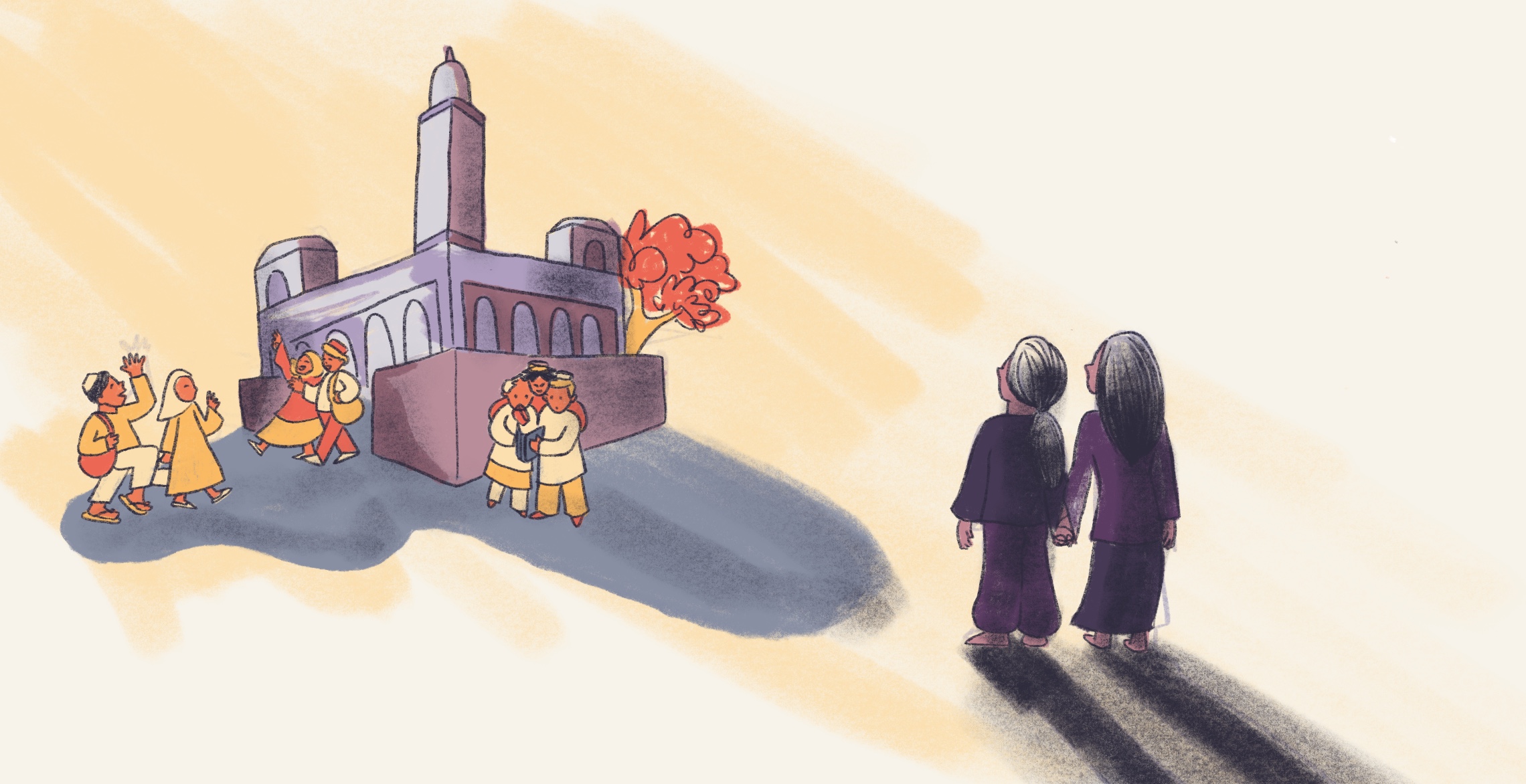
    I remember feeling really happy when I found out that the Waria community in Indonesia have managed to set up their own mosque. Finally they can have their own holy space where they can pray without being harassed, and where they know they belong. They can perform their ibadah and strengthen their relationship to their faith and to God. But in my heart, I find it sad that marginalized communities have to go through the difficulty of finding the resources to set up their own mosques just so they can have what so many Muslims take for granted. It’s sad that they have been prevented from simply being in a mosque, and that people were willing to prevent another human being from performing their ibadah, and made the environment hostile for another person. For me, it is unthinkable to get between someone and God when a connection between the two is about to be made. I don’t think God would appreciate us pushing away one of their creations from worship and connection.

    It’s important to mention that when we talk about “religious spaces,” it does not simply pertain to the physical space of the mosque or even the Muslim community. It’s also about whether there is space in dominant, mainstream religious narratives and culture for the presence, importance, and appreciation of those who are basically not just Muslim men. Is there space for them in positions of authority, in cultural spaces, in the family? Is their history told alongside the history of “great men”? Are religious interpretations done with them in mind too?

    And of course, it’s important to think about what kind of spaces are available when it is made available. For example, a benevolent sexism and the idealisation of Victorian ideals of femininity is often used to soothe and assure women that they have a special place in the culture. But this sends the message that only a certain type of woman is valued. It makes access conditional, far more conditional for some than it is for others. This is against the tradition in Islam where women are accorded equal dignity.

    The spaces we keep as a community says a lot about us. Who are included in our spaces, and perhaps more importantly who are not included, can reveal our actual values in practice, versus what we may insist our values to be.

    In the future, I truly hope that every Muslim who seeks to deepen their connection to their maker, to visit the house of God, and to participate in their religious communities can do so without any anxiety or feelings of inadequacy. I hope they can do so without feeling like they are unwanted.

    For the present, I hope that those who have felt rejection from Muslims can know that it is not rejection by God. That even if the communities may not, or even do not want to make space for them, that this cannot take away the connection they have to their maker.

    The beauty of Islam, to me, is in the fact that it was to be a non-hierarchical religion. That every person is equal before God, even if on earth they are not seen as equal to other human beings. After all, in the Qur’an, in Surah Qaf, we are given the beautiful reminder: We are closer to him than [his] jugular vein.

    And that is a closeness that nobody can take away from you.

    Illustration by Ishibashi Chiharu