Category: Love & Relationships

  • Love Confessions of A Villain

    Love Confessions of A Villain

    by Ham

    –

    I’m not sure from whom I heard it. Or perhaps it’s an amalgamation of different sayings and lessons throughout my growing years. The idea was that if you’re a good and pious Muslim girl, God will provide for you, even reserve the best future for you. Specifically, if you remain chaste, feminine and a God-fearing young woman, you will undoubtedly get the man of your dreams who will also be equally chaste, God-fearing and righteous to lead you. Your marriage will be filled with lots of love and a couple of kids down the road. Your life will be the image of perfection. In a way, you will be safe – you will have done everything that you were intended to do. You were put here on Earth to love, propagate and lead a pious life of worshipping God.

    You’re not a problem.

    This is in stark contrast to the only other alternative, usually shown in television dramas. The scheming, vindictive and non-religious woman who sleeps around or cheats on her boyfriend will undoubtedly lose out in the end. She will usually get into an accident due to karma (unless she repents in time). She is instantly recognisable due to her hyperfeminized features: beautifully exposed hair, layers of makeup and fashionable clothes. She always wants things to be done her way and the man to be at her beck and call. However, no matter how much she threatens or has major meltdowns, the villain will never find true love because she doesn’t deserve a man, let alone a prince charming.

    She is a problem.

    Growing up, I did my best to stay in line. Besides doing well in school, I didn’t indulge in the vices of stereotypical “bad girls” like smoking or drinking. I was a bit of a tomboy but as long as I didn’t cross some imaginary, arbitrary line of what is deemed too masculine for a girl, I was still within the safe zone. Sure, I had a few crushes and a couple of casual relationships while growing up but they never amounted to anything serious. It wasn’t until I was almost at the brink of adulthood, did I enter my first serious relationship. I had known him for years as a friend so it seemed a safe enough option. Back then, it did seem like I had struck the lottery. A tall Muslim boy who was filial, generous and kind. He wasn’t overly religious but considering that I was just as inconsistent with my own daily prayers, I was in no position to judge.

    A deluge of information that came after our honeymoon period completely and irrevocably shattered me. The first big blow came during one of our long nightly talks. I learnt that he was not a virgin. Looking back now it seems utterly ridiculous, but that knowledge devastated me. What did he mean we won’t be each other’s first if we married? What did he mean his mum and other siblings weren’t practicing Muslims? What did that make him? What did he mean he was conceived outside marriage or held the dreaded status of ‘anak luar nikah’? What will that mean for our future? How could he have such sacrilegious desires for me?

    Cue the dramatic music. Someone had flicked the villain switch in me.

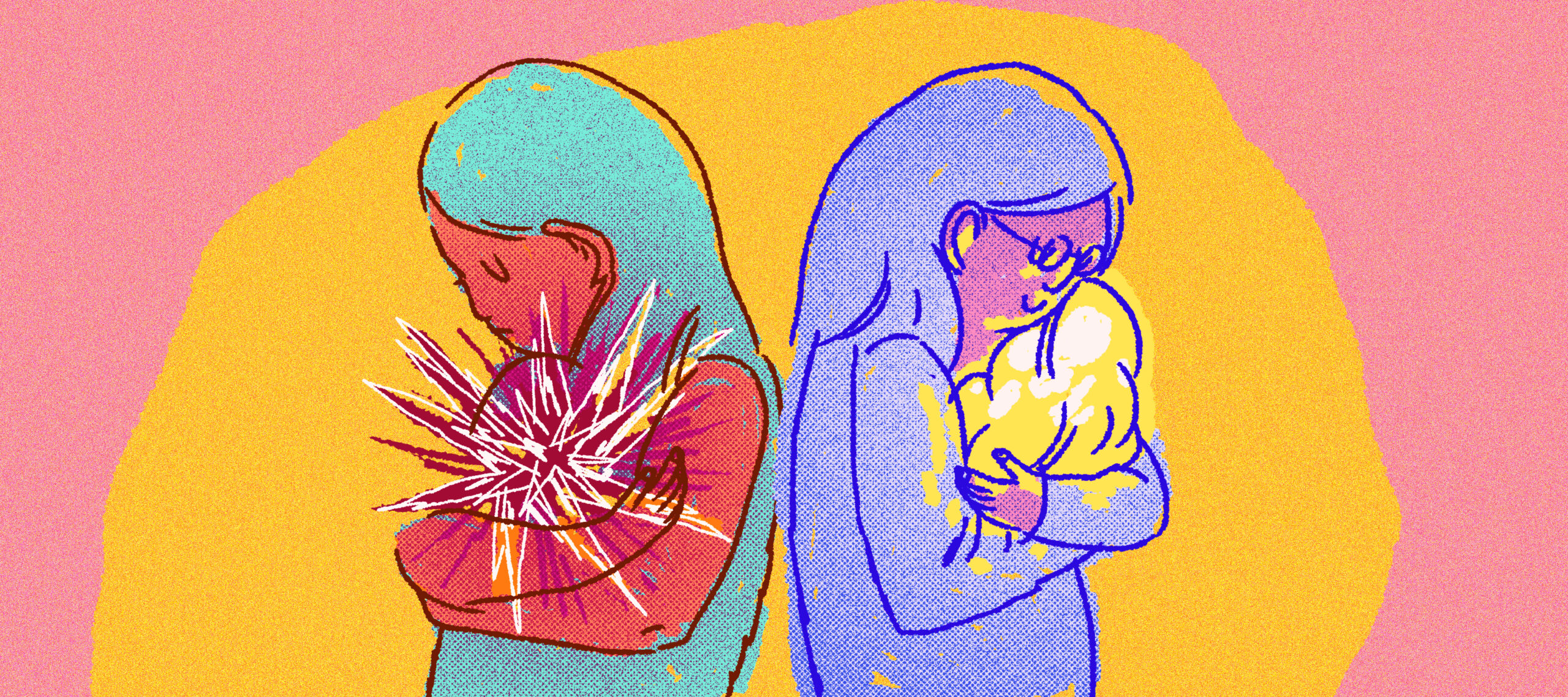
    Initially, it felt like the devil had pulled the wool over my eyes. My cotton candy fairytale dissolved in bitter tears. I transformed into one of those female villains in Malay dramas. I was demanding him to somehow change and bend him into doing things my way. I wanted him to change for me. The problem was, I wasn’t a villain. I was playing the role of the good girl. But I was outraged and in my mind, rightfully so. I had an excuse for my piss poor behaviour. After all, I had spent all my life staying true and being good. Where were my rewards? How dare he trick me into a relationship, knowing full well that he was no prince charming? How dare he try to taint my purity?!

    If I was an outsider looking in, I would be internally screaming for the guy to leave my judgmental and immature ass. Why deal with a crazy girlfriend who demands you attend religious lessons so you can ‘be a better Muslim’? Why stay with someone who was so hurtful when you were at your most vulnerable after confessing your inner most secrets? What a toxic, selfish person who clearly didn’t understand back then that there should be no compulsion in religion. Luckily for me, he didn’t leave me. Even on the most infuriating days, he stayed by my side with more patience than I could ask for or deserved. He allowed me to voice my concerns and criticisms and tried to explain the many other sides of our arguments. This is not to say that he was perfect. He had his many flaws because he was so very much human. We all are.

    Even as I write this, I still cringe and want to delete everything. But I won’t.

    I consider myself as an advocate for women. As a writer and occasional theatre practitioner, I want to make sure that marginalised female voices are heard. I want to keep writing about the misogynistic and patriarchal ways in which we continue to oppress girls and women. But I can also no longer ignore the fact that I was once on the other side of the fence. To keep writing about the victims in our society, we must also acknowledge that there are bullies and though this may be a bitter pill to swallow, if we grew up in such a society, chances are, we were once bullies too. We can be complicit in the oppression of others, even without realising it. It might have been unintentional but we might have hurt others in our effort to conform and uphold what we believed were the right values.

    There are so many types of relationships out there that are wonderful in their own ways. We really need to do away with this notion of a heteronormative fairytale relationship where we set nearly impossible patriarchal standards for both guys and girls to achieve. Why do we keep punishing ourselves? We must stop labelling, period. The moment we label ourselves as the ‘good guys’ in our narratives, we are also implicitly labelling others who are different from us as the deviants and villains. Why do we not promote mutual love, respect and understanding as the ideal instead? We also need to stop shaming and hurting those who do not conform. There is nothing wrong with anyone who isn’t a virgin, is gay or chooses to remain single. There is absolutely nothing wrong with couples without children just as there is nothing wrong with couples who have them. It’s fine if you didn’t marry young, really. Finally, it is not true that there is only one path in life or that all paths end up in a blissful marriage.

    It’s been years and the memories still haunt me on quiet nights. And there are many, many quiet nights. This is another thing that rarely gets talked about. We don’t really discuss the tempest of emotions left in the aftermath. Upon realizing how harmful it is to subscribe to problematic beliefs such as placing the value of a woman’s worth on her virginity, how do you deal with the anger, pain, disappointment and guilt directed at yourself? How do you heal from these self-inflicted wounds? I can spend the rest of my life fighting so other girls won’t have to go through this but I’m afraid I will always have, in the darkest recesses of my mind, voices whispering the old judgmental shit I was raised with. It will be take a constant conscious effort on my part to work against the old beliefs. Occasionally, I may fail, and that’s okay as long as I don’t give up.

    I hope that when you read this, you will keep an open mind and have the same patience and kindness afforded to me back then. I hope you will continue to face and overcome adversity and rigid, unhealthy traditions with lots of love. But let’s start by acknowledging the beginning.

    I was a problem.

    __

    With a BA (Upper Hons.) in English and a minor in Creative Writing from NTU, Ham spends her time coming up with stories in between gaming sessions. Her FYP focused on exploring the connection between the physical body and family relations through the lens of horror. 

    Illustration by Wan Xiang Lee.
  • Our Traditional Non-Traditional Marriage

    Our Traditional Non-Traditional Marriage

    by N

    My husband S and I would like to pride ourselves on preserving tradition… somewhat. We always ensure our home is all decked out and ready for major festivals. During the Chinese New Year season, red adorns the outside of our home, with chun lian to bring in great luck for the year. During Hari Raya, we put up dazzling lights you can see from miles away. But in many ways, people would say we are odd and do not fit into the confines of what they think a marriage should look like.

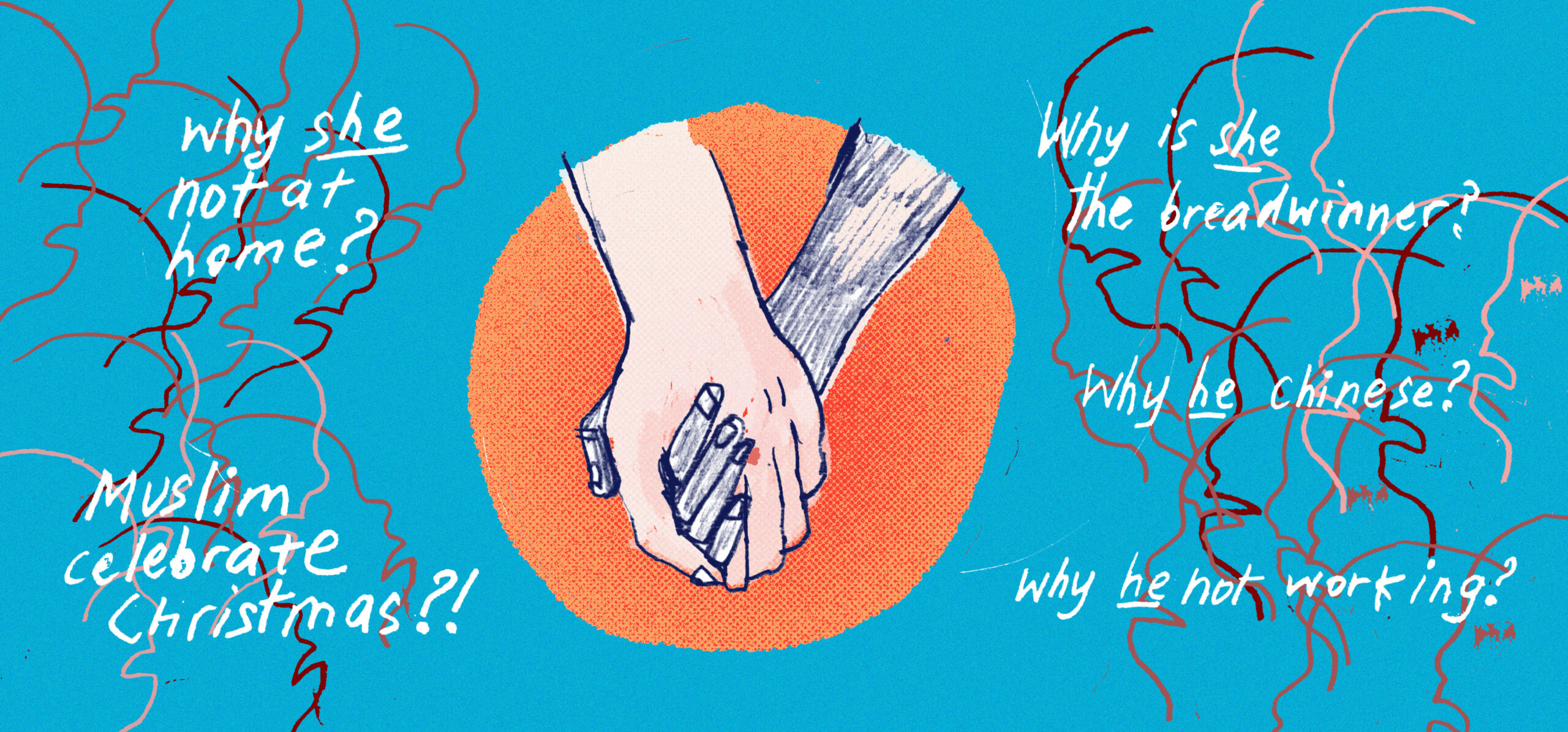
    For starters, S and I are a year apart. We got married really young. In fact, he was still in university. I have no issue supporting the costs of living such as the mortgage, bills and other expenses. S has also been great, working part-time to contribute to the household bills and does not mind not living up to his “manly responsibility” of being the main breadwinner of the family until he completes his education. We had discussed this prior to the solemnization and all was good between us. But we soon learnt that although this marriage is technically our bond, the whole society had somehow decided that they had a stake in it as well.

    Enter the pre-marital counselling session. Our counsellor seemed pretty nice at first until she found out about our little financial situation. She seemed genuinely horrified that I was going to handle the household finances. After a few moments, she composed herself and came up with a “solution” to our “problem”. I would simply take whatever S rakes in from part-time jobs and use that, and only that, to feed our little family of two. Of course we (okay, largely I) fought over this. Apparently it is simply unheard of for the wife to be doing the husband’s job of feeding the family! To allow that to happen is akin to him coming home and telling me I folded the clothes wrong and he should fold them instead! (I’m not kidding. Actual example used during the session).

    There have also been so many instances where people were genuinely shocked by how liberal we both are.

    “Your husband lets you go out with your guy friend?”

    “Does your husband know you’re out late?”
    “Yeah I texted to let him know”
    “But you need his permission!”

    No matter how un-traditional we may come across, we still do try to keep some traditions intact from both our families. For Hari Raya, we honour my family’s traditions by visiting relatives with my parents. S comes from a Christian family so we would get together with them on Chinese New Year and also for Christmas dinners to ensure we continue his family’s traditions. And this is where it gets complicated.

    We soon found out that the Malay/Muslim community as a whole held contradictory views on the celebration of festivals. It is encouraged, and even celebrated, when people of other ethnicities join in on our celebrations and take efforts to wear a baju kurung or greet others. But when a Chinese-Muslim and his wife decorate their house for Chinese New Year and have Christmas dinner with his parents, it is a cause of concern. From concerns about halal cutlery to ensuring we don’t get duped into going to church, there were a myriad of questions that had us giggling like 15-year-old girls. But still, we continue to embrace and honour the different traditions we’ve grown accustomed to.

    To us, a marriage is not just a union between two individuals but also a marriage of cultures and customs. It is very clear to both S and I that the moment he recited the shahadah, nothing changed except his status as a Muslim. We are also steadfast to the belief that marriage does not mean one person drops their background and identity to mould into the other’s family. For us, the moment our nikah was official was the moment we started building our family’s traditions and culture. Traditions that are uniquely ours. Our case might be a little bit different but as I tell all my friends; all marriages are comprised of two individuals from two very different households. No matter what, a marriage requires accepting the individuals wholly. There will always have to be discussions on what traditions, customs or norms should stay, leave, or be replaced. All families are, after all, just a unique blend of cultures and traditions that have been customised according to the couple’s preferences.

    So yes, we are the weird household that may confuse neighbours with the changing décor according to the change in festive seasons. We celebrate Hari Raya, Chinese New Year and Christmas with our families. We do not conform to the traditional idea of a Chinese or a Malay family but we would not have it any other way.

    __

    N likes to think of herself as a free spirit, in her very own limited way. After being married for 2 years, she tried her best to enjoy her own individual activities. This includes spending time with her cat and watching Netflix all day long.


    Illustration by Wan Xiang Lee.


  • Editor’s Letter: Love & Relationships

    Editor’s Letter: Love & Relationships

    by Diana Rahim

    How does one even begin to talk about love? It’s almost unthinkable. It’s like asking one to talk about a topic as fraught and as nebulous as “consciousness.” I am not sure I am exaggerating. I struggled for a while about how to introduce this topic, how to write this letter. But I realised that perhaps this nebulous way of thinking about love is part of the problem in the first place. It is almost instinct to think and speak of love as something essential, as a value, or as something innate in us waiting to be expressed. That’s why discourses on love can often lead to lofty essays or a philosophical exposition. They are obsessed in trying to explain love as essence; as some intangible force within us.

    However love is perhaps better understood not as something that is already there, but something that we have to create out of nothing. Love as created ex-nihilo. Love as a doing, a verb, not a noun (or at least not just a noun). The same goes, I suppose, with every other positive value such as being “good” or “understanding”. It is not enough to make a self-declaration, to say “but I’m a good person!” or “I’m understanding” and that perennial favourite even by KKK members, “I’m not racist.” These positive values are not proven by self-declarations but by concrete actions. Our being in the world necessitates relationships with others, so personal declarations are never enough. How we engage and affect other people bear strong judgement on our character.

    When we think of love then, let’s try to think of it through concrete actions. When I think of love, I think of my mother bathing me as a child during my high fevers. I think of someone drying my hair. I think of a support group that is a safe space for people who have been through trauma. I think of acts of communal love and service. I think of the act of apologising, the ability to go beyond the defensiveness of the ego. I think of the ability to listen to each other in the experience of hurt. In all of these instances, we feel supported, heard, and cared for. We feel ourselves valued as human beings. So when we think of love, we should perhaps think about the concrete actions we can take, and exhibit consistently in our commitment to being loving.

    It seems simple, but it never really is, because love isn’t cultivated in a vacuum.

    So when I think of love, I also think of the very real world within which love has to be cultivated and sustained. A world that sometimes gets in the way, prohibits or controls the kind of relationships that are valued and devalued. A world that decides what gets to be legitimised and recognised as love. A world that pushes a politics of desirability to decide who appears to be more lovable, or deserving of love, than others. Most of the submissions for our upcoming series deal with these challenges — the ways in which the scripts of community, society and even the script we are told to follow as individuals, can inhibit the true, more genuine expressions of love in favour of something that the prevailing order finds more acceptable.

    We receive different scripts sometimes about how love is supposed to look like, and they are almost always never innocent. Look hard enough and you can see the ideology that underpins the script, the ideology that seeks to be perpetuated through your very experience of love. Perhaps it is compulsory heteronormativity. Perhaps it is the belief that interracial coupling is not as “normal.” Perhaps it is even the insistence that a marriage is the goal of a coupling. It is important that we problematise received scripts not just because they inhibit our experience of love, but because it distorts the way we see and understand love.

    And then there is also the question of who, exactly, are promoting these scripts. Is it our families? Our ethnic communities? Our religious communities? The society at large? What justification do they have for deciding the rules that govern the kind of relationships we are allowed to have? Of course our family, our communities, would always say that they come from a place of love, and the prohibitions are set for our own good. So what happens if we were to disobey or cross over the limits they have placed? Often times, the individual can find themselves alienated from the community, not belonging or fitting in quite as well, or in the worse case scenario, even casted out and rejected completely. Sara Ahmed, in The Cultural Politics of Emotion had discussed how this “acting in the name of love can work to enforce a particular ideal onto others by requiring that they live up to an ideal to enter the community.”

    It is actually really sinister how love, this powerful force that is so deeply, personally felt, can be manipulated as a tool of control. After all, what can be more affecting, more powerful, than this fundamental thing that humans yearn for and cherish so deeply? What can be more psychologically threatening to a person than to tell them that love will be withheld unless they behaved properly?

    *

    It is scary how difficult it can be to detect when love becomes toxic. When we find it so difficult to let go of a relationship we are holding on to (and I do not mean just romantic relationships, but all manner of relationships), because we are convinced that it is good for us, that it is where love resides. It can be so hard to let go of love when we are told that this terrible thing is what love is supposed to look like. (I can’t help but think about how child abuse can often be dismissed as simply an ‘Asian’ way of discipline, or that it is in fact an act of love. This is believed despite there being no research to prove the usefulness of spanking as a disciplinary technique, but plenty to show how it breeds issues of self-esteem, bad behaviour, increases risk of mental illness, and promotes anger in both child and parent, amongst other negative effects.)

    Love is not always innocent, it can also be a tool of manipulation used to conceal pain and power under the guise of care. It is why abuse and manipulation can often be accompanied by the language of love with phrases like “I was doing this because I love you” or “I was only trying to help and support you.” In each of these cases you are posited as the person that stands in your own way to being loved.

    Of course hidden behind this veiled, complicated play of power is the fact that the terms of the relationship, or what is constituted as love, is being disproportionately decided by one party. Power feels entitled to demand that you act in a certain way. It can reject any other form of love other than its own. You would think: if I behaved right, in the way they wanted, then I would receive love, then this relationship could be fulfilling.

    The way love can be used as a weapon, or the way the language of love is utilised, often ends up re-directing blame to the very people that are suffering. Not only that, it can even posit the ones who are abusive or hateful as the ones who are ‘loving.’

    Sara Ahmed had noted that hate groups often branded themselves as groups premised on love. White supremacy groups did not see themselves as hate groups, but groups that were guided by their love for the White race and the Aryan nation. They would even quote a biblical verse “Love thy neighbour of thy people,” following it up by saying “My people are white.” Think also of the rhetoric that vilify vulnerable communities such as migrant workers or refugees. Someone might justify their hateful views against them by saying that migrant workers or refugees can threaten the safety of our women, our children, and of course, that great big love of all loves in this age of nationalism, the nation.

    Through a discourse of love, even hate can be twisted into love. This is why love, its language and the dynamic of relationships, always have to be understood critically.

    So in your relationships, in the practice of your love, perhaps it would be a great help to be self-reflective and critical. Are you free? Are you given the option to be free? Do you give that option to the other party? Is anyone less able to set the terms of the relationship? Is the relationship genuinely giving you feelings of love, of being cared for? Or is it instead insisting that you are loved, while your actual feelings border more on anxiety, a lack of self-esteem, and a sense of rejection of your self?

    In a healthy relationship, power cannot be exercised at the disadvantage of anyone. You have to be an equal participant. This means that true love is not present without justice. There has to be freedom in the exercise of love. It is not something that should be coerced, demanded, or guilted out of you. This is true not just in our romantic or personal relationships, but also the relationships to the things that are important to us such as our families, our communities and our faith. That famous line in surah Al-baqara “there is no compulsion in religion,” is popular precisely because deep inside we know that love and relationships cannot be forced or imposed, at least not if it’s going to be genuine. Love can keep you in line, but it should not hold you back. It can give you constructive critique, but it should not tear you down or invalidate your very existence.

    Knowing this, the question we can ask moving forward is how do we ensure that there is a healthy expression of love in our personal and social lives? How do we make sure that the relationships fostered in our communities are not ones that are coercive, unreasonably demanding or even abusive? How can we learn to recognise when what presents itself as love is actually harmful and toxic? How do we develop the ability to leave toxic relationships? How do we create alternative systems of support and care for those who have been casted out? Essentially, at the heart of all these questions, is the question — how can we learn to love each other better?

    __

    illustration by Wan Xiang Lee

  • Malaysian Dramas: Put A Ring On It

    Malaysian Dramas: Put A Ring On It

    By Ham

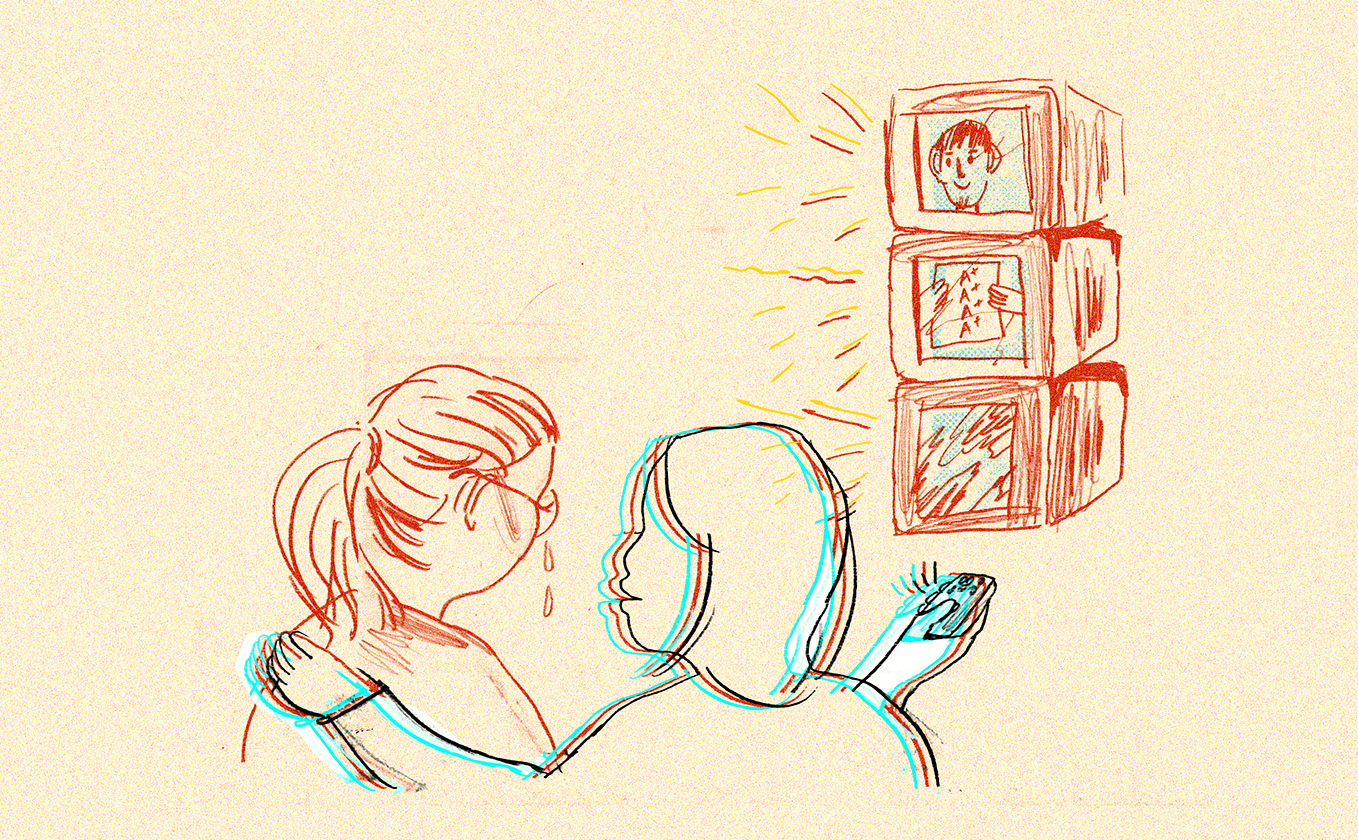
    It’s barely ten minutes past seven and I’ve already lost my appetite. It’s taking all of my willpower not to throw my dinner plate at the screen. My mother is seated across from me, passively taking in the sight.

    The female lead argues in a half-assed manner, “If you can’t respect me as a woman, then respect me as your fiancée.”

    I stab my piece of chicken. I want the leading lady to stand up for herself. Tell the man that if he can’t respect her opinions and trust her judgment, he can always leave. I want her to know that respect should be given to all, regardless of marital status.

    “I’m going to be your husband so if I say we’re going for a honeymoon, we are going.”

    I’ve murdered my chicken. My mother says nothing but the annoyance flickering in her eyes is evident. It’s a scene we know too well, both on and off screen. How many times have we heard that excuse used to normalise coercing a woman into submission, even if she had very valid reasons for protesting in the first place? The belief that the husband’s word is law is often taken literally and in isolation, forgetting that Islam also decrees compassion, respect and mercy towards the wife as well.

    The local channel imports Malaysian dramas with suspiciously gooey titles like ‘Rindu Awak 200%’ and ‘Dia Semanis Honey’. The shows are given close to half of the prime time slots from 7pm onwards. Such shows espouse marriage as the solution for a variety of problems ranging from the fear of tarnishing a family’s reputation to preventing pre-marital sex between young couples. This is justified with religious quotes on how marriage is noble in the eyes of God. Marriage becomes the endgame, ignoring the fact that a ring on the fourth finger doesn’t work like a fairy godmother’s wand. You cannot just slip on a wedding ring and expect to be instantly swept up in some earth-shattering love that solves any crisis while gaining absolute understanding of not just your spouse but his/her family as well. If that’s the case, we can easily attain world peace just by wearing rings.

    There are only so many times a person can roll their eyes. Instead of merely doing eye exercises during dinner time, I’ve also created a list to count how many common tropes a show can squeeze in before I massacre my dinner:

    • Is it based on a novel aimed at young readers? Check.
    • Does it have a title that revolves around love or defines a woman based on her relationship with a man? Yes, check.
    • Does it strictly involve heterosexual romance? Check. God forbid anything else.
    • Are good, chaste girls represented by their tudungs matched with nude or pale makeup while their scheming female counterparts are dressed in tight dresses with bold lip colours? Check because good girls shouldn’t stand out and fashionable women were simply asking for all the bad things that happen to them.
    • Is there a fair-skinned heroine who prays regularly? Check. There’s no such thing as a dark-skinned heroine because only fairness is beautiful and virtuous.
    • Does the girl give up her dreams to stay home and take care of the family? Check again.
    • Is the heroine forced, due to circumstances or by the people around her, to marry someone she barely knows? Definitely check.
    • Is her husband the son of a datuk or a rich businessman? Check. There’s no fantasy greater than money.
    • Does the show remind the audience that the husband is practically god-like in a marriage and his word is law? Do I need to say more? Check!

    A typical Malaysian drama would have more than half of the items on the list. It’s a bonus if the show actually checks off everything.

    It’s dangerous to think that these are just harmless entertainment. They are being widely disseminated during prime time on a free-to-air channel. Not only do they have a wide-reach, but the devastating and misogynistic messages they send out have very real life consequences.

    I’m not accusing the shows of lacking anything praiseworthy. On the contrary, it’s heartening to see more females represented as aiming for or already achieving tertiary education and building careers. Increasingly, female characters are more certain of what they want in life and a future partner (even though they always succumb to marrying the guy in the end). They are also less afraid to voice their opinions.

    However, the fact that such shows tend to present themselves as family-friendly stories that extol positive virtues aligned with Islamic teachings disturbs me. These characters are presented as the ideal: beautiful, rich, pious and a whole lot of drama. However, there’s absolutely nothing friendly or Islamic about coerced marriages or the way the wives are treated. To promote love blossoming after marriage to someone you just met isn’t just naïve, it is potentially dangerous. After all, in most cases, the woman has to move out of her house where she is separated from her family or immediate support system while being subjected to the whims and fancy of her new husband and unfamiliar in-laws. What if her husband is abusive? In the popular ‘Hati Perempuan’, a husband publicly admonishes his wife for wanting to take morning-after pills (note: she hasn’t taken any yet). He refuses to listen to her reasons while calling her dishonest and branding her as a disappointment. To add salt to the wound, he uses religious quotes to justify this emotional blackmail. In the end, the wife accepts the blame, going so far as to apologise to her in-laws. There is nothing romantic about emotional abuse. More often than not, in real life, this can lead to other kinds of abuses and the victim is trapped in a vicious cycle. Victim-blaming is dangerous and helps no one.

    Many years ago, I watched a show where the new bride stayed up for three consecutive nights to avoid consummating her marriage to a stranger. By the fourth night, she collapses from exhaustion and her husband rapes her. Yes, rape. Any sex with an unwilling individual or one who is unable to consent is rape regardless of the context. Yet this is presented as acceptable, even kind on the part of the husband because he is gentle when he tells her in the morning that she needs to shower.  To have sex with his unwilling wife is regarded as his right. Despite having been violated, the bride is supposed to willingly accept that they are now officially husband and wife. It is worrisome to know that these shows are endorsing such abuse and normalising violence against women.

    For real-life victims, such scenes don’t just trigger fear, they re-inflict trauma. It is unbearable to watch flippant depictions of assault because such portrayals trivialise their experiences. Worse, this can be damaging to their well-being as women are implicitly taught to accept the abuse in silence.

    Throw in as many tudung wearing characters or prayer scenes as you want. Such visual symbols do not and cannot hide the fact that such stories are reprehensible on many levels. Women shouldn’t be emotionally blackmailed into marriage. It is no fault of theirs if a groom has cold feet on his wedding day. It is unjust to expect a woman to bear the burden of the man’s cowardice or find a solution. Neither is marriage a solution to anything. Why do we keep equating marriage with ultimate happiness in life? Why are we constantly taught to blame women? More importantly, why are wives portrayed as less than human without control over their lives or bodies? Why do we teach men that it is romantic to take charge by dismissing and belittling their wives? That they can make up for all the abuse with a bouquet of roses? A wife is a partner who has rights, not a slave chained to the kitchen stove. Prophet Muhammad encouraged manumission of slaves and his first wife, Khaddijah, was a successful businesswoman. He respected his wives and even consulted his second wife, Umm Salama, in the treaty of Hudaybiyya.

    I get it. Many Malaysian dramas are selling a fantasy. The whole idea of stumbling into the arms of a handsome stranger on the street who turns out to be a rich Datuk keen on marrying you is the equivalent of a modern fairytale. But what if that fairytale discriminates against women under the guise of Islam? I’d rather wear a magic ring on my finger.

    Photo credit: Indra Gunawan

  • The Gift of Listening

    By: Diana Rahim
    [Transcript of speech given on International Women’s Day 2015 in Hong Lim Park]

    Imagine the 1960s. Everything around you is heavy with the scent of tropical heat and greenery. Somewhere in the village my grandmother directs men to carry the furniture from the house into the truck that would drive their possessions to the family’s new home. My grandfather came home from work to this scene. He wasn’t informed. He had not wanted to move but my grandmother had planned it anyway. Dumbfounded, all he could do was follow.

    In my mother’s stories about my grandmother, there is rarely talk about how the women of the time were beaten down by society or their husbands. How they were forced into marriages with men twice their age they barely knew. Instead, she always spoke with awe about these moments of assertion from her mother. How she yelled at her husband when she found him incompetent or how she singlehandedly planned their move when he refused to leave the village during a dangerous racial riot. My grandmother was always in my mind an image of peacefulness. She was gentle, but she was also a woman who knew how to find power in whatever spaces left for her, collect them, and wield it when necessary. Especially when it came to protecting her loved ones. She learned from her mother.

    My great-grandmother was a fiercer woman. At her time, she divorced her husband who refused to get another job that would sustain her and the kids. She wasn’t afraid of stigma. At 40, she lost her 12 year old son, marking a significant spiritual turning point in her life. She turned her pain into something beautiful. Throughout her life she was stubborn in her willingness to love and forgive even the people who pained her most. There were times when this seemed a weakness, simply because she looked so pitifully frail and broken when she cried. She allowed herself to be openly vulnerable. Yet, she also had a fiery temper and blistering sarcasm. She contained multitudes. She wasn’t afraid to be all of them. I know now how brave she was to show to the world her gaping wounds.

    Whenever I applauded their moments of speaking up to their husbands or taking charge of a situation, my mother would always be quick to add that women at their time were still treated badly. The only reason why these moments were compelling was precisely because they were subversive. Because they weren’t treated as equals. One musn’t mistake the replication of power, silencing or putting down another person, as empowerment, even if women are the ones doing it. In fact, if women are doing it to other women, it is a real problem.
    The struggle for women’s equality is diverse. Ideally the multiple struggles by everyone they happen side by side, in solidarity. But in reality there is a hierarchy happening because there are factors that position women differently. Race, class, sexuality, where you live. Etc.

    For example, I can’t speak women’s issues without also talking about my race. Growing up malay, I knew too many girls who did not feel fair enough for beauty. I knew girls with whitening creams in their pockets, aspiring to fairness that they saw in their chinese classmates. In the context of the Muslim community, the only women’s issue that seems important enough to be discussed all the time is modesty or the hijab or whether you’re a “real muslim” or a “practising muslim” if you don’t dress accordingly. It’s not that these things aren’t important, but it’s telling that these are what are talked about most rather than domestic violence, marital rape or single mums.

    It’s important to think about this in the context of Singapore. Whose voices are shouted over and whose are prioritized? Whose experiences are triviliazed or forgotten? Is our ‘empowerment’ built on the suffering of other women? Like the archetypal strong, businesswoman who is a paragon of female power but has a domestic worker she pays below minimum wage and doesn’t bother to talk to. Do we listen enough to the other women in our lives, the ones who do not speak? Do we give them space to speak? This was why I wanted to talk about my late grandmother and great-grandmother instead of myself.

    There is so much we can learn when we are willing to listen to the women around us. My grandmother and great-grandmother for example taught me how power needen’t be something violent or assertive. It was also the willingness to be vulnerable in a world that punished it. Theirs was a soft kind of power, and I hope they passed it to me by blood.