Category: Essays

  • Apa salahku?: Unpacking Narratives around Domestic Violence in the Malay-Muslim Community (Part 2)

    Apa salahku?: Unpacking Narratives around Domestic Violence in the Malay-Muslim Community (Part 2)

    by NH Rahman
    __

    This article is part 2 of a 2-part series that critically examines how the problem of domestic violence within the Malay/Muslim population is imagined. Read part 1 and if interested, the Full thesis including full citation list.

    Content Warning: This post discusses domestic violence and institutional understandings and responses to domestic violence. This includes mentions of victim-blaming, retraumatisation and procedures utilised by social services and the criminal justice system.


    How we think we can solve a problem tells us a lot about what we think a problem is. In the same vein, examining policy ‘solutions’ to domestic violence (DV) can be helpful, prying open what we’ve collectively imagined the problem of DV in Singapore is, particularly for within the Malay/Muslim population in Singapore. 

    I used an analytical method called WPR (What’s the problem represented to be?) approach to dive into an analysis of policy texts and solutions we hear commonly espoused to ‘solve’ or ‘prevent’ DV. I will use the term ‘problematisations’ here, which are basically the ways that a problem has been understood—though of course, it is not necessarily what the problem actually is. From there, we can also explore the silences within these problematisations of DV, and see where they fall short in factoring in the political, social and economic realities of the Malay/Muslim population.

    “Counselling for anger/conflict management”

    Family, couple’s and individual counselling is regularly offered as a policy solution to addressing DV. Some of my interview participants spoke about counselling as a solution that works to emotionally regulate men who abuse and as a remedy that can potentially stop abusive behaviours, while others spoke about the restorative effect of counselling for marriages. 

    A few participants discussed how men’s abusive tendencies could come from ‘anger management’ issues, lack of psychoeducation on men’s roles as husbands, and men not knowing that DV is not a good solution to their problems or ‘conflicts’. Similarly, outreach efforts by MSF to “detect signs” of DV discussed the “importance of…the ability of individuals to manage conflict”.

    I believe anger and conflict management as a solution to end or stop DV problematises individual psychopathological issues within DV. As a natural continuation of this problematisation, DV then ends up being reduced in our collective understanding. It is wrongly or reductively represented as, perhaps, a problem of male anger, of conflicting parenting styles, of family conflicts and tension, of couples’ quarrelling and disagreements, of poor communication, financial insecurity, or even the result of retaliation from women experiencing DV.  
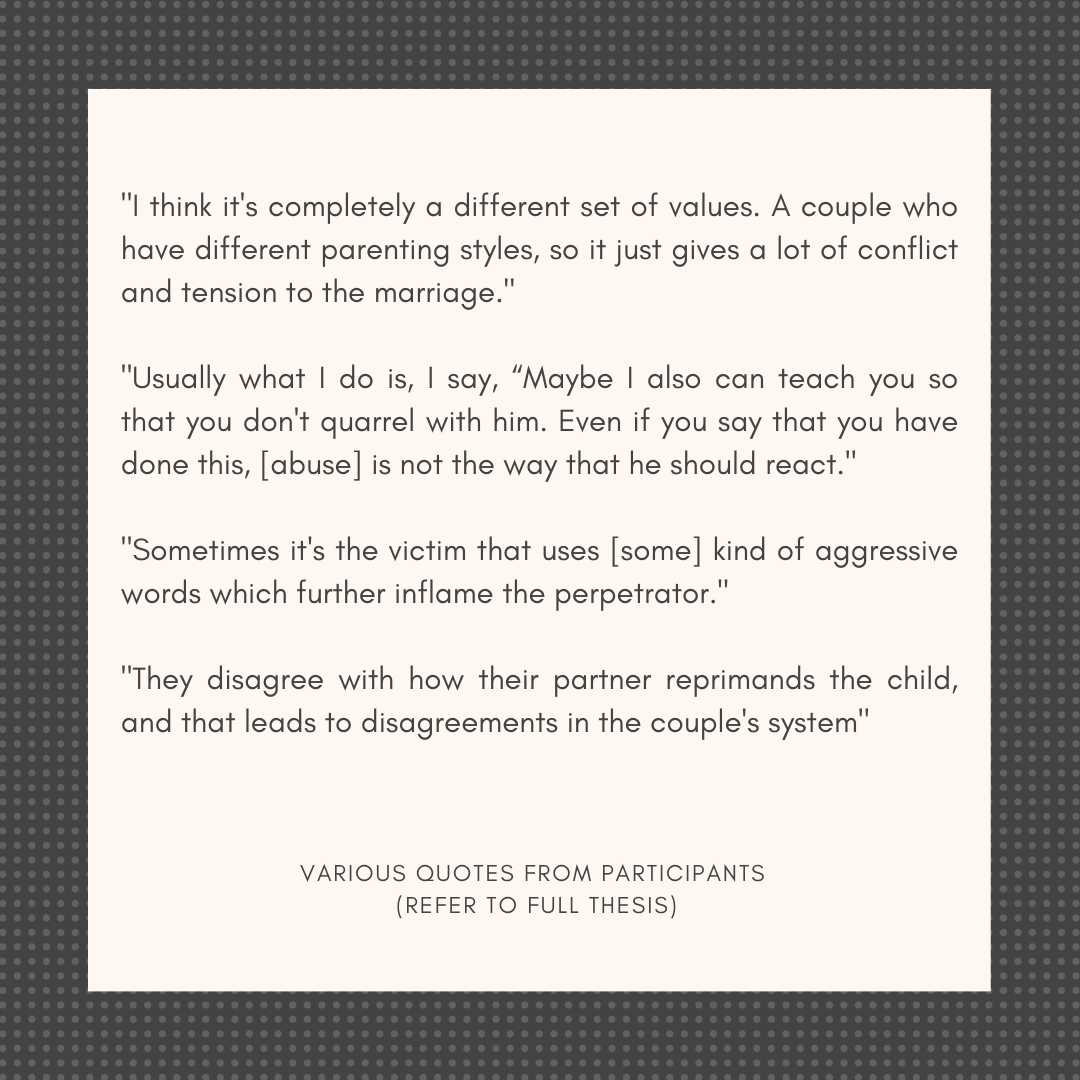
    While these examples could also be excused as a matter of conversation style or simplicity in participants’ choice of words, if taken at face value, these problematisations inadvertently flatten the power imbalance in abuse. They also paradoxically presuppose how DV is a problem of lack of control or power over one’s emotions, rather than the deliberate use of often patriarchal power and control over others. 

    In the MSF video campaign, Break the Silence (BTS) (2016), DV can be seen—through marks and bruises on the body—or heard—through pained screaming, angry yelling, verbal harassment or otherwise vocal forms of resistance and expression.  

    This is an unsurprising yet unfortunate outcome in our discourse around DV, given how policy documents, including social service websites, do little to name patriarchal power and control as a major root of DV. When these forces are not extensively or visibly addressed or identified, patriarchal violence is then also presented simply as learnt behaviour that individual men pick up. When policy solutions represent DV as something abusers do to address a problem, they may inadvertently place the blame on those experiencing DV, by assuming that an issue that causes a violent or controlling response is something people who are abused can ‘solve’ one way or another.

    Furthermore, what this ends up doing is neutralising the power imbalances in gender roles which do not resort to violent and controlling behaviour. The subservience of women, girls and children that does not correlate directly with DV is made unproblematic, or inevitable, as a result of the silence. It represents DV as a problem that individual, ‘angry’ men use to exert power and control (an imagination we need to recognise is subject to racist stereotypes of brown or Muslim men as well), and in the absence of acknowledging patriarchal power relations in our systems of organisation, assumes patriarchy as otherwise a benevolent force.

    “Raising awareness” 

    [youtube https://www.youtube.com/watch?v=ZiH5zXPvdPk&w=560&h=315] 

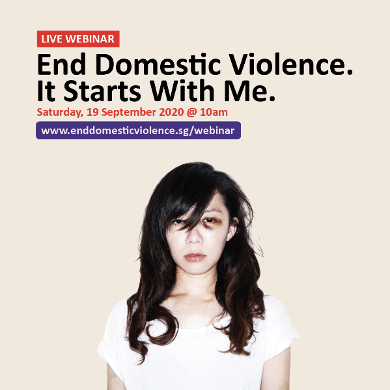
    End Domestic Violence, a more recent anti-violence campaign, addresses how non-physical and non-verbal forms of DV are equally crucial to address (official website is currently down). However, representations used in ads for the campaign still prioritise representing the physical aspects of DV. 
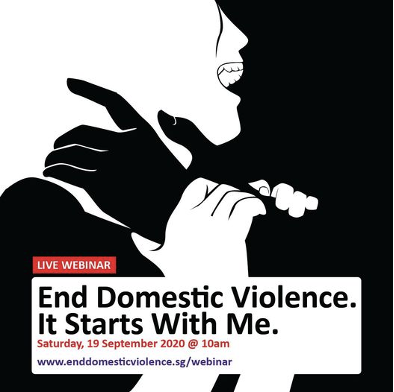
    Beyond these campaigns the spotlight on physical violence is often seen in the headlines, images and illustrations of mainstream media reports on DV.
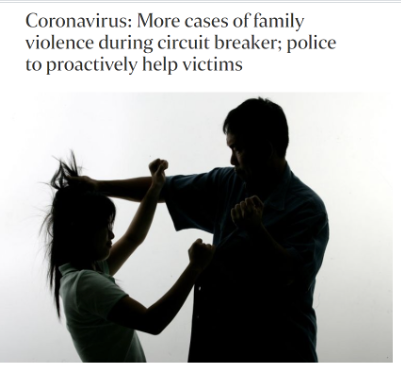
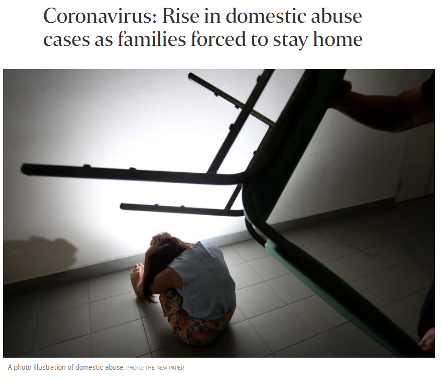
    MSF’s educational resources and social service websites such as PAVE’s briefly mention the non-physical and non-verbal aspects of DV, but much of the representation privileges support information for those whose experiences centre on physical violence: get a medical examination, apply for PPO and go to a crisis shelter, with “counselling” being the typical exception. This is consistent with how shelter policies admit mostly women who have gone through physical violence, and the difficulty of PPO applications for psychological or emotional abuse. The language of DV as ‘incidents’ is often used, imagining violence as emotional eruptions that can be tangibly pinned down as events.

    These problematisations ignore the elements of power and control, the relational pattern of DV, and even the psychological or emotional aspects of DV, which are harder to single out. Coercive control, which does not necessarily have to “resort” to physical abuse or verbal denigration, is then left unproblematic. There is also overwhelming silence about the ideological forces that uphold DV, particularly patriarchal violence. 

    Moreover, the Break the Silence video series represent victims of violence as overwhelmingly silent or passive, as people who do not seek help, and thus need to be empowered enough to reach out. This imagination mutes the ways that women do resist: using personal strategies such as prayer, seeking support from friends and religious leaders, going through laborious processes with social services and the legal remedies, and attempting to be financially secure.  

    With this collective representation of DV, the problem then becomes focused on “an individual level of analysis”, viewing DV “as a problem that resides within individuals” (Salazar and Cook, 2002, p. 418). Ultimately the pattern of how DV operates as a social and structural problem, and the landscape that it happens in, is erased.

    “Equipping bystanders” through public education

    In the Break the Silence campaign, bystander intervention is, quite literally, the final scene in narratives about DV. Videos end dramatically with people interrupting violence, and we are left to assume that the intervention went successfully to end the violence once and for all. 

    The process of the intervention, the considerations that women make, and the way State systems are able to support women are unquestioned. These representations portray DV as something that will continue unless bystanders interrupt it (placing the responsibility on romanticised ideas of ‘community’), and will immediately halt or de-escalate when there is bystander involvement (which reveals a belief that all interventions are good interventions).

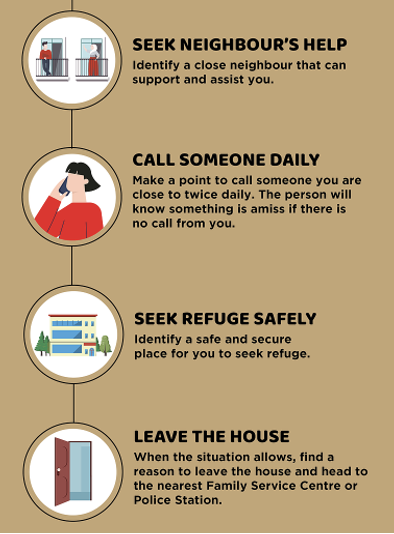
    Similar to Break the Silence’s campaign angle, much of End Domestic Violence’s focus is on the actions that those experiencing DV can do to minimise the impact of violence in their homes, and bystanders can do to support them. 
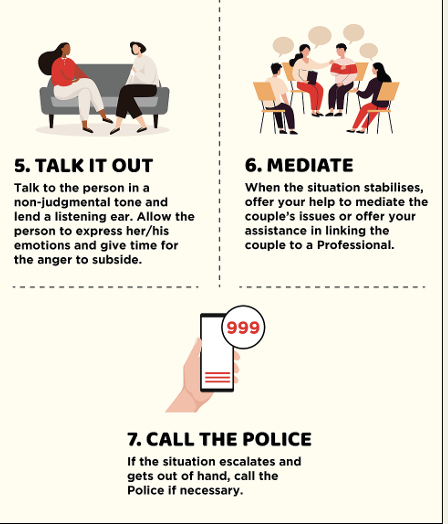
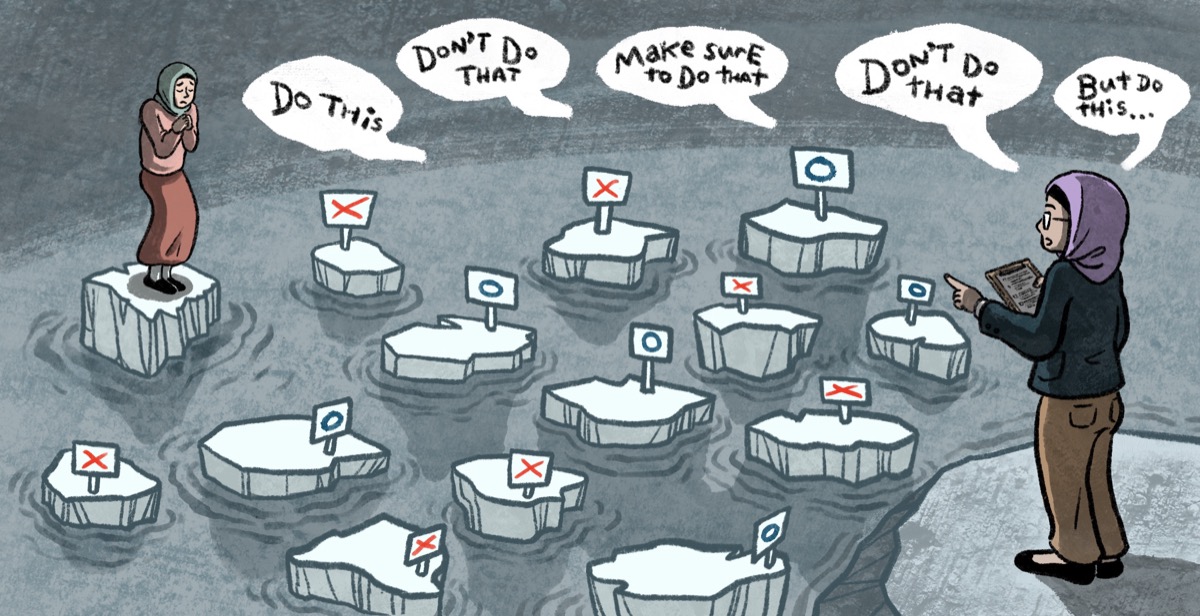
    Although more nuanced than Break the Silence, the representation still emerges in simple lists of superficial dos and don’ts, revolving once again around noticing physical and verbal signs. The solutions are similarly limited to “calling the police”, listening and empathising, and accompanying people to the police or family service centre.

    What these approaches do is assume that bystanders already have the information, skills, principles and ethical values required to end DV. But mediation efforts veer towards maintaining the status quo, typically for the purposes of restoration or reconciliation. Given the dominant discourse and policies that support patriarchal, nuclear families, is it reasonable to expect communities, particularly under-resourced and politically weakened communities, to mediate a couple’s ‘issues’ without reproducing values that cause further harm to women? It is also dangerous to view physical intervention as a catch-all solution that will always lead to de-escalation, especially considering how women have reported that family intervention can cause abuse to, in fact, escalate.

    Amidst all this, there is silence in the way the State and services continue to enact indirect violence and oppression on families as they attempt to wean themselves out of abusive relationships. It is however painfully consistent with the State’s principle of family—and sometimes community—as the first line of social protection, rather than the State, and the privatisation of the problem and solutions of DV. This way, the State maintains its role as advisory, with an end-goal of keeping the patriarchal family unit together.

    Religious and cultural counter-education

    Over the years, substantive effort has been put into countering common misinterpretations of religious texts that seemingly justify DV, including through targeted campaigning and asatizah training initiatives. Often, including in my interviews, misinterpretations of religious texts is identified as one “source” of patriarchal violence against women, presupposing that religious values (however distorted) in and of themselves may be what causes men to use violence. 

    The privileging of the role of Malay-Muslim “culture” or religion is also seen represented in training programmes organised by government institutions. One NCSS training titled “Understanding and Working with Malay-Muslim Clients” works to focus on the “multi-faceted nature of Malay-Muslim culture, in allowing social work practitioners to attain in-depth awareness and understanding when working with Malay-Muslim clients”. 

    Based on the policy text alone, the problem representations demonstrate at least two assumptions: that differences with working with Malay/Muslim clients are largely cultural and religious (rather than in relation to other intersections such as socioeconomic oppression and marginality through ongoing coloniality that the Malay population face) and that religious, rather than structural, reframing is necessary for “change” to arise.

    This has the effect of essentialising culture and religion, and risks over-privileging cultural reasonings to social and political problems that emerge as a result of historical and oppressive forces that are far greater than the individual Malay/Muslim ‘client’.

    Thus, it is reasonable to see how culture and religion appear to be reduced to a set of attitudes, beliefs, misconceptions and dispositions that individual ‘perpetrators’, ‘victims’ and the ‘society’ hold, unlinked to the State structural conditions. This also works to represent wayward religious and cultural values within an ethnically minoritised population as major causes of DV, adding to a caricature of the Malay/Muslim “Other”.

    “Legal and criminal justice remedies”

    Common problematisations of DV assumes that its solutions lie in the shape and borders of the legal system: DV is presupposed as something that will be remedied or reduced according to whether laws change, and whether individuals are aware of their rights to police reports, PPOs and Magistrate’s complaints.

    Take the speech made in September 2020 by Minister for Law K. Shanmugam, where he announced the process of a White Paper on gender equality. The speech uses the language of “mindset change” and education, but there was also a description of violence being a violation of “fundamental values”. While this appears to be a promising expansion of the State’s problematisation of DV, there is little self-reflexivity involved: ‘fundamental values’ is described as something that must be instilled, with State leadership, instead of something the State needs to inject into their own structures. 

    In his problematisation, expanding the role of the criminal justice system—through stiffer laws and harsher penalties—is a given. It represents the State’s punishments as proportionate to the amount of harm caused by DV, imagining that penalties can actually end DV.

    Unfortunately, the silence in this problematisation is in the role of the State in enacting further structural violence on vulnerable families (e.g. through economic consequences on weakened, minoritised communities) and the emotional and material costs of seeking support from a legal system. 

    Criminal justice remedies sit uncomfortably given the reality of ethnic minority oppression within its system. There is no denying the intersection of class and race, and my interviews show how it operates within abusive households too.

    In DV cases, State violence and re-victimisation occur also through victim-blaming officers and professional first-responders, inadequate support from social services, lack of holistic, long-term support for those experiencing DV, the economic oppression that Malay and ethnic minority families struggle against, and the material effects on their wellbeing, health and livelihoods. Reliance on these remedies bolsters the racism, patriarchy and homophobia coursing through criminal justice systems, and promotes an individualistic approach to ending DV. As a result, we are left grasping at straws when trying to imagine community accountability strategies that transform social and community support systems.

    Conclusion

    Despite State campaigns and statements that on the surface articulate the belief that family violence is “not a private matter”, Singapore’s social policy solutions are still privatised. The State is positioned as a solution, with rational, advisory powers to fix DV, and distinctly separate from the problem itself. Our social policies represent DV within the Malay/Muslim population as a result of collective or cultural deficiency. 

    This is in spite of how representations of DV by participants and in first-hand accounts, instead, show that the problem is an echo of wider structural violence—the rippling effects of colonisation, authoritarianism, patriarchy and neoliberal capitalism. The tragic poetry of this can be observed in the details:

    Malay/Muslim women’s freedom of religion and faith practices are limited by men who coercively control them, and wield conservative interpretations of religious texts—an echo of how the State relies on patriarchal leadership and a paternalistic approach to govern the ‘othered’ Muslim population. 

    Malay/Muslim women’s freedom of movement is curbed by those abusing them, while the government’s social policies, social sector and criminal justice system supervise and police their only options for safety. 

    Women face violations in their autonomy in private and public spheres for instance, through clothing regulations: by men who determine what they wear, and a government that has justified prohibitions of the tudung in many job sectors. 

    Women articulate DV as violence that results from “disobeying” their husbands, espoused by religious leaders, while the State similarly legitimises “nushuz” in law, sanctions violence through messages within pre-marriage courses, doles out carceral punishments and regularly uses corporal violence against its own transgressors. 

    Devastatingly, our current system leaves in its wake an Indigenous population that bears the weight of a turbulent relationship with the State. Malay/Muslim women experiencing DV continue to seek trust and connection and resistance within their own politically weakened community, represented by a conservative leadership.

    Instead of simply creating DV policies and programmes, we must radically re-imagine and change the structures in our society, including how the “domestic violence industry” (Koyama, 2006) of NGOs and social services has co-created current problematisations of DV. 

    Ultimately, we need vigorous interrogation of taken-for-granted solutions to domestic violence, and to reimagine what long-term eradication and recovery can look like. Policy workers, politicians and advocates alike need to always reflexively ask themselves “what is the problem represented to be?” in any policy proposal, so that abused women are never taught to absorb the effects of their current lack of inquiry by, instead, asking themselves, “Apa salahku?” – what’s the problem with me?

    The solution to DV lies in the decolonisation efforts that can dismantle the violence of colonial structures. To end DV, the Singapore State has to critically confront its history and present, by recognising how it inherits mechanisms of control and stratification that the former colonial government employed, which has resulted in the marginalisation of the Indigenous Malay population.

    [Full thesis with a complete reference list can be found here]

    __

    Nabilah is a researcher, writer, and artist based in Te Whanganui-a-Tara (Wellington). Currently, she is doing research on how Asian migrants participate in Treaty of Waitangi justice efforts and movements in Aotearoa New Zealand. She makes art at nebula.art89.

    Illustration by Elisa Tanaka
  • Apa salahku?: Unpacking Narratives around Domestic Violence in the Malay-Muslim Community (Part 1)

    Apa salahku?: Unpacking Narratives around Domestic Violence in the Malay-Muslim Community (Part 1)

    by NH Rahman
    __

    This article is part 1 of a 2-part series that critically examines how the problem of domestic violence within the Malay/Muslim population is imagined. Please read part 2 when it is released! [Part 1 of 2]

    Content Warning: This post discusses domestic violence and institutional understandings and responses to domestic violence. This includes mentions of victim-blaming, retraumatisation and procedures utilised by social services and the criminal justice system.


    Almost a decade ago, I handed my mother brochures for an anti-violence campaign I was involved in. “Mama, tengok (look), these are the workshops I’ve been helping to run. Nak ikut (Want to join in)?”. She glanced at it. Perhaps the word ‘empowering individuals’ was on the brochure, perhaps it was how I sold the message. Either way, her response was, “Kenapa? Apa salah ngan Mama? (Why? What’s the problem with me?)”.

    I remember being struck by this, but its gravity did not hit me fully until much later. Her reaction makes sense. The solution you are continually offered shapes the limits of how you imagine the problem. 

    Conventional studies accept policies as neutral, rational solutions to social problems. But policies – everything from community campaigns to laws – have the power to influence and shape definitions, frameworks and representations. If the solution to end domestic violence (DV) is empowerment, the problem suggested is  that you are too disempowered. You are framed as the problem.

    This is part one of a two-part series summarising my study on DV policies in Singapore. I used an approach called ”What’s the problem represented to be?” to explore how the problem of DV within the Malay/Muslim population has been imagined (and its limitations). I interviewed professionals who work with families going through DV, and, later, analysed policy texts. Throughout, I argue that Malay/Muslim women’s experiences of DV are shaped not simplistically by what has been imagined as the problem (often assumed to be violence related almost solely to “cultural” or religious beliefs, practices, customs or laws). Instead, I argue that it is manipulated by capitalist, patriarchal, authoritarian and colonial governance that violates and restricts safety and health, through housing, welfare and social service policies that, together, uniquely affect the Indigenous population. 

    Examining the environmental and historical context

    Domestic violence cannot be fully understood without looking at the greater environment it sits within. We need to consider not only Malay/Muslims’ racial, religious and economic positions in Singapore, but also the Singapore State’s governance. More significantly (and often ignored in the discussion of DV), we need to recognise Malay indigeneity, the intergenerational repercussions of historical colonisation and the ongoing colonialism that continues to shape our experiences in the country.

    Having said that, there are many who consider colonialism a thing of the past, something Singapore left behind when we became an independent republic. But while colonisation can be seen as an event or a period (like the period of British colonisation that Singapore went through), colonialism in contrast, has been defined as a process or a movement that endures “beyond the life-span of the colonial situation”. The impact of both colonisation and colonialism on Indigenous populations’ social, political and health outcomes have been well-documented internationally. Indigenous peoples had—and in many cases continue to have—their land dispossessed and their traditional social, welfare, healthcare and political structures eroded. Colonisation expanded capitalist systems and Indigenous populations in many colonised states were economically disenfranchised and forced into low-waged labour. 

    As Indigenous people of Singapore, Malays were similarly affected by colonisation, which brought to our shores a racial pecking order that relegated Malays to the bottom rungs of economic growth. The racist myth of the inferior or “lazy” native persists in modern Singapore’s political discourse, eugenicist policies, and cultural memory, tracing its genealogy back to a colonial depiction of Malays. But coloniality is not just about the endurance of stereotypical beliefs, or even belief systems. It cements its dominating power in structures and institutions, such as our legal, healthcare and social organisation systems. Today, it maintains Malay marginality in economic, political and educational realms, manifesting in poorer health outcomes and driven by policies such as the Ethnic Integration Programme, that minoritise Malays, and splinter and reduce their electoral force (Rahim, 1998). 

    How can we understand the links between colonialism and experiences of domestic violence? There are many ways to approach this complex relationship and many Indigenous researchers have offered us maps to trace the connections. For instance, it is often said that for women to leave violent relationships, there has to be environmental or material conditions that make leaving a possibility. We often hear of how women who experience violence in the home do not have strong social systems to support them, and to help remove themselves, whether temporarily or permanently, from violent situations. But colonialism changed these conditions for Indigenous people dramatically. Researchers have argued that, by weakening Indigenous peoples’ relationships with their land, neighbours, and families, colonialism caused a loss of autonomy and disrupted the ability to practice self-determination, thus disintegrating the systems of accountability necessary to end DV. 

    I wrote my study in Aotearoa New Zealand, a settler colony where the British Crown continues to dominate, with devastating consequences on the Indigenous Māori population. One Māori researcher (Cavino, 2017) wrote about intergenerational sexual violence and whānau (Indigenous extended family), exploring how the process of colonisation in Aotearoa New Zealand had changed Māori traditional systems of organisation and, thus, social control. The whānau was transformed “from a public collectivity of inter-related family members raising children and caring for the elderly in concert—to a private family: a mother, a father, and children contained within four walls”. In other words, the erosion of traditional family structures into private, nuclear families also disintegrated traditional ways of accountability and recovery. To summarise, I quote directly from her paper where she succinctly and powerfully described this relationship between colonialism and DV:

    While there are obvious differences between Singapore and Aotearoa that should not be flattened, there are also many connections. Although my study’s framework did not allow for a detailed examination of DV experiences, it began with the recognition that coloniality is very much present in Singapore’s governance, and that, in turn, creates assumptions about what the problem of and solutions to DV are within the Malay/Muslim community.  

    My findings

    I interviewed people who worked with DV survivors because I wanted to learn about how they understood the “problem of DV”. Their representations of DV were then mapped against the environmental context DV sits within, which I laid out above. Below are the major themes that were identified in my analysis.

    Patriarchal violence, religious authoritarianism and the State


    In all my interviews, participants named how gender roles are fundamental to women’s experiences of DV. DV was discussed in terms of expectations of women’s subservience, a male head of household, and as a gendered phenomenon. Discussions on obedience to the male head of household sometimes use the legal term ‘nushuz’ (Administration of Muslim Law Act). 

    But in Singapore, deference to (male) authority is not limited to the household. The State, too, upholds elitist and hierarchical social structures, using the refrain of pragmatism, meritocracy, and traditional ‘Asian values’ to defend patriarchal authoritarianism (E. Tan, 2008). An everyday example can be seen in Singapore’s “head of household” policy concept. We also see this in draconian legislation, which has been used to crush dissent and political criticism (Jaipragas, 2019), and the continued use of corporal punishment, which disproportionately affect minorities and legitimises State violence. 

    In my interviews, one participant shared how egalitarian interpretations of Islamic text (where gender justice is concerned, this may include ideas like Islamic feminism), face resistance from the community because there is widespread acceptance of traditional gender roles. But we also need to explore this lack of acceptance within the context of the State’s restrictive laws and policies surrounding race and religion, which act as a “coercive instrument” that “castrate(s)…alternatives in civil society” (K. Tan, 2017, p.68). The presence of MUIS, a largely conservative statutory board which relies on predominantly male leadership (Jamil, 2016), may also act as a barrier in the expansion of religious discourse into more progressive arenas. It is not unreasonable to see the trickle effects of coercive State control resulting in the inability for progressive religious ideas to gain traction and thus, both directly and indirectly endorsing religious and patriarchal authoritarianism.

    Housing and income in a patriarchal and capitalist economy 

    Economic and housing insecurity are major barriers to safety for women facing DV. With Malay/Muslim couples being overrepresented in divorce statistics in Singapore, the population may be disproportionately affected by economic and housing policies (“Marital Status, Marriages and Divorces”, 2020). Single parents face rampant housing discrimination and there are no known housing or financial assistance policies that specifically support those experiencing DV. 

    Neoliberal policies, which centre self-reliant individuals, sometimes with families as the “first line of support” (Jagdish, 2018a) is at work here, valuing “individual initiative, enterprise and responsibility” (Ishkanian, 2014, p.334), and encouraging individuals to be self-sufficient. In other words, even though the State’s social services are touted as a major intervening and preventative instrument in the eradication of DV, State support and housing, in reality, only comes in as a last resort.

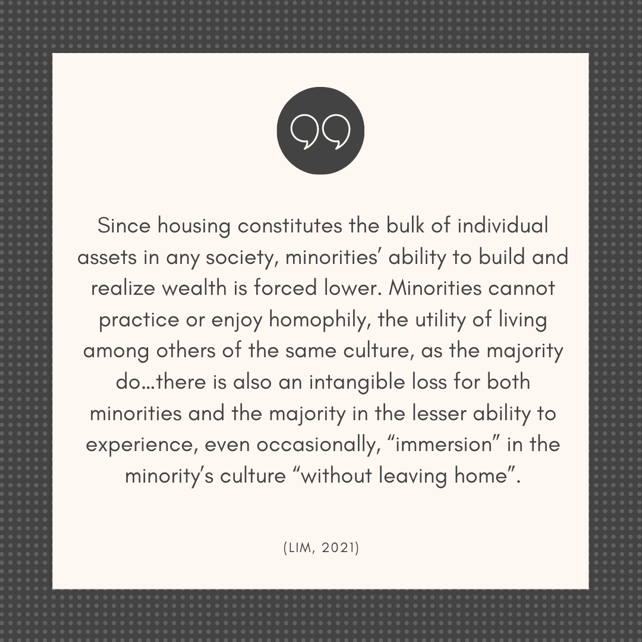
    Moreover, the role of EIP (“Ethnic Integration Policy”, n.d.) must be recognised for what it is: an imposition of racial quotas on ethnically minoritised population to maintain a Chinese majority.  Ethnic minorities have fewer opportunities than the Chinese population to have their application for housing in their preferred estate accepted (“Written Answer”, 2021). EIP also has a ripple effect on the day-to-day lives of ethnic minorities (Lim, 2021).

    Text

Description automatically generated

    The choice of women to stay in abusive marriages becomes a reasonable strategy in a society where safety, housing, livelihood, and overall welfare are not public goods, but relies on private capital from nuclear patriarchal families.  

    Resistance 

    Friends, family & religious community

    Participants discussed women’s social support systems which are inadequately equipped to support them. I am reminded of the links Indigenous scholars have made between colonisation, fractured communities and weaker systems of accountability. Poor social support does not simply happen because of stigma surrounding “broken marriages”, but also material constraints. Under-resourced, weakened, materially poorer, ethnically minoritised communities are more deeply and directly affected by divorce. It is not unreasonable to recognise family and friends’ unhelpful advice for women to work through abusive relationships as a response, whether overtly or subconsciously, to material constraints that are a result of neoliberal policies. 

    Moreover, women who reach out to religious leaders are often given unsupportive advice, prioritizing ‘patience’ and ‘endurance’. Some participants felt that public education by MUIS has not been adequate, that it does not trickle down to asatizah’s teachings/advice, and that MUIS should take on a more decisive role in challenging patriarchal family structures. However, we need to first acknowledge that MUIS itself functions within a patriarchal and authoritarian State. An expansion of MUIS’ powers would simply mean an expansion of the paternalistic reaches of the State.

    Police, PPOs and criminal justice system 

    In my interviews, participants discussed the lack of powers and sensitivity that the police have in terms of DV intervention, and the limitations of a Personal Protection Order (PPO). However, any push to rely on a stronger, supposedly more empathetic or progressive system of police, prosecutors, courts and punishments – a.k.a. “carceral feminism” – assumes that violence is a problem of individuals’ behaviour, and that the problem to fix is within those individuals (Kim, 2019; Sweet, 2016). It ignores the systemic nature of DV, and silences the State as a perpetrator of violence. Furthermore, criminal justice punishments disproportionately impact ethnically minoritised groups (Ganapathy & Lian, 2016) and this demands a more complex undertaking of the problem with policing. 

    Yet, despite these realities, few participants spoke about barriers or discrimination Malay/Muslim women face when making police reports, accessing PPOs and criminal justice remedies. One said, “I’ve never seen outright discrimination because someone is from the Muslim community.” But “discrimination” cannot only be simplistically recognised as overtly unfair or unequal treatment against particular groups. To recognise systemic discrimination, one has to be conscious of the existing and historical social stratification of society. Malay/Muslims are “Othered” in ways that are normalised, as well, including through the legitimisation of discrimination against Muslim workers who wear the tudung, the framing of it as an issue of Muslims who do not make an effort to “compromise and integrate themselves” (J. Tan, 2014), and the narratives of the ‘disloyal’ and potentially dangerous Malay/Muslim citizen in nationalist discourse (W.M. Tan, 2020). This “Othering” changes the shape of both policing, and the ability to see the police as a source of support or help. 

    Social services & shelters

    Text

Description automatically generated

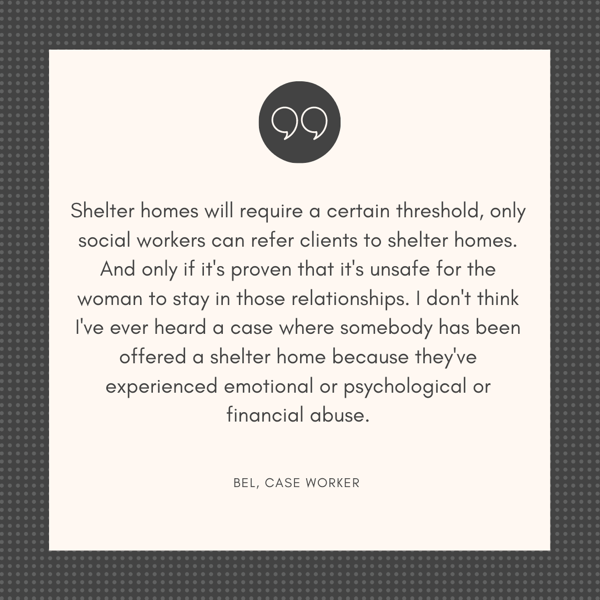
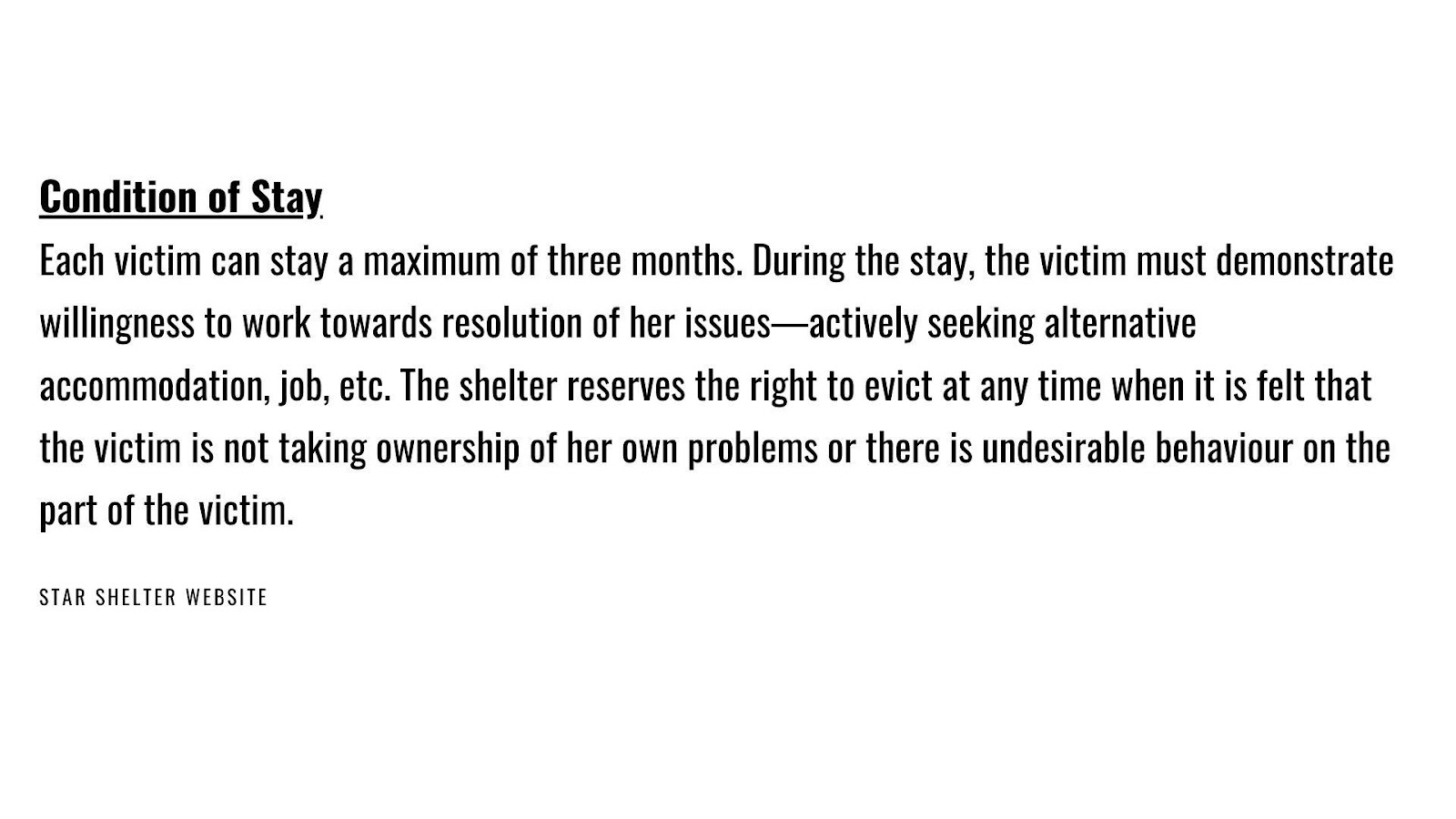
    Women more often than not have to have been physically harmed recently before crisis shelters become an option, given that admission policies do not account for experiences of coercive control. Crisis shelters function only to support women who are not “at risk” of physical or mental illnesses, and excludes disabled people, showing a shocking lack of care for the impact that violence has on women’s bodies and lives. 

    One participant spoke about how some women may fear institutionalisation, based on a case where a DV victim was once, in her youth, institutionalised through a juvenile home. This is consistent with research which criticises shelter systems for being modelled after prison systems: women are monitored, policed and isolated, mimicking abusive patterns of control that further remove women from their communities.

    Graphical user interface, text, application, letter

Description automatically generated

    (Star Shelter, 2020)

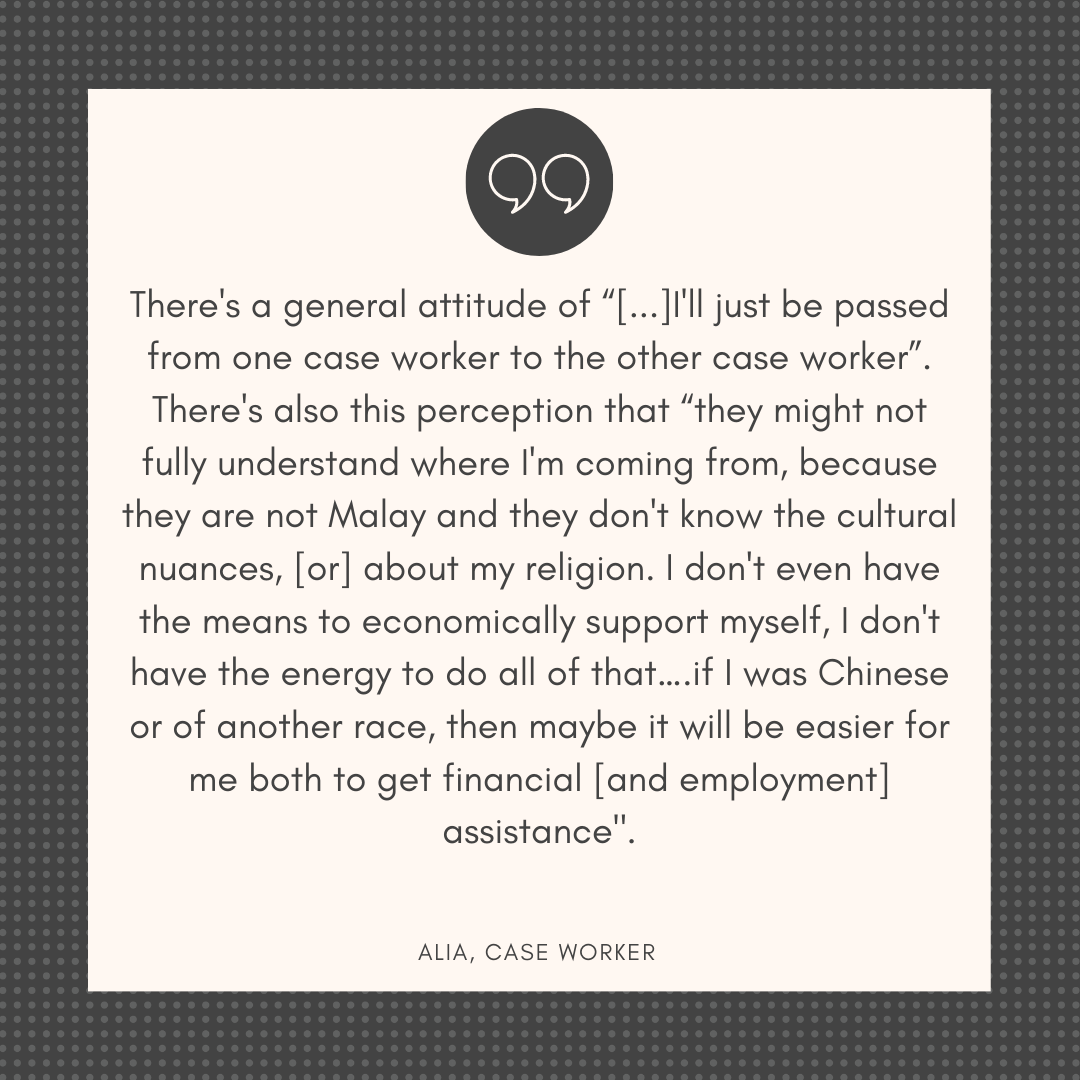
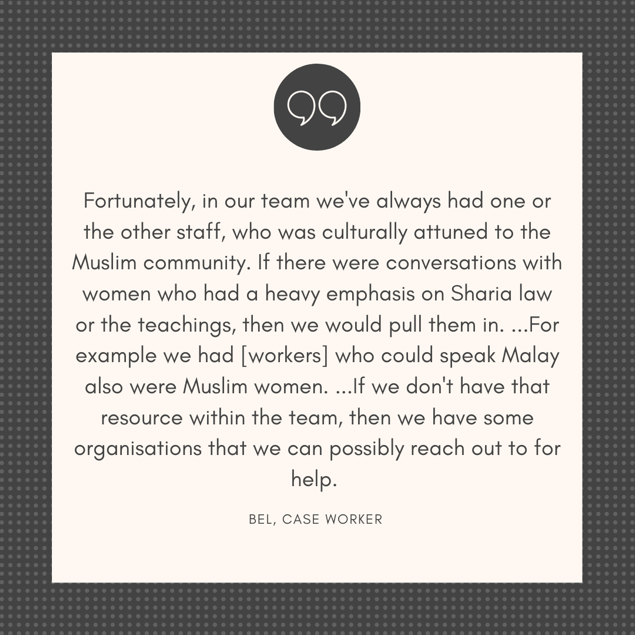
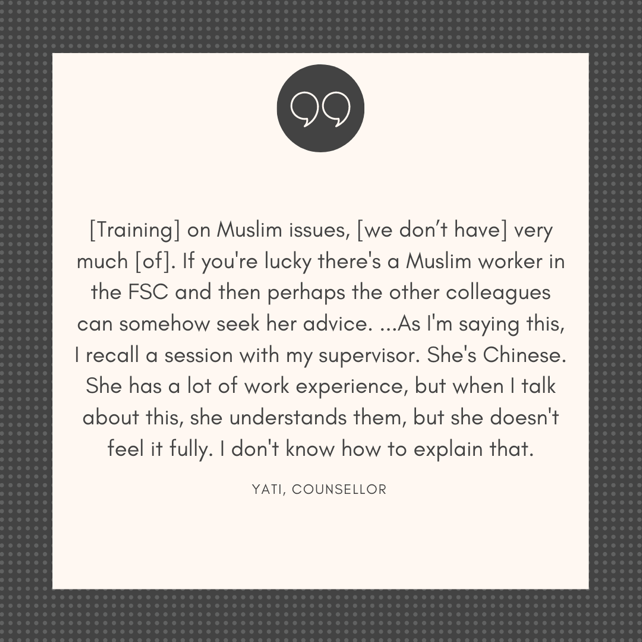
    Keeping women safe from violent relationships should not rely on social and organisational methods of monitoring and controlling women’s lives, as it reproduces paternalistic forces of subjugation. Participants also spoke directly about the struggles that Muslim women face in the social service system as religious and racial minorities. 

    Text

Description automatically generated

    Yet very few participants who work in service settings shared any relevant “cultural competence” training they have received. Most had to rely on their own immersion into the culture or religion. Knowledge of culture and Muslim personal law are “othered” to minority workers, rather than something inherently woven into working with DV survivors. 

    Text

Description automatically generated
    Text, letter

Description automatically generated

    When something is assumed to be “unique” to the Malay/Muslim population, it tends to be contextualised within spiritual abuse, Islamic law or conservative Quranic interpretations. Not enough is discussed about the Malay/Muslim population’s unique social, political and economic marginality. The imagined “sameness” of violent experiences across all ethnic/religious demographics flattens Malay/Muslim women’s realities. This has a damaging effect on the options women are given and in the trust that minoritised groups have of social services. Rather than demanding that women be accountable to institutions that monitor their behaviour, we have to ask: how are our social services accountable to minoritised communities?

    *

    The patriarchal and authoritarian State paternalistically governs the options for women going through DV, seen through neoliberal housing, welfare and social service policies. Women are presented with two broad options: either work through abusive relationships through State mediation or leave violent relationships but face structural and material consequences. This has a particularly damaging effect on Malay/Muslims whose social, economic and political outcomes are negatively shaped by colonisation and continued colonialism. In the second part of this series, I turn to policy texts, to interrogate how the State has imagined the problem of DV, based on what it offers up as “solutions”.

    [Full thesis with a complete reference list can be found here]

    __


    Nabilah is a researcher, writer, and artist based in Te Whanganui-a-Tara (Wellington). Currently, she is doing research on how Asian migrants participate in Treaty of Waitangi justice efforts and movements in Aotearoa New Zealand. She makes art at nebula.art89.


    Illustration by Elisa Tanaka

  • Interrogating the Uncomfortable

    Interrogating the Uncomfortable

    by Diana Rahim
    Editor

    _

    Beyond The Hijab began four years ago as a platform for Muslim women to share their stories. I often say this when asked to describe the beginnings and the purpose of the blog, and I am always struck by its simplicity. All we wanted to do was to be a space where women can share their own stories, in their own words, and to feel safe doing so.

    How can something so simple be so controversial to some? How can something so simple still be so needed? At the end of the day, it points to the uncomfortable fact that many Muslim women in Singapore are still very much spoken over, unheard, or reduced to unsatisfactory stereotypes. As an editor of the site the past few years, it has become increasingly clear to me how there is a lack of acceptance and willingness to even confront the more “unsavoury” realities that people go through.

    The public is more than happy when we speak about our happiness and our successes. State papers celebrate the model minority with perhaps the same intensity they regurgitate culturally essentialist reports on our rates of diabetes. They may even tolerate stories of grief, difficulty, and overcoming adversity if it lies within the comfortable limits of the apolitical and personal. But when we speak of our deepest griefs and difficulties that we have yet to resolve, or may never resolve; the ways in which our own community can be cruel or fail us; the ways in which our elites can be condescending to experiences they don’t understand (e.g. poverty); the lack of institutional support (be it state or religious bodies) when faced with issues like domestic violence—these are things that can unearth hostile reactions from certain readers.

    Because Beyond The Hijab functions as a safe space where writers are even allowed to write under a pseudonym for interest of safety, we often receive stories that do not enter mainstream conversation. Whether it’s mental health, sexuality, domestic violence, or education—to name a few of the topics we’ve covered—women submit stories that are often uncomfortable and at times elicit antagonist reactions from certain groups of people.

    I can understand the hostility and defensiveness up to a point. In the Muslim community, there is often the concept of adab and to tutup aib. Good manners is not to air the dirty laundry. That’s how it goes.

    I also understand that this anxiety over maintaining our good image is especially felt for minority communities which are already burdened with negative stereotypes. I understand that there can be a certain anxiety in not wanting to shame the community or to further confirm the negative, even racist assumptions people may have for our community.

    Those who hold this anxiety may even function from a position of love for the community. But is it truly an act of love to demand that those who suffer, who go through abuse, who struggle with issues that are not brought to the public eye, to continue to suffer in silence, ignored, just for the sake of our image? Are we truly willing to throw the suffering and the marginalized under the bus because we value the approval of others to such an unhealthy degree?

    Another refrain I often hear is: “you are so one-sided, what about the other side of the story?” This refrain often appears when those in a position of power do not come off in a flattering light. Whether it is stories of domestic violence, of how conservative family members enact body shaming to the point of abuse, of how spiritual abuse resulted in anxiety attacks and mental health problems, the testimony of the woman who shared her story is sometimes met with this skepticism. What about the other side of the story?

    Of course the truth is a good thing to know, but what lies within this refrain is the quick instinct to disbelieve, a kind of defensiveness. This is not to say that skepticism is unhealthy. In fact, I do think it’s a necessary element of the serious intellectual. But is this instinct to be skeptical of what is read, the instinct to ask “what about the other side of the story?” present whenever the person consumes the narratives they are presented with every day in mainstream conversation and media? When certain groups of people are vilified, or when they are taught a certain narrative about a historical event, or a social phenomenon, do they also ask the same question?

    Additionally what lies behind this demand for us to not be “one-sided” is the assumption that dominant opinion and narratives are somehow neutral and do not advocate for a specific position or maintain a certain status quo. It assumes that the field is equal and that all narratives have the ability to enter the field of conversation.

    This is truly not the case. If this were the case, then many of the stories shared in Beyond The Hijab would have appeared a long time ago, and the conversations surrounding the difficult topics within the community would have already begun. Many of the women who share their stories on Beyond The Hijab do so because there were little other spaces available for them to safely share their story without judgement. For many of them, sharing their story on Beyond The Hijab was also the first time they shared their story.

    The fact is that “the other side” of the story is often on the side of power, on the side of the status quo, of institutions, and with little difficulty in making itself heard. It sees itself represented in mainstream media, in daily conversation, and has little difficulty expressing its views. Despite being on the side of power, of representation, and the already heard, why exactly do some people feel so offended hearing some of the stories shared in Beyond The Hijab? Why are those on the side of power often also rather fragile?

    I don’t think a community can truly progress if it is unwilling to interrogate what makes it uncomfortable. At this point, it feels like we are still trying to chip away at even trying to start the conversation, to bring willing listeners to the table.

    The hostility, the common refrain, the request to hide the “shameful” aspects of one’s experiences—these are all ways of silencing what ultimately cannot be fully suppressed and silenced. I don’t want to reduce the stories in Beyond The Hijab to simply those of the taboo, of suffering, and marginalization. Because even within these stories lie immense love, wisdom, and a treasure trove of tried and tested advice.

    In struggle, people often find innovative ways of coping and living that break against established forms of affection and care. For those who have no family, they learn that collective forms of care can be even more fulfilling. For children that grow up in domestic violence households, they learn (though not through any happy willingness) how to recognise manipulative language and tactics. Through sharing their stories of struggle, they also often shore up the areas in our community and institutions that need urgent work and improvement. They often also recognise the solutions because they have been victims of its failures.

    I learn so much the past few years by simply reading these stories, by actively listening. It is quite easily the most rewarding aspect of being able to be the editor of Beyond The Hijab. If everyone could open their hearts to truly listen, so much can be improved.

    Stories are never just stories. They are the bed upon which the prevailing ideology, the status quo, rests. They craft a narrative, and therefore help to substantiate certain beliefs. Stories are powerful things because within each story lies a kind of meaning.

    I said in the beginning that I am often struck by the simplicity of Beyond The Hijab’s purpose — that it is a platform to share the stories of Muslim women. In our context in Singapore, it is an aim that is both simple and profound, because sometimes the most powerful thing you can do, in a society that is intent on ignoring your voice and invalidating your pain, is to share your story. They may close their ears, look away, invalidate you, but in the process of sharing your story, you affirm another person. You make them feel a little less lonely, a little more represented and heard, and the world a little more bearable.

    _

    This piece was first published in the NUS Malay Studies Society Annual Publication, Coretan: Kita Edition.

  • The Woes of an Indian Muslim Sister

    The Woes of an Indian Muslim Sister

    By Nurul Deanna

    –

    I am an Indian Muslim. No, I did not convert. No, I am not Hindu (did I already mention I’m Muslim?). I am Indian and yes, I’m very sure that I’m Muslim.

    I remember when I was in a Grab on the way to work for my internship. The driver took one look at me and the first thing he asked me was, “Eh, you Indian ah?” When I replied that I am Indian, he was shocked. “You don’t look Indian eh,” he said. I began to think. What is an Indian supposed to look like? You mean to say each person has specific biological features that determines their race?

    Oh man, here we go again.

    I hoped the conversation would end there and I could pretend to be asleep. But alas, the driver was an extremely curious man.

    “So that means you Hindu, right?”

    “Uh… No, uncle, I’m Muslim.”

    “Huh? But I thought you said you Indian?”

    At that point of time, I begged to be thrown out of the car. I imagined the road would open up and I would be swallowed into the black hole, never having to deal with this kind of situation ever again. But this is real life, and Singapore’s roads are smooth and efficient and probably one of the best in the world.

    And then he tried to convert me to Christianity because according to him, “Islam very restricted, right?”. I thank Allah SWT for giving me the patience to sit through that ride.

    Fast forward a few years later and I was sitting in an interview to qualify for my University’s bursary that would help with my tuition fees. In front of me sat four Chinese women. For some reason, I felt extremely nervous and my brain was subconsciously preparing me for some kind of fight. I remember telling myself to keep calm. I remember reminding myself that I had to stand up for my rights too if something were to happen. But I was also confused. I am in a room with women. I should be comfortable, but why was I scared?

    Turns out my instincts were right.

    The interview lasted about 10 minutes, but it was the longest and most painful 10 minutes of my life. To sum up, I felt attacked and violated. In the first few minutes, they asked me about my religion. When I told them I’m Muslim, they must have assumed I am Malay too. I had to explain how I am actually Indian, but it looked like they couldn’t seem to grasp the idea that I am both Indian and Muslim. The kinds of questions they were asking after that made me feel like I had to prove that I am Muslim. I was quite taken aback by all this. As an educational institution, shouldn’t their priority be helping the students get the best education they deserve? What has my religion or my race got to do with my chances of getting a bursary? My fight or flight mode began to kick in. I felt like I was being interrogated instead.

    “Why do you need the money?”

    “How hard is your family’s condition financially?”

    “How do you get the money for your daily expenses?”

    “Why didn’t you apply for a bank loan?”

    “You’re Muslim, right? Apply for Mendaki lah.”

    “What’s the difference between Malay and Muslim? Same what.”

    For every answer I gave, they had a counter for it. And for every counter they gave, I felt my hope diminishing. I felt smaller and smaller. It was four against one, what could I do? By then, I was already preparing an explanation for my parents. I did not want them to know that I might not get a bursary because of my race or my religion. I began to list down in my head some other ways I could do to get more money to help pay for my tuition fees. All this while they were shutting me down with every question asked.

    Half of the interview was them trying to convince me to apply for a bursary with Mendaki. To my knowledge, the bursary under Mendaki is only for Malay-Muslim applicants. So, the other half of the interview was me trying to convince them that Malay and Muslim are two different identities, and that I am Indian and not Malay. From anecdotes I heard, I knew my chances of getting accepted by Mendaki were extremely low. If someone I knew had to change his race from Indian to Malay just to receive financial aid from Mendaki, what makes you think I don’t have to do it too? If someone I knew, a convert, had to put in voluntary hours on the weekends to receive the financial aid from Mendaki, what makes you think I don’t have to do it too?

    I felt like the weight of representing the Malay, the Indian and the Muslim communities fell on my shoulders. My answers and my explanation would determine what they would think about race and religion in Singapore. This was not a responsibility I wanted nor am I ready for. But they were ruthless. I had been silenced countless of times during the interview. By the end of it, I became quiet. What was the point of trying to defend myself anymore, I thought. I left that room thinking that I will probably never get that bursary. (I got it in the end. I guess my defence left some kind of impact on them.)

    The fact that race plays a vital part in determining your access to services and opportunities is problematic. The CMIO policy, for example, continues to frame our national policies from housing to education, including public housing ethnic quotas.

    With the brownface incident involving the E-Pay advertisement and local online star, Preetipls and her brother, rapper Subhas Nair, it shows that conversations on race are long overdue. Avoiding such discussions by censoring them does not help deepen our understanding about racism and the offensiveness of brownface. It only entrenches our fear of talking about race. By avoiding and censoring issues, it limits knowledge and prevents the exchange of ideas. As a society, we need to mature and learn how to have a civil conversation about a difficult topic. We need to have more open discussions and debates to talk about these issues without the risk of censorship, and in a safe and non-threatening environment. This includes sharing stories from minority communities by giving spaces and public platforms for them to be heard.

    Not only that, sharing and reading stories from minority communities allows us to practice empathy. It forces us to analyse the thoughts and feelings of the person in the narrative, putting ourselves in their shoes. Hearing their experiences and the troubles they face can teach you not to judge, but to listen actively and understand. From these stories, it answers the question of what it’s like to be ignored and sidelined by society.

    Similarly, in the Muslim community, it is important that we not only giving air time and platforms to just the Malays or just the Sunnis. A Muslim in Singapore is not always someone who is Malay or Sunni. They may not always be wearing the hijab. They may not even be heterosexual.

    We shouldn’t censor the diversity in our community by choosing to present only one kind of “acceptable Muslim” and ignoring everyone else that do not fit within this restrictive and arbitrary category. In her talk at TEDGlobal 2009, Chimamanda Ngozi Adichie talked about the danger of a single story, wherein a community or a group of people are only shown as one thing and only one thing over and over again. It reduces people to one single identity and robs them of their dignity. It emphasises how we are different rather than how we are similar.

    It is important that we continue questioning the narratives, stereotypes and assumptions that has been fed to us. From these powerful diverse stories, we can become a more inclusive and empathetic community.

    –

    Nurul Deanna is an undergraduate pursuing her degree in Criminology. Her interests include studying marginalised communities and risk societies, looking at colonial and postcolonial literature, and learning about intersectional and transnational feminism.

    Photo credit: Firqin

  • Who Speaks for Muslim Women?

    Who Speaks for Muslim Women?


    By Diana Rahim

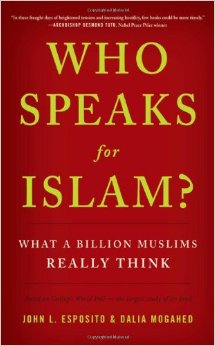
    I just finished reading “Who Speaks For Islam?: What A Billion Muslims Really Think.” by John L. Esposito & Dalia Mogahed. The book presents the data collected from a 6 year long study conducted by Gallup Organization. They conducted tens of thousands of hour long interviews with people from more than 35 predominantly Muslim nations. The data collected helps empirically answer questions like – Do Muslims hate the West? Do they hate democracy? Are Muslim women silenced & oppressed? Are extremists acting on religious grounds? (The data collected answers ‘No’ to all questions, but of course the answers are more insightful and complex than the questions asked).

    With data collected from a billion Muslims, we get the silenced voice of Muslims to the forefront to answer these questions — not from the media, not from extremists given the loudspeaker, nor from politicians with rudimentary understanding of the faith who resort to racist caricatures to state their point.

    An interesting section that I thought would be relevant to share would be “What Do Women Want?”

    With all my reading, some things presented in this chapter still came as a surprise to me. I didn’t know for example how directly the call to “save the oppressed Muslim woman” under the banner of feminism was used as a justification for the invasions of Afghanistan and Iraq. Isn’t that amazing? I always knew the power of opinion and how with enough numbers and momentum, they can shape policies, providing justifications even for wars. It is why I’m frustrated by the accusation that Muslims are “overreacting” whenever they call out someone for saying or doing something Islamophobic. And with regards to using women’s rights as justification, it seems too basic if your feminism stops at simply trying to ‘save’ someone while keeping her voiceless in her own liberation. It seems so basic to not interrogate one’s country’s own participation in the oppression of the women. What, are we still in the first wave?

    But anyway.

    Our white saviours so concerned for the oppression of poor muslim women by their oppressive Muslim husbands and fathers might be surprised to know the following (which I quote from the book):

    “Western attacks on Islam often use women’s rights as a justification. Also, as discussed before, acute conflicts such as the invasions of Afghanistan and Iraq were both partially justified in the name of the liberation of women. Yet, Muslims believe that these wars have harmed rather than helped Muslim lands. Muslim men and women alike believe that the invasion of Iraq has done a great deal more harm than good — this is the sentiment of majorities in most of the countries in which this question was asked. Add to this Muslims’ perception that Western concern for Muslim women is limited to the abuse they might suffer at the hands of Muslim men, while the suffering that women endure at the hands of Western power appears to be ignored.”

    I remember answering a question on Quora, a site that I have now abandoned, when someone asked “Are Muslim Women Oppressed?” I pointed out that a lot women are oppressed around the world. Some more so than others. This includes the oppression of Muslim women by Muslim men. But why is it that Muslim women have become the poster girls for female oppression? Perhaps simply because she is the most peddled picture of female oppression today. Why is it that this poster girl will also be wearing the sky-blue burqa, her eyes behind the a little strip of net? After all, less than 0.05% of muslim women actually wear the burqa.

    Then again, it would be good to interrogate how this singular image of the quiet, oppressed Muslim came about. What are the images received by the public eye when it comes to Muslim women? I quote the book again:

    “In a survey of all photographs of Muslims in the American press, three-quarters (73%) of the women were depicted in passive capacities, compared with less than one-sixth (15%) of the men. In photographs of the Middle East, women were six times (42%) to be portrayed as victims than men (7%).”

    The idea of Islam as a monolithic entity, which breeds reductive views of muslims, is nothing new. In this monolithic view of Islam the men are bearded. The women wear a burqa or a veil. They’re both Arab. When Europeans are resistant to the idea of an influx of Muslims, they comment on how Europe might turn into “Eurabia”. Never mind the fact that 80% of muslims are non-Arab.

    It is reductive to point to one thing, be it religion, or race, or culture, and not look at the whole web of structures intersecting with each other. How even politics and power relations come into the mix. If one truly cares about the condition of muslim women, one has look to more than just the muslim men, who are very often the target of Islamophobic and neo-colonialist violence as well, two forces that are more successful at oppressing women more than any muslim man can ever hope to achieve.

    In all of this talk about the Muslim woman, her own voice is rarely heard. She is an object of pity, whose saving is decided without consultation to her own opinion. British Parliamentarian and journalist Boris Johnson encapsulated this perfectly when he said in 2001:

    “It is time for concerted cultural imperialism. They are wrong about women. We are right.”

    And just like that any consideration for the opinions of women themselves are obliterated. With the misdiagnosis of oppression being Islam, well-meaning but nevertheless rather condescending Westerners assume that the imposition of their own culture, their version of democracy, and ‘rescuing’ women from their own religion will liberate them. This alienates the very women westerners want to liberate since –

    “One of the most pronounced themes to emerge from our study of the Muslim world was the great importance of faith in respondents’ personal lives and in society. Substantial majorities in virtually all predominantly or substantially Muslim countries Gallup surveyed say “religion is an important part of life.” ”

    In short: Muslim women value their rights and their faith.

    To end, I quote Snigdha Ali, whose insight is relevant:

    “Very often Third World women have been presented as “oppressed” without any attempt of further analysis of the form and extent of the process of oppression. … Women as a group/social category is not a homogenous collectivity. Terms like “women’s problem/s” often hide the fact that women from different class, culture, race and religion face very different challenges and can experience even contrasting outcomes of the same social phenomenon.

    […]

    If [people] harbor a thought of “liberating” illiterate, impoverished, suppressed women they are denying or undermining the ability of those who they want to liberate. Coming from outside with whatever amount of knowledge or other resources and having the benevolent idea of “doing good” to the women of a community, is not only patronizing on their part it is also a misconstrued reality to begin with… any researcher or activist so to speak, has to work with the women and not on them.“

  • Look beyond the Hijab – How hijab is affecting decisions on education

    Look beyond the Hijab – How hijab is affecting decisions on education

    In recent years, Muslim parents are asking the mainstream schools to take into consideration for Muslim girls to wear their hijabs to school but MOE is taking a strong stand against this idea . The reason given was that the mainstream schools subscribe to the idea of identical uniform represents a institute of equality and no group should have alteration privilege to the uniform. On the other hand, many Muslims who believe that Islam is a way of life and donning on a hijab is the representation of such a belief. As a result, many Muslim parents are “forced” to put their children in madrasahs. With the progression of Singapore’s society, one wonders if it is necessary for the rigidness of uniform conduct in mainstream schools without exception for religious needs? On a greater picture, is it necessary to differentiate our education system for Muslims between the mainstream schools and religious schools?

    Many Muslim parents have chosen to enroll their children into madrasahs over mainstream schools mainly for the integration of religious and secular education that these schools offer. Currently, Muslim children who are in the mainstream schools can only visit mosques for their prayers outside school hours. Moreover, mainstreams schools neither allow Muslim female students to wear hijabs to school, in line of their code of uniform; nor do they allow Muslim students to observe their five daily prayers openly. This poses as a problem to parents who strongly believe that those measures are clear obstacles to practicing Islam as a way of life. As the Muslim population becomes more highly educated, many of them seek to have a greater voice for their religious beliefs for their families and their future generations. However, problems are still abundant with the rigidness of mainstream schools and the lack of resources for madrasahs to cater for such growing demand.

    In 2000, the Singapore government passed the Compulsory Education Act i to ensure that all citizens of Singapore attend compulsory education. However, there is an exemption for children who opt for designated schools, namely the 6 madrasahs. Although this exemption seems to be an embracement of diversity and freedom of choice, one wonders if the quality of such schools differs from the mainstream schools’ offerings? In addition, our mainstream schools are known for their secular education. Hence, should we take into account embracing our different religions and making an effort to retain our cultural roots?

    One of the most notable gauge for school quality is to study the way classes are conducted. Currently, there are no explicit benchmarks stated for the 6 madrasahs on the MOE website. Instead, the Committee of Compulsory Education only states that madrasahs are subjected to Education Act and they are under the jurisdiction of the Islamic Religious Council of Singapore (MUIS) since 1990. This leads one to question if madrasahs are providing an education that is comparable to the mainstream schools as there are no statistics to compare against. Furthermore, there are concerns that the high emphasis on both Islamic teachings may prevent the madrasahs from exposing its students to different cultures and non-academic studies and there are no alternative routes of learning for academically weak students.

    Another way to compare the quality of education between mainstream schools and designated schools is by the amount of funding available. With more funding, one can fairly assume that the school is able to hire better-qualified teachers and provide more unique experiences for its students to learn better. Under the CE act, it states that no government funding is available for the designated madrasahs. These schools mainly rely on the students’ school fees, limited grants from MUIS and donation drives.

    Despite the difference between mainstream schools and madrasahs, it seems madrasahs are gradually progressing to the stage where the students can handle both religious studies and the normal academic subjects. The local Muslim community has highlighted the local madrasahs’ achievements and they have become an alternative to the mainstream schools. Such progression in the madrasahs leads one to wonder if it is possible to have our mainstream schools to offer an alternative subject and environment where students can choose to be themselves instead of a homogenous generation? Will there be a day when mainstream schools can also serve some functions of religious schools to provide a truly secular education?

    Sources: