Category: Justice

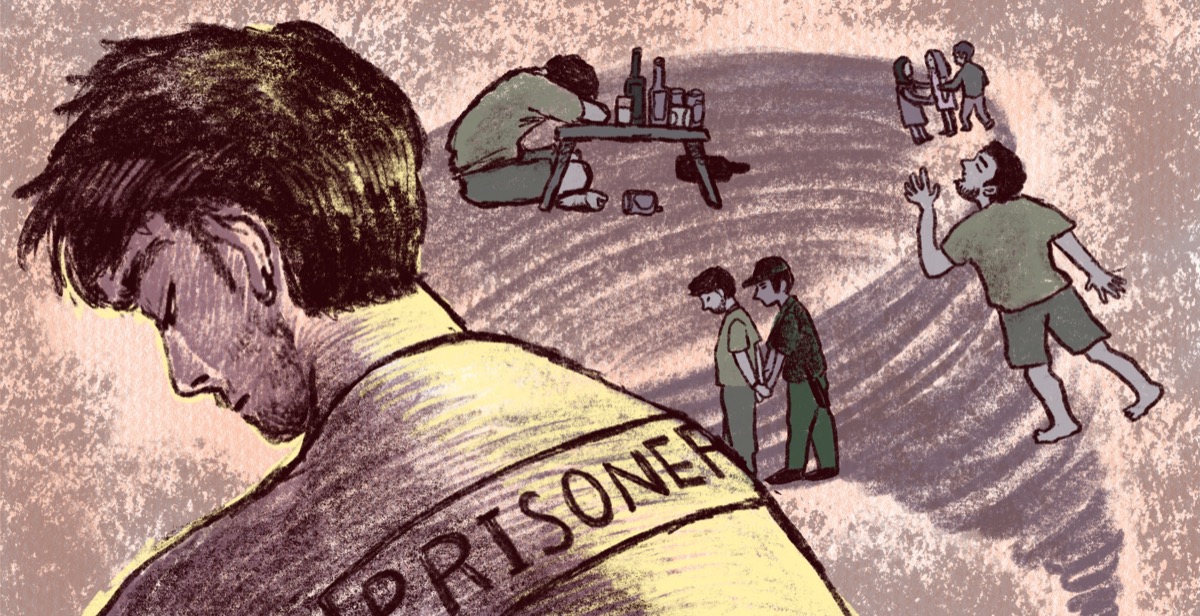
  • The Traumatic Process of Seeking Justice for Victims of Sexual Violence

    The Traumatic Process of Seeking Justice for Victims of Sexual Violence

    CW: Sexual Assault

    by Nur
    __

    Trigger warning: Rape, sexual assault, sexual offences, victim-blaming

    In 2016, the Brock Turner case in California was one of the first instances that made me reflect on how the criminal justice system fails victims in cases of violence against women. In that case, the perpetrator who had sexually assaulted an unconscious woman, was a 19-year-old first-time offender and Stanford University swimmer. He was only sentenced to 6 months of prison but only ended up serving 3 due to good behaviour. This happened before I entered law school. The outcome of the case felt wrong but I had no understanding of the law at the time and I figured such an outcome would not arise in Singapore. 

    Between 2019-2020, Singapore saw a spate of cases where the public perceived the sentences meted out to young male offenders to be too light. In a case where a perpetrator filmed a student showering in the NUS hostel, he was only given a 12-month police conditional warning and suspended from school for one semester. In another case, a second-year dental student, who had climbed into his ex-girlfriend’s home and strangled her, was sentenced to a short detention order for 12 days, a day reporting order for five months with counselling, and an order to complete 80 hours of community service over a year. The judge noted that while probation was not appropriate in this case, the perpetrator received community-based sentences due to his “relative youth, his rehabilitative prospects and his lack of (previous convictions)”. Meanwhile, victim care in both cases were said to be inadequate. In the latter case, the victim suffered severe psychological trauma.

    These cases illustrate how the justice system is more preoccupied with the rehabilitative prospects and future lives of perpetrators, rather than the rehabilitation and care of victims. This is only one of many ways the system has failed.

    By this time, I had a better understanding of the law, the balancing exercises that judges had to undertake, and precedent cases which set out outcomes for certain types of cases. But, this did not make me feel any less indignant about the outcome for victims. 

    While our courts are fair and the judges deliver justice based on our laws, there is a systemic problem in place. Our laws and the approach on victim care needed to be reviewed and improved upon. This was done when Minister K. Shanmugam announced stricter penalties for certain sexual offences, and less weight to be placed on accused persons’ ‘academic potential’. In response to a question about trauma literacy within the criminal justice system by MP Nadia Samdin, Minister Shanmugam mentioned that the Ministry of Law is considering allowing the use of video interviews in lieu of examination in chief, to avoid victims having to go through the trauma of recounting their ordeal. 

    However, what we must understand is trauma is not just felt when recounting one’s ordeal at trial. Victims often experience retraumatisation during medical examinations, when being questioned by the police, and while giving evidence in court. While some victims choose to report and try to put the perpetrator behind bars, other victims choose to put the incident behind them and heal because of how difficult the criminal justice process is. 

    To add insult to injury, society often disbelieves victims, gaslights, and victim-blames. This victim-blaming arises partly due to the way victims are treated by the criminal justice system, and the criminal justice system continues to treat victims in a certain manner due to society’s culture of victim-blaming. It is a cycle of retraumatisation by society and the systems designed to ‘protect’ victims. 

    Between 2017-2019, there were 6,988 reports of sexual assault, including rape, sexual assault by penetration, outrage of modesty, and sexual offences involving children and vulnerable victims. Of all the reports made, 1,368 cases resulted in prosecutions, with 931 convictions to date. According to AWARE’s Sexual Assault Care Centre (SACC), only three in 10 clients who reached out for help in 2016 made police reports. 

    Apart from seeing light sentences being meted out to perpetrators while victims are left to deal with their trauma throughout the process, such low numbers of prosecution and convictions also make victims think twice about whether it would be “worth it” to come forward and report. Victims often feel shame as they ponder how they could have prevented this; they feel fear as they consider how reporting may affect their lives; and they feel worry for the perpetrator’s family if he is caught (especially in cases where the victim knows the perpetrator).

    The number of prosecutions of sexual offences is less than 20% and this is often due to the lack of evidence in cases of sexual offences or violent crimes against women. In cases of sexual assault, the police have said that most victims who report, only do so after 72 hours. Since victims can only go to the hospital to get a medical examination after lodging a police report, most DNA evidence would have been compromised or lost by then. Moreover, sexual offence cases are often “he said-she said” cases as they take place when victims are alone and there are no witnesses present. These factors also explain why conviction rates are even lower.

    In Singapore, in cases where the only evidence available is the victim’s testimony, the standard of proof that has to be met is “unusually convincing testimony”1. When assessing in totality whether the Prosecution has proven its case beyond a reasonable doubt, the court will evaluate the internal strength of the Prosecution’s case AND its comparative strength to the Defence’s case. This means the court will have to determine whether a witness’s or complainant’s testimony is to be preferred over the accused’s evidence.  

    While it is understood that such a high standard is a deterrent against false reporting and to ensure justice for falsely accused persons, it is no surprise that this has led to difficulty in prosecuting some cases and getting convictions. Victims are put in a position where they have to recollect every single detail they can to bolster their case, have their credibility called into question, and prove their word is somehow worth more than their perpetrators’. 

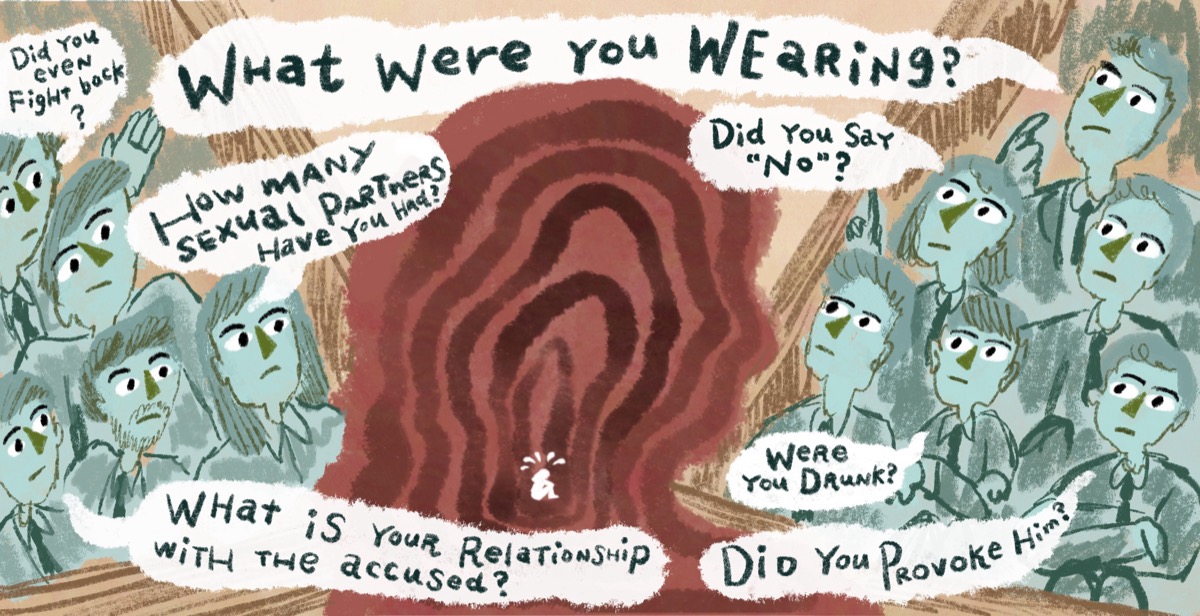
    During police questioning and cross-examination by the defence in court, victims are often asked questions that are aimed at poking holes in their story or to discredit them in some way. This is part of ensuring that the accused is not being falsely accused and that the victim is able to prove her version of events beyond a reasonable doubt. However, when police officers and defence lawyers ask about the clothes victims were wearing during the incident, their sobriety, their past sexual history and other supposedly “mitigating” factors that may ‘explain’ the accused’s behaviour, this is victim-blaming. Having to go through such a difficult process of having their behaviour called into question, while recounting their traumatic ordeal, often discourages victims from reporting. Anecdotal evidence of such incidents of police questioning has been shared on social media by various survivors and such instances of cross-examination can be found in reported cases. 

    In a decision where the judge placed some weight on the behaviour of the victim to reach its decision to acquit, AWARE pointed out that there was a lack of understanding in terms of the behaviour of complainants in cases of sexual assault. While it is not doubted that the court had done its job and considered various factors to come to its decision, its assessment of the victim’s behaviour was flawed. In the context of behaviour exhibited by sexual assault survivors, generally some victims do freeze, are unable to give consistent testimony due to the trauma they have faced, and may decide to delay reporting the incident due to a multitude of reasons. 

    Having said all of that, in 2017, our lawmakers did propose changes to the Criminal Procedure Code and Evidence Act to better protect victims. For instance, the sexual history of victims can only be raised with permission by the court. Investigators will also be given the power to take statements through video recording so victims do not have to repeat themselves multiple times. The same can be done for testimony in court.

    Nonetheless, on top of such protections, we also need to train our police officers, lawyers, and judges, to ask the right questions in the right manner, and to better understand trauma and behavior of survivors in cases of sexual offences. 

    People do not understand that an acquittal or refusal to prosecute or charge, due to lack of evidence, does not necessarily mean the perpetrator did not commit the act. People do not understand that the questions asked during cross-examination in an effort to discredit the victim, does not make the victim a liar. People do not understand that while our Singapore courts and judges are fair and competent in serving justice based on the laws of the land, it is still possible for us to cause injustice to victims. 

    There is still much to be done through our justice system and as a society. The way forward would be to find ways to support victims through the criminal justice system and to provide better care for victims post-trial. Most importantly, on a societal level, we must learn to believe victims, encourage victims to make their own choices to heal, and understand the complexities of the justice system and how it affects victims.  

    __

    Nur is the co-founder of Lepak Conversations

    Illustration by Elisa Tanaka

    __

    1Public Prosecutor v GCK [2020] SGCA 2 at [143]-[149]
  • Why I Believe Prison Abolition is A Muslim Issue

    Why I Believe Prison Abolition is A Muslim Issue

    Ruth Wilson Gilmore, a Black woman prison scholar who laid the rich groundwork for abolitionist politics, has defined racism as “the state-sanctioned or extralegal production and exploitation of group-differentiated vulnerability to premature death”. This implies that minoritised people, people of colour or people from minority ethnic background get exposed to earlier deaths because of racist structural systems within the state and society. For example, children of minority backgrounds in poor neighbourhoods are prone to respiratory illnesses such as asthma amongst others, due to environmental racism leading to their neighbourhoods having higher levels of pollution. These poor neighbourhoods inhabited by poor minorities are highly likely to have insufficient infrastructural inspection and upkeep. Poor people of colour face more health risks because of institutionalised racism.

    So now, what does it mean when we speak of ‘abolition’ or someone who holds ‘abolitionist politics’? Abolition implies getting rid of the capitalist, oppressive structures. It’s the total and utter dismantling of these violent structures, and that includes prisons. Prison, more than anything, is a racialised space where human rights and humanity are suspended. To have a racialised space is to also have a form of containment that subordinates racial minorities, and the ways said minorities cope and resist with spatial containment.

    As an abolitionist Muslim, I believe that anti-oppression and abolition are deeply intertwined in the struggles for justice. Abolition implies that human lives are not disposable or negligible: We humanise, contextualise, and look with compassion and mercy as per Islamic teachings, to our loved ones who had committed harm in the past and we should try to extend the same to strangers. Muslims, especially Black Muslims, are sentenced longer than any other faith groups. Most of these crimes are not even “violent” crimes. More so in light of the current pandemic, incarcerated people are five times more likely to get infected with Covid-19 simply because they’re locked up.

    In the context of Singapore, Malays and Indians are disproportionately overrepresented in prisons, where they are less likely to achieve reintegration as compared to their Chinese counterparts.  Any stabilising factors that they might have salvaged, and the factors that caused their crimes – unemployment, poverty, homelessness, addiction, and other external influencing factors – are made worse by prison, not better. An issue that gets heavily slept on is how formerly incarcerated people are being released from prisons into failing and unstable support systems. 

    We’ve witnessed how policing and carceral ideas so deeply infect our bodies, minds and actions to the extent we even have a community policing strategy. Carcerality, or carceral logics entail punitive orientations, and the ways our ideas and thinking are influenced by practices of imprisonment and policing. Playing god on who deserves mercy from the inhumane prison system necessitates the idea that some people deserve to remain caged—this animates a carceral logic that is far removed from what Islam has taught us concerning justice. When you treat people’s freedom as a subject matter to be debated, you not only accept the legitimacy of a heavily violent and flawed system, but you also justify the dehumanisation inherent within it. Abolition is not simply an eradication of violence the carceral state wields on, nor is it also just an absence of the carceral systems, but the presence of systems that aid people to not even resort to crime in the first place. 

    By now, I’m sure the sceptics would ask, “But WHERE do the murderers and rapists go?!”. One thing for sure, they won’t go where they currently go: into the police, the military, FBI, CIA, etc. Most mass murderers and those who have committed or are still committing extreme violence are not the ones who are locked up right now. There is also this massive assumption that rapists are people in prison, right? Well, no. In the UK, the conviction rate for rape cases is 3.3%. In the US, it’s 18.8%. In Singapore, it isn’t any better either. About 13.3% of rape cases led to conviction here. Rape cases were even reportedly up by approximately 75% since the past few years. And as we know, rape is something that’s massively underreported considering the re-traumatisation survivors have to go through when they report to the police. Not only that, the dynamics within relationships are also a factor as most cases of sexual violence happen between people who know one another.  When we consider the existing system we’re in and the current way it’s been structured, violators who occupy positions of power are more likely to get away with it. We’ve seen that happening with Trump, the current president Joe Biden, and many other politicians, police officers, celebrities, and many more.

    Reconstruction is vital to prison abolition, and where basic needs and justice are concerned, the needs of the individual have to be balanced with longer systemic change. Reconstruction calls for transformative changes, and it’s not just about changing one thing, but everything. This could include creating strong communities through investments in resources such as mental health facilities, schools, after school programs, career centres, amongst many others. It seeks to replace ideas of disposability of people to build a world that prioritises care, mercy, compassion, deep community relationships – which are fundamentally Islamic principles.

    Mercy and humanity are so central to Islam that so many times in prayers and when we recite the Qur’an, we’d mention that Allah is الرحيم (Al-Rahim – the Most Merciful). Aside from that, the Qur’an even tells us to pay zakat in order to free people – it profoundly focuses on restorative justice rather than punitive. This concept of mercy is an act that Jews, Muslims, Christians, and believers in other traditions can deeply resonate with. The concept of accountability or muḥāsabah (محاسبة  – retrospection, accounting, reckoning) is one of the core and important issues in Islam. Furthermore, in Surah Ar-Ra’ad 13:11, we are told that “Allah will not change the condition of a people until they change what is in themselves”. Apart from having to deeply reckon with our own behaviour and be accountable for the harm we may have enacted upon others where we have been careless in our actions, words and agreements, we are also responsible for other human beings and creations, and not only that – we are accountable for them too where we have acted unjustly towards them.

    From neglectful policy and action, to deprivation of basic necessities which include proper medical treatment and medication for incarcerated people, to literal violence and torture enacted by prison guards, the purpose of the prison system is social discipline and punitive retribution. To put simply, punitive punishment does not reap any tangible benefit to society at all. In fact, subjecting people to torture and violence violates a socio-religious sensibility in Islam.  

    Prison abolition is about a societal shift in what justice looks like for us, especially for the harmed and victims – it’s about abolishing the environmental conditions that made that harm even possible in the first place. Through this, it seeks to create a new world where there will be less victims because you’re tackling and addressing the root of the harm. It’s about community healing, accountability, redressing of trauma and harm, where approaches are victim-centred and trauma-sensitive, and not responding to violence with state-sanctioned violence. To quote Ruth Wilson Gilmore, “Abolition is about abolishing the conditions under which prison became the solution to problems, rather than abolishing the buildings we call prisons”. The only way this culture of how we talk about transformative justice shifts, is if we all shift. And that takes recognising that punitive punishment under a current paradigm of capitalist individualism, isn’t actually working.

    In Surah Al-Ma’idah 5:8, the Qur’an states, “Be just, for that is closest to piety, and beware of God”. Hence, we also need to ask ourselves: Are we just in our homes? Are we just in our politics? Are we just in our economics? We shouldn’t be reliant on racist, supremacist and capitalist notions of justice as presented by violent structures of the colonial state. It is also quite impossible for anyone to maintain a carceral system that doesn’t also produce death by design. We so desperately need to nurture transformative justice within our Muslim communities and beyond, rather than retributive or punitive measures of justice in prisons. 

    __

    Ryaihanny Sahrom is a legal professional and a freelance writer with a passion in human rights for marginalised genders.

    Illustration by Elisa Tanaka

  • The Time I Fought for Justice and The Hijab

    The Time I Fought for Justice and The Hijab

    by Anisah Kader

    I have always heard or read stories about Muslim women and the discrimination they faced
    with their hijab on. In fact, all these stories I have read about were from other countries. I
    never thought, right here, in Singapore, I would actually experience such discrimination, but I
    did. It was an unforgettable moment that would change my life.

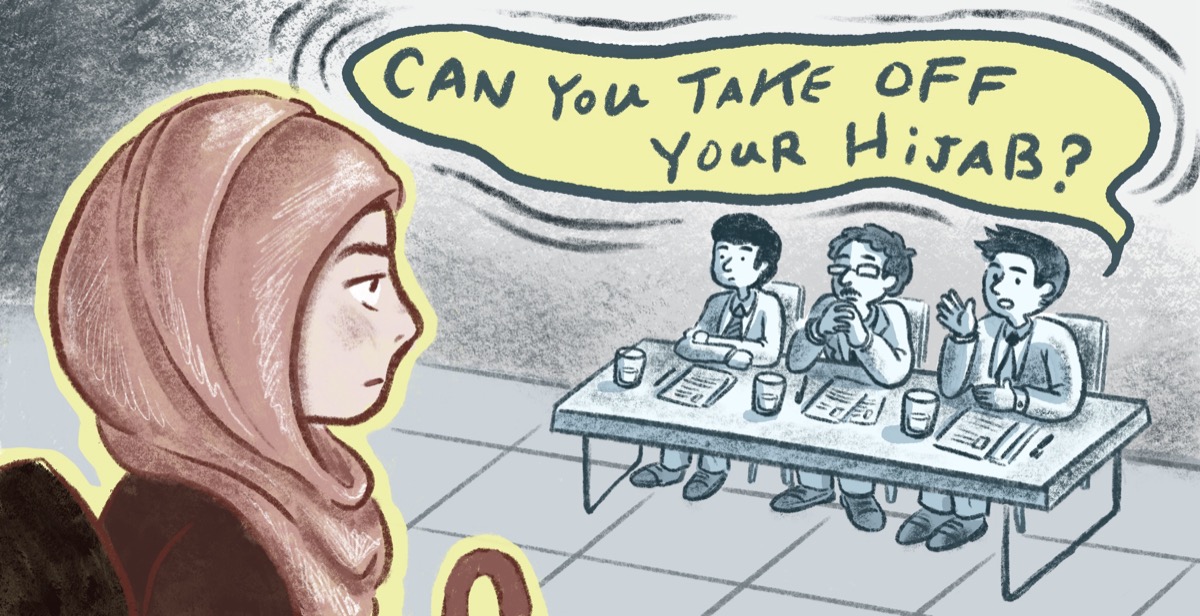
    I always wanted to step foot into the social service sector as my passion lies in counselling, advocacy and social work. I had even quit my full-time nursing job to pursue my passion and I was honestly so excited about it. However, after 3 interviews, I realized a common concern: my hijab. In all 3 interviews, they asked: “Can you remove your hijab?”.

    “But why?”. I was so confused. What did my hijab have to do with the role? All I wanted to be was a role model for at-risk youths. Why do I have to remove my hijab?

    The thing that baffled me most was how casual the tone was whenever they asked me to
    remove the hijab, as if they did not realise how insensitive their request was to me. One of the interviewers even proceeded to ask, “but you don’t wear it when you were a nurse right?”. Again, what has this got to do with the job I am trying to apply for?

    This whole experience honestly broke me. I felt very demoralised and even had thoughts of removing my hijab. I spoke about this to my sister and friends and they all told me to let it go. To walk away from the organization.

    I tried to but I could not just sit still anymore. I did not want to remove my hijab, not without a valid reason (for e.g., infection control in healthcare settings). So, I mustered up the courage and wrote an email to these organisations explaining nicely the significance of the hijab to a Muslim woman and how it is inappropriate and culturally insensitive to ask her to remove the hijab for a role that does not require one to do so. I went on to state that such a request is simply unacceptable in this day and age and it is important to educate ourselves culturally.

    It then also hit me that if this was being asked to me, is this also being asked of other Muslim
    females who don the hijab? I wanted to find out.

    I took this over to my then public Instagram account and even shared my story to Minority Voices and this really helped to gain the public’s attention. However, I remembered how heavy it made me feel inside when other girls started sending me in DMs sharing their own experiences of discrimination and how it is happening in various sectors as well—schools, public sectors, etc. I had to do more. We cannot be silenced anymore. Therefore, I did my research and reached out to TAFEP for help. I gathered necessary hotlines and work attire standards as stated by MOM and shared them on my Instagram and to these girls personally as well so that they may take necessary action. However, most of these girls shared that they did not want to make this an issue because of the fear of losing their job.

    Therefore, I continued to push TAFEP to make a bigger change and I wrote in to MSF to inform them on the such dress code standards as well. To cut things short, 2 of the organizations have now officially changed their dress codes and have allowed Muslim females to don the hijab to work. The other organization has refused to take further action.

    Honestly, pushing for this matter is so important to me because no one deserves to be denied a job opportunity just because of their religion or what they wear on their head. This whole experience has also made me stand up for what is important, and it has allowed me to use my voice and, allow me to speak out for the ‘voiceless’. I genuinely hope the society will take more efforts in educating themselves on the importance of multicultural awareness and sensitivity. I hope for a society where Muslim women do not have to feel fear or feel ashamed of their hijab. I hope we can all learn from one another and respect all cultures equally.

    Today, I am still fighting for this as much as I can. Even though, I am no longer active online,
    I do my best by educating the people around me first, educating the Youths I currently work
    with and I hope to suggest talks (importance of multicultural respect) in my own organization
    as well.

    At the end of the day, I am not giving up just yet. I want to spread awareness as much as I
    can and I hope this platform with help with that as well! Because you see, the work does not stop here. It will never stop. It is a continuous battle, but it is a battle one cannot fight alone in. I need you – yes you, the one who’s reading this.

    I am grateful for the changes that will take place with regards to donning the hijab in the work places. I am grateful for the Government – that they are now giving importance to it. However, what happens after that is where the actual work takes place. 

    Implementing a change in dress code may be done but the key lesson here is, to understand the significance of the hijab. What does the hijab mean to Muslims? Are you aware of that? If you had answered no, then let us close this gap today.

    The hijab does not only mean a religious practice. It means modesty, respect, a personal journey the female Muslim chooses to go on. It could also mean many different things to various women – but, regardless of what it means, it is something that has to be regarded. It is not something you can tell a woman to remove. The hijab is a part of her identity and you need to understand that. 

    When you have understood the significance of the hijab, then you have chosen to be culturally sensitive. You have chosen to be culturally aware and you have chosen to stay informed. This is what I seek of you. I’m not asking you to read up on the history of how the hijab was first introduced to women, but I am here kindly asking that you speak to someone about your uncertainty of it. 

    If you lack information on it, please ask. Do not ever be afraid to ask and if you really cannot find someone in your circle to do so, please reach out to me. I will be more than happy to answer your questions ☺

    But moving forward, let’s start somewhere. Let us be respectfully curious, let us work towards gaining knowledge and staying informed and most importantly, let us practice kindness and empathy to the ones who may need it the most. 

    Also, as I close this piece, I want to say a final thing—the hijab should never act as a factor to identify someone’s capabilities. The Hijab is a part of one’s identity, it is more than just a dress code. Please do not reduce its significance to anything lower than that. 

    I will continue to stay firm, be strong and work my way up with my Hijab on and I urge all of my ‘Hijabis’ to do the same too. We got this, ladies! 

    __

    Anisah is 28, an introvert, and a counselling graduate.

    Illustration by Elisa Tanaka

  • What Is Right?: My Journey Towards Justice

    What Is Right?: My Journey Towards Justice

    by ‘A

    __

    “… اِعۡدِلُوۡا هُوَ اَقۡرَبُ لِلتَّقۡوٰى …”

    “… Act justly – that is nearer to God-consciousness…”

    – Surah Al-Maaidah – Verse 8.

    I have always been a believer in standing up for what is right and upholding justice because I believe that it is a responsibility. I believe that I am heavily influenced by my faith and my religious upbringing. ‘’Adaalah’ – Justice. ‘Haq’ – Truth. ‘Ma’ruuf’ – Right. The Qur’an and ahadith are filled with verses on a Muslim’s responsibility to uphold justice and stand up for what is right, and my parents and teachers would always talk about the gravity of having responsibilities and carrying them out properly. “Kita semua bertanggung-jawab dan akan disoal pada Hari Kiamat nanti.” – We will all be held responsible and we will be questioned on the Day of Judgement.

    The very thought of being held accountable is both thrilling and scary. Thrilling because God knows that I am capable of fulfilling these big responsibilities because He created me to have that capacity. It’s a feeling that God trusts me, which is a feeling of empowerment that can move me to tears. But at the same time, it’s scary because what if I don’t do my best? How will I answer Him? How can I stand before God and say “I didn’t do my best.” even with everything He’s given me? Oh God, I cannot even imagine being so ungrateful and disrespectful.

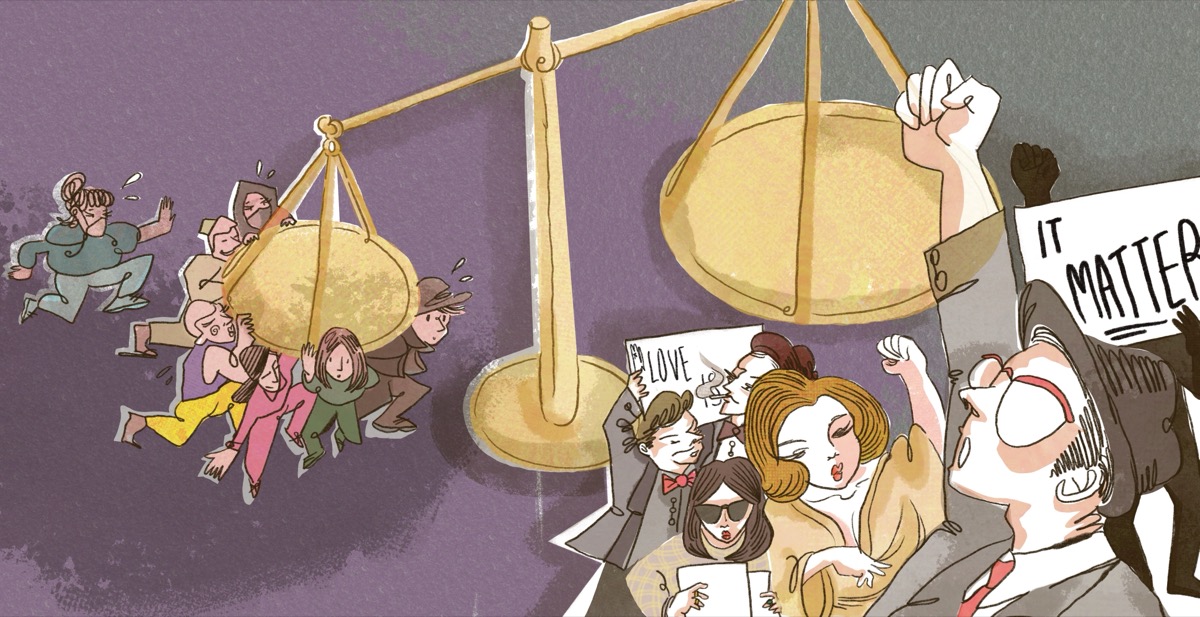
    It’s also the idea of being a member of a larger community. It’s knowing that whatever I do, or don’t do, will have an impact on the lives and wellbeing of other people. When I stand up for the rights of other people, there’s a chance that they might get better lives. Even if it’s slim, there is still a chance, so I’ll take it. When people say my one voice won’t change anything, I think of Mulan’s emperor saying: a single grain of rice can tip the scale. If I speak out, things may or may not change. But when we don’t fight for the rights of others, it is almost definite that change will never take place and I do not want to be complicit in enabling a system that causes pain and difficulty for other people. That is not Islamic, and that is not something I can live with.

     ” إِنَّ ٱلۡإِنسَٰنَ لَفِي خُسۡرٍ. إِلَّا ٱلَّذِينَ ءَامَنُواْ وَعَمِلُواْ ٱلصَّٰلِحَٰتِ وَتَوَاصَوۡاْ بِٱلۡحَقِّ وَتَوَاصَوۡاْ بِٱلصَّبۡرِ “

    “Indeed, mankind is in loss. Except for those who have believed and done righteous deeds and advised each other to truth and advised each other to patience.”
    – Surah Al-Asr – Verse 2 & 3.

    Being a middle-low class, Malay/Indian Muslim woman in Singapore would open anybody’s eyes to the many forms of injustice that still exists. There’s so much to work on. And I want to do it all. But to what lengths would I go to in the pursuit of a fairer society? I find myself asking this often. What am I willing to risk to even speak against a system that is much bigger than myself? I find other people asking me this too.

    Anyone who knows me to any degree would probably say that I’m vocal. Some may even agree with you if you called me a troublemaker or a person who likes to look for problems. I actively engage myself in Malay/Muslim circles and the issues that we face. But doing this has subjected me to some of the worst attacks and threats I’ve received in my life, be it on the internet or in real life. I once spoke about the possibility of racial profiling in our country, and somebody I didn’t know messaged me privately, threatening to report me to the authorities and employers while hurling insults at me. 

    I also spoke about the anti-blackness and racism the larger Malay community has against South Asians and I received streams of personal attacks, calling me fat, stupid, illogical, divisive and so on. One person even uploaded pictures of me on their Twitter account that was dedicated specifically to fat and slut-shaming women. I’ve spoken about issues that exist in Muslim communities, and people of higher influence and authority decided that I needed to know my place as a person of low rank in the hierarchy. As a result, they used their authority to penalise me for ‘unrelated reasons’.

    But I still can’t stop myself. When I feel like something needs to be said, I cannot stop myself from speaking. As I reflect, I wonder if this is an ego problem that I have, or if I am truly coming from a place of wanting positive change. Am I just a person who thrives on drama and negativity or do I genuinely want to do what is right? Maybe it’s all of these combined? Who’s to say that all these feelings or reasons are mutually exclusive? I’m still figuring it out. My most recent opinion is that I want to be more strategic (maybe even selective) about what I talk about and how I speak about it so that I don’t burn out. I don’t have to win all fights when I’m trying to win the bigger war. 

     ” مَنْ رَأَى مِنْكُمْ مُنْكَرًا فَلْيُغَيِّرْهُ بِيَدِهِ، فَإِنْ لَمْ يَسْتَطِعْ فَبِلِسَانِهِ، فَإِنْ لَمْ يَسْتَطِعْ فَبِقَلْبِهِ، وَذَلِكَ أَضْعَفُ الْإِيمَانِ “

    “Whosoever of you sees an evil, let him change it with his hand; and if he is not able to do so, then [let him change it] with his tongue; and if he is not able to do so, then with his heart — and that is the weakest of faith.”

    Imam Nawawi’s compilation of 40 Hadiths – Reported by Muslim.

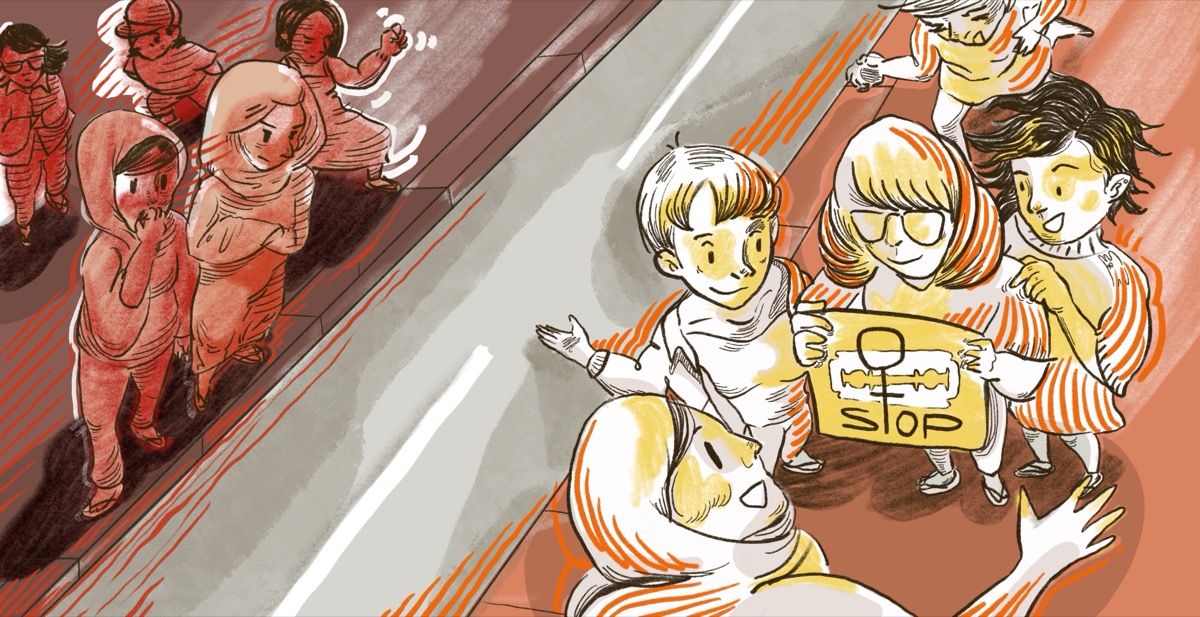
    “Do you want to join the End Sunat Perempuan group?” someone asked me. I immediately said: “I don’t think so, but I’ll think about it.” And boy, were thoughts being thunk. Initially, I thought about how advocating against Female Circumcision during a pandemic sounds a bit distasteful. Shouldn’t we focus on other issues that are more important? I just left my job because people started to report my social media account to my organisation, do I really want to draw that kind of attention to myself and potentially affect my livelihood again? How will the Muslim community take this? I had to ask myself so many questions. 

    But at the end of it, I always arrived at the same questions: “Do I think Female Circumcision is wrong?” Yes. Undoubtedly. When I found out that I was cut as a child because society didn’t want me to be promiscuous, I felt rage. When I found out that there were alternative views by prominent scholars in Islam, I felt betrayed that I was fed myths. “Do I want to put an end to female genital cutting?” Yes.

    And then, I started to find more answers. There are so many issues in the world, and even if we solve the ones that are ‘more important’, other ‘more important’ issues will come up. And issues arent mutually exclusive; I can (and I am) working on more than just ending FGC in my time. I work to end unemployment, I work to help the elderly, I work to support women, I work to support queer Muslims, I work for mainstream Muslim rights, I work to end Islamophobia and racism. I do talk about ‘more important’ issues. In any case, if we have this mentality of ‘more’ or ‘less’ important, the ones deemed less important will be swept under the rug almost indefinitely because it will never be important enough to anyone. And the only issues that are not important enough to us are issues that do not affect us personally. Not realising that I am unaffected by this issue would be not realising my privilege, and not speaking about an issue just because it doesn’t affect me would be selfish, and an abuse of my privilege. That wouldn’t be right. I am not here to be self-serving.

    No matter what I talk about, there will always be someone who will disagree. No matter what I talk about, eyes are already on me whether I like it or not. Will it affect my livelihood? The income that I earn or the people I mix with? Maybe. But if I’m not allowed to have my own voice and opinions with my friends and relatives,  then they probably aren’t very good company. If they cannot give me the benefit of the doubt to assume that I am trying to do what is right and immediately assume that I’m doing what I do out of bad faith, naivety and lack of education, then I’m not sure that I’m the problem. 

    How will the Muslim community take this? Probably not well. But what do I expect? I don’t doubt that my community did this out of good faith. They genuinely think/thought that FGC is medically beneficial and religiously necessary and they just did what they were taught was right. Now, I am telling them that something they’ve believed to be good all this time is not and that they have done something undesirable to their children. This is a tough pill for anyone to swallow and I have to understand that this will not be an easy transition. I have to respect their feelings and give the community the space to process what we are fighting against too. I’m sure that those who want to do what’s right will at least give us a chance and hear us out.

    I decided. I want to join the End FGC group.

     ” يٰۤـاَيُّهَا الَّذِيۡنَ اٰمَنُوۡا كُوۡنُوۡا قَوَّامِيۡنَ بِالۡقِسۡطِ شُهَدَآءَ لِلّٰهِ وَلَوۡ عَلٰٓى اَنۡفُسِكُمۡ اَوِ الۡوَالِدَيۡنِ وَالۡاَقۡرَبِيۡنَ​ ؕ اِنۡ يَّكُنۡ غَنِيًّا اَوۡ فَقِيۡرًا فَاللّٰهُ اَوۡلٰى بِهِمَا​ فَلَا تَتَّبِعُوا الۡهَوٰٓى اَنۡ تَعۡدِلُوۡا ​ۚ وَاِنۡ تَلۡوٗۤا اَوۡ تُعۡرِضُوۡا فَاِنَّ اللّٰهَ كَانَ بِمَا تَعۡمَلُوۡنَ خَبِيۡرًا‏ “

    “O believers! Stand firm for justice as witnesses for Allah even if it is against yourselves, your parents, or close relatives. Be they rich or poor, Allah is best to ensure their interests. So do not let your desires cause you to deviate ˹from justice˺. If you distort the testimony or refuse to give it, then ˹know that˺ Allah is certainly All-Aware of what you do.”

    Surah An-Nisaa – Verse 135

    Predictably, we had bad days. At one point in time, a large part of the community started attacking us. “Kafir”, “Sesat”, “Pandai-pandai”, “Problem-makers”, “Naive”- so many heavy terms were thrown around so lightly. It was personally difficult for me because I had relatives talking about me and I foresee that they will bring it up during family gatherings in the future. I had a family member speak about me on her very public platform, exposing my identity, without my consent. I had someone who I considered a friend, indirectly speaking about us on their podcast that had so many followers even though we have offered to speak with them about this issue on their platform way before it blew up. It was quite hurtful, and I foresee that this will happen again sometime soon. 

    But the work continues. The End FGC group continues to churn out Social Media posts to promote critical thinking. We come on different podcasts and have discussions about this with various government leaders, officials. medical professionals, asatizah and the community. We successfully conducted 3 webinars: A panel of parents who decided not to cut their daughters, a workshop for FGC survivors and a panel with Asatizah. The panel with the Asatizah was especially touching for me. We had 400 sign-ups and the asatizahs filled me with a sense of hope. It reassured me that I’m not what all these people are calling us, that I’m not baseless in my beliefs.

    In the pursuit of justice, especially when what we advocate for goes against the norm we have been raised with, many people will belittle our faith in God and our practice of Islam. And sometimes, that gets internalised, and it affects my relationship with God. But I always find myself being reassured that I do have a basis for my beliefs and that Allah will always be aware of what I do, why I do it and what my beliefs are. He will for sure know that I’m trying my best to do right by Him, and that is enough for me. Nobody gets to speak on behalf of God in my personal relationship with Him.

    I’m incredibly grateful to have been chosen to partake in this cause for justice. I recently looked back at a piece I published in a book as a teenager about FGC. 

    “So I take strength in the fact that I am now more informed. I will continue to search and equip myself with knowledge and wisdom, so that one day I can do my part in ensuring other girls won’t get treated the way I was, God willing.”

    Hey, 18 year-old me. God Willed.

    __

    ‘A is a part of the End FGC SG working group and wants to have a part in bringing back critical thinking, intellectual discussions and compassion in the Muslim community. She hopes that in this process, one day, Sunnat Perempuan can be permanently stopped as well.

    Illustration by Ishibashi Chiharu

  • Editor’s Letter: Justice

    Editor’s Letter: Justice

    It is without a doubt that justice is one of the most foundational aspects of Islam. When I think of Islam, I think of the fact that it is a religion that was revealed to our Prophet Muhammed (peace be upon him), someone who fought resolutely throughout his life against tribal injustice and steadily worked to introduce reforms to improve the material conditions of women. 

    In the Qur’an, the words qist and adl give us an understanding of what justice means within the context of Islam. Qisṭ refers primarily to its application within the socio-economic domain, whereas ‘adl refers to an essential quality of fairness, equality, and divine justice that can be emulated and practiced in our interactions and behaviours. The Qur’an thus offers an understanding of justice that is directed towards society as well as the self and others, one that is systemic and societal as well as personal.

    This duality makes perfect sense to me: in order to change and improve society, it is important that we also work to improve ourselves, and even as we work on changing our own behaviours, it is important that we do not close our eyes to the injustices of our society and the world around us. In fact, often times when we look closely enough to the suffering and injustices that we face, we see that it is linked to the suffering of others. We do not struggle in a vacuum or in isolation. We struggle under the same system that benefits from us being isolated and passive, accepting of our lot.

    Throughout his life, the prophet exhibited this duality. He not only embodied justice through his fairness, kindness and just behaviours even to his enemies, but he also stood resolutely against injustice in his own community. He was not a passive bystander by any means and actively participated in speaking up to power and standing for the oppressed. His approach was also significant since he moved away from punitive methods of settling conflict and harm in favour of consultation and reform. This reformist and non-punitive approach to justice is reflected in a submission to our series by Ryaihanny Sahrom about why Prison Abolition is a Muslim Issue.

    I have constantly sought comfort in remembering the Prophet’s (PBUH) behaviour. He was a person who had to struggle his whole life within a society that had a predatory, capitalist economic system. In its place, he had instituted within Islam a more socialist ethos of wealth redistribution and the belief that the well-being of all was a collective responsibility. When it came to the condition of women, even his own sahabah were at times resistant to the reforms that he wanted to enforce, indicating just how radical his vision was and how fierce his commitment was to justice. He was constantly moving against the tide of opinion and behaviours and practices that society was uncomfortable in addressing and questioning. It is not an easy task. Similarly, I am inspired by the pieces by ‘A and Anisah in their commitment to speaking up about female genital cutting in the community as well as the “hijab issue” respectively. ‘A’s vulnerability in sharing the mean-spirited comments that she has received due to the passion she has in challenging harmful practices moved me deeply. Here is a young woman who has chosen to speak up, even at personal cost, and I am moved too to know that she has found an accepting community who can support and do this work with her.

    I take comfort too in the following verses in Surah Al-Nisa:

    O you who believe! Stand firmly for justice, as witnesses to God, even as against yourselves, or your parents, or your kin, and whether it be (against) rich or poor; for God can best protect both. Follow not the lust (of your hearts), lest ye swerve, and if ye distort (justice) or decline to do justice, verily God is well acquainted with all that ye do.
    – Surah Al Nisa’ (4), Aayah 135

    I see in this the call for a commitment and dedication to justice so pure and devoted to the universal value of a human life and their rights, that it is imperative to disregard hierarchy in any form—whether within the family, within socio-economic standing, or within society. It is a beautiful reflection of the concept of Tawheed, where all are equal before God. Hierarchy in itself, I believe, is vulnerable to perpetuation of injustice.

    I have learned from the Islamic conception of Justice that in order to live in this world, we must engage with our community and its political realities. My faith is not simply about a transactional relationship with God where I do good deeds with the sole desire to enter heaven. Instead, I see my faith as giving me guidance on how to live in a difficult and painful world, it gives me guidance on a path of struggle, of jihad, against the many injustices that are perpetrated against vulnerable communities.

    There’s been a strange thing I’ve been doing after my daily prayers. As I sit on the mat and supplicate, my usual requests for contentment, safety, and direction for myself and my loved ones have steadily been replaced by larger requests that are no longer individual in nature. To me, in a period of such intense suffering as this pandemic had brought, it felt insufficient and empty to request for only myself and my loved ones.

    When I was young the concept of prayer has always been about requesting for myself and for others, but these requests are always somewhat personal and largely individual in nature. There is of course strong encouragement to pray for others, but they were still largely individual requests—I pray that my grandmother will get better, I’ll pray for my friend’s recovery, I’ll pray for my family’s security, I’ll pray for late relatives. We don’t really ask for bigger things that are more structural in nature. Can I pray for universal healthcare? Can I pray for a world without fascist leaders? I have been doing that these days, even if it feels strange and impossible. Why be stingy in your requests the one who can make all things possible?

    It sounds strange, but I ask for the collapse of our current system that sacrifices the lives of the poor and marginalised, and pray for a world where all can have an opportunity to thrive. I pray for the end of the pandemic, that humanity survives climate crisis, and that we can bring forth a way of organising ourselves and our society that prioritises universal access to basic necessities and human rights.

    As we ride out a pandemic that has seen mostly the poor and marginalised bearing the brunt of political failures, where vaccines are hoarded by richer nations and lacking in poorer ones, where the disease of racism has resulted in attacks against South Asians in Singapore, I think it is as good a time as ever that we take a deep look into how committed we are to journey of justice. To survive this pandemic as a global family, to survive climate change, to survive the persistence of poverty, and bigotry in all its forms, I cannot imagine a journey more imperative than the journey towards justice.

    __

    Illustration by Ishibashi Chiharu