Category: Hijab

  • The Time I Fought for Justice and The Hijab

    The Time I Fought for Justice and The Hijab

    by Anisah Kader

    I have always heard or read stories about Muslim women and the discrimination they faced
    with their hijab on. In fact, all these stories I have read about were from other countries. I
    never thought, right here, in Singapore, I would actually experience such discrimination, but I
    did. It was an unforgettable moment that would change my life.

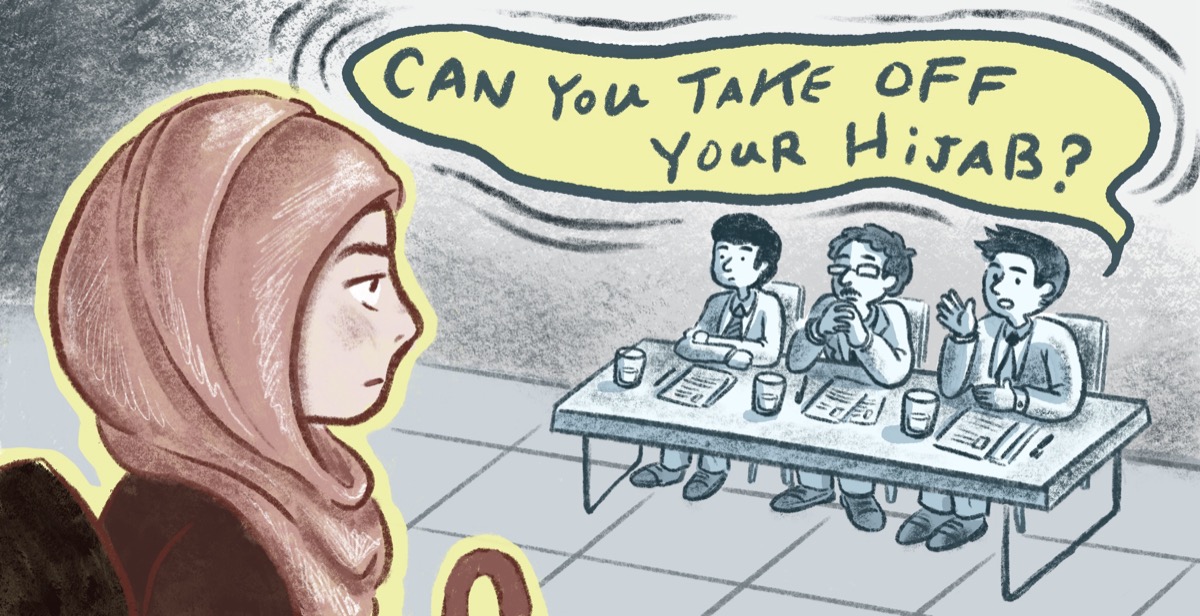
    I always wanted to step foot into the social service sector as my passion lies in counselling, advocacy and social work. I had even quit my full-time nursing job to pursue my passion and I was honestly so excited about it. However, after 3 interviews, I realized a common concern: my hijab. In all 3 interviews, they asked: “Can you remove your hijab?”.

    “But why?”. I was so confused. What did my hijab have to do with the role? All I wanted to be was a role model for at-risk youths. Why do I have to remove my hijab?

    The thing that baffled me most was how casual the tone was whenever they asked me to
    remove the hijab, as if they did not realise how insensitive their request was to me. One of the interviewers even proceeded to ask, “but you don’t wear it when you were a nurse right?”. Again, what has this got to do with the job I am trying to apply for?

    This whole experience honestly broke me. I felt very demoralised and even had thoughts of removing my hijab. I spoke about this to my sister and friends and they all told me to let it go. To walk away from the organization.

    I tried to but I could not just sit still anymore. I did not want to remove my hijab, not without a valid reason (for e.g., infection control in healthcare settings). So, I mustered up the courage and wrote an email to these organisations explaining nicely the significance of the hijab to a Muslim woman and how it is inappropriate and culturally insensitive to ask her to remove the hijab for a role that does not require one to do so. I went on to state that such a request is simply unacceptable in this day and age and it is important to educate ourselves culturally.

    It then also hit me that if this was being asked to me, is this also being asked of other Muslim
    females who don the hijab? I wanted to find out.

    I took this over to my then public Instagram account and even shared my story to Minority Voices and this really helped to gain the public’s attention. However, I remembered how heavy it made me feel inside when other girls started sending me in DMs sharing their own experiences of discrimination and how it is happening in various sectors as well—schools, public sectors, etc. I had to do more. We cannot be silenced anymore. Therefore, I did my research and reached out to TAFEP for help. I gathered necessary hotlines and work attire standards as stated by MOM and shared them on my Instagram and to these girls personally as well so that they may take necessary action. However, most of these girls shared that they did not want to make this an issue because of the fear of losing their job.

    Therefore, I continued to push TAFEP to make a bigger change and I wrote in to MSF to inform them on the such dress code standards as well. To cut things short, 2 of the organizations have now officially changed their dress codes and have allowed Muslim females to don the hijab to work. The other organization has refused to take further action.

    Honestly, pushing for this matter is so important to me because no one deserves to be denied a job opportunity just because of their religion or what they wear on their head. This whole experience has also made me stand up for what is important, and it has allowed me to use my voice and, allow me to speak out for the ‘voiceless’. I genuinely hope the society will take more efforts in educating themselves on the importance of multicultural awareness and sensitivity. I hope for a society where Muslim women do not have to feel fear or feel ashamed of their hijab. I hope we can all learn from one another and respect all cultures equally.

    Today, I am still fighting for this as much as I can. Even though, I am no longer active online,
    I do my best by educating the people around me first, educating the Youths I currently work
    with and I hope to suggest talks (importance of multicultural respect) in my own organization
    as well.

    At the end of the day, I am not giving up just yet. I want to spread awareness as much as I
    can and I hope this platform with help with that as well! Because you see, the work does not stop here. It will never stop. It is a continuous battle, but it is a battle one cannot fight alone in. I need you – yes you, the one who’s reading this.

    I am grateful for the changes that will take place with regards to donning the hijab in the work places. I am grateful for the Government – that they are now giving importance to it. However, what happens after that is where the actual work takes place. 

    Implementing a change in dress code may be done but the key lesson here is, to understand the significance of the hijab. What does the hijab mean to Muslims? Are you aware of that? If you had answered no, then let us close this gap today.

    The hijab does not only mean a religious practice. It means modesty, respect, a personal journey the female Muslim chooses to go on. It could also mean many different things to various women – but, regardless of what it means, it is something that has to be regarded. It is not something you can tell a woman to remove. The hijab is a part of her identity and you need to understand that. 

    When you have understood the significance of the hijab, then you have chosen to be culturally sensitive. You have chosen to be culturally aware and you have chosen to stay informed. This is what I seek of you. I’m not asking you to read up on the history of how the hijab was first introduced to women, but I am here kindly asking that you speak to someone about your uncertainty of it. 

    If you lack information on it, please ask. Do not ever be afraid to ask and if you really cannot find someone in your circle to do so, please reach out to me. I will be more than happy to answer your questions ☺

    But moving forward, let’s start somewhere. Let us be respectfully curious, let us work towards gaining knowledge and staying informed and most importantly, let us practice kindness and empathy to the ones who may need it the most. 

    Also, as I close this piece, I want to say a final thing—the hijab should never act as a factor to identify someone’s capabilities. The Hijab is a part of one’s identity, it is more than just a dress code. Please do not reduce its significance to anything lower than that. 

    I will continue to stay firm, be strong and work my way up with my Hijab on and I urge all of my ‘Hijabis’ to do the same too. We got this, ladies! 

    __

    Anisah is 28, an introvert, and a counselling graduate.

    Illustration by Elisa Tanaka
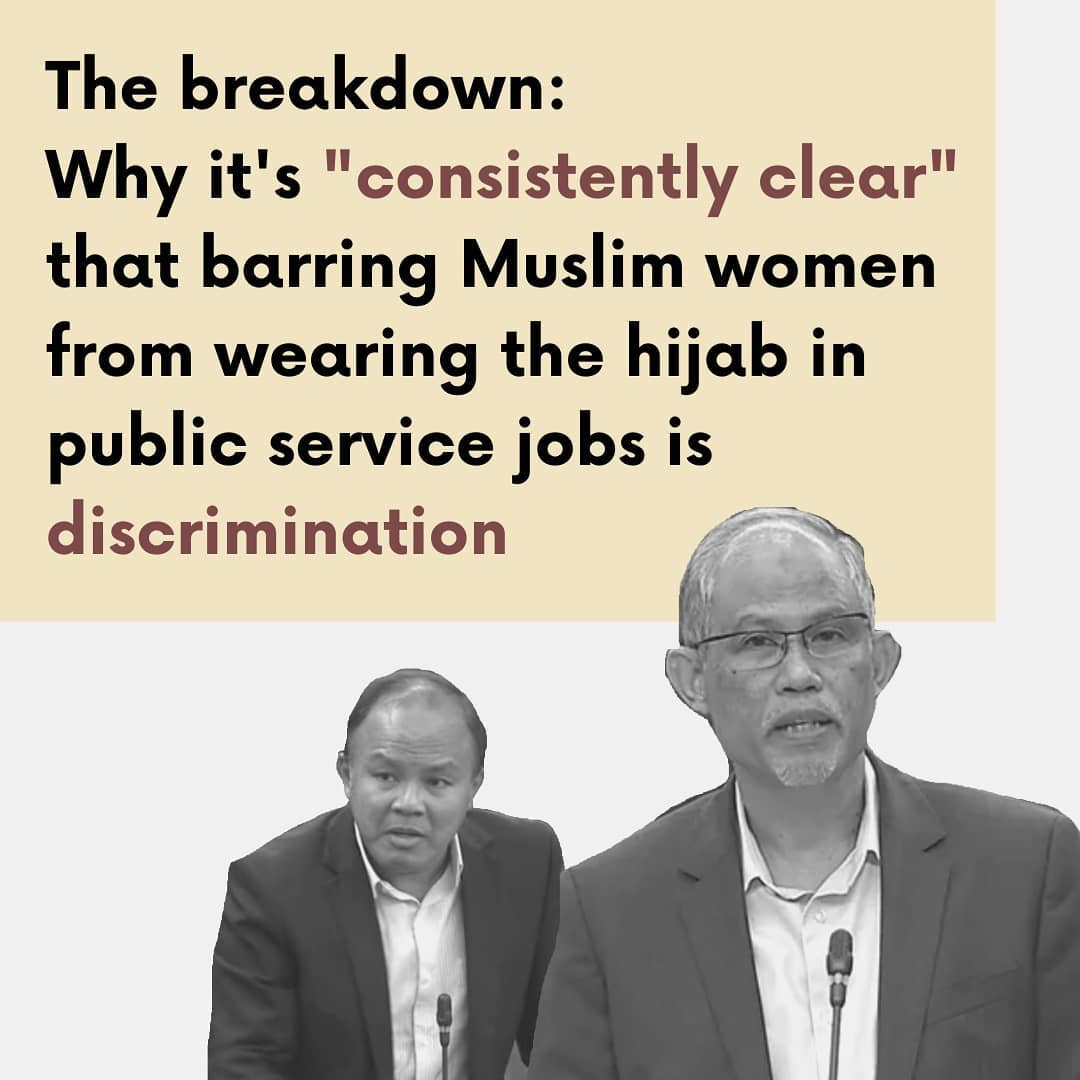
  • The breakdown: Why it’s “consistently clear” that barring Muslim women from wearing hijab in public service jobs is discrimination.

    The breakdown: Why it’s “consistently clear” that barring Muslim women from wearing hijab in public service jobs is discrimination.

    During parliament’s Budget Debate on 24 Feb, MP Faisal Manap raised the issue of current legislation which does not allow Muslim women to wear the hijab in certain public service jobs, such as nursing or law enforcement. Mr Manap argued that this rule has deterred many Muslim women from taking up such roles.

    On 8 March (International Women’s Day), Minister Masagos Zulkifli responded that uniform policies in the public services are meant to ensure that “service is rendered equally regardless of race or religion”.

    He continued: “Allowing tudungs will raise a very visible religious marker that identified every tudung-wearing female nurse or uniform officer as a Muslim…We don’t want patients to prefer or not prefer to be served by a Muslim nurse, nor do we want people to think that public security is being enforced by a Muslim or non-Muslim officer.

    Mr Masagos also labelled the issues as “complex” and “sensitive” and reiterated the PAP’s approach of “careful closed-door discussions”.

    He added that “public aggressive pressure” can only make compromise harder – possible in reference to many previous public campaigns and petitions asking for this rule to be reviewed.

    There are a few reasons why these statements are problematic and are continued attempts to defend an inherently discriminatory policy.

    1. Barring Muslim women from wearing the hijab is not a fix for workplace discrimination
    2. Characterising the issue as “sensitive” implies that opposition to the hijab ban is disruptive by default, shutting down attempts at open discussion about it
    3. Insisting on “closed-door discussions” with representatives excludes open consultation with Muslim women who wear the hijab and relegates their autonomy to others who may not fully represent their interests
    4. This policy is a form of gendered discrimination which disproportionately affects minority women (who already experience multiple forms of marginalisation)
    5. Discussing the hijab as a threat to secularism and the racilisation of public service frames the hijab as a political issue rather than a personal religious choice
    6. Characterising public pressure as “aggressive” and saying that it “only makes compromise harder” undermines citizens’ rights to campaign against and discuss policies they disagree with while framing advocacy as something which “harms minority communities”
    7. There is little to no evidence that hijab affects work practices in the healthcare sector. Muslim nurses wear the hijab while maintaining hygiene standards in Canada, the UK, Australia and many other countries. In Singapore, many Muslim public doctors wear the hijab and still fulfill their professional requirements. However, this rule somehow does not apply to nurses.

    Policies which discriminate against any minority groups, and Muslim women in particular, extend beyond the harm caused to any individual and has the effect of further entrenching the marginalisation of these groups. The reality is that many Muslim women, when faced with this dilemma, elect not to take up opportunities or choose to leave their jobs rather than to give up on what they see as a crucial part of their religious obligations. Creating space for Muslim women to wear the hijab at work would encourage greater participation in the workforce and in society, without for forcing them to choose between practicing their religion and earning a livelihood.

  • Wearing the Hijab at Work

    Wearing the Hijab at Work

    The Tripartite Alliance for Fair & Progressive Employment Practices (‘TAFEP’) is currently investigating an incident in which a hijab-wearing woman (‘hijabi’) working as a promoter at Tangs was asked to remove her hijab. Tangs had initially taken the position that this was a case of miscommunication regarding the company’s dress code and grooming standards to the sub-contractor. However, this incident is bigger than a simple issue of communicating guidelines and is part of a larger pattern of discrimination and exclusion that hijabis often have to endure in the job market.

    Hijabis often face barriers when applying or interviewing for jobs and have anecdotally reported that they are sometimes passed over for opportunities because of their headgear. Even when they are offered jobs, the hijab is subjected to added scrutiny and judgement over whether it is considered “professional” attire. This has material impact on hijabis when they are denied jobs because of their appearance, feel obliged to defend their choice of clothing or lifestyle, or have to expend more energy to overcome implicit biases of their colleagues or employers.

    It is also worth interrogating why the instinct was to assume that the hijab is seen as “unprofessional” or even subject to be scrutinised in this first place. What are the assumptions about the hijab and those who wear it that need to be questioned and unlearned? Are hijab-wearing women any less educated, committed or capable than their counterparts?

    Employers or policymakers who offer explanations that the hijab and other religious garments cannot be allowed because Singapore is a secular country signal that personal religious garments pose a threat to our secularism in some way. These justifications frame the hijab as a political issue rather than a personal religious choice and serve as a basis to validate policies which unfairly discriminate against hijabis.

    Policies which discriminate against any minority groups, and Muslim women in particular, extend beyond the harm caused to the individual in question and has the effect of further entrenching the marginalisation of these groups. The reality is that many Muslim women, when faced with this dilemma, elect not to take up opportunities or choose to leave their jobs rather than to give up on what they see as a crucial part of their religious obligations. Creating space for Muslim women to wear the hijab at work would encourage greater participation in the workforce and in society, without forcing them to choose between practicing their religion and earning a livelihood.

    We are encouraged that TAFEP is seriously investigating this incident and urge other women to seek support if they face instances of discrimination at the workplace because of their religious beliefs. If you are facing or are aware of any such discrimination, you may make a complaint to TAFEP, or consult AWARE’s Workplace Harassment and Discrimination Advisory.

    Hijabi women should be allowed to practice their faith without being discriminated against. Until we have comprehensive anti-discrimination laws in the workplace, it is up to us to look out for each other and call these instances out when we see them.

    —
    Edit: Tangs has recently issued statement that it now intends to allow all front-line staff to wear religious headgear. We encourage all companies to similarly review and revise any policies which unfairly discriminate against Muslim women or any other minorities.

  • The Hijab Syndrome

    The Hijab Syndrome

    By Zuby Eusofe

    I started wearing hijab when I was 27. When I was in my 50s, I stopped.

    Some people may think I am going senile for removing my hijab at this age. But I had learnt that hijab is more than just the piece of cloth that covers one’s modesty. To me, hijab is more than just a dress code. Hijab pertains to one’s definition of modesty and one’s perspective of being a righteous Muslim – woman or man. My hijab is about my moral ethics and my conduct, be it alone or around others, Muslim or not.

    Before I go on further, let me reiterate that this article is purely within the capacity of my personal observations and limited knowledge about hijab. I value your patience and understanding in reading this.

    The late Fatima Mernissi, a renowned Muslim woman scholar and feminist of the 21st century stated: “The most precious gift God gave humans is reason. Its best use is the search for knowledge. To know the human environment, to know the earth and the galaxies, is to know God. Knowledge (science) is the best form of prayer.”

    And through reasoning, I have come to my own conclusions about hijab. It is my hope that sharing my perspective will help clear our conscience about hijab, and open the hearts and minds of all women to use reasoning in approaching their faith or religion.

    In reframing my understanding of hijab, I first look at its history before the revelation to Prophet Muhammad PBUH.

    ‘Hijab’ or the veil is a practice that precedes Islam, tracing back to early civilizations. Archeological artifacts of Roman and Greek art such as pottery fragments, paintings or recorded civil laws reflect the practice by both men and women in religious contexts. The tradition of veiling (by women) and head covering (by men) was adopted by the Jews, as way of respecting “the continuing custom for thousands of years” and later, by the Christians. To this day, Jewish and Christian woman cover their heads in many religious occasions and festivities. After the passing of Prophet Muhammad PBUH, the writers of the Hadith adopted and encouraged this ancient tradition of head covering.

    Irrespective of religion, Arabs wore hijab, the head cover because of tradition. Tradition too, rather than Islam, directs men in Saudi Arabia to cover their heads. In North Africa, the Tuareg tribe has their Muslim men, not the women, wear hijab. In sum, hijab is a traditional dress that in origin has nothing to do with Islam or any other religion.

    Yet today, hijab is largely understood as a head covering that is obligatory upon every Muslim woman.

    ‘Hijab’ is the term used by many Muslim women to refer to their head cover that may or may not include covering their face except their eyes, and sometimes covering only one eye. ‘Hijab’, an Arabic word, can be translated as ‘veil’ or ‘yashmak’. Other translations include ‘screen’, ‘cover(ing)’, ‘mantle’, ‘curtain’, ‘drapes’, ‘partition’, ‘division’, and ‘divider’. None of these ‘hijab’ words are used in the Quran in reference to what the traditional Muslims consider to be the dress code for the Muslim woman.

    There are three rules for a woman’s dress code in Islam that are stated in the Quran:

    1. The Best Garment: “O children of Adam, We have bestowed upon you clothing to conceal your private parts and as adornment. But the clothing of righteousness – that is best. That is from the signs of Allah that perhaps they will remember.” (7:26)
    1. Cover Your Bosoms: “…and not display their beauty except what is apparent, and they should place their khumur over their bosoms.” (24:31)

    Some traditional scholars quote this to mean hijab, or head cover, by pointing to ‘khumoorehenna’ (from ‘khimar’). The early mufassirun (scholars who were expert transliterators of the Quran) can see that ‘khimar’ in this verse is not interchangeable with ‘hijab’ or head cover. Moreover, those who quote this verse include the addition of ‘(head cover)’ after ‘khumoorehenna’.

    However, here, God instructs the women to use their khimar (which can be a dress, coat, shawl, shirt, blouse, tie or scarf) to cover their bosoms, not their heads or hair. If His instruction had been to cover their heads or hair, He would have indicated it clearly.  In short, it is my understanding that God did not order the women to cover their heads or hair.

    The word ‘zeenatahunna’ refers to the woman’s beauty that can be exaggerated by bodily movements. God instructs women not to strike their feet to show their ‘zeenatahunna’. It is important to remember that striking the feet while walking does not have an effect on the head, hair or face; they are outside of what God means by the hidden zeena (adornment/beauty).

    1. Lengthen Your Garments: “O Prophet! Say to your wives, your daughters, and the women of the believers that; they should let down upon themselves their garment.” (33:59)

    When I reflect on this verse, I understand the great wisdom of the Most Wise, Most Merciful. In this verse, God deliberately said only to lengthen their garments. Out of His mercy, God excluded any specification of how long for us, his believers. God knows that we would be living in different communities and have different cultures and insists that the minor details of this dress code to be left for the people of every community to fashion for themselves.

    It becomes clear to me from the above verses that according to the Quran, the dress code for the Muslim woman is modesty. God knows that this modesty would be understood differently in different communities, thus left it open for us to decide for ourselves. What is deemed modest for a Western woman may not be so for a Middle Eastern woman. Likewise, modesty for the Middle Eastern woman may not be accepted by an Asian woman.

    The breadth in understanding modesty is well known to God, our Creator who put no hardship on us in this great religion. God left it open for us to decide what modesty would be and no one – scholars or otherwise – has the authority to dictate or restrict it. Modesty is also to carry oneself humbly with others (24:30-1) and one’s behavior and good conduct (4:36).

    For example, reflecting on the verses 33:35 and 24:60 shows me that God permits women to relax their dress code in the family setting. God did not provide details of what this relaxation is because every situation is unique. Having said that, I think I have the right to relax in front of my own family.

    It is pointless to don the hijab for the sake of God if one continues to judge fellow Muslim sisters for not doing the same. Donning the hijab then does not make one a better Muslim. Serving God – being kind, sincere and good to all of God’s creations is to me, what makes one a better Muslim.

  • How to throw a party in a hijab

    How to throw a party in a hijab

    By anonymous

    I. The Period Party

    The Muslim equivalent of the legal drinking age
    is when a woman has her period for the first time.
    It is when you become truly human, Woman
    so when I first had my period:

    I heard that God started a countdown.
    I heard there was a party involved.
    I heard that there was a giant holy pinnata labeled “religious adulthood”
    and that God got really wasted and struck one of those
    high-striker machines at carnivals and a pinging sound
    erupted through the heavens and he won top score
    and he pointed to the biggest yellow minion plushie and said
    “I want that one” and I heard that my face was pinned
    onto Lucifer’s dartboard
    and he started a holy war against me;
    and all the angels started chanting my name
    to the tune of Tom Jones’ She’s A Lady.
    because I was a lady.

    Basically it’s kind of a big deal.

    I had to start wearing sanitary pads. Like a lady.
    I had to start wearing my heart on my sleeve.
    I had to start wearing sleeves, the scholars told me,
    cover up, start with your skin, you are mostly skin.

    2. A Sinister Party

    When you first have your period,
    your sins would unravel, decode themselves,
    they learn to walk on their own,
    they run away from your childhood leash
    and when you’re not looking
    they fuck other sins behind the bushes
    and make little baby sins that grow up
    and form a sin army. (A sinarmy.)

    My sins learnt new words by the time they were two.
    Started talking back to me,
    laughing at how silly I look, a jumble of contradictions
    that don’t match, this living, breathing quilt,
    shreds of old rags and blankets that made up my body.
    They said things like “You are accountable for us now,
    all your shedding blood
    means that you are losing the weight of stars inside you.”

    So I counted my sins like they were stars.

    I counted the square inches of skin I exposed to each lick of hell fire.

    I counted the undignified desires that knocked on my door
    and barged into my bedroom and demand to be pleasured.

    I counted the number of times I masturbated in a day
    (Once before Zohor and twice after Isyak)
    and I made promises into my pillow
    that I wouldn’t do it anymore.

    I broke holy promises daily. I lied to God.
    I knew if I kept it up, I would get blacklisted from heaven.

    4. A Pity Party

    So I shroud myself in several pastel shades of cloth
    around my head determined to be the complete portrait of woman
    And I listened to punk rock that told me to liberate, fuck it all,
    the system is sick, fight against the man, you are bigger than what you’ve been told.
    I prayed five times a day, Alhamdulillahirabbil ‘alamin
    kissed the prayer rug like it was a lover,
    like I couldn’t rely on anything less than godly.
    And I started bookmarking my favourite porn fan fiction
    so I knew where to flip straight to for a mid-afternoon quickie.
    And I started reading the Quran, dragged through each syllable
    and inflection as if I understood every throaty word.
    And I started saying “Fuck” more, flipping off more, and subscribing
    to concepts that once seemed culturally absurd like…..evolution.

    5. The Microaggressive Party

    “Aren’t you hot in that?
    “Why don’t you take it off?”
    “Ohhhh you look so pretty without it!”
    “Are you like, religious?”
    “Oh if we give you the job you can’t, you know, wear that thing…”
    “What are your thoughts on sex?”
    “What are your thoughts on boyfriends?”
    “What are your thoughts on men?”
    “Do you wear that thing at home?”
    “Do you ever, like, party?”
    “What are your thoughts on masturbation?”
    “Eh, minah tudung!”
    “Were you forced to wear it?”
    “Why aren’t you speaking Malay?”

    6. The Rock Show

    The first rock show I went to, I was trampled mid-way,
    after throwing myself into the moshpit, sweaty,
    covered in hormones, and too much cloth.
    There was silent confusion by the presence of a hijabi
    in their overnight queue, I could hear them thinking,
    WHY WOULD YOU WEAR THAT THING
    ON YOUR HEAD IF YOU LISTEN TO HARDCOREEEE MUUUUUSIC?
    It’s not hardcore, bruv, it’s just My Chemical Romance, calm yourselves.
    Because this scarf is cool and fancy in black around your neck
    next to studs and badges of Metallica and Skinny Puppy,
    but primitive around my head.

    Then it hit me. That this was no mere cloth,
    this thing, folded and pinned in the right way, brings with it
    too much: stitched within its seams is
    the silence of cerebral gears of strangers spinning, trying to reconcile
    my presence with my environment, trying to understand what kind
    of woman I really am without having said a word to me
    because I had a quilt of untold stories draped around my head,
    I was always a mismatch,
    I always belonged somewhere else.

    (What was I doing at the party?
    With other normal people who are dressed for it?
    What was I doing trying to be a newscaster or a radio deejay?
    Nobody wants to see my kind on their TV screens.
    What was I doing writing oral sex scenes secretly in my notebook,
    reading them back and touching myself after prayer so I didn’t have to wash the sins
    from my body because my body was magnet for dirty,
    and I’m supposed to be clean
    What was I doing in the comic book store,
    shouldn’t I be at home reading about Lucifer and his diabolical plan
    to ruin my life – shouldn’t I be speaking in an ethnic language,
    am I even allowed to walk by a bar,
    If I see a bottle of alcohol, will I start melting in horror
    Shouldn’t I get a job somewhere else,
    I don’t know where, but somewhere else they can’t see me
    because people are not ready to be greeted by those
    who look nothing like them.)

    7. How to party in anything

    It’s been two years since I lost God.
    But I found women,
    and I found men who stood by us.
    And I found those in between who
    were forced to pick one way or the other.
    And I found love and sex and hope and fire.
    And I found poetry and I found
    rock and roll.

    And for a long time I thought
    that I never found these things
    until I stripped back to my skin.
    But we are not contradictions worn on our bodies.
    We are not balancing acts,
    we are ruined and wrong and right
    at the same time,
    we are the crucifix dildos and the
    punk anarchist imaam,
    we are carnival high-striker machines
    and yellow minion plushies,
    The photograph on Lucifer’s dartboard is our selfie.

    We can coexist with ourselves
    without battle. We can stop justifying our existence
    and our tongues and the things we do to our bodies,
    because we are not conflicts meant to be solved.
    We are more than threads.
    We are more than the lines that we tread.
    We are finding our own angels
    and we are throwing parties so loud that
    God herself would want to gatecrash,
    get drunk and steal our vodka-cranberries.
    Because that’s how you throw a party.

  • Moving Beyond Homogenizing The Hijab: Part 2

    Moving Beyond Homogenizing The Hijab: Part 2

    By Nurul Huda Rashid

    Of late, the term ‘hijab’ has been used pervasively across different contexts of discussion, from that of religion, ‘Islamization’, the symbolic, in movements and representation, and especially in relation to the discussion of women, ‘Muslim women’. The latter is a most contested term as it is often relegated a single identity of a highly visualesque nature: that the ‘Muslim woman’ is a body seen donning a hijab, shawls of black or colors draped over the head and chest. The ‘hijab-ed’ body becomes a visual and ideological representation of the ‘Muslim woman’ – one largely shaped by an outsider perspective as opposed to stemming from self-definition – and inevitably so, used as discourse on issues concerning women and Islam. This sparks an imagination of ‘Muslim women’ as communities of the ‘hijabi’, defined solely by the visibility of the hijab, and in antithesis to it, the ‘non-hijabi’ or other. The dichotomous existence of these two imagined communities map them as visual opposites, and assumes a largely single narrative for each, one that focuses solely on the issue of hijab as symbolic identifier and definer, disregarding and nullifying all other possible narrative threads that make up ‘Muslim women’.

    The Hijab as Visualesque

    I believe that one of the reasons why it is so convenient to map the hijab onto the body of the Muslim woman is because of its highly visual nature. Google ‘hijab’ under ‘Images’ and you will be greeted with shawls of varying colors and styles, and the smiling faces of the women who don them. These are images from fashion blogs and vlogs posted by the users, alongside images posted by everyday Muslim women doing everyday activities. These women are often identified as the ‘Liberal Muslims’ or the ‘Moderate Muslims’ who integrate well with (secular) society. They have also evolved to become icons of ‘modest fashion’, a growing market in the fashion industry.

    Now, Google ‘Muslim woman’ and the images gathered will portray a distinctly different visual spread. Aside from some burst of colors and faces, the images mostly show women clad in black, donning a face veil or purdah – with their exoticized eyes – seen more as black silhouettes rather than selves. It is often these visuals that spark outcries of ‘Muslim women as oppressed’, living within a rigid system that forces them to cover up. I do recognize that this is sadly a reality in several contexts, but it is also important to note that these contexts are born out of highly patriarchal mindsets that sow the roots of discrimination into institutionalized Islam. It is thus unfortunate that the black hijab is visually equated to symbolize oppression when there are Muslim women who wear it willingly in other societies.

    Looking through these images of ‘Muslim woman’, you will also see the ‘random’ ‘non-hijabi’ woman, a stark reminder that the category of ‘Muslim woman’ cannot be visually pigeonholed, as it often is. But what is made evident is that the Muslim woman is a highly visible body and its visualesque nature is identified primarily by the hijab. The effect of this is twofold: that we, as a society, begin to identify the hijab as equated to a certain definition of Islam and what it means to be a ‘Muslim woman’, and secondly, that the hijab becomes a (symbolic) marker of how society (at large) views and expects a ‘Muslim woman’ to look like, and what they experience. This means that we begin to govern the Muslim women’s body into fitting a certain visual expectation, which inevitably transforms into symbolic and ideological constructs. In doing so, we visually create archetypes of the ‘hijabi’ and her other – she who doesn’t wear the hijab – as binary identities within the Muslim women community, each defining and at the same time, isolating the other. What is also unfortunate is that the other is sometimes left out in this imagination of the ‘Muslim woman’ or ‘hijabi community’ for her visual lack of a hijab, rendering not only her experiences excluded, but her identity, invisible.

    The Hijabi and her Other

    As someone who dons the hijab, perhaps I can firstly speak from the vantage point of a ‘hijabi’, a term I have never attributed to myself for I find it redundant, categorical, and frankly, rather hipster. But for the sake of this discussion, I temporarily will. I personally believe that there is no such thing as a ‘hijabi community’. As above-mentioned, it is an imagined construct rooted in the visibility of the Muslim woman’s body and the visualesque nature of the hijab. She is ascribed certain qualities or characteristics, which are built on assumptions and stereotypes of her identity as ‘Muslim woman’. And somehow, she is often lumped together with her other ‘hijabi’ sisters, imagined to belong and identifying only with those like her, and in the process, othering those who aren’t.

    The women I meet in my Islamic Studies class all don the hijab but our conversations do not revolve around this juxtaposition of hijabi and other. Our conversations cover a large spectrum of topics, from that of Islamic studies to politics, social issues, everyday life and yes, the hijab. However, our conversations on the latter would usually be along the lines of, “Oh your hijab is nice! Where did you get it from?” or “How did you manage to pin it up this way?” or “What? It took you less than a minute to put this one! Oh, it’s stitched up and ready to wear! Where can I get one?” Our conversations have never revolved around ‘non-hijabis’ as the ideological or visual other for there never was a need for such a conversation, which in itself speaks volumes. This is because, it is a discussion that is only provoked when we are pit against our supposed other, and this provocation is one that comes from the ‘outside’ via questions such as, “Why do you wear hijab, but she doesn’t?”

    The above is a question that has spurred many discussions, especially alongside different interpretations of the Quran. Whilst it is necessary as part of larger Islamic discourse, it becoming a repeated point of argument is highly redundant, especially when it is predicated on the need to justify one person’s choices, by criticizing or judging the choices and experiences of the other. It entrenches the visual and ideological presence of the hijab as being a single identifier of the Muslim woman, and assumes that her narrative and lived experience revolves solely around it, whilst disregarding or underplaying the experiences of the Muslim women without hijab, as well as other aspects of their lives as Muslims and well, human beings. Therefore, this convenient dichotomy of the hijabi and her other brings about a rather skewed discourse in relation to women in Islam as it automatically robs agency from the Muslim woman, relegating her to the realms of visual objectification and the overly-symbolized.

    Hijab as Visual Symbol

    Symbols are a marvelous thing. But it is important to remember that they are constructed and are embedded meaning and power by those who can afford to do so: those with access to words to describe, explain, elaborate, and sometimes, exaggerate and exploit. Symbols also exist as highly visual and at times, do not really care for an ‘authentic’ representation of reality, which can be both beautiful and dangerous. And this is perhaps why the hijab has become a most symbolic entity, encompassing all the traits above. Its visual nature alongside a strong dichotomized other allows for it to be crafted as a perceived symbol and narrative of what makes a ‘Muslim woman’ or what is ‘Islam’, a view that both outsiders and Muslim women themselves adopt, a view that can be beautiful, but mostly dangerous.

    To some Muslim women, donning the hijab is perceived as symbolic of Islam, in that, it is not just a piece of cloth for it reflects their belief and desire to be seen as practicing their religion as Muslim women. This is why there are women who don their hijab despite circumstances. But this is also perhaps why it is possible to find some hijabis enforcing judgment on the others without hijab, as being non-practicing. On the other hand, to some Muslim women, there is no need to don the hijab because of its symbolic nature – it is just a piece of cloth – as what becomes more important are the core beliefs underlying it, rooted in spirituality. Some of them also perhaps use this as a means of judging those in hijab as being ‘extreme’ or non-inclusive. I address this not as a judgment of Muslim women, but because I do recognize that the dichotomies are created and disseminated not just by the ‘outside’ world, but also within the Muslim women community itself. We have bought into this visualized dichotomy of the hijab as identity and sometimes repeatedly use it as a symbol of labeling the ‘Muslim woman’. And this is perhaps the most dangerous, as this notion of the hijab as symbolic of Islam is deeply entrenched in societies where women are forced to bodily and symbolically perform their Islam-ness, by being forced to cover up. In this case, donning the hijab is not just seen as symbolic of being Muslim, but in more drastic terms, to not cover up is symbolic of being un-Islamic, and can incur a huge penalty, from punishments, to death. This is also evident in societies where Islamophobia persists, subjecting hijabis to constant fear or real threats and danger by those who see them as symbolic of ‘Islamophobic Islam’. The hijab as symbolic can thus be very dangerous.

    On the flipside, if these different interpretations of the hijab as symbolic churn varied narratives, intentions, and lived experiences within the Muslim women community, what does it then mean for the ‘outsider’? How do the rest of society begin to relate to and interact with the hijab as a symbol? This is possibly what movements like World Hijab Day and donning the hijab as acts of solidarity with Muslim woman is grounded on: the imagining of a ‘Muslim woman’ as solely being hijabi and thus, the rush to don the hijab as the only symbolic method of standing in solidarity with them. On one hand, such movements and acts can be perceived as having no real connection to what it actually means to be a Muslim woman because of its symbolic nature; also highly visualized and only representing a specific visible group. This is perhaps a most direct and convenient reading of such movements. It is however done to the point that we begin to undermine or undervalue the symbolic act of the non-Muslim women who perhaps are attempting to understand not just what it means to be a Muslim woman, but more so, what it means to be a highly visible Muslim woman, especially in societies when it is becoming harder to do so. I personally do not see it as a problem. In fact, I feel that it comes from a place of love as, although problematic, it recognizes what the symbol means for some, and attempts to stand alongside it. In that instance, it is about reaching out to be a part of the Muslim women community, as an act of inclusivity, a symbol most beautiful.

    On a final note, I believe that in order to fully understand the ‘Muslim woman’ entails a need to firstly recognize that she is beyond the symbolic, the dichotomies, and the visualized form she is made to embody. This is a most arduous task, even for the Muslim woman herself. The need to rethink this category of ‘Muslim women’ and their lived experiences requires a decentralization of the hijab as sole definer, departing from the visual and symbolic as yardsticks of measure to orchestrate and ostracize who, what, and how we experience and understand Muslim women in the context of today. Whose narratives and representations are we subscribing to? Whose authorship and agency defines the self? How can we begin to narrate and understand their lived experiences beyond the hijab? How do we begin to move away from the hijab as visual and symbol? Would that perhaps change the way we begin seeing and understanding the hijab? Is it possible to understand and perceive of Muslim woman beyond the presence or absence on her body? Women are constantly tied in a tango: between putting on and taking off, absence and presence. Perhaps if all these are critically re-evaluated, we might be released from our restricted notions of who and what make up ‘Muslim women’.

    __

    image credit:  Hijab/Her (2013). nuruL H. 

  • Moving Beyond Homogenizing the Hijab: Part 1

    Moving Beyond Homogenizing the Hijab: Part 1

    By Diana Rahim

    It seems like we never stop talking about the Hijab. Asra Nomani and Hala Arafa unearthed a storm of anger and debate recently with their op-ed in the Washington Post which went down bitterly for understandable reasons. Although well-meaning, they also came across as condescending and reductive, not particularly acceptable in a climate where Muslim women are condescended to enough from Islamophobes and misogynistic Muslim men without receiving it from fellow Muslim women as well.

    Of the storm of opinions that have bubbled up, predictably many have pushed people into diatribes. Few responses have captured the problem with the op-Ed, its responses, and the nuances that ought to be considered aside perhaps from this response, this one from Muslim feminists and these especially lucid thoughts by Sarah Eltantawi

    *

    Nomani and Arafa’s op-Ed infantilize and trivialize Muslim women who choose to wear the hijab, reducing the meaning of the veil to merely a signifier of a patriarchal expression of Islam that seeks to control female sexuality, and therefore dismissing any consideration for the personal reasons why women choose to veil (or unveil). They also make an alarmingly brash claim that the Wear a Hijab day (or World Hijab Day) movement “spreads an ideology of political Islam, called “Islamism,”” Yet a look at the aims of the movement show nothing to do with politics, and arguably nothing to do even with religion, but everything to do with confronting difference and fostering greater understanding and tolerance in an environment where Muslim women face discrimination due to their visibility when wearing the hijab. The movement can be closer categorized as sociological than Islamic, and saying that it promotes a strain of Islam as conservative and alarming as Islamism seems like an absurd leap.

    They are not wrong to point out that the hijab can and does feel oppressive for certain women, especially women who are coerced or forced into wearing it. To flat out reject the fact that the hijab has been connoted with oppression by women who were forced to wear it is to be wilfully blind. They are also not wrong to point out the semantics of the word hijab, and in fact I would agree with demanding a deeper understanding of the term ‘hijab’ as per written in the Qur’an and to point out misinterpretations, especially since Muslim jurists, dominantly male, have for centuries formulated discriminatory laws against women based on their own misogynistic interpretations of certain verses. Asma Barlas’s “Believing Women” in Islam does an especially good job at uncovering this.

    But educate every single woman about the semantics of the term (how infantilizing it is to think that women wear the hijab because they don’t know better) and you still won’t be given a world where all women will either be veiled or un-veiled nor a world where the choice to don the hijab would primarily be premised on theology. In fact, there are plenty of Muslim women who may agree that the Hijab is not in fact mandatory, but still continue to wear it anyway, simply because there are a host of other reasons that influence their choices.

    In this article listing the personal reasons why some women don the hijab, Shahzia Rahman stated that she started wearing the hijab in order to assert her identity as a Muslim and help counter negative stereotypes. Maria Ahmed continued wearing hers despite some unsettling experiences because she wanted to be an example to her children to “stay strong, remember who they are, know in their hearts that they’re not doing anything wrong.” None of these reasons are theological, but rather one rooted on identity. These are just two examples. There are hundreds of millions of Muslim women in the world, there is no way anyone can homogenize ‘hijabis’ as a category nor can anyone homogenize the reasons for veiling.

    To reduce the meaning of the hijab to merely the theological is to view it primarily through the lens of religion, a classically orientalist approach, one already used in many disappointing studies on Muslim women. Such an approach neglects to acknowledge Muslim women as complex beings defined by more than just the one factor that is their religion. Within our own context, Humairah Zainal had explicated how framing the Hijab debate in Singapore as a religious and racial issue ignores the fact that “women face multiple forms of discrimination at work with respect to the hijab.” There is a need, when talking about the hijab, to seriously understand that it is a discourse that can’t be framed solely through religion. Any discussion that does not understand this is doomed to fail.

    One is also hard-pressed not to notice the neo-imperialistic tendency to modernization theory in their letter where the veiled and the un-veiled are correlated with progress (modernity) and backwardness (tradition) respectively. They correlate a movement that believes the hijab to be a marker of modesty and dignity to be one that is already codified in places like “Saudi Arabia, Taliban Afghanistan and the Islamic State,” possibly the worst, most regressive places a Muslim woman could end up in. To call this hyperbolic would be an understatement. One would think there are worse things you could do to be related to the Taliban and ISIS than to say that you wear the hijab due to reasons of modesty and dignity.

    In the end, though Nomani and Arafa may be valid in requesting a problematization in associating the hijab with modesty, or in requesting an honest and in-depth look to what hijab truly means qur’anically, they ultimately deny Muslim women the agency to assert their own meanings for wearing the hijab. To decide unilaterally that to wear the hijab is to perpetuate an ideology of Islamism is to dismiss the multifaceted meanings the hijab has accrued and the personal reasons women have for choosing to wear it. They call themselves ‘mainstream Muslim women’ although it is clear that their understanding of the term ‘hijab’ is far from mainstream. Then there is also the question of mainstream in which context? The ‘mainstream’ Muslim woman varies vastly all over the world.

    *

    For women’s clothing to be so hotly debated is nothing new. The female body and female clothing has always been a site of contestation in power struggles, ideological or otherwise. Anglo missionaries who came to India in the 19th century worked together with British colonialists to urge women in the Nadar caste to wear more ‘modest’ clothes under a moral pretext — the female body becoming the site where the power of colonialism is exercised. The burqa was turned into a symbol of moral justification by western liberal-feminists for the imperialism and war in Afghanistan (something Afghan women’s rights activists have criticized). While in certain places the hijab can be seen as oppressive, in others it becomes a symbol on the re-assertion of indigenous identity in the face of western imperialism. Even within these places one can’t make such homogenous claims.

    In the end, the hijab is just a piece of cloth. The fact that it can mean vastly different things to different people throughout different times means that anything assumed about the cloth reveals more about the person making such assumptions than it does about the cloth itself.

    __

    image credit:  Hijab/Her (2013). nuruL H. 

  • Hijab Pressure

    From a few life experiences, I have deduced the following:

    Ways to encourage doning the hijab that work:

    1. Tell the person gently to don it for the sake of Allah.
    2. Explain the benefits.
    3. Share your personal struggles with the hijab and how you overcame it.
    4. Allow freedom of choice.
    5. Encourage; never force beliefs down her throat.

    Now, ways to encourage doning the hijab that do not work:

    1. Using fear and guilt-tripping. (i.e. Guaranteeing that she will drag her mother to hell for every strand of hair she shows to men; and that she will be hanged by the strands of her hair in hell.)
    2. Coercion. (i.e. Telling her – despite her having confided her predicaments to you – the reason she feels a gaping hole in her soul and the reason she is going astray is because she doesn’t cover enough from the gaze of perverted men.)
    3. Making her promise to cover up by a specific day of your choosing.
    4. Degradation. (i.e. Incessantly announcing to your children that she is going to veil herself, without even consulting her first.)
    5. Being rude and discriminatory. (i.e. Slut-shaming and warning your sons not to choose a non-hijabi like her for a spouse.)

    Let me tell you… I like being veiled. I love keeping up with the multitude of hijab trends, taught by hijabi Youtubers. I do quite enjoy how suddenly approachable Muslim women are to me, greeting me with warm smiles and salaams when they spot me in a hijab. I’m happy that now hijabis have greater representation due to the hijab going mainstream.

    However I really despise the culture which promotes that only women who are “modestly covered” are worthy of respect, whereas non-hijabis like me deserve to be treated with degradation and disregard. But what really hurts the most is when someone you (once) look[ed] up to thinks you’re not entitled to make your own choices.

    Till today, the Qur’anic verse that reverberates with the beating of my heart is the one my mom has always repeated to me: “There is no compulsion in the religion” [2:256]. That is a simple fact.

  • Coming Undone.

    Coming Undone.

    By Zubaida Ali

    My head is so wrapped up with silken lies
    As I walk this flimsy path of truths and untruths

    Will Allah love me more just because I cover my hair?
    Will Ibu, Ayah, all look up to me?

    I get burdened with so much guilt
    just because of this piece of fabric a mere two feet long

    My conscience pin-pricked with so many questions
    Who am I doing this for?

    As the lies unfurl
    I do not know where my true self begins
    and ends


  • more than this

    I had the pleasure of reading the article “Here’s whats wrong with your hijab tourism and your cutesy modesty experiments” a few days ago, and this passage in particular resonated with me:

    “These approaches reduce Muslim women to veiled, enigmatic symbols of Oppression; and whether you’re upholding the veil as symbolic of oppression or purporting to “challenge assumptions” about it, this is still a reductive, one-dimensional and over-simplistic view of how Muslim women experience their faith, their identity and their bodies. Hijab and niqab are positioned as central to our experience, such that the only thing one has to do to understand how Muslim women feel is put on the ‘costume’ of one. In a society obsessed with externalities it’s not terribly surprising that Muslim women’s lives are constantly reduced to the most salient external symbol of our identity; but it is frustrating and depressing. We are more than just a veil.”

    So true, and yet, I sometimes wonder if we Muslim women have somehow subconsciously equated ourselves to the veil. We bristle when what we perceive to be “outsiders” engage in this kind of reductionism, but are slow to see our own tendencies to do the same.

    So much of our own discussions on what it means to be a Muslim woman centre on the question of the hijab – from our debates on what can properly be considered a hijab, to whether there is a need to wear one at all, and how it shapes our identities. Every time we meet a new person, we size them up based on what they’re wearing, measuring faith in square centimetres of covered skin. We raise our girls to strive to wear the hijab, believing it is somehow the gold standard of piety. And then we expect the women who have donned the hijab to suddenly be paragons of virtue, free from all temptation, as if the hijab is some kind of miracle cure, a panacea to all the world’s ills. We are, quite frankly, obsessed.

    What is truly ironic is that we should expend so much time and energy defending the practice, and educating others about the purpose of the hijab – to guard our modesty, so people value us for the people we are and not for our appearances – only to run the same risk of valuing the appearance over all else. We want people to look at who we are behind the veil, but in our collective fixation, we have somehow lost sight of the need to cultivate the values that we want to be defined by: the constant pursuit of knowledge, a healthy work ethic, the intolerance of injustice, charity, and respect for others.

    Unless and until we start believing that our religion is more than the cloth that covers us (or lack thereof), how can we possibly expect everyone else to do the same?